
Map your workflows, define stage gates, capture evidence at every step, and pilot the full governance cycle with an audit-capable platform such as Videra before you scale. That single discipline separates FM operations that pass scrutiny from those that scramble when auditors arrive.
What to change first:
- Replace ad-hoc task lists with mapped, role-assigned process flows covering every work-order type
- Pilot one service line (planned preventive maintenance is the lowest-risk starting point) with full evidence capture before touching anything else
- Establish one governance rule immediately: no work order closes without a time-stamped sign-off and at least one supporting artefact
First 30–90 days:
- Days 1–30: Triage current workflows. Identify the three highest-volume or highest-risk processes and document their actual steps, not the intended ones.
- Days 31–60: Scope and launch a pilot on one process. Configure stage gates, assign ownership, and begin capturing evidence bundles.
- Days 61–90: Measure pilot outcomes against baseline KPIs, resolve governance gaps, and prepare the board case for full roll-out.
Table of Contents
- What does success look like in FM workflow optimisation?
- What are the core components of an audit-ready FM workflow?
- How do you design and optimise FM workflows step by step?
- What technology and data strategy supports audit-ready FM?
- What does an FM implementation roadmap look like?
- Are your FM workflows audit-ready? A governance checklist
- How do you embed change and sustain continuous improvement?
- How do you measure FM success with KPIs and dashboards?
- How Keystoneconsulting delivers audit-ready workflow optimisation
- Key takeaways
- Why governance design matters more than the technology you choose
- Keystoneconsulting: scoped pilots that deliver audit-ready governance
- Further reading and sources
What does success look like in FM workflow optimisation?
Operational leaders need a definition of success they can defend to a board, not just a list of efficiency targets. The four top-level goals are: reducing cost-to-serve, improving asset uptime and resilience, achieving full auditability, and maintaining a positive occupant experience.
Statistic: 81% of organisations identify cost efficiency as their primary FM priority, yet only 28% report embedding AI into FM operations — a gap that represents the clearest near-term opportunity in the sector.
Translate those goals into metrics your team can track weekly. Mean time to repair (MTTR), SLA attainment rate, work-order cycle time, and evidence-completeness percentage are the four measures that matter most for governance. A sample dashboard should surface: open versus closed work orders by priority, SLA breach count and trend, evidence-complete rate by service line, and exception flags requiring human review. These fields give a steering group everything they need in a single view without requiring them to interrogate the underlying system.
What are the core components of an audit-ready FM workflow?
An auditable workflow is not simply a documented process. It is a structured system where every action produces a verifiable record. The building blocks are:
- Mapped process flows: end-to-end diagrams with named roles, decision points, and escalation paths for each work-order type
- Role and approval definitions: who can raise, assign, progress, and close each task, with no ambiguity about authority levels
- Stage gates: mandatory checkpoints that prevent a work order advancing until defined criteria are met and recorded
- Evidence capture: photographs, digital signatures, and time stamps attached to the work-order record at each gate
- CMMS/CAFM integration: a single system of record that holds asset history, maintenance schedules, and work-order data
- Exception reporting: automated flags for overdue tasks, missing evidence, or SLA breaches, routed to the correct owner
At each stage, the audit artefacts to produce are: a work-order record with timestamps, a sign-off certificate from the responsible technician or supervisor, an updated asset history entry, and a complete evidence bundle. Workflow mapping techniques that produce these artefacts by design are far easier to audit than those retrofitted with documentation after the fact.
Pro Tip: UK public-sector bodies and NHS trusts are subject to the Public Records Act 1958 and sector-specific retention schedules. Set your evidence retention policy before you configure the platform, not after. A minimum of six years for most FM records is a reasonable default, but safety-critical maintenance records (fire, lifts, pressure systems) often require longer. Check the relevant statutory instrument for your sector.
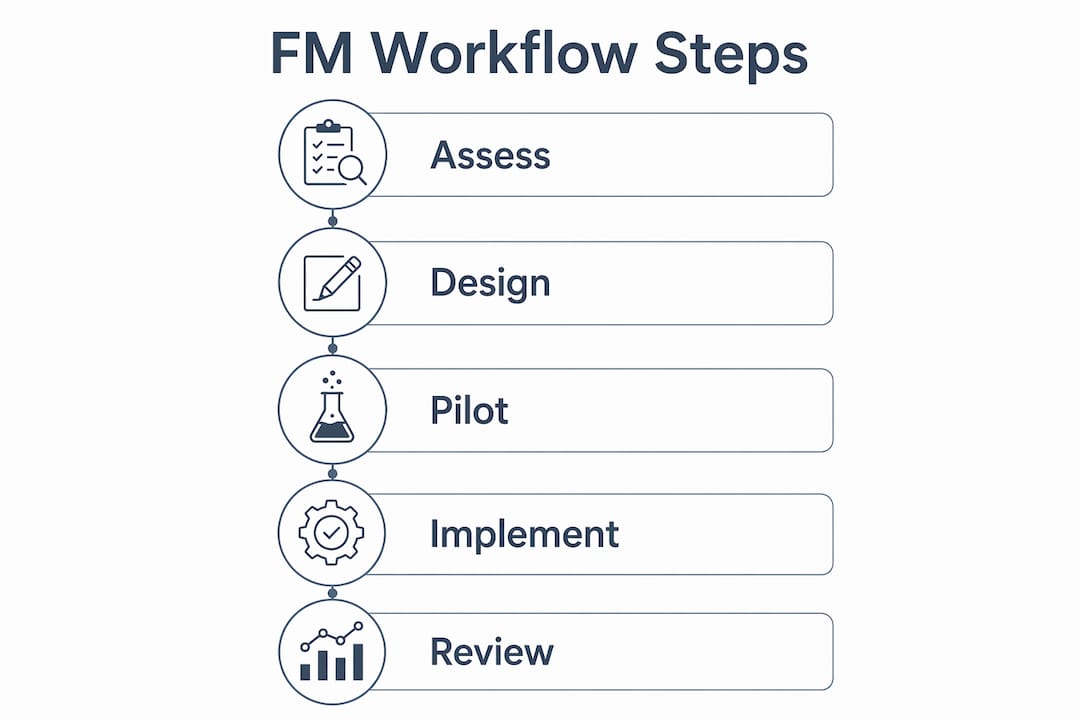
How do you design and optimise FM workflows step by step?
A sequenced design method prevents the most common failure: redesigning a process on paper and then discovering the governance model does not survive contact with real operations.
- Assess current state. Interview service managers and technicians. Map what actually happens, not what the procedure manual says. Identify bottlenecks, ownership gaps, and evidence failures.
- Map target workflows. Produce process maps for each priority service line. Define roles, approval authorities, and stage-gate criteria explicitly.
- Design governance. Assign a named process owner to every workflow. Define escalation paths, HITL thresholds, and exception-handling rules before touching any technology.
- Configure the platform. Build the mapped workflows into your chosen system. Favour configuration over custom code — large-scale FM programmes that prioritise configuration reduce their integration surface area and keep upgrade paths clean.
- Pilot. Run one service line for four to eight weeks. Capture every exception and governance override. Treat the pilot as a governance validation exercise, not just a technology test.
- Evaluate. Measure pilot outcomes against the baseline KPIs defined in step one. Review evidence-completeness rates, SLA attainment, and HITL override frequency.
- Scale. Roll out to remaining service lines in priority order, applying lessons from the pilot. Iterate the governance design quarterly.
Pro Tip: During the pilot, track how often operators override automated triage decisions and why. A high override rate is not a failure — it is diagnostic data. It tells you where your automation logic needs refinement or where a HITL gate is missing. Pilot success is measured by governance confidence, not by how few overrides occur.
Workflow automation use cases for performance-metrics reporting and work-order management are the highest-value automation candidates in FM, given the volume of repetitive tasks and the governance reporting burden they carry.

What technology and data strategy supports audit-ready FM?
The technical architecture must serve the audit trail, not just operational efficiency. Integration priorities:
- CMMS/CAFM as the system of record for all work orders and asset data
- BMS/SCADA feeds for environmental and plant-status data
- IoT/sensor data ingested as time-series with canonical asset IDs
- Identity and access control to enforce role-based approval authorities
- REST APIs for work-order orchestration between systems
Data model principles matter as much as the integration list. Every asset needs a canonical ID used consistently across all systems. Evidence bundles must be linked directly to the work-order record, not stored separately. Audit logs must be immutable: no deletion, no silent edits.
| Integration layer | Primary purpose | Audit contribution |
|---|---|---|
| CMMS/CAFM | Work-order lifecycle management | Complete work-order record and asset history |
| BMS/SCADA | Plant and environment monitoring | Condition data linked to maintenance triggers |
| IoT/sensors | Real-time asset telemetry | Time-series evidence for predictive dispatch |
| Identity/access | Role enforcement | Approval authority audit trail |
Intel's agentic AI architecture describes a three-tier model: perception (sensor ingestion), reasoning (anomaly detection and planning), and action (work-order creation). Critically, supervisory and safety-critical actions retain HITL validation gates. In one utilities application, AI-enhanced monitoring produced a significant reduction in false positives and an estimated substantial annual saving. Those figures illustrate the scale of value available, but they depend entirely on clean data and a governance model that operators trust enough to act on.
What does an FM implementation roadmap look like?
| Phase | Typical duration | Gating criteria |
|---|---|---|
| Assess | 2–4 weeks | Baseline KPIs documented; priority workflows identified |
| Pilot | 4 weeks | Governance design signed off; evidence capture live |
| Roll-out | 8 weeks | Pilot evaluation complete; board approval obtained |
| Embed | Ongoing (quarterly review) | Continuous improvement cadence established |
Major cost drivers are: platform licences, integration engineering (particularly where legacy CAFM systems lack modern APIs), data cleansing before migration, change management and training, and ongoing governance support. For UK public-sector bodies, procurement must consider framework routes such as G-Cloud or Crown Commercial Service agreements. Supplier assurance requirements, including Cyber Essentials certification and data-processing agreements, should be confirmed before contract award.
A simple ROI framing for a board paper: if an NHS trust reduces MTTR and closes the evidence gap that currently generates audit findings, the avoided remediation cost and reduced contractor call-back rate typically outweigh licence and integration costs within the first year. AI-enabled predictive maintenance can deliver uptime gains that translate directly to reduced clinical disruption in a healthcare setting.
Are your FM workflows audit-ready? A governance checklist
Audit-readiness checklist:
- Every work order has a named owner from raise to close
- Stage gates are configured and cannot be bypassed without a documented override
- Evidence bundles (photo, signature, timestamp) are attached before closure
- Audit logs are immutable and retained per the applicable schedule
- Change history is recorded for every workflow configuration update
- Exception reports are routed to a named owner within a defined SLA
- Role and approval authorities are documented and reviewed at least annually
Common failures and quick remediation:
- Ownership gaps: no named process owner means exceptions go unresolved. Fix: assign owners in the platform, not just on an org chart.
- Fragmented systems: evidence stored in email or shared drives breaks the audit trail. Fix: mandate evidence capture within the CMMS/CAFM record.
- Missing evidence: work orders closed without artefacts. Fix: configure stage gates to block closure until evidence is attached.
A remediation sprint for these three failures typically takes a few weeks involving configuration, training, and audit of records to close the gaps.
How do you embed change and sustain continuous improvement?
Governance does not sustain itself. The role matrix for programme governance should include: an executive sponsor (accountable for outcomes), a programme lead (day-to-day delivery), a process owner per service line, service managers (operational performance), technicians (evidence capture), and an audit owner (compliance and evidence review).
Training should cover three stages: onboarding to the new workflow and platform (week one), competency checks on evidence capture and stage-gate compliance (weeks two to four), and a practical exercise simulating an audit evidence request (month two). Repeat competency checks every six months or after any significant workflow change.
The governance cadence that sustains improvement: a weekly squad meeting for operational exceptions, a monthly steering review of KPIs and SLA trends, and a quarterly audit review that tests evidence completeness against the checklist above.
Pro Tip: The quarterly audit review loses momentum fast if it becomes a box-ticking exercise. Assign a rotating 'audit challenge' role to a different service manager each quarter. They review a sample of closed work orders from a peer's service line and report findings to the steering group. Peer review creates accountability without requiring external resource, and it builds audit literacy across the team.
Embedding continuous improvement practices into the governance cadence, rather than treating it as a separate programme, is what separates organisations that sustain gains from those that revert within six months.
How do you measure FM success with KPIs and dashboards?
| KPI | Operational audience | Board audience |
|---|---|---|
| SLA attainment rate | Weekly | Monthly trend |
| MTTR | Weekly | Monthly trend |
| Evidence-complete rate | Weekly | Quarterly |
| Audit exceptions raised | Monthly | Quarterly |
| Cost per work order | Monthly | Quarterly |
Daily operational reporting should focus on open work orders, SLA breach alerts, and HITL override flags. Weekly management reporting adds SLA attainment trends, evidence-completeness rates, and exception resolution times. Monthly board reporting presents cost-per-work-order trends, audit-exception counts, and a forward-looking risk summary.
A well-designed dashboard surfaces three things immediately: where the operation is breaching SLAs right now, where evidence gaps exist that would fail an audit, and where HITL overrides are clustering (which signals automation logic that needs review). Exception and trend views matter more than raw counts.
How Keystoneconsulting delivers audit-ready workflow optimisation
A typical Keystoneconsulting engagement in a regulated healthcare or government setting follows four steps: map current workflows against the target governance model, design stage gates and evidence-capture requirements, pilot on one service line using the Videra platform, and embed the governance cadence before scaling.
Videra provides mapped, auditable workflows with configurable stage gates, evidence bundles linked directly to work-order records, AI-powered exception and board reporting, and sector-specific workspaces for healthcare, construction, and government. The platform is designed to produce the audit artefacts an NHS trust or local authority auditor expects, without requiring bespoke development.
Keystoneconsulting brings extensive sector experience to governance design, which means the common failure modes — ownership gaps, fragmented evidence, reporting bottlenecks — are addressed in the methodology before they appear in your audit findings. For operations consulting that integrates directly with your team rather than producing a report and leaving, the approach is built around capability transfer, not dependency.
Key takeaways
Facilities management workflow optimisation succeeds when governance design, mapped workflows, and evidence capture are treated as a single programme, not three separate workstreams.
| Point | Details |
|---|---|
| Map before you automate | Document actual workflows first; automation built on undocumented processes embeds the existing failures. |
| Stage gates prevent rework | Mandatory checkpoints with evidence requirements stop non-compliant work orders reaching closure. |
| HITL governance is non-optional | Automated triage and dispatch must retain human override thresholds, especially for safety-critical tasks. |
| KPIs drive board confidence | SLA attainment, MTTR, evidence-complete rate, and cost per work order give boards the evidence they need. |
| Keystoneconsulting and Videra | A scoped pilot delivers mapped workflows, governance design, and audit-ready evidence capture within a matter of weeks. |
Why governance design matters more than the technology you choose
The organisations that struggle most with FM audit findings are rarely using bad technology. They are using reasonable tools with no governance model underneath them. Evidence is captured inconsistently, ownership is assumed rather than assigned, and exception reports go to a shared inbox that nobody owns. The technology gets blamed, but the problem is structural.
What the research from JLL, Intel, and IBM consistently shows is that the prerequisite for any meaningful automation or AI adoption is a clean, governed data model and a workflow design that produces reliable records. You cannot train a predictive model on incomplete work-order data. You cannot trust an anomaly score if the underlying sensor data is not linked to a canonical asset ID. Governance is not the boring part you do before the interesting AI work. It is the foundation that determines whether the AI work produces anything worth acting on.
The practical implication: spend more time on the assess and design phases than feels comfortable. A four-week assessment that surfaces real ownership gaps and evidence failures is worth more than a twelve-week technology deployment that automates a broken process.
Keystoneconsulting: scoped pilots that deliver audit-ready governance
Governance design that actually holds up under scrutiny is harder to buy off the shelf than most procurement teams expect. Keystoneconsulting offers a scoped pilot that delivers mapped workflows for your priority service lines, a governance design with named ownership and stage gates, live evidence capture configured in Videra, and a baseline-to-pilot ROI estimate you can take to a board or programme sponsor.
The engagement model combines consultancy delivery with a Videra platform subscription, so the governance framework and the audit-ready tooling arrive together rather than as separate procurement decisions. For NHS trusts, local authorities, and regulated construction programmes, that matters: you get a single supplier accountable for both the design and the evidence it produces.
To discuss a pilot scope or request a platform demonstration, visit Keystoneconsulting and contact the team directly. Procurement conversations, including G-Cloud and Crown Commercial Service routes, are supported from the first call.
Further reading and sources
- JLL Spark: FM market context and cost-efficiency priorities — supports the 81% cost-efficiency statistic and the case for automation in performance reporting and work-order management
- Intel: Agentic AI in facilities operations — primary reference for HITL governance architecture, three-tier AI model, and the false-positive reduction and savings data
- IBM: AI in facilities management — supports the phased AI adoption roadmap, uptime-gain estimates, and the technology-preparation checklist
- IBM: Scaling FM operations with a system of record — supports the configuration-over-customisation principle and the system-of-record consolidation recommendation
- TKD Consulting: operations consulting services — partner resource for change management and operations audit perspectives