
Workflow mapping is defined as the visual documentation of sequential tasks, decision points, and handoffs that clarify how specific work gets completed within an organisation. Unlike a standard flowchart, which traces logic, a workflow map specifies ownership at every step, making accountability visible and measurable. This distinction matters because most operational failures occur not within tasks, but at the transitions between them. Understanding what workflow mapping is, and how it differs from process mapping, gives professionals the foundation to reduce errors, prepare for automation, and build genuinely repeatable operations.
What is workflow mapping and why does it matter?
Workflow mapping is the practice of documenting the exact sequence of tasks, responsibilities, and transitions required to complete a defined piece of work. The standard industry term is "workflow diagram," though "workflow map" is equally accepted across operations and project management disciplines. Both refer to the same output: a visual representation that shows who does what, in what order, and what decisions govern the flow.
The core value of workflow mapping lies in shared visibility across teams, which drives accountability, communication, and transparency. When a team can see the full sequence of a process on one page, they stop making assumptions about who owns each step. That clarity alone removes a significant source of operational friction.

Workflow maps are particularly valuable in sectors with complex delivery chains. In healthcare, construction, and facilities management, tasks pass between multiple teams and contractors. Without a map, handoffs become guesswork. With one, every transition is documented, owned, and auditable.
The importance of workflow mapping also extends to compliance. Organisations that operate under regulatory frameworks need to demonstrate that their processes follow defined sequences. A well-maintained workflow map provides that evidence without requiring additional reporting effort.
How does workflow mapping differ from process mapping?
The terms "workflow" and "process" are frequently used interchangeably, but industry standards distinguish them clearly. A workflow is task-specific and repeatable, covering a narrow sequence of actions within a single function. A process is broader, linking multiple workflows together to serve a wider business objective.
Treating workflows and processes as identical leads to what practitioners call strategic blindness. Teams focus on making individual tasks faster without checking whether those tasks serve the organisation's actual goals. The result is local efficiency with no measurable business impact.
The table below illustrates the key distinctions between workflow mapping and process mapping.
| Feature | Workflow mapping | Process mapping |
|---|---|---|
| Scope | Single task or function | Entire business function |
| Focus | Task sequence and handoffs | System-level design |
| Ownership | Individual or team level | Departmental or cross-functional |
| Detail level | Granular, step-by-step | High-level and strategic |
| Primary use | Execution and accountability | Governance and redesign |
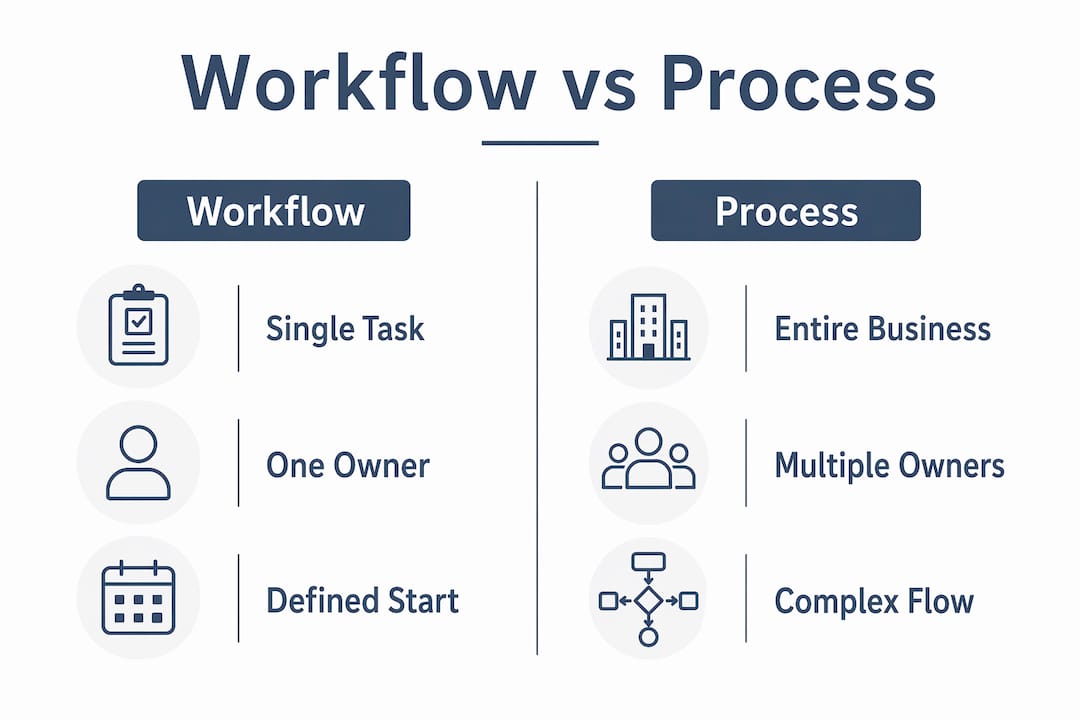
A practical example clarifies this further. Raising a purchase order is a workflow: it has a defined start, a sequence of approvals, and a clear end point. Procurement, by contrast, is a process: it encompasses supplier selection, contract management, purchase orders, and payment, each of which contains its own workflows.
Pro Tip: When you are unsure whether you are mapping a workflow or a process, ask: "Does this have one owner and one output?" If yes, it is a workflow. If multiple departments own different parts, you are mapping a process.
What are the essential components of a workflow map?
An effective workflow map contains five core elements. Each one serves a specific function, and omitting any of them reduces the map's usefulness.
- Process steps: The individual tasks or actions that move work forward. Each step should be expressed as a verb and noun, such as "submit request" or "review document."
- Decision points: Logic gates where the flow branches based on a condition. These are typically shown as diamonds in standard notation and represent the moments where errors most commonly occur.
- Ownership assignments: The person or role responsible for completing each step. Without this, a map shows what happens but not who is accountable.
- Handoffs: The transitions between one owner and the next. These are the highest-risk moments in any workflow and the primary focus of effective mapping.
- Dependencies: Steps that cannot begin until a prior step is complete. Mapping dependencies prevents teams from starting work prematurely and creating rework.
Standard workflow diagrams use a recognised set of symbols drawn from Business Process Model and Notation (BPMN) conventions. Rectangles represent tasks, diamonds represent decisions, ovals mark start and end points, and arrows show the direction of flow. Swimlane diagrams add a further layer by organising steps into horizontal or vertical lanes, one per role or department, making ownership immediately visible.
| Symbol | Shape | Meaning |
|---|---|---|
| Task | Rectangle | An action or step to be completed |
| Decision | Diamond | A yes/no or conditional branch |
| Start/End | Oval | The boundary of the workflow |
| Flow | Arrow | Direction of movement between steps |
| Swimlane | Horizontal band | Ownership by role or department |
What are the practical steps to create a workflow map?
Creating a workflow map follows a five-step sequence. Skipping any step produces a map that looks complete but does not reflect how work actually happens.
- Identify the target workflow. Choose a specific, bounded piece of work with a clear start and end point. Avoid mapping an entire department at once. Start with one repeatable task that causes friction or delays.
- Define the boundaries. Agree on exactly where the workflow begins and where it ends. A purchase order workflow, for example, starts when a need is identified and ends when the order is approved, not when it is delivered.
- Gather input from actual performers. This is the discovery phase, and it is the most critical step. Ground-level input from the people who do the work surfaces real shortcuts, workarounds, and bottlenecks that managers rarely see. Interviews and observation both work; surveys alone do not.
- Map the steps using standard visual conventions. Use BPMN symbols or swimlane diagrams to represent tasks, decisions, handoffs, and ownership. Digital tools that support these conventions make collaboration and iteration faster.
- Refine by identifying bottlenecks. Once the map is drafted, review it with stakeholders to find steps where work stalls, decisions that lack clear owners, and handoffs that are poorly defined. Each of these is an improvement opportunity.
Pro Tip: Resist the urge to map every micro-task. Focusing on handoffs and decision points identifies the highest-risk moments without burying the map in unnecessary detail.
The most common mistake at this stage is producing an idealised map: the workflow as leadership believes it should work, rather than how it actually works. That gap is where inefficiency lives. Keystoneconsulting's approach to operations consulting addresses this directly by embedding consultants within teams during the discovery phase, not just interviewing managers.
What benefits and challenges come with workflow mapping?
The benefits of workflow mapping are concrete and measurable when the map is built and maintained correctly.
- Visibility and accountability: Workflow charts make work visible by showing task owners, decision points, and handoffs. This eliminates the "black hole" effect where tasks disappear between teams, with no one knowing their current status.
- Improved communication: A shared map gives every stakeholder a common reference point. Disagreements about who owns a step are resolved by looking at the map, not by escalating to management.
- Automation readiness: Workflow mapping is a prerequisite for successful automation. Automating unmapped workflows accelerates existing inefficiencies rather than eliminating them. The map must come first.
- Audit and compliance support: Documented workflows provide evidence that defined procedures are followed, which is directly relevant to regulatory audits in healthcare, construction, and facilities management.
The challenges are equally real, and ignoring them produces maps that gather dust.
- Over-detailing: Mapping every micro-task dilutes the map's impact. The focus should stay on handoffs and decision points, not on listing every click in a software system.
- Outdated documentation: A workflow map created once and never updated becomes misleading within months. Processes change, roles shift, and tools are replaced.
- Lack of performer input: Maps built from management assumptions rather than frontline observation reflect how work should happen, not how it does happen.
Pro Tip: Treat your workflow map as a living document. Schedule a quarterly review with the people who use it, and update it whenever a role, tool, or decision point changes.
Addressing these challenges requires both a cultural shift and a practical system. Teams need to see the map as a working tool, not a compliance artefact. When that shift happens, the map becomes the foundation for continuous improvement rather than a one-time exercise.
Key takeaways
Workflow mapping is the most direct method for making operational accountability visible, and it must precede any automation initiative to be effective.
| Point | Details |
|---|---|
| Workflow vs process | Workflows cover single tasks; processes link multiple workflows across a business function. |
| Discovery phase | Input from frontline workers is critical to produce accurate maps that reflect real operations. |
| Focus on handoffs | Mapping decision points and transitions identifies risk more effectively than listing every micro-task. |
| Automation readiness | Map workflows before automating; otherwise, you accelerate inefficiencies rather than removing them. |
| Living documents | Workflow maps must be reviewed and updated regularly to remain accurate and operationally useful. |
Why I think most teams are mapping workflows at the wrong level
After working across healthcare, construction, and facilities management for two decades, the pattern I see most often is this: teams map workflows at the level of comfort, not at the level of risk. They document the steps everyone already agrees on and stop before reaching the handoffs where things actually go wrong.
The discovery phase is where the real work happens, and most organisations rush it. A 30-minute interview with a project manager produces a tidy map. A half-day observation of the actual team produces a map that reflects reality. The difference between those two maps is the difference between a document and a tool.
Automation makes this even more consequential. Organisations are moving quickly to automate delivery workflows, particularly in AI-assisted reporting and governance. But automation applied to an inaccurate map does not fix the problem. It locks the problem in place and runs it faster. The teams I have seen succeed with automation always spent more time on mapping than they expected, and less time on the technology than they feared.
The other shift worth noting is the move from static diagrams to living workflow assets. The best-performing organisations I have worked with treat their workflow maps the way engineers treat technical drawings: versioned, owned, and updated whenever the underlying reality changes. That discipline is rare, but it is the difference between a map that drives improvement and one that creates a false sense of control.
— Peter
How Keystoneconsulting supports workflow mapping and delivery governance
Keystoneconsulting has spent 20 years working inside healthcare, construction, and facilities management teams to address the governance failures and reporting bottlenecks that generic consultancy approaches miss. Workflow mapping sits at the centre of that work.
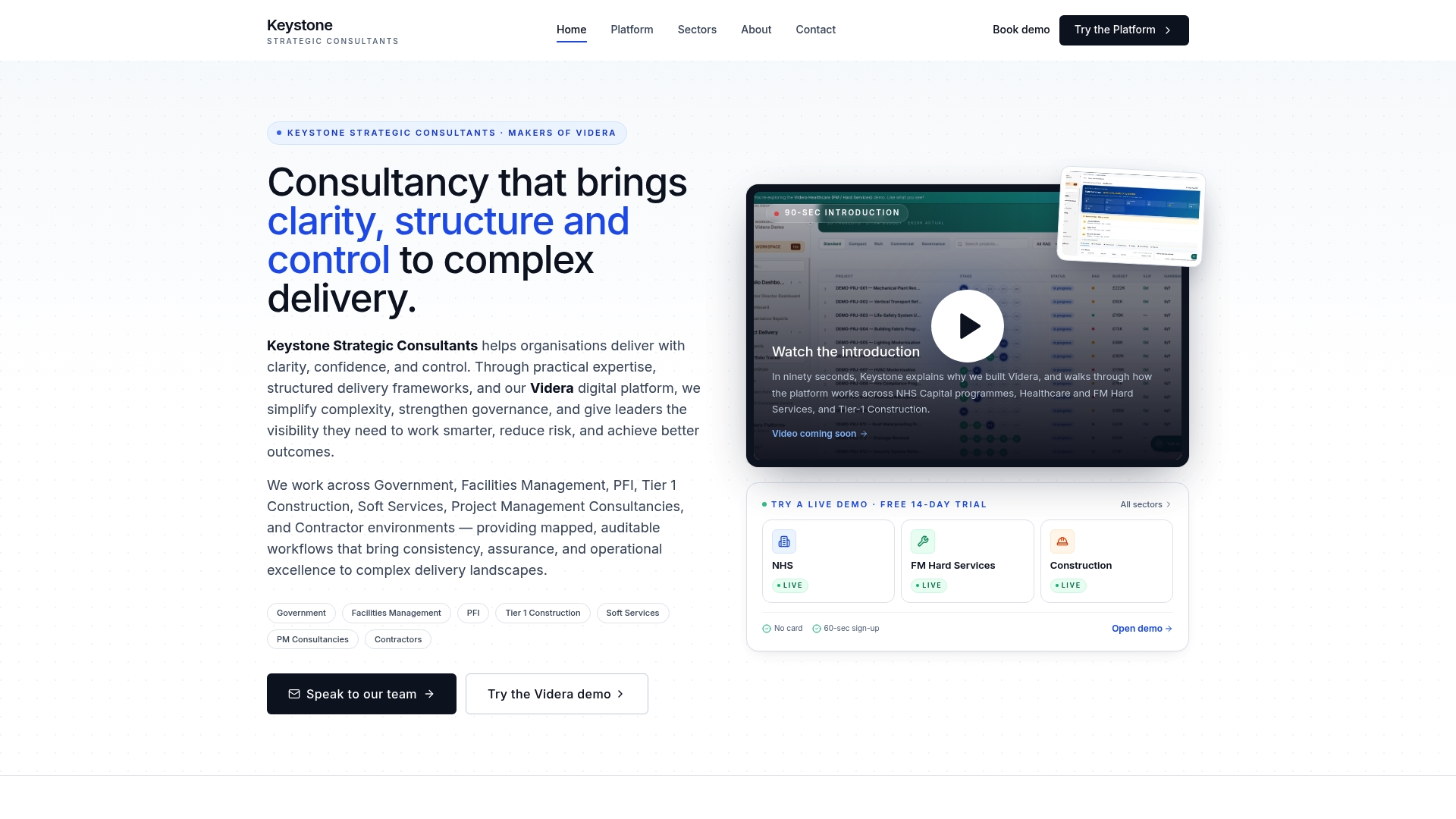
The Videra platform, Keystoneconsulting's core delivery tool, supports organisations in building mapped workflows that are audit-ready and connected to AI-powered reporting. Rather than handing over a document and leaving, Keystoneconsulting integrates directly with teams to build maps that reflect real operations and remain current as those operations evolve. For organisations ready to move from ad hoc processes to governed, repeatable delivery, Keystoneconsulting's delivery governance services provide a structured starting point.
FAQ
What is the workflow mapping definition?
Workflow mapping is the visual documentation of sequential tasks, decision points, and handoffs within a defined piece of work, specifying ownership at each step to clarify accountability and support operational efficiency.
How does a workflow map differ from a process map?
A workflow map covers a single, task-level sequence with one clear owner and output. A process map covers a broader business function that links multiple workflows across departments.
What are the key steps in workflow mapping?
The five steps are: identify the target workflow, define its boundaries, gather input from actual performers, map steps using standard visual conventions, and refine the map by identifying bottlenecks and unclear handoffs.
Why is workflow mapping important before automation?
Automating an unmapped or inaccurately mapped workflow accelerates existing inefficiencies rather than removing them. The map must accurately reflect real operations before any automation layer is applied.
What symbols are used in a workflow diagram?
Standard workflow diagrams use rectangles for tasks, diamonds for decision points, ovals for start and end points, and arrows to show flow direction. Swimlane diagrams add horizontal bands to indicate ownership by role or department.