
Why risk management in project delivery matters
Risk management in project delivery is the systematic process of identifying, assessing, and responding to threats and opportunities that could affect whether a project meets its objectives. Done well, it increases certainty across portfolios, programmes, and individual projects. Done poorly, it becomes a paper exercise that gives senior leaders false confidence.
The UK Project Delivery Teal Book 2024 defines risk management as a continuous activity embedded across the full project lifecycle, from development through to disposal. This is not optional guidance for government-adjacent sectors. For NHS administrators, construction project managers, facilities management heads, and government programme managers, it sets the standard against which delivery will be judged.
Key principles underpinning this framework:
- Risk management aims to meet project objectives by managing both upside opportunities and downside threats, not merely to satisfy compliance requirements
- Visible leadership is essential: teams must feel safe to raise risks without fear of blame
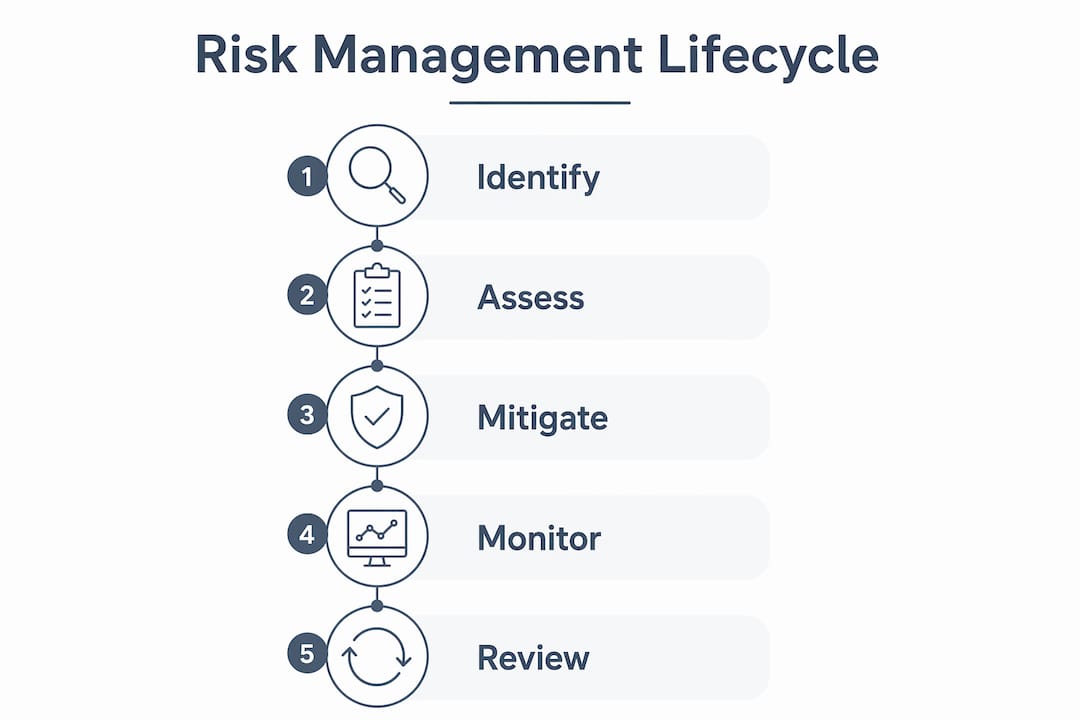
- Risk management is a lifecycle activity, not a milestone event
- The Association for Project Management stresses that causes, risk events, and effects must be kept distinct to enable objective board-level reporting
- Keystoneconsulting brings 20 years of client consulting experience across healthcare, construction, government, and facilities management to this challenge
Table of Contents
- How to embed risk management across the project lifecycle
- Building a risk-aware culture and audit-ready governance
- Keystoneconsulting: governance built into delivery, not bolted on
- Key takeaways
How to embed risk management across the project lifecycle
Embedding risk management across the project lifecycle means treating it as a continuous discipline, not a monthly compliance tick. Risk identification and monitoring must be iterative, revisited at every major milestone and whenever project conditions shift materially.
The four main risk response strategies, each requiring a named owner and measurable Key Risk Indicators (KRIs), are:
- Avoid: restructure scope or approach to eliminate the risk entirely
- Reduce: take action to lower probability or impact, such as additional site investigation or supplier diversification
- Transfer: shift the risk to a party better placed to manage it, typically through contract mechanisms
- Accept: acknowledge the risk and hold contingency to absorb it if it materialises
A risk register is the central tool here, capturing risk description, ownership, status, and mitigation actions. Alongside it, a risk budget and contingency fund must be actively managed throughout delivery. Unused contingency at project close typically signals good early planning; insufficient contingency often reflects poor baseline work rather than bad luck.
One distinction that separates credible risk management from box-ticking is the cause-risk-effect framework. A cause is a fact; a risk event is an uncertainty; an effect is the potential impact. Conflating them produces muddled registers that obscure real exposure from decision-makers.

Technology is increasingly central to making this work at scale. The Videra platform by Keystoneconsulting uses AI-powered reporting and mapped workflows to automate board reports, exception reports, and stage-gated governance, giving operational leaders a real-time view of risk exposure without manual aggregation.
Pro Tip: Treat risk monitoring as a standing agenda item in every project meeting rather than a separate monthly exercise. Continuous integration with normal reporting, as the APM recommends, catches emerging issues weeks before they appear in formal reviews.
Building a risk-aware culture and audit-ready governance
Leadership behaviour sets the ceiling for risk culture. If senior leaders respond to bad news by shooting the messenger, risks go underground. The UK government's guidance is explicit: operational leaders must actively promote an environment where team members feel safe to surface vulnerabilities, including risks to vulnerable people and high-value assets.
Practical steps for operational leaders across healthcare, construction, government, and facilities management:
- Standardise risk perception using the cause-risk-effect distinction across all teams, so board reports carry consistent, comparable information
- Assign named owners to every risk response, with KRIs that have defined thresholds and escalation protocols triggering action before a risk becomes a crisis
- Implement governance frameworks aligned with UK standards, including stage-gate reviews and exception reporting that satisfy audit requirements
- Use change management processes to handle scope and risk profile shifts without disrupting delivery momentum
- Train project teams from inception through closure, not just at onboarding; risk competence degrades without reinforcement
- Tailor communication strategies for multidisciplinary teams: a construction site manager and an NHS programme director need the same risk information framed very differently
- Integrate regulatory compliance requirements directly into the risk framework rather than running them as a parallel process
Optimism bias in early project baselines is one of the most persistent governance failures. Independently validated baselines, as the Teal Book recommends, are foundational to credible risk mitigation. Without them, every subsequent risk assessment is built on sand.
The Videra platform addresses the reporting bottleneck directly: configurable sector workspaces for healthcare, construction, and facilities management mean that audit-ready compliance is a product of normal workflow, not an end-of-project scramble.
Pro Tip: Focus active management effort on risks above your agreed severity threshold. Monitor lower-tier risks to prevent escalation, but do not allocate the same resource to a minor risk as to a critical path threat. The RICS guidance on risk thresholds is a practical starting point for calibrating this.
Keystoneconsulting: governance built into delivery, not bolted on
Governance failures and reporting bottlenecks are not solved by adding more process. They are solved by integrating the right structure from the start.
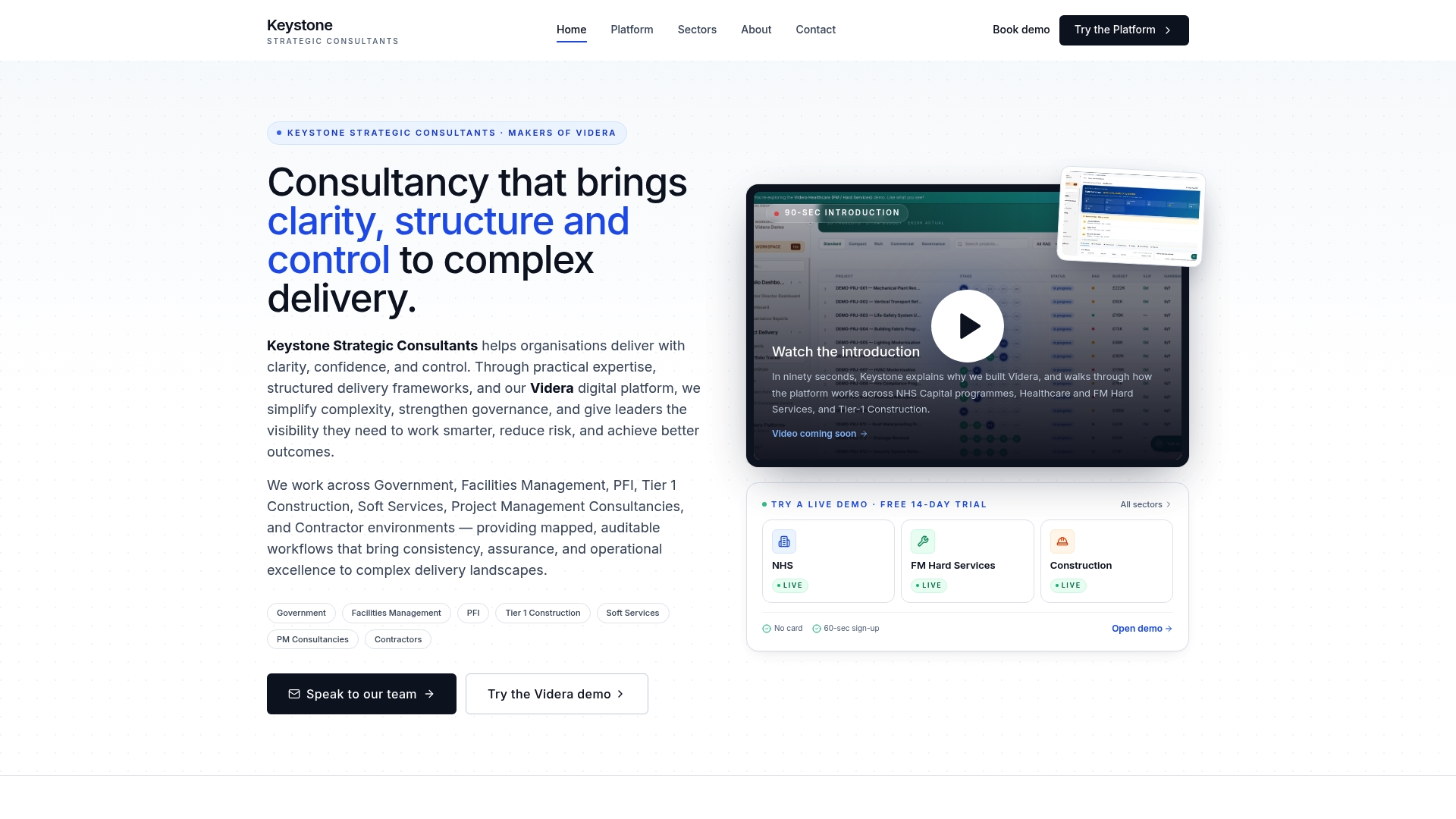
Keystoneconsulting works directly with operational teams in healthcare, construction, government, and facilities management to design governance frameworks that hold up under audit and actually support delivery. The Videra platform provides mapped workflows, AI-powered reporting, and configurable sector workspaces that make risk visibility a daily operational reality rather than a quarterly report. With 20 years of consulting experience, Keystoneconsulting addresses the specific governance and reporting failures that generic approaches miss. Explore the Videra platform to see how integrated delivery governance works in practice.
Key takeaways
Effective risk management in project delivery requires continuous lifecycle integration, clear ownership, and governance frameworks that produce audit-ready evidence as a natural output of delivery.
| Point | Details |
|---|---|
| Lifecycle integration | Risk management must be embedded from project inception through closure, not treated as a periodic compliance exercise. |
| Four response strategies | Avoid, reduce, transfer, and accept each require a named owner and measurable KRIs with defined escalation thresholds. |
| Cause-risk-effect clarity | Distinguishing causes, risk events, and effects is the foundation of credible board-level reporting across all sectors. |
| Leadership and culture | Senior leaders must actively create conditions where teams feel safe to raise risks, or threats remain hidden until they escalate. |
| Keystoneconsulting and Videra | Keystoneconsulting integrates governance design and the Videra platform to deliver audit-ready, AI-powered risk management across healthcare, construction, government, and facilities management. |