
Operations consulting is the practice of diagnosing and transforming business operations to improve efficiency, quality, and profitability through measurable, tailored interventions. Unlike general management advice, it targets the end-to-end operational workflows where value is created or lost. Frameworks such as Lean Six Sigma and the ADOTMA model give consultants the structure to move from diagnosis to implementation without losing momentum. Keystoneconsulting has applied this discipline across healthcare, construction, and facilities management for 20 years, embedding governance and workflow clarity where organisations need it most. The result is not just a better process. It is a more capable organisation.
1. What does operations consulting actually involve?
Operations consulting is defined by its focus on diagnosing how work actually flows through an organisation, not how it is supposed to flow on paper. Consultants map real workflows, time handoffs, and interview frontline workers to surface the bottlenecks that high-level documents miss. That gap between documented process and lived reality is where most operational losses occur.
The scope typically covers process design, resource allocation, supply chain management consulting, quality systems, and performance measurement. A well-scoped engagement produces a prioritised roadmap with quantified impact at each stage. Business leaders who receive a roadmap without cost or time estimates should ask for one before proceeding.

2. Start with a maturity assessment
Every credible operational excellence consulting engagement begins with a maturity assessment. Consultants conduct stakeholder interviews and data analysis across functions including operations, finance, HR, and IT to establish a baseline. This phase typically lasts three weeks and produces a clear picture of where the organisation sits relative to industry benchmarks.
The assessment covers process capability, systems maturity, workforce skills, and leadership behaviours. Without this foundation, any improvement programme risks addressing symptoms rather than causes. A maturity assessment also creates the shared language that makes later implementation faster and less contested.
3. Map workflows at the point of work
Workflow mapping is the diagnostic core of any serious operational efficiency engagement. Effective consulting maps actual daily workflows and times each handoff rather than relying on process diagrams drawn in a meeting room. The difference between the two is often where weeks of delay or rework hide.
Tools such as value stream mapping, swimlane diagrams, and process mapping software make this analysis visible and shareable. Once bottlenecks are named and located, teams can prioritise fixes by impact rather than by assumption. This step alone frequently surfaces two or three high-value changes that deliver results before the broader programme begins.
4. Apply Lean Six Sigma for root cause analysis
Lean Six Sigma is the most widely used methodology in operations consulting for identifying and eliminating the root causes of process failure. Lean targets waste in flow and cycle time. Six Sigma targets variation and defect rates. Together they give consultants a quantitative toolkit for diagnosing problems that feel qualitative to the people living with them.
Root cause tools within Lean Six Sigma include fishbone diagrams, the 5 Whys technique, and statistical process control charts. These methods convert anecdotal frustration into measurable data. Once a root cause is confirmed with data, the fix becomes far easier to design and far easier to sustain.
5. Use the ADOTMA model for structured delivery
The ADOTMA model organises an operational excellence programme into five phases: Understand, Design, Operate, Train, Monitor, and Audit. Each phase has defined outputs and gates, which prevents the common failure mode of moving to implementation before the diagnosis is complete. The model is particularly effective in complex, multi-site environments where consistency matters.
The Understand phase captures current-state performance. Design builds the future-state operating model. Operate deploys it in a controlled sprint. Train embeds capability in the workforce. Monitor tracks performance against targets. Audit confirms that gains are holding and identifies the next improvement cycle. Enterprise project management platforms can support each phase with structured task tracking and reporting.
6. Apply the 3P model: process, practice, people
The 3P model addresses the three dimensions that determine whether an operational improvement lasts. Process covers the design of workflows and systems. Practice covers the daily routines and management behaviours that reinforce the process. People covers the skills, accountability, and culture that make both sustainable.
Most failed improvement programmes fix the process and ignore practice and people. A new workflow without a new daily management routine reverts within weeks. Embedding the 3P model means that training, coaching, and performance review cadences are designed alongside the process itself, not added as an afterthought.
Pro Tip: When evaluating an operational excellence consulting firm, ask specifically what they deliver for the "People" dimension. If the answer is limited to a training day, the programme will not hold.
7. Run time-boxed implementation sprints
Consulting engagements run in sprints of three, five, or nine weeks, with each sprint targeting a defined set of improvements. This structure forces prioritisation and creates visible progress that sustains leadership commitment. It also limits the risk of a programme that runs for months without delivering anything tangible.
Sprint-based delivery works best when the roadmap has already quantified the expected impact of each initiative. Teams know what they are working toward and can measure whether they are getting there. At the end of each sprint, a brief review captures what worked, what did not, and what the next sprint should address.
8. Embed daily management cadences
Sustained operational performance depends on daily management routines, not quarterly reviews. Tier-board sessions at shift or site level bring performance data into the hands of the people who can act on it immediately. This moves accountability from the executive slide deck to the shopfloor.
A daily tier-board review typically covers safety, quality, delivery, cost, and people metrics. Each metric has an owner. Deviations trigger a structured response rather than a wait for the next management meeting. Organisations that embed this cadence consistently outperform those that rely on periodic reporting alone.
Operational problems are typically interconnected. Addressing isolated issues without a comprehensive operating system overhaul almost always fails. The daily management cadence is what holds the system together between major improvement cycles.
9. Adapt best practices to local context
Copying a lean implementation from one site to another without adaptation is one of the most common causes of programme failure. Best practices must be adapted for local culture, infrastructure, and operational environment. What works in a high-volume automotive plant does not transfer unchanged to a healthcare facility or a facilities management contract.
Effective performance optimisation consulting deploys subject matter experts who understand the client's sector and geography. They adjust the methodology to fit the context rather than applying a fixed template. This is the difference between a programme that takes hold and one that is quietly abandoned six months after the consultants leave.
Pro Tip: Before signing an engagement, ask the consulting firm for a case study from your specific sector. Generic references to "manufacturing" or "services" are not sufficient evidence of contextual expertise.
10. Use technology to sustain visibility
AI-assisted workflow mapping identifies hidden bottlenecks faster than manual observation alone. ERP and business intelligence systems track KPIs live and support executive decisions with real data rather than reported estimates. Digital quality tracking and automation improve asset reliability by flagging deviations before they become failures.
C-suite leaders now expect instrumented KPIs for throughput, quality, and cost-to-serve measured in daily operations. Narrative improvement stories no longer satisfy boards or investors. Keystoneconsulting's Videra platform supports this shift by providing AI-powered reporting and mapped workflows that make governance visible and audit-ready across complex delivery environments.
Technology does not replace the consulting methodology. It amplifies it. A well-designed operating model with live data feeds produces faster learning cycles and more durable results than either element alone.
Key takeaways
Effective operations consulting combines structured diagnosis, sprint-based delivery, and embedded daily management to produce measurable, lasting improvements across any sector.
| Point | Details |
|---|---|
| Start with a maturity assessment | Baseline the organisation before designing any improvement programme to avoid fixing symptoms. |
| Map workflows at the point of work | Time actual handoffs and interview frontline workers to surface bottlenecks invisible in process documents. |
| Embed daily management cadences | Move performance accountability to shift-level tier-board reviews, not quarterly executive reports. |
| Adapt to local context | Tailor lean and operational excellence methods to sector, culture, and infrastructure or risk programme failure. |
| Use technology to sustain gains | AI-powered reporting and live KPI dashboards convert improvement programmes into permanent operating capability. |
What I have learned after 20 years of operational improvement work
The most persistent myth in this field is that a good methodology is sufficient. It is not. I have seen Lean Six Sigma applied with textbook precision to programmes that collapsed within a year because nobody addressed the management behaviours that surrounded the process. The process was fixed. The culture was not.
The shift I find most significant right now is the move toward instrumented performance. Leaders no longer accept a consultant's narrative that "things have improved." They want a dashboard. They want a number. They want to see it move. That pressure is healthy. It forces consultants to design measurement into the programme from day one rather than retrofitting it at the end.
The other lesson I keep relearning is that speed matters more than perfection in the early stages. Moving rapidly from assessment to action and deploying experts who understand the client's world produces better outcomes than extended analysis phases. Organisations that stall in diagnosis rarely recover their momentum. Get something real into a sprint within the first three weeks and the rest of the programme becomes easier to sustain.
— Peter
How Keystoneconsulting supports your operational improvement goals
Keystoneconsulting brings 20 years of structured delivery experience to organisations that need more than advice. The team integrates directly with your operations to run diagnostic sprints, map workflows, and embed the governance routines that make improvements permanent.
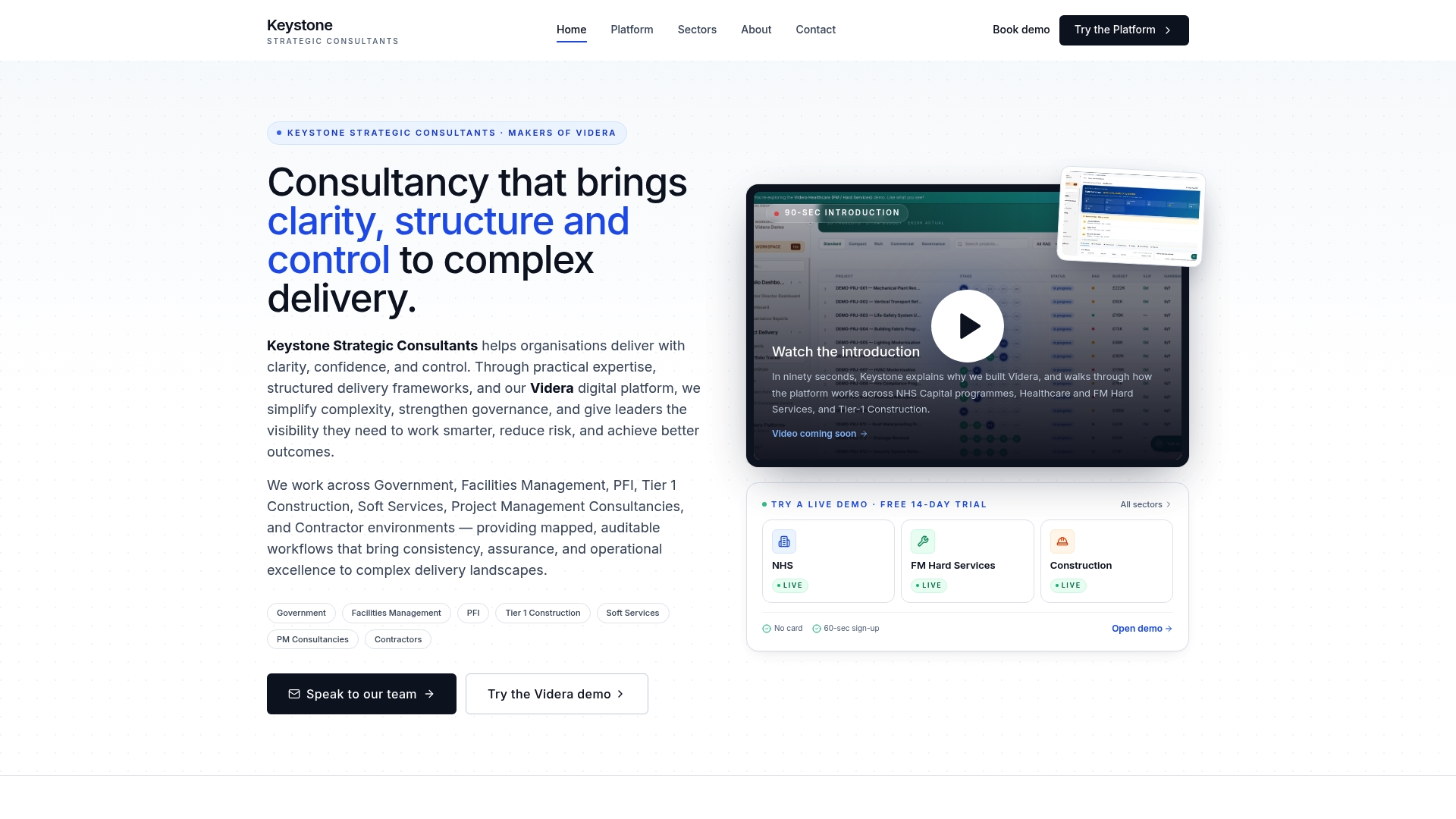
The Videra platform provides AI-powered reporting and audit-ready compliance tracking across healthcare, construction, and facilities management. Every engagement produces a prioritised roadmap with measurable targets, not a report that sits on a shelf. If your organisation faces persistent governance failures or reporting bottlenecks, Keystoneconsulting's delivery governance services offer a structured path to resolution. Speak to the team about an initial assessment and see where the real losses are occurring.
FAQ
What is operations consulting?
Operations consulting is the practice of diagnosing and improving end-to-end business workflows to increase efficiency, reduce cost, and sustain quality. Engagements typically combine structured assessment, workflow mapping, and sprint-based implementation.
How long does an operations consulting engagement take?
Diagnostic phases typically last three weeks, followed by implementation sprints of three, five, or nine weeks depending on scope. The full programme length depends on the complexity of the operating environment.
What is Lean Six Sigma and why does it matter?
Lean Six Sigma combines waste reduction techniques with statistical process control to identify and eliminate the root causes of operational failure. It is the most widely used methodology in operational excellence consulting services.
How do consultants ensure improvements last?
Sustained improvement requires embedding daily management cadences, tier-board reviews, and live KPI tracking at the point of work. Without these routines, process changes revert within months.
When should a business engage an operations consulting firm?
Engage a consulting firm when persistent operational problems resist internal fixes, when growth is exposing process fragility, or when governance and compliance requirements exceed current reporting capability.