
Digital consulting is defined as a professional advisory service that aligns an organisation's technology, data, and business strategy to produce measurable outcomes. It sits within management consulting but treats technology as the primary driver of business model change and growth. Unlike a one-off IT project, a digital consulting engagement reshapes how an organisation creates value. Keystoneconsulting has spent 20 years working inside organisations across healthcare, construction, and facilities management, and the pattern is consistent: executives who understand what digital consulting actually does get far more from it than those who treat it as outsourced IT support.
What does digital consulting involve?
Digital consulting is a structured process, not a vague advisory relationship. A typical engagement runs 4–8 weeks and moves through three clear phases: diagnosis, roadmap development, and planning for change.
The diagnostic phase evaluates your current technology stack, maps existing processes, and identifies where performance gaps sit. Consultants use business process mapping to surface bottlenecks that internal teams often overlook because they are too close to the work. The output is a clear picture of where technology is helping and where it is slowing the organisation down.

The roadmap phase translates that diagnosis into a sequenced plan. This covers digital strategy, data strategy, and cloud strategy, each tied to specific business targets. The plan does not just list technology options. It prioritises initiatives by impact, cost, and risk, so executives can make informed investment decisions rather than chasing the latest trend.
The change management phase addresses the human side. Technology rarely fails because of the technology itself. It fails because people do not adopt it, governance is absent, or the rollout is poorly sequenced. A good digital consulting engagement builds the change plan alongside the technical plan, not as an afterthought.
Pro Tip: Ask any prospective digital consultant to show you a sample deliverable from a previous engagement. If it is a lengthy theoretical report with no prioritised actions, walk away. Effective digital consulting produces concise, prioritised documentation that both technical teams and executives can act on immediately.
How is digital consulting different from IT consulting?
The distinction matters because executives often conflate the two, then wonder why they are not getting strategic value from their technology spend.
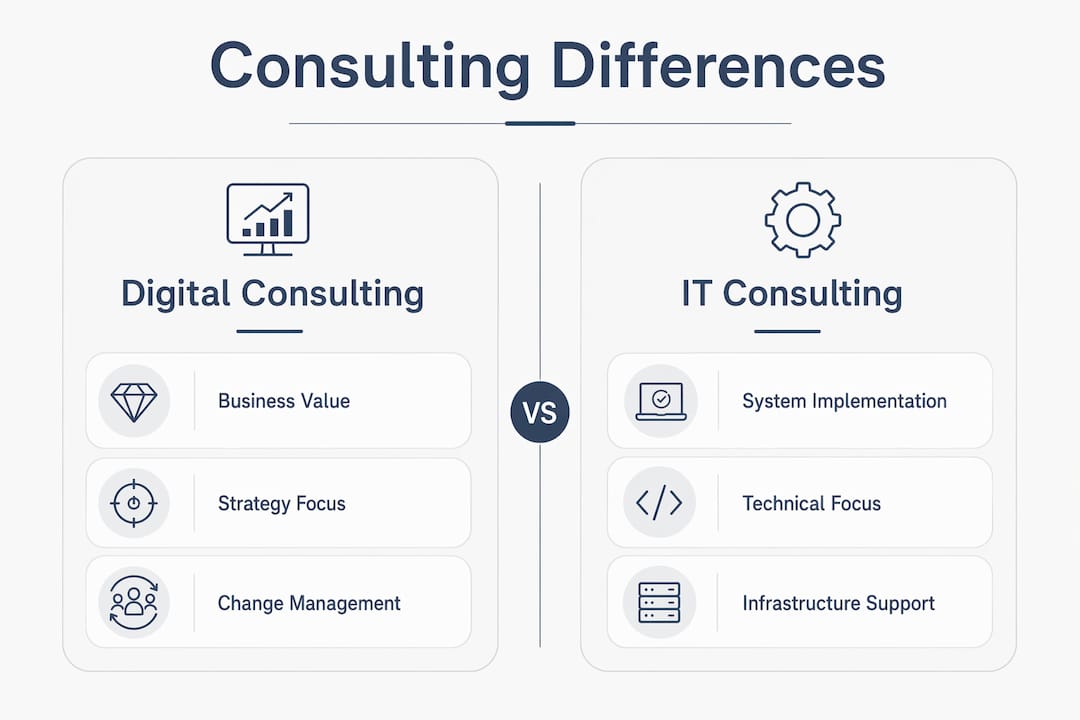
Digital consulting integrates business strategy, technology, data, and human behaviour. It focuses on rethinking how the business creates value, not on deploying software. An IT consultant implements a system. A digital consultant asks whether that system is the right answer to the right problem in the first place.
The table below summarises the key differences.
| Dimension | Digital consulting | IT consulting |
|---|---|---|
| Primary focus | Business value creation through technology | Technical implementation and system delivery |
| Scope | Strategy, data, experience, and change | Infrastructure, software, and integration |
| Stakeholders | C-suite, operations, and technical teams | IT department and project managers |
| Typical outcome | Prioritised digital roadmap tied to business goals | Deployed system or resolved technical issue |
| Engagement driver | Strategic inflection point or growth ambition | Specific technical requirement or gap |
Digital consultants design and govern work across product, data, customer experience, and organisational change. IT contractors fill specific skill gaps. Both are useful, but they answer different questions. Hiring an IT contractor when you need a digital consultant is like hiring a builder when you need an architect.
When should organisations hire a digital consultant?
The right time to engage a digital consultant is at an inflection point, not after a crisis. Common triggers include scaling challenges, significant technology investment decisions, and situations where an external, unbiased perspective is needed.
Specific situations that signal the need for digital consulting include:
- Fragmented customer journeys. Customers experience inconsistent service across channels because systems do not talk to each other.
- Slow software releases. Development cycles are long, releases are unreliable, and the business cannot respond quickly to market changes.
- Untrusted analytics. Executives distrust internal data because reports contradict each other or the methodology is unclear.
- Major technology investment. You are about to spend significantly on a new platform and want an independent view before committing.
- Governance failures. Projects repeatedly overrun, miss objectives, or produce outputs that nobody uses.
- Scaling pressure. The organisation is growing faster than its processes and systems can support.
Each of these situations shares a common thread: the organisation knows something is wrong but lacks the external perspective to diagnose it clearly. Internal teams are often too embedded in current processes to see the structural issues.
Pro Tip: Before engaging a digital consultant, write down the three outcomes you expect from the engagement. If you cannot articulate them clearly, the engagement will drift. Consultants who do not ask you for these outcomes upfront are a warning sign.
What benefits does digital consulting deliver?
The primary benefit of digital consulting is alignment. Digital consulting links technical changes directly to growth, cost, and risk targets rather than to abstract transformation goals. That distinction separates engagements that produce measurable returns from those that produce impressive slide decks.
Specific benefits executives consistently report include:
- Avoided misdirected investment. Organisations frequently spend on technology that solves the wrong problem. A diagnostic phase catches this before the budget is committed.
- Faster, better decisions. A prioritised roadmap gives executives a clear basis for technology investment decisions rather than relying on vendor pitches or internal advocacy.
- Reduced delivery risk. Sequencing initiatives correctly, with governance built in, reduces the probability of overruns and failed rollouts.
- Improved data confidence. Addressing data strategy as part of the engagement means analytics become a reliable input to decisions rather than a source of internal argument.
- Stronger internal capability. Good digital consulting does not create dependency. It builds the organisation's own capacity to manage technology change, so the next initiative runs better than the last.
The cost of not engaging digital consulting is often invisible until it is too late. Misdirected development, failed system rollouts, and governance failures each carry significant financial and reputational costs. A well-scoped engagement pays for itself by preventing one significant mistake.
How to apply digital consulting insights in your organisation
Knowing what digital consulting is and actually extracting value from it are two different things. The gap between them is almost always governance.
Start with a small pilot tied to measurable KPIs, clear data privacy rules, and a weekly review cadence linked to value. This approach surfaces problems early, builds internal confidence, and creates a template for scaling. Organisations that try to implement everything at once rarely sustain the change.
- Define success before the engagement starts. Agree on two or three measurable outcomes with your consultant. Review progress against these weekly, not monthly.
- Involve both technical and executive stakeholders. Digital consulting fails when it is treated as an IT project. The C-suite must remain engaged throughout, not just at the start and end.
- Prioritise governance from day one. Use workflow automation and mapped processes to create audit trails and accountability structures before scaling any initiative.
- Choose consultants with hands-on sector experience. A consultant who has worked inside your industry understands the constraints you face. Generic advice from a consultant with no sector knowledge is expensive and slow.
- Treat the roadmap as a living document. Review and update it quarterly. Business conditions change, and a roadmap that was correct six months ago may need adjustment.
Pro Tip: Insist that your digital consultant works alongside your internal teams rather than in isolation. Consultants who present findings only at the end of an engagement have not transferred knowledge. The goal is a team that is stronger after the engagement than before it.
Key takeaways
Digital consulting delivers measurable business value when it links technology decisions directly to growth, cost, and risk targets rather than treating transformation as an end in itself.
| Point | Details |
|---|---|
| Clear definition matters | Digital consulting aligns technology, data, and business strategy to produce measurable outcomes, not just deploy software. |
| Structured process | A typical engagement runs 4–8 weeks, covering diagnosis, roadmap development, and change planning. |
| Distinct from IT consulting | Digital consultants govern strategy and change across the whole organisation; IT consultants fill specific technical gaps. |
| Right timing is critical | Engage at inflection points such as scaling pressure, major investment decisions, or governance failures. |
| Governance drives value | Pilots with measurable KPIs and weekly reviews consistently outperform large-scale rollouts without governance structures. |
Why most digital consulting engagements fail to deliver
I have watched organisations spend significant sums on digital consulting and walk away with a glossy report that nobody reads six months later. The failure is almost never about the quality of the analysis. It is about what happens after the consultant leaves.
The engagements that work share one characteristic: the consultant was never treated as an outsider. They sat with the operations team, challenged assumptions in real time, and built the roadmap with the people who would have to live with it. The ones that failed treated the consultant as a vendor delivering a product.
The other pattern I see consistently is scope creep driven by ambition rather than evidence. Executives want to transform everything at once. Digital consulting works best when it is disciplined. Pick the two or three initiatives with the clearest link to business outcomes, govern them tightly, and prove the model before scaling. The organisations that do this build genuine internal capability. The ones that try to do everything at once usually end up back where they started, but with less budget and more scepticism.
Digital consulting is not a silver bullet. It is a method for making better decisions about technology, faster, with less waste. That is worth a great deal, but only if you use it correctly.
— Peter
How Keystoneconsulting supports digital consulting and delivery governance
Keystoneconsulting works directly inside organisations across healthcare, construction, and facilities management to address the governance and reporting failures that undermine digital initiatives. Rather than delivering reports and leaving, Keystoneconsulting integrates with your teams to map workflows, build accountability structures, and improve processes from the inside.
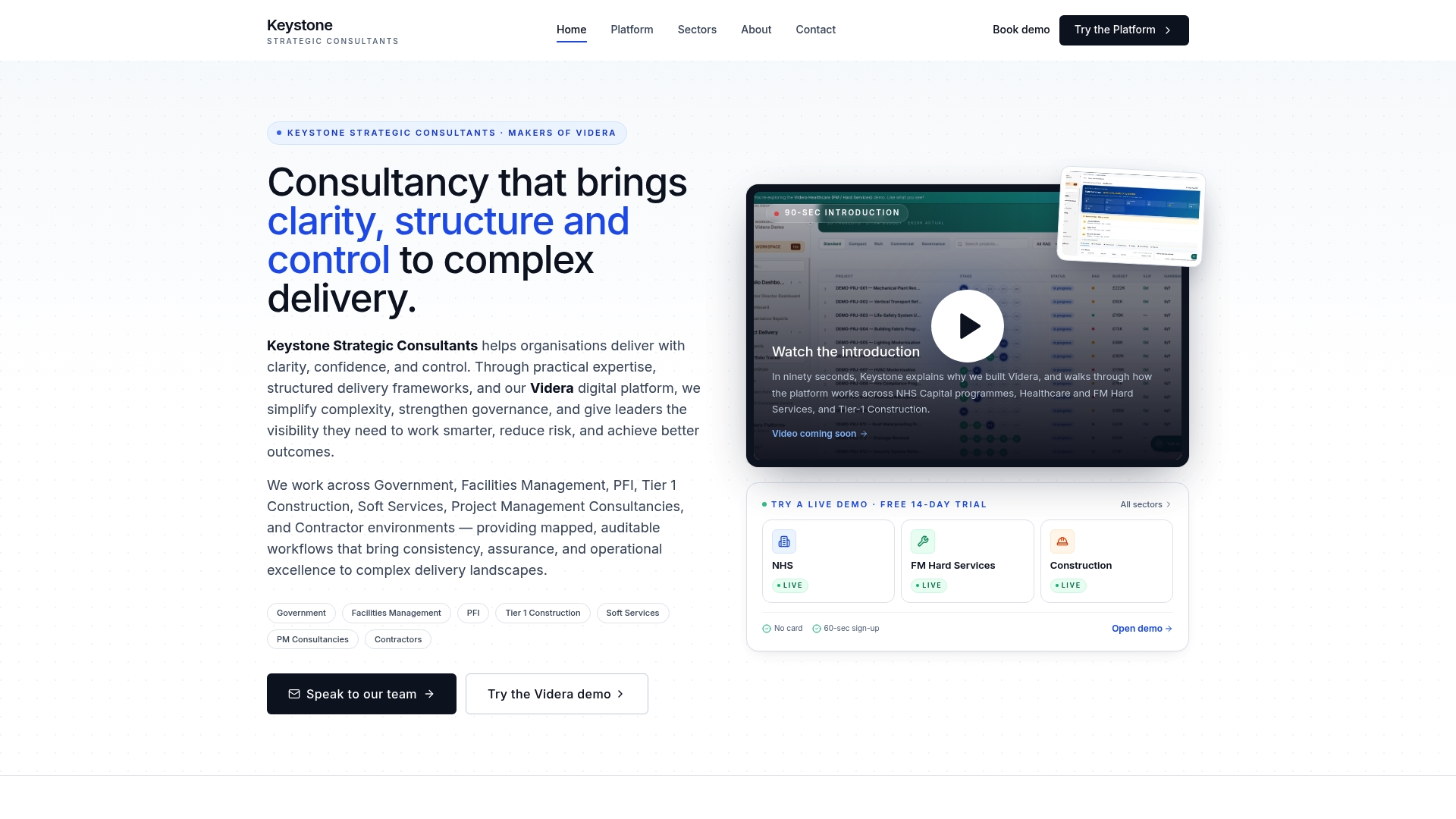
The Videra platform sits at the centre of this approach, providing AI-powered reporting tools and mapped workflows that make governance visible and audit-ready. If your organisation is at an inflection point and needs a consulting partner with 20 years of sector experience, Keystoneconsulting offers the depth and the tools to move from diagnosis to measurable delivery.
FAQ
What is the digital consulting definition?
Digital consulting is a professional advisory service that aligns technology, data, and business strategy to produce measurable outcomes. It sits within management consulting and treats technology as the primary driver of business model change.
How long does a digital consulting engagement typically last?
A typical engagement lasts 4–8 weeks and covers technology evaluation, digital roadmap development, and alignment of initiatives with business goals.
What does a digital consultant actually do?
Digital consultants design, sequence, and govern work across product, data, customer experience, and organisational change. They are outcome-focused advisers, not technical implementers.
When should a business hire a digital consultant?
Organisations benefit most from digital consulting at inflection points such as scaling challenges, significant technology investment decisions, or when internal analytics are no longer trusted.
How is digital consulting different from digital transformation consulting?
Digital transformation consulting is a subset of digital consulting that focuses specifically on large-scale organisational change programmes. Digital consulting is broader, covering strategy, data, governance, and change at any scale.