
A compliance culture is defined as the shared values, behaviours, and attitudes across an organisation that prioritise adherence to laws, ethical standards, and internal policies at every level. Building a culture of compliance goes well beyond writing a code of conduct or running an annual training day. Regulators including the FCA and the UK Solicitors Regulation Authority now assess culture alongside policies, recognising that rules alone do not prevent misconduct. The organisations that get this right treat compliance as a daily operating standard, not a periodic exercise.
What are the essential building blocks of a compliance culture?
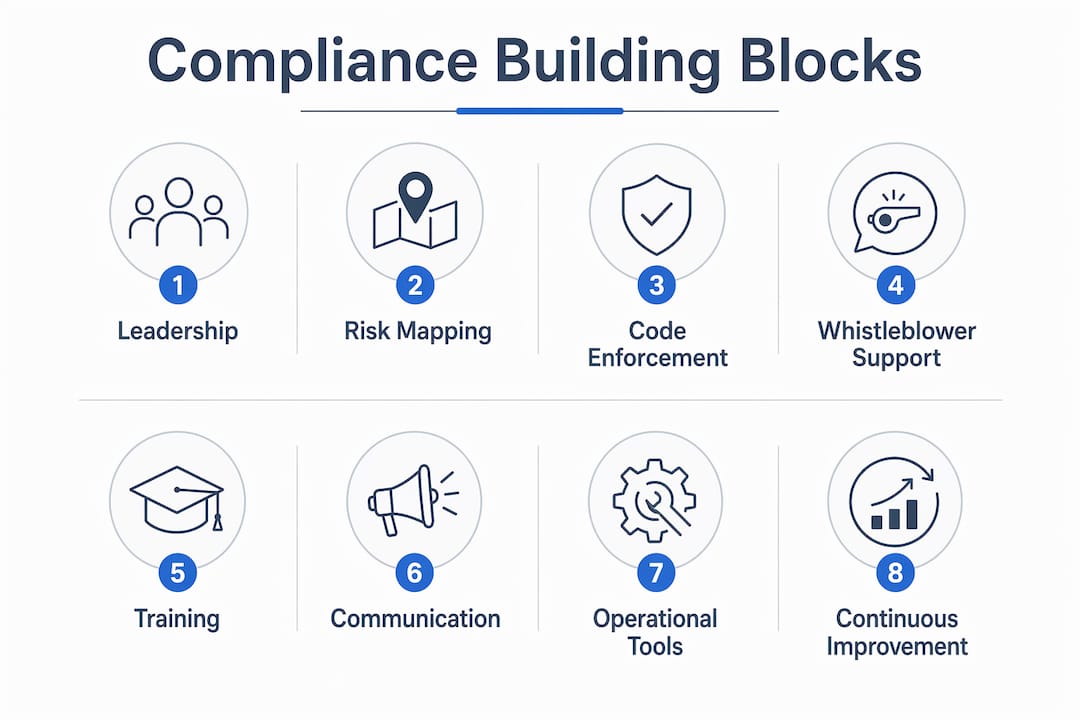
High-functioning compliance environments contain 8–10 core building blocks that work together rather than in isolation. Remove one and the others weaken. The table below maps each block to its practical impact.

| Building block | Practical impact |
|---|---|
| Leadership commitment | Sets the behavioural standard every employee observes |
| Code of conduct | Translates values into specific, testable expectations |
| Risk mapping | Identifies where rules are most likely to break down |
| Whistleblower mechanisms | Creates a safe channel for early warning signals |
| Role-specific training | Closes knowledge gaps where risk is highest |
| Consistent enforcement | Signals that rules apply equally to everyone |
| Performance integration | Ties ethical behaviour to appraisal and reward |
| Communication cadence | Keeps compliance visible between formal events |
These blocks reinforce one another. A strong code of conduct means little without consistent enforcement. Whistleblower systems fail without psychological safety. Risk mapping loses value if frontline managers are excluded from the process.
Pro Tip: Organisations in early maturity stages should prioritise leadership commitment, risk mapping, and enforcement consistency first. Adding more policies before those three are solid creates a compliance programme that looks thorough on paper but collapses under pressure.
How can leadership actively shape a compliance culture?
Senior leaders must visibly model ethical behaviour rather than simply endorse policies. Employees follow observed actions far more readily than written directives. A chief executive who cuts corners on a procurement decision, even once, signals to the entire organisation that the rules are negotiable.
Leadership responsibility does not sit only at the top. Line managers are the most influential compliance actors in most organisations. They set the daily tone, respond to concerns, and decide whether ethics conversations happen at all.
Practical leadership activities that reinforce compliance culture include:
- Raising compliance topics in team meetings without waiting for an incident
- Responding visibly and promptly to concerns raised by staff
- Integrating ethical behaviour into performance reviews alongside output metrics
- Acknowledging when a decision was difficult and explaining the reasoning
- Refusing to reward results achieved through rule-bending, regardless of commercial pressure
The most common leadership pitfall is passive endorsement. Signing off on a compliance policy and attending the annual training day is not leadership. Culture is built through repeated, small, observable actions over time.
Pro Tip: Ask line managers to share one real compliance dilemma they faced in the past quarter during team briefings. This normalises ethical reasoning as a daily skill rather than a compliance department concern.
What training and communication strategies reinforce compliance daily?
Annual training events are insufficient on their own. Compliance risk spikes in the months after annual training as staff forget specifics and revert to habitual behaviour. The solution is not longer training sessions. It is more frequent, shorter, and operationally grounded ones.
Effective compliance communication follows a structured cadence:
- Monthly nudge reminders tied to a specific operational scenario relevant to that team's work
- Quarterly case studies drawn from real incidents, anonymised and discussed in team meetings
- Role-specific refreshers targeting the highest-risk activities for each function, not generic content
- Two-way feedback loops where staff can flag unclear rules or unrealistic expectations
- Visual cues in physical and digital workspaces that reinforce key standards without requiring active engagement
Tailoring content to roles matters enormously. A site manager in construction faces different compliance risks than a procurement officer in a healthcare trust. Generic training treats both identically and serves neither well.
Continuous, varied communication integrates compliance into daily work far more effectively than isolated events. The goal is to make compliance thinking automatic, not effortful.
Pro Tip: Run a short anonymous survey after each training event asking staff what they would actually do differently as a result. If the answer is "nothing," the training is not working and the content needs redesigning before the next cycle.
What operational tools embed compliance into everyday workflows?
Compliance fails most often at the operational level, not in the boardroom. Front-line managers excluded from compliance control design produce controls that are technically correct but practically ignored. The fix is co-ownership: involving operational managers in designing the controls they will be expected to enforce.
Risk mapping serves a dual purpose. It identifies where rules are most likely to break down, and it starts a genuine conversation with practitioners about why those gaps exist. That conversation is often more valuable than the map itself.
The following tools and practices embed compliance into daily operations:
- Mapped workflows that build compliance checkpoints into standard processes rather than treating them as separate steps
- Accessible whistleblower systems with clear, trusted follow-up processes that staff actually believe in
- Transparent disciplinary mechanisms applied consistently across all levels of the organisation
- Audit-ready documentation maintained as a by-product of normal operations, not assembled in a panic before inspections
Fear of retaliation undermines reporting systems and weakens culture at its foundation. Trust is built through follow-up. When staff report a concern and see a credible response, reporting rates increase. When concerns disappear without explanation, silence follows.
Keystoneconsulting's Videra platform addresses this directly by mapping workflows and generating AI-powered reports that make audit-ready compliance a normal output of daily operations rather than a separate exercise. Organisations using mapped workflow tools reduce the gap between policy and practice because compliance is built into the process itself.
What are the common challenges in building a compliance culture?
Culture breakdowns follow predictable patterns. Recognising them early is the fastest route to remediation.
- Toxic leadership behaviour that contradicts stated values destroys credibility faster than any policy can rebuild it
- Policy-practice gaps where written rules bear no resemblance to how work actually gets done
- Ambiguous rules that leave staff guessing and defaulting to whatever is easiest
- Subcultures within teams or sites that develop their own norms, often in conflict with organisational standards
- Inconsistent enforcement that signals some people are above the rules
Failure to enforce policies consistently destroys employee trust more reliably than almost any other factor. Staff notice immediately when a senior manager faces no consequence for behaviour that would result in disciplinary action for a junior employee.
Post-scandal silence compounds the damage. When an incident occurs and leadership communicates nothing, staff fill the vacuum with speculation. Transparent investigation processes, even when they cannot share full details, signal that the organisation takes its own rules seriously.
Regular internal surveys and anonymous reporting analysis give compliance officers an early warning system. Patterns in anonymous data often reveal cultural problems months before they surface as incidents.
Pro Tip: Run a compliance ambassador programme in each business unit. Ambassadors are not enforcers. They are trusted peers who normalise compliance conversations and surface concerns informally before they escalate.
Key takeaways
Building a compliance culture requires leadership accountability, operational integration, and continuous communication working together. No single element is sufficient on its own.
| Point | Details |
|---|---|
| Leadership drives behaviour | Employees follow what leaders do, not what policies say. |
| Annual training is not enough | Compliance risk rises after training events; frequent, targeted reminders are needed. |
| Operational co-ownership matters | Front-line managers must help design controls or those controls will be ignored. |
| Enforcement must be consistent | Selective enforcement destroys trust faster than any other single failure. |
| Speak-up culture requires follow-up | Whistleblower systems only work when staff see credible responses to reports. |
What I have learned about compliance culture after 20 years
The phrase "culture eats strategy for breakfast" is quoted so often it has lost its edge. The underlying truth has not. No policy document, however thorough, can override the behaviour modelled by the people in authority. I have seen organisations with hundreds of pages of compliance documentation fail catastrophically because a single senior leader behaved as though the rules did not apply to them.
What I find most useful is thinking about compliance culture as invisible architecture. It shapes how employees make decisions when no one is watching. You cannot see it directly, but you can see its effects in every near-miss report, every whistleblower call, every audit finding.
The biggest misconception I encounter is that compliance teams exist to police the organisation. The most effective compliance functions I have worked with operate as partners to operational teams. They help people navigate risk rather than catch them failing. Shifting to a partnership model increases voluntary reporting and builds the trust that makes culture sustainable.
The organisations that sustain compliance culture over time are not the ones with the most policies. They are the ones where a site manager in construction or a ward sister in healthcare feels confident raising a concern and expects a fair hearing. That confidence is built through hundreds of small leadership actions, not a single training day.
— Peter
How Keystoneconsulting supports your compliance programme
Keystoneconsulting has spent 20 years working directly inside healthcare, construction, and government organisations to address the governance failures that compliance programmes most commonly miss. The focus is not on adding more documentation. It is on integrating compliance into the operational processes your teams already use.
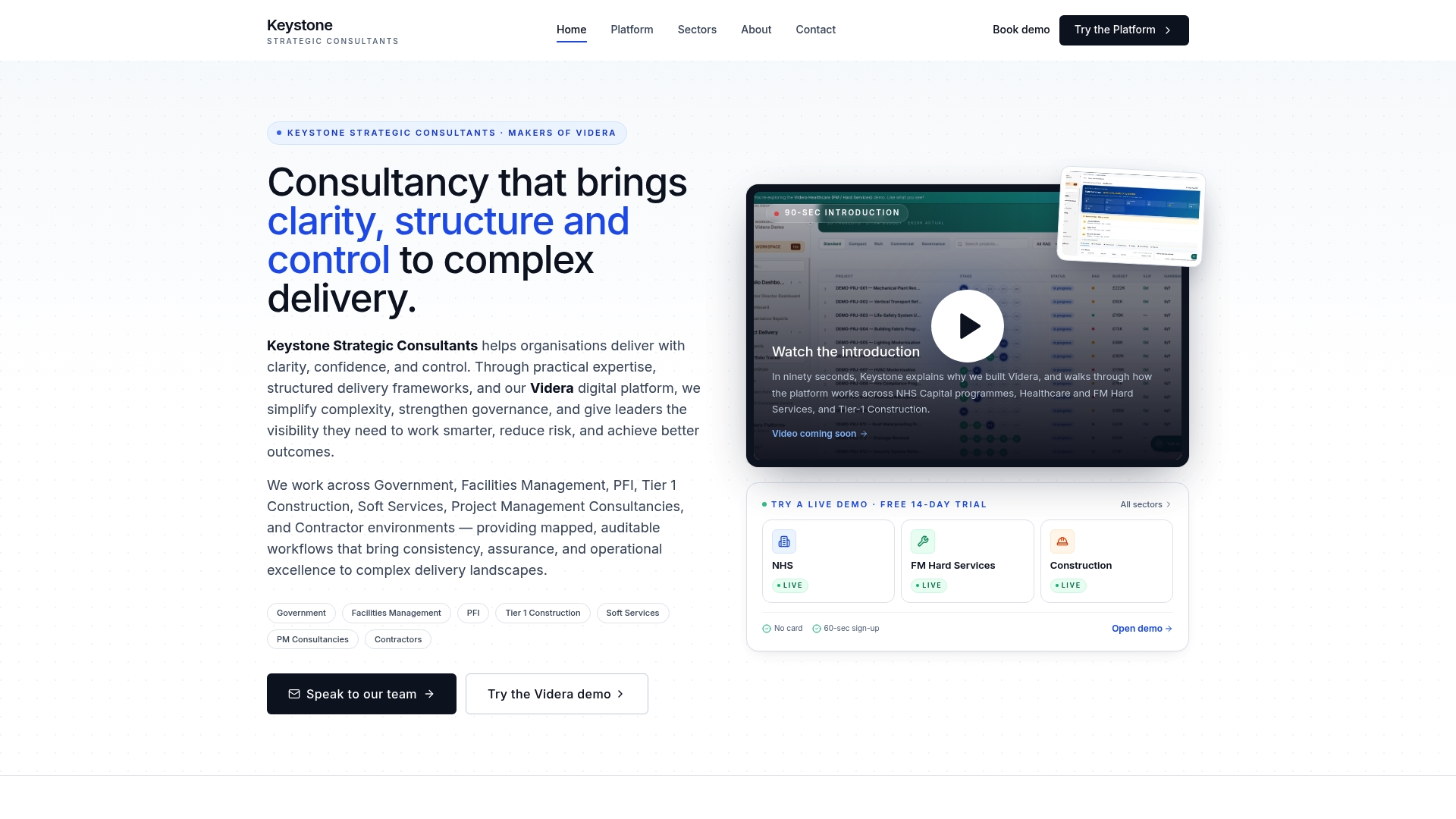
The Videra platform maps workflows and generates AI-powered reporting that makes audit-ready compliance a standard output of daily operations. Risk mapping, whistleblower system design, and enforcement frameworks are built into the consultancy methodology rather than treated as add-ons. If your organisation needs a compliance culture programme that works at the operational level, Keystoneconsulting integrates directly with your teams to build it from the inside out. Explore the full range of operations consulting methods that support this approach.
FAQ
What is a compliance culture?
A compliance culture is the set of shared values, behaviours, and attitudes across an organisation that prioritise adherence to laws, ethical standards, and internal policies. It describes how employees make decisions when no one is supervising them directly.
Why does annual compliance training fail on its own?
Compliance risk rises in the months after annual training as staff forget specifics and revert to habitual behaviour. Frequent, short, role-specific reminders are needed to maintain awareness between formal events.
What role do line managers play in compliance culture?
Line managers are the most influential compliance actors in most organisations because they set the daily behavioural tone. Their response to concerns, their conduct under pressure, and their willingness to raise ethics in team meetings shape culture more than any policy document.
How do you measure compliance culture?
Regular internal surveys, anonymous reporting analysis, and audit finding trends all provide measurable indicators of cultural depth. Patterns in anonymous data often surface problems months before they escalate into incidents.
What is the biggest risk to a compliance culture?
Inconsistent enforcement is the single greatest threat. When staff observe that rules apply differently depending on seniority, trust in the entire compliance programme collapses and reporting rates fall.