
AI governance is defined as the structured set of policies, controls, and oversight mechanisms that guide the responsible development, deployment, and management of artificial intelligence within organisations. The recognised industry term is "AI governance," and it sits at the intersection of ethics, law, and operational risk management. Standards such as the NIST AI Risk Management Framework, the EU AI Act, and ISO 42001 now form the backbone of how organisations translate ethical principles into measurable practice. For business leaders and policymakers, understanding AI governance is no longer optional. It is the foundation for responsible AI use that creates lasting value and protects organisations from significant legal and reputational harm.
What is AI governance and why does it matter?
AI governance is the system that converts abstract AI ethics principles into concrete, auditable actions. The IEEE Standards Association draws a clear line between ethics and governance: ethics defines what AI should do, while governance defines how those principles get implemented and verified. That distinction matters enormously in practice. A commitment to "fairness" means nothing without documented processes, assigned responsibilities, and audit trails to prove it.
The importance of AI governance grows directly with the scale of AI adoption. Organisations deploying AI in hiring, credit scoring, medical triage, or infrastructure management face real legal exposure if their systems produce biased or harmful outputs. Governance provides the controls that catch those failures before they become liabilities. Without it, boards are effectively signing off on risks they cannot see or measure.
AI governance also builds the trust that makes AI deployable at scale. Regulators, customers, and partners increasingly demand evidence of responsible AI practice. Governance gives organisations that evidence in a form that holds up to scrutiny.
What are the key components of an AI governance framework?
The NIST AI Risk Management Framework organises AI governance into four core functions: Map, Measure, Manage, and Govern. Each function addresses a distinct phase of the AI lifecycle, from identifying risks in the design stage through to ongoing monitoring of deployed models.
| NIST function | What it means in practice |
|---|---|
| Map | Identify AI use cases, affected stakeholders, and potential risks across the organisation |
| Measure | Assess and quantify risks using defined metrics, bias tests, and performance benchmarks |
| Manage | Apply controls, mitigation strategies, and escalation procedures to address identified risks |
| Govern | Establish policies, roles, accountability structures, and continuous improvement processes |
A governance framework also requires clear ownership across business units. Legal, compliance, product, and operations teams all carry accountability for AI risks, not just IT or data science. This cross-functional structure reflects the reality that AI failures produce legal, financial, and reputational consequences that no single department can manage alone.

The core policy pillars of any AI governance framework cover transparency, fairness, accountability, privacy, and security. Each pillar requires specific controls. Transparency demands model documentation and explainability standards. Fairness requires regular bias audits. Accountability needs defined escalation paths and named decision-makers.
One distinction that leaders often miss is the difference between AI governance and data governance. AI governance monitors model behaviour actively, addressing bias and performance anomalies as they emerge. Data governance, by contrast, focuses on securing and managing static data assets. AI governance covers the full lifecycle from design through to decommissioning, which makes it a far more dynamic discipline.
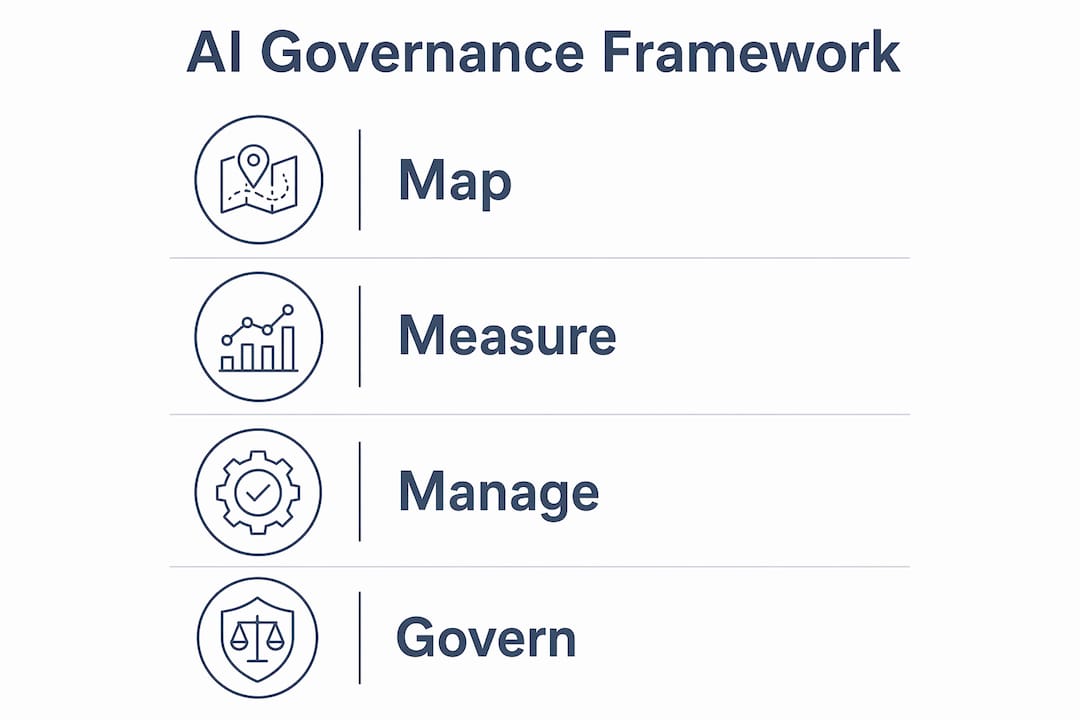
Pro Tip: Build your governance framework around the NIST four functions before layering in external standards. The functions give you a universal structure; the standards give you sector-specific detail.
How do AI governance standards and regulations shape organisational practices?
The EU AI Act is the most consequential AI regulation currently in force. It classifies AI systems by risk level and imposes strict obligations on high-risk applications, including those used in employment, education, critical infrastructure, and law enforcement. Compliance deadlines for high-risk AI systems fall on 2 december 2027, with AI in robotics and machinery following on 2 august 2028. These are not aspirational targets. They are enforceable deadlines with significant financial penalties for non-compliance.
High-risk AI systems under the EU AI Act must meet the following requirements:
- Maintain a risk management system throughout the AI lifecycle
- Use high-quality, representative training data with documented lineage
- Provide technical documentation sufficient for regulatory audit
- Enable human oversight and the ability to override AI decisions
- Achieve defined accuracy, robustness, and cybersecurity standards
- Register the system in the EU database before deployment
ISO 42001 complements the EU AI Act by providing an internationally recognised management system standard for AI. Where the EU AI Act sets legal minimums, ISO 42001 offers a governance structure that organisations can adopt voluntarily to demonstrate maturity beyond compliance. Together, these frameworks give business leaders a layered approach: meet the legal floor, then build upward toward best practice.
Non-compliance carries consequences beyond fines. Organisations that cannot demonstrate AI governance face exclusion from public procurement, loss of partner confidence, and reputational damage that outlasts any regulatory penalty. The business case for governance is as much about market access as it is about legal risk.
What are common challenges and misconceptions about AI governance?
The most damaging misconception is that governance slows innovation. Governance acts as a guardrail that enables safe AI scaling, not a brake on it. Boards and regulators approve AI deployments faster when governance evidence is already in place. The organisations that move quickest with AI are typically those with the most mature governance structures, because they have already resolved the questions that would otherwise stall deployment.
The second major misconception is that AI governance belongs to the IT department. AI governance requires board-level ownership and spans legal, HR, operations, and finance. Each of these functions carries exposure to AI-related risk. HR faces liability if an AI recruitment tool discriminates. Finance faces regulatory scrutiny if an AI credit model produces unfair outcomes. Treating governance as an IT task leaves those risks unmanaged.
Practical challenges include:
- Managing the dynamic behaviour of AI models that change performance over time without retraining
- Aligning AI risk appetite with existing enterprise risk frameworks
- Maintaining audit-ready documentation across multiple AI systems simultaneously
- Keeping governance policies current as regulations evolve
AI governance demands continuous monitoring using a multidimensional threat model that assesses inputs, models, integrations, and outputs. Traditional IT security controls do not cover this ground. Organisations that rely on static policy documents rather than live monitoring processes will find their governance frameworks obsolete within months of deployment.
Pro Tip: Build an internal AI risk register before mapping to any external standard. Knowing your own risk appetite and use cases first means you adopt NIST or ISO 42001 as tools, not constraints.
How can organisations implement AI governance effectively?
Effective implementation follows a clear sequence. Skipping steps, particularly the early assessment phase, produces governance frameworks that look complete on paper but fail in practice.
- Audit current AI use. Catalogue every AI system in use across the organisation, including third-party tools embedded in existing software. Many organisations discover AI exposure they did not know they had.
- Define risk appetite. Establish what level of AI risk the organisation is willing to accept before selecting any framework or standard. This decision belongs to the board, not the technology team.
- Establish a governance committee. Assign cross-functional membership covering legal, compliance, product, HR, and operations. Give the committee clear authority to approve, pause, or decommission AI systems.
- Map to a framework. Apply NIST AI RMF or ISO 42001 as a flexible structure, not a rigid checklist. Governance frameworks should start with internal risk registers before mapping to external standards.
- Implement continuous monitoring. Deploy audit trails, performance dashboards, and bias detection processes for every live AI system. Schedule regular reviews, not just annual audits.
- Document everything. Maintain records of model design decisions, training data sources, risk assessments, and incident responses. Audit-ready documentation is the proof of governance in action.
| Governance activity | Before deployment | During deployment | After deployment |
|---|---|---|---|
| Risk assessment | Full risk register and impact analysis | Ongoing monitoring of model outputs | Post-deployment review and lessons learned |
| Documentation | Design decisions and data lineage records | Incident logs and performance reports | Decommissioning records and audit archive |
| Human oversight | Define override protocols and escalation paths | Active human review of high-risk decisions | Review of override frequency and outcomes |
| Regulatory compliance | Pre-deployment conformity assessment | Continuous compliance monitoring | Regulatory reporting and certification renewal |
Pro Tip: Treat your AI governance framework as a living document. Schedule quarterly reviews tied to model performance data, not just annual policy cycles.
Key takeaways
Effective AI governance requires cross-functional ownership, continuous monitoring, and a framework grounded in internal risk appetite before external standards are applied.
| Point | Details |
|---|---|
| Governance is a strategic function | Board-level ownership and cross-department accountability are non-negotiable for effective AI governance. |
| NIST AI RMF provides the structure | The four functions, Map, Measure, Manage, and Govern, give organisations a universal governance architecture. |
| EU AI Act sets hard deadlines | High-risk AI systems must meet compliance requirements by 2 december 2027, with penalties for non-compliance. |
| Start with internal risk registers | Define your organisation's risk appetite before adopting external standards like NIST or ISO 42001. |
| Continuous monitoring is mandatory | Static policy documents cannot manage dynamic AI model behaviour; live monitoring processes are required. |
Why AI governance is a leadership discipline, not a technical one
After working with organisations across healthcare, construction, and facilities management, the pattern I see most often is this: governance fails not because the technology is too complex, but because leadership treats it as someone else's problem.
The organisations that get AI governance right do not start with a framework. They start with a board conversation about what they are willing to risk. That conversation forces clarity about which AI systems are genuinely high-stakes and which are low-risk tools dressed up in alarming language. Once that clarity exists, the frameworks, whether NIST, ISO 42001, or the EU AI Act, become genuinely useful rather than overwhelming.
What I find most encouraging is that governance, done well, actually accelerates AI adoption. When a board can see documented evidence of risk controls, they approve deployments faster. When a regulator asks for audit trails, you hand them over in hours rather than weeks. Governance is not the slow lane. It is the lane that keeps you on the road.
The future of AI governance is engineering-informed and continuous. Organisations that treat it as a living discipline, reviewing it quarterly, updating it as models evolve, and owning it at every level from the board to the operations team, will be the ones that deploy AI at scale without the crises that make headlines.
— Peter
How Keystoneconsulting supports AI governance implementation
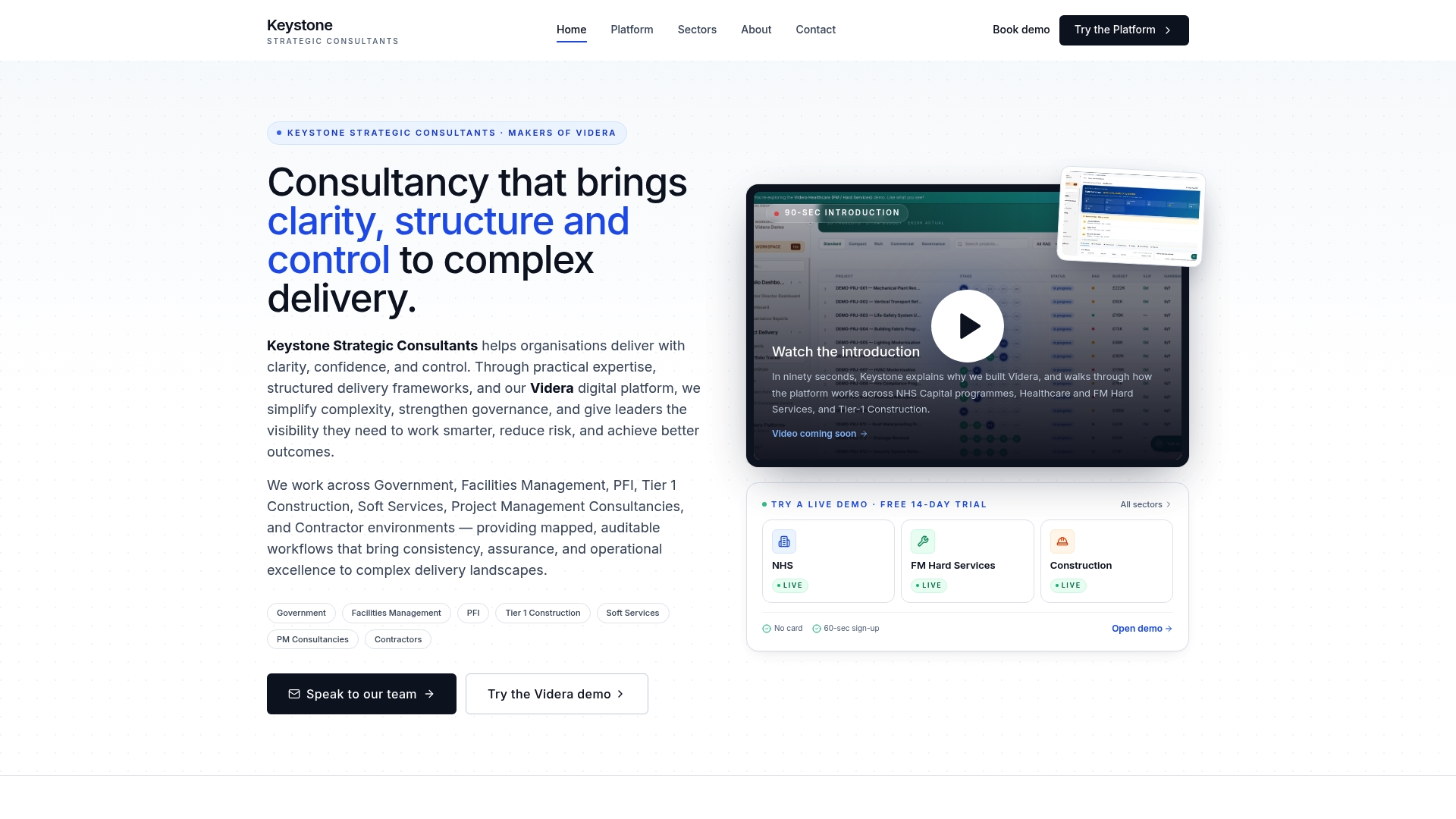
Keystoneconsulting has spent 20 years helping organisations in healthcare, construction, and facilities management resolve governance failures and reporting bottlenecks that persist long after policy documents are written. The Videra platform maps workflows, generates AI-powered reports, and maintains the audit-ready documentation that regulators and boards require. For business leaders who need more than a framework template, Keystoneconsulting integrates directly with your teams to build governance processes that hold up under scrutiny. If you are establishing or maturing your AI governance approach, speak to Keystoneconsulting about a tailored consultation.
FAQ
What is the AI governance definition?
AI governance is the structured set of policies, controls, and oversight mechanisms that guide the responsible development, deployment, and management of AI systems within an organisation. It translates ethical principles into auditable, operational practice.
What does an AI governance framework include?
An AI governance framework includes policies for transparency, fairness, accountability, privacy, and security, alongside defined roles, risk registers, continuous monitoring processes, and audit documentation. The NIST AI Risk Management Framework organises these elements into four functions: Map, Measure, Manage, and Govern.
What are the main challenges in AI governance?
The main challenges include managing dynamic model behaviour that changes over time, aligning AI risk appetite with existing enterprise risk frameworks, maintaining audit-ready documentation across multiple systems, and keeping policies current as regulations such as the EU AI Act evolve.
Who is responsible for AI governance in an organisation?
AI governance is a board-level responsibility that spans legal, compliance, HR, operations, and finance, not just IT or data science. AI risks produce legal, financial, and reputational consequences that require cross-functional accountability and executive sponsorship.
When do EU AI Act compliance deadlines apply?
High-risk AI systems must comply with the EU AI Act by 2 december 2027. AI systems used in robotics and machinery face a compliance deadline of 2 august 2028. Non-compliance carries financial penalties and potential exclusion from regulated markets.