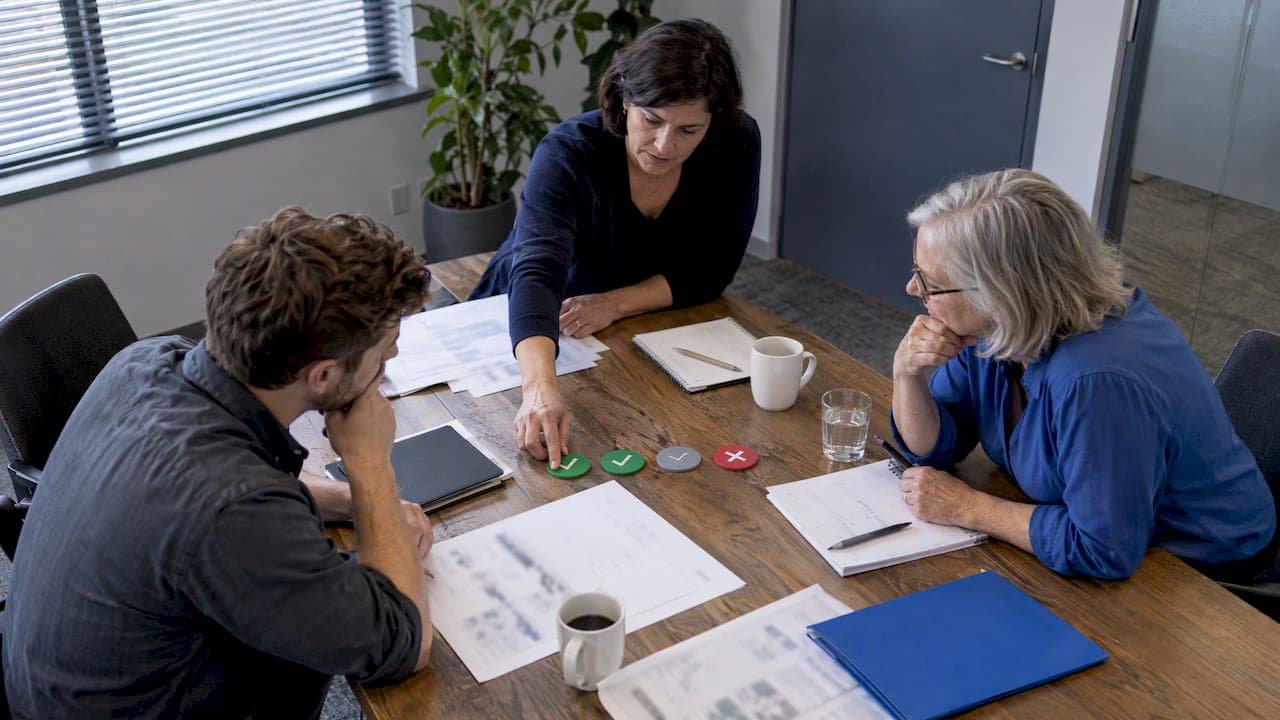
Stage-gate is a structured, stage-based decision control system that uses formal review gates to decide go, kill, hold or recycle for a project at fixed points in its life. It earns its place where risk, regulatory exposure or capital spend is high: construction, medical devices, energy and complex technology R&D. Below, we walk through the stages, real examples from each sector, and a copy-ready checklist you can adapt today.
TL;DR:
- Stage-gate is most beneficial for high-risk projects such as capital builds, regulated products, or long-lead tech development, where costly mistakes are difficult to reverse.
- Gate decisions should be binary—go, kill, hold, or recycle—to ensure clear accountability and avoid project drift due to ambiguous outcomes.
- Gate criteria must focus on concrete evidence in market demand, technical feasibility, financial viability, and regulatory compliance, with evidence packages prepared in advance.
- Hybrid approaches incorporating Agile sprints between strategic gates can accelerate software-heavy or uncertain projects while maintaining governance control.
- Effective gate governance requires well-defined stages, senior gatekeepers with decision authority, fixed review cadences, and digital evidence collection to reduce delays and improve decision quality.
Table of Contents
- What the stages and gates are: a practical breakdown
- Stage-gate examples across industries
- Variants and hybrids: Agile-Stage-Gate and when to combine approaches
- How to set up stage-gate governance and gate criteria that work
- Common pitfalls and quick fixes
- Copy-ready gate checklist and a sample gate criteria matrix
- How Keystone applies stage-gate in practice
- Author viewpoint: when stage-gate is worth the effort
- Keystone offering: a practical next step
- FAQ
- Sources
What the stages and gates are: a practical breakdown
Most stage-gate models run on several stages separated by multiple gates, though the exact count varies by sector and risk appetite. The ITP / DOE stage-gate guidance lays out a commercial track built around concept definition, prototype development, validation and scale-up, with a gate review sitting between each stage to confirm the project earns its next tranche of investment.
A typical structure looks like this:
- Discovery: scoping, early feasibility and problem definition, ending at Gate 1 with a rough concept and business case.
- Scoping: market and technical assessment, ending at Gate 2 with a validated opportunity statement.
- Build: detailed design, prototyping or construction planning, ending at Gate 3 with a tested design and cost estimate.
- Testing and validation: pilot runs, trials or commissioning, ending at Gate 4 with evidence the solution performs as promised.
- Launch or handover: full rollout, production or occupation, with a post-launch review to capture lessons.
Each stage has its own deliverables, and a gate only works when those deliverables are complete before the review starts, not assembled the night before. A gate reviewing a prototype with no test data is not a gate, it is a status update dressed up as governance.
Gate decisions should be binary wherever possible: go (proceed with current scope and funding), kill (stop and reallocate resources), hold (pause pending new information) or recycle (return to an earlier stage for rework). The binary framing matters because ambiguous outcomes, like "proceed with caveats", let weak projects drift forward without anyone taking ownership of the risk. The DOE Stage Gate Management Guide distinguishes a research track from a commercial track, with research gates measured against learning objectives rather than commercial readiness, since killing a research project for lacking a market plan at an early stage would be the wrong test entirely.
Gatekeepers typically assess four categories of evidence:
- Market: is there confirmed demand, a competitive position, and a credible customer or user base?
- Technical or feasibility: does the design, technology or construction method work as intended, backed by test or trial data?
- Financial: does the cost estimate, return projection or funding position still hold up against the original business case?
- Regulatory or compliance: are the required approvals, standards or safety sign-offs secured or on a credible path?
The DOE guidance specifies exactly this combination: market, technical, economic and regulatory review criteria applied consistently at each gate, so that a project cannot sail through on strong technical merit alone while ignoring a shaky business case. Getting this evidence package right before the meeting, rather than during it, is the single biggest driver of gate speed, a point we return to later when discussing how to design gate governance that forces decisive outcomes.
Stage-gate examples across industries
Seeing the model applied in different sectors makes the abstractions concrete. The three examples below cover technology R&D, a regulated product, and a capital construction project, each showing how stages, risks and gate decisions actually play out.
-
Technology R&D: lab proof to scaled production. A materials science team developing a new battery chemistry starts at a lab proof-of-concept stage, where the gate question is simply whether the underlying chemistry behaves as the theory predicts. The gatekeeper here is usually a technical lead or chief scientist, and the evidence is lab data, not a business case. The project then moves to prototype, where a small working cell gets built and the gate question shifts to whether performance holds at a slightly larger scale. Pilot production follows, often over 12 to 18 months, testing manufacturability and yield, with the main risk being that lab-scale success does not translate to production tolerances. The final gate before scale-up brings in commercial and financial reviewers alongside the technical team, because by this point the question is whether the economics justify a factory-scale investment. A kill decision at pilot stage, when yield numbers do not improve, is a success for the process, not a failure, because it stops capital flowing into a design that will not scale.
-
Regulated product development: medical devices and market validation. Medical device and healthcare product teams face an early gating decision that most industries skip: a regulatory feasibility check before any serious engineering spend. At the concept stage, the gate asks whether a credible regulatory pathway exists at all, since a device requiring years of clinical trials needs a very different funding plan than one qualifying for a lighter-touch approval route. The next stage runs design and prototyping in parallel with early regulatory engagement, and the gate here checks both technical performance and whether the regulatory strategy still holds. Market validation then runs alongside clinical or usability testing, often over several months, with the biggest risk being that a technically sound device fails to fit clinical workflows or reimbursement models. Readers building out this pathway in detail will find useful grounding in a partner guide on the clinical product development process, which walks through how regulatory and clinical milestones interact with commercial planning for healthcare products. A hold decision is common here, pausing a device at the validation gate until a reimbursement question gets resolved, rather than killing a project that is fundamentally sound but commercially premature.
-
Capital construction: planning through commissioning. A capital building project, such as a hospital extension or a new facility, maps stages to planning, procurement, construction and commissioning rather than research milestones. The planning stage covers site assessment, design brief and early cost modelling, with the gate testing whether the business case and site constraints are compatible. Procurement follows, selecting contractors and finalising detailed design, where the main risk is a cost estimate drifting from the original business case as design detail firms up, and the gate decision often triggers a recycle back to design if costs have moved too far. Construction itself can run 18 months to several years depending on scale, with risk concentrated in supply chain delays and design changes mid-build, and the gate at this point checks progress against schedule and budget rather than asking fundamental go or kill questions. Commissioning and handover close the process, confirming the building performs as designed before occupation. Integrated delivery approaches in healthcare construction show that strong alignment between the client, designers and contractors at the earliest planning gate materially reduces the schedule and cost risk that otherwise surfaces mid-construction, as the Cone Health MedCenter Greensboro case study illustrates in a hospital delivery context.
Variants and hybrids: Agile-Stage-Gate and when to combine approaches
Pure stage-gate suits projects where risk and capital exposure justify slow, deliberate checkpoints, but it can feel heavy-handed on software-heavy or fast-moving work. Research into Agile and Stage-Gate interaction found that plan-driven stage-gate models can be associated with slower speed and higher cost in software contexts, while Agile methods tend to improve quality outcomes but can extend time-to-market; hybrid approaches show mixed but promising results when the blend is deliberate rather than accidental.
The practical fix is not to abandon gates, it is to change what they measure. Useful hybrid patterns include:
- Strategic gates with iterative sprints: keep formal go, kill, hold or recycle gates at major milestones, but let delivery teams run Agile sprints between them.
- Mini-gates inside sprints: add lightweight checkpoints every sprint or two for teams that need tighter feedback loops than quarterly gates allow.
- Learning-oriented gates for research tracks: measure progress against learning objectives rather than commercial readiness, matching the research-track approach the DOE guidance describes.
Pro Tip: Set gate questions at the level of risk reduction, not task completion, so a sprint team can report against them without rewriting their workflow.
The signal to choose a hybrid over a pure stage-gate model is usually speed pressure combined with genuine technical or market uncertainty, the exact conditions where rigid upfront planning breaks down fastest. A team building a new clinical app alongside a hardware device, for example, might run the hardware through classic stage-gate while the software side runs sprints feeding into the same gate reviews. The research evidence suggests this works best when gates stay at a strategic level, measuring whether risk has genuinely reduced, rather than drilling into sprint-level detail that belongs to the delivery team, not the gatekeeper.
How to set up stage-gate governance and gate criteria that work
Building a gate process that actually changes decisions, rather than just producing meeting minutes, comes down to four steps.
- Select the right stage granularity. Match the number of stages to risk and spend: a small internal tool might need three stages and two gates, while a multi-year capital programme justifies the full five-stage model. Too many stages on a low-risk project just adds friction without adding insight.
- Define the minimum evidence package per gate. Write down, in advance, exactly what market, technical, financial and regulatory evidence a gate needs before the meeting is booked. The DOE guidance's recommendation of a short, standardised evidence pack, paired with a decision service-level agreement such as five working days, cuts the hold times that otherwise pile projects up waiting for a verdict.
- Choose gatekeepers and set a cadence. Match the authority of the gatekeeper to the risk of the decision: a junior project lead should not be killing a multi-million-pound programme alone, and a steering board should not be relitigating a minor prototype tweak. Set a fixed review cadence, define a deputy for each gatekeeper role, and write an escalation rule for when a gate decision cannot be reached on schedule.
- Integrate with portfolio governance and reporting. A gate decision that never reaches the PMO's funding dashboard is a decision in name only. Tie gate outcomes into portfolio governance that aligns funding and prioritisation, and capture the evidence trail digitally so an auditor or board member can trace exactly why a project passed or stalled.
Pro Tip: Build "gates with teeth" by writing the kill criteria down before the project starts, not during the review, so the decision is measured against a pre-agreed bar rather than whoever argues hardest in the room.
A clear cadence matters more than most teams assume. Projects that introduce a defined governance meeting cadence alongside explicit gate rules can cut decision delay by six to eight weeks, simply because projects stop sitting in limbo between an informal "almost ready" status and an actual scheduled review.

Common pitfalls and quick fixes
Most stage-gate failures trace back to a handful of repeated mistakes, and each has a fairly direct fix.
- Over-bureaucracy: gates accumulate extra checklists and sign-offs over time until a simple project needs twelve approvals. Slim the process by auditing every gate requirement against whether it changed a decision in the past year, and cut anything that never has.
- Unclear criteria: vague standards like "sufficiently validated" invite debate rather than decision. Replace them with measurable pass or fail checks, a specific test result, a cost threshold, a named approval, so the gatekeeper has something concrete to assess.
- Slow reviews: gates without a deadline drift for weeks. Set a cadence and a decision service-level agreement, and require a lightweight evidence pack rather than a full report, which keeps reviewers focused on the decision rather than the paperwork.
- Wrong gatekeepers: a committee too senior for the decision slows everything down, while one too junior lacks authority to actually kill a project. Match gatekeeper seniority to decision risk, and name a deputy for every role so a single diary clash cannot stall a gate.
Research on implementing stage-gate governance identifies over-bureaucratisation, unclear criteria and weak gatekeeper roles as the most common failure modes, and recommends scorecards and lightweight evidence packs as the fix, alongside the "gates with teeth" principle of writing kill criteria down before anyone needs them.
Copy-ready gate checklist and a sample gate criteria matrix
A reusable checklist beats reinventing gate documentation for every project. Keep this compact enough that nobody skips it.
- Deliverables for the stage complete and dated.
- Evidence pack assembled against the pre-agreed criteria, not compiled on the day.
- Named gatekeeper confirmed, with a deputy available if needed.
- Decision recorded as go, kill, hold or recycle, never left ambiguous.
- Red flags logged separately, even on a go decision, so recurring risks get tracked.
A simple criteria matrix works for most projects without needing bespoke documentation each time:
| Criteria | What it checks | Pass example |
|---|---|---|
| Market validation | Confirmed demand or user need | Signed customer commitment or usage data |
| Technical feasibility | Design or method proven at this stage | Test result meeting the agreed threshold |
| Risk assessment | Known risks documented with owners | Risk register updated, no unowned critical risks |
| Cost estimate | Budget still within approved tolerance | Variance under the agreed threshold |
| Regulatory status | Required approvals secured or on track | Submission filed or approval received |
For small projects, cut this to market, feasibility and cost, dropping regulatory review entirely where it does not apply. Large capital programmes should expand it with sub-criteria for procurement risk, supply chain exposure and stakeholder sign-off, since a single "regulatory" row will not capture the layered approvals a major construction programme typically needs.
How Keystone applies stage-gate in practice
We implement stage-gate governance through a digital platform rather than treating it as paperwork bolted onto an existing project plan. Mapped workflows define exactly what evidence each gate needs, and reporting tools pull that evidence together automatically instead of leaving a project manager to chase documents across emails and spreadsheets the night before a review.
In practice, this changes what a gate review actually looks like:
- Evidence collation happens continuously as the project progresses, not in a scramble before the meeting.
- Audit trails capture every decision, criterion and sign-off, so compliance reviews draw on records that already exist rather than reconstructed history.
- Dashboards give portfolio leads a live view across projects, so a gate decision on one programme reflects the funding and risk position of the wider portfolio, not just that project in isolation.
We work across several sectors where governance failures and reporting bottlenecks tend to repeat in similar ways: gates waiting on missing evidence, decisions made without a full risk picture, and compliance records assembled retroactively rather than captured as the work happens. Mapping workflows directly into a platform, instead of leaving gate evidence scattered across disconnected tools, turns what used to be a subjective debate into a review grounded in records everyone can see.
Author viewpoint: when stage-gate is worth the effort

Stage-gate earns its complexity on projects where a wrong call is expensive to reverse: capital builds, regulated products, anything with a long lead time between decision and consequence. On smaller, low-risk work, a full five-gate process is usually overkill, and the honest fix is fewer gates with sharper criteria, not more paperwork.
The leadership habit that makes gates work is uncomfortable but simple: a willingness to actually kill a project at a gate, not just wave it through because cancelling feels like admitting a mistake. Teams that write their kill criteria down before a project starts, and stick to them, tend to catch weak projects months earlier than teams relying on gut feel in the room. Governance that has teeth, rather than governance that performs the appearance of scrutiny, is what separates a gate process that changes outcomes from one that just generates meeting minutes.
— Peter
Keystone offering: a practical next step
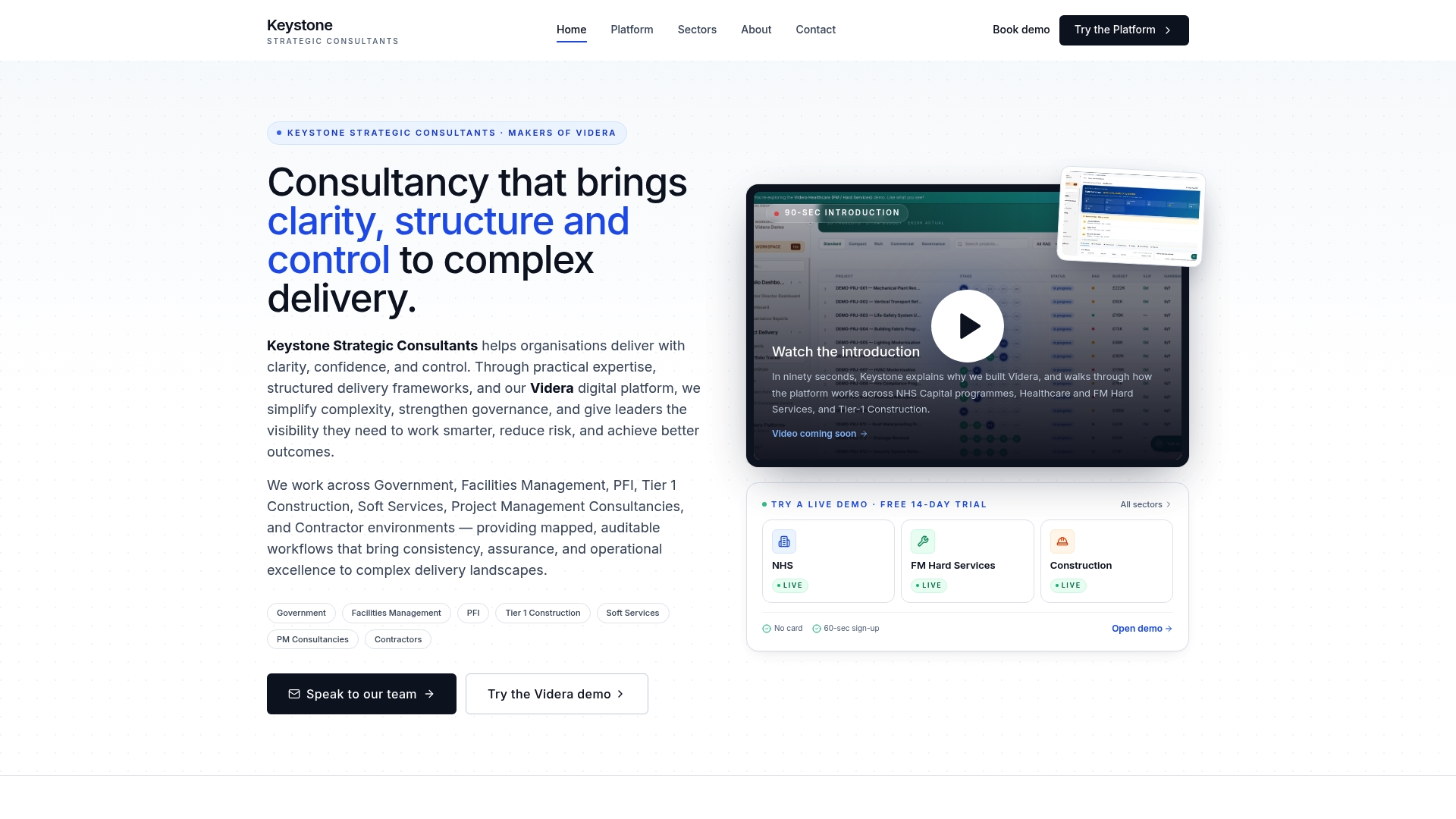
If slow or inconsistent gate decisions are the actual problem behind a stalled project, the fix usually sits in how evidence gets collected and reviewed, not in adding another layer of meetings. We built Videra PM to map workflows and automate reporting so gate reviews run on live evidence rather than a scramble the night before. For healthcare delivery specifically, Videra Healthcare handles the regulatory and clinical evidence trail that comes with that sector's gates, and for teams running capital builds, Videra Construction and Videra Hard Services keep procurement, risk and commissioning evidence in one auditable place. Where the need is hands-on governance redesign rather than a platform, our consultancy services work directly with your team to rebuild gate criteria and cadence. Start with a conversation about where your gates are stalling: visit Videra PM to see how mapped workflows and evidence capture fit your process.
FAQ
What are the five stages of the Stage-Gate process?
A typical model runs discovery, scoping, build, testing and validation, and launch, each ending in a formal gate review before the project proceeds. Research-focused organisations often use a parallel research track with learning-oriented milestones instead of commercial gates, as described in the DOE Stage Gate Management Guide.
What is another name for a Stage-Gate process?
Stage-gate is also called a phase-gate process, and in some engineering and construction contexts it overlaps with a milestone-based or phased review process. The terminology varies by industry, but the underlying structure of defined stages separated by formal decision points stays consistent.
What does Stage-Gate mean?
Stage-gate describes a project governance model where work is split into defined stages, with a formal review gate between each one that decides whether the project continues, stops, pauses or gets reworked. The ITP / DOE overview frames it as a structured way to control risk and spend as a project matures.
What are the different types of gate decisions?
The four standard outcomes are go, kill, hold and recycle: go means proceed as planned, kill means stop the project, hold means pause pending more information, and recycle means return to an earlier stage for rework. Keeping these outcomes binary, rather than allowing vague "proceed with caveats" verdicts, is what gives a gate real decision-making power.
How does Agile-Stage-Gate differ from traditional Stage-Gate?
Agile-Stage-Gate keeps formal strategic gates in place but lets delivery teams work in iterative sprints between them, rather than following a single long linear stage. Research on the two models found that plan-driven stage-gate can slow software-heavy projects and raise costs, while Agile tends to improve quality but can extend time to market, making a careful hybrid worth considering for software-intensive work, according to the study published in ScienceDirect.
Sources
- Stage Gate Management Guide (U.S. Department of Energy)
- Stage‑Gate innovation management guidelines (ITP / DOE)
- Agile–Stage‑Gate and their combination: Exploring their interaction (ScienceDirect)
- Integrated project delivery case study: Cone Health MedCenter Greensboro (LeanIPD)