
Project portfolio governance is the decision framework that determines which projects an organisation funds, pauses or stops, so the whole portfolio stays pointed at strategy rather than at whichever initiative shouts loudest. Done properly, it gives leaders a repeatable way to make funding, gate and reprioritisation calls with real authority behind them. That requires four things working together: defined forums, clear decision rights, a fixed cadence, and data everyone trusts.
TL;DR:
- Effective portfolio governance requires explicit decision rights assigned to specific roles and forums to prevent ambiguity and foster accountability.
- Regular cadence of operational, portfolio, and stage gate reviews ensures decisions are timely and aligned with strategic objectives.
- Using risk-adjusted scoring and transparent criteria for prioritization improves project selection and supports fair resource allocation.
- Trusted, integrated data sources streamline decision-making and prevent governance from becoming time-consuming or politically driven.
- Implementing governance gradually through diagnostics and staged pilots helps organizations fix authority gaps and enforce decision rights more effectively.
Table of Contents
- What project portfolio governance actually covers
- Core components: decision rights, forums and criteria
- Who runs governance: roles, PMO type and accountability
- How often should portfolio reviews and gates happen?
- Prioritisation and capacity: funding the right mix
- Reporting and the digital backbone governance actually needs
- Implementation checklist: designing and rolling out governance
- Common pitfalls and how to avoid them
- Keystone perspective: practitioner notes from delivery governance
- How Videra and Keystoneconsulting help you govern faster
- Sources
- FAQ
What project portfolio governance actually covers
Governance and delivery are not the same job, though most organisations blur them until something breaks. Delivery is about running individual projects well: schedules, budgets, risks, scope. Governance sits above that layer entirely. It decides which projects deserve delivery resource in the first place, and whether they still deserve it six months later.
PMI's practice guide on governance draws this distinction explicitly, separating governance at the portfolio, programme and project levels, and setting out leading practices for building a framework rather than assuming one will emerge on its own. It won't. Left alone, portfolios drift towards whatever gets the most political attention, not whatever creates the most value.
The portfolio's actual job is threefold:
- Alignment: every funded project should trace back to a strategic objective, not just a departmental wish list.
- Value optimisation: the mix of projects should represent the best use of finite capacity, not simply "everything everyone asked for."
- Benefits realisation: governance tracks whether promised outcomes actually land, not just whether projects finish on time.
ISO 21504:2022 reinforces this by treating portfolio management as a set of adaptable principles rather than a rigid procedure, meant to flex to an organisation's size, sector and maturity. That matters because governance built for a 500-person construction firm will strangle a 40-person facilities management team, and vice versa.
Core components: decision rights, forums and criteria
Governance only works when every decision has exactly one accountable owner. Ambiguity here is the single biggest reason governance frameworks quietly collapse into rubber-stamping. Four decision types need explicit homes:
- Fund a new project: usually a portfolio director or investment board, based on strategic fit and capacity.
- Approve passage through a gate: a portfolio review forum, checking evidence against pre-agreed criteria.
- Increase budget or scope: escalated to whoever holds the original funding authority, never absorbed quietly at project level.
- Stop or pause a project: the same forum that funded it, using the same criteria it used to approve it.
Each of these needs a forum with genuine authority, not just visibility. A steering group that only ever "notes" updates isn't governance. It's a meeting.
Criteria matter as much as authority. If one project is judged on strategic fit and another on gut feel, the portfolio review becomes a debate about fairness instead of a decision about value. Document the criteria once, apply them consistently, and gate reviews stop being political. A project RACI matrix is a practical way to pin decision rights down on paper before anyone can argue about who owns what.
Who runs governance: roles, PMO type and accountability
Accountability and operation are different jobs, and conflating them is how governance ends up owned by nobody. The portfolio director (or equivalent senior sponsor) holds ultimate accountability for the portfolio's shape and performance. The portfolio manager operates the mechanics day to day: convening reviews, tracking gate evidence, chasing data. The PMO prepares and validates the information both of them rely on. Government project delivery guidance sets out this split clearly, alongside the need for documented authority limits and integrated assurance plans across the portfolio.
PMO design should follow from governance choices, not precede them:
- Directive PMOs run projects directly and suit organisations wanting tight central control.
- Controlling PMOs enforce standards and gate compliance without running delivery themselves.
- Supportive PMOs provide tools and templates but hold no enforcement power.
PMI's PMO framework research notes that mismatched PMO type and governance ambition is a common failure point: a supportive PMO cannot enforce a controlling-style gate, however good its templates are.
Pro Tip: Set an escalation trigger before you need one, such as "any significant budget increase triggers escalation to the portfolio board," so nobody has to invent a threshold under pressure.
How often should portfolio reviews and gates happen?
Cadence is what turns governance from an occasional event into a working rhythm. Three tiers cover most organisations:
- Operational reviews (weekly or fortnightly): project-level status, risks and blockers, owned by delivery teams.
- Portfolio reviews (monthly or quarterly): cross-project prioritisation, capacity checks, and early warning on strategic drift.
- Stage gates (tied to project lifecycle, not the calendar): formal go/no-go decisions with real power to stop work.
Keep these tiers separate. The moment a portfolio review starts debating one project's task list, it has stopped being a portfolio review. Practitioner guidance from Portfolio Hub argues that tactical and strategic forums need firm boundaries precisely because blending them lets a handful of loud projects dominate time meant for the whole portfolio.
Gates work best when built around one real question rather than a checklist for its own sake. Something like, "is this still worth the investment given what's been delivered so far?" A gate structured this way needs only the evidence that answers that question, not a stack of status slides nobody reads.
Agile delivery changes cadence but not the underlying logic. Guidance on PMO governance models points out that agile teams still need clear decision authority and escalation paths; the review rhythm simply compresses and the "gate" becomes a continuous funding decision rather than a fixed milestone.
Prioritisation and capacity: funding the right mix
Scoring models turn "which projects matter most" from opinion into something defensible. Most organisations weight strategic fit, expected value, risk and delivery cost, then rank the list. The output isn't gospel, but it gives the portfolio review something concrete to argue about instead of relying on whoever pitches loudest.
A few practical adjustments make scoring hold up under scrutiny:
- Risk-adjust the value estimate, discounting benefits by delivery confidence rather than treating every forecast as equally certain.
- Model capacity against demand, because a perfectly scored project list is worthless if the organisation can't actually staff it.
- Publish the criteria before scoring, not after, so nobody can retrofit a justification for a favoured project.
Transparency here does more work than most people expect. When a project gets paused, the team wants to see it lost fairly against the same criteria as everything else, not that someone senior simply preferred a different one. That's the difference between a prioritisation model people accept and one they quietly resent.
Reporting and the digital backbone governance actually needs
Governance decisions are only as good as the data behind them, and most portfolios drown in metrics that add noise rather than clarity. A workable KPI set is deliberately short: schedule and budget variance against baseline, benefits realisation against the original business case, risk exposure trend, and resource utilisation against planned capacity. Each of those maps directly to a decision a forum needs to make. Anything that doesn't inform a decision is reporting for its own sake.
A lean, trusted KPI set beats a comprehensive one. Practitioner analysis from Portfolio Hub makes the case plainly: too many metrics dilute decision focus, and a single dashboard executives actually read outperforms a sprawling report nobody finishes.
A single validated data source matters more than any dashboard design choice. If finance, delivery and the PMO each maintain their own version of "the numbers," every portfolio review starts with fifteen minutes of arguing about whose figures are right before anyone discusses a single decision. Integrated feeds, agreed once and refreshed automatically, remove that argument entirely.
What executives need on one screen:
- Portfolio health at a glance, colour coded against the agreed KPI set.
- Gate status for every project currently in review, with a plain flag for anything overdue.
- Capacity versus demand, so funding decisions account for delivery bandwidth, not just budget.
The PMO's job is preparing that view before the meeting starts, not compiling it live while executives wait. Weak risk visibility is a recurring cause of governance failure, and a structured approach to risk management inside the reporting cycle catches drift before it becomes a crisis discussion.
Implementation checklist: designing and rolling out governance
Building governance from scratch, or fixing a broken version, works best as a staged sequence rather than a big-bang rewrite.
- Diagnose first. Map existing decision rights, forums and data flows before designing anything new; you can't fix what you haven't measured. Governance diagnostics that trace decision rights and data flows tend to surface fixes faster than a full framework rebuild.
- Define the minimum viable framework. Pick the smallest set of forums, cadences and criteria that would produce real decisions, resisting the urge to design for every edge case up front.
- Pilot on one portfolio segment. Run it for one review cycle, then treat the actual decisions made (or not made) as evidence for what to adjust.
- Operate, measure, refine. Track whether decisions are happening faster and more consistently, then hand the running model to the PMO with clear ownership documented.
Pro Tip: Judge the pilot by decisions produced, not meetings held. A cadence that generates three clear go/no-go calls in one cycle has succeeded; one that produces five status updates hasn't, however well attended it was.
A staged rollout of operating model governance over roughly 8 to 12 weeks is a realistic timeframe for most mid-sized portfolios attempting this properly.
Common pitfalls and how to avoid them
Governance theatre is the most common failure: forums that meet regularly but hold no real authority to stop or redirect funding. The fix is blunt honesty about what each forum can actually decide, then stripping out the ones that can't decide anything.

Diffused accountability comes next. When three people are "sort of" responsible for a gate decision, none of them owns it. Assign a single accountable name to every decision type and write it down.
No trusted data undermines everything else. If the numbers in the room are disputed before the discussion starts, decisions stall. A single source of truth and a lean KPI set fix this faster than any governance redesign.
Keystone perspective: practitioner notes from delivery governance
Most governance failures we see across healthcare, construction and facilities management trace back to the same root cause: decision rights exist on paper but nobody enforces them in the room. Fixing that rarely requires a new framework. It usually requires collapsing three overlapping forums into one with actual authority, and refusing to let a portfolio review discuss a single project's task list.
A platform like Videra addresses enforcement gaps that often stem from data problems. When the PMO spends a week reconciling conflicting spreadsheets before a portfolio review, the review itself becomes theatre by the time it happens. A mapped, validated backbone changes what's possible in that room, not just what's visible in it.
— Peter
How Videra and Keystoneconsulting help you govern faster
There's real value in building governance capability internally, using a diagnostic and a staged rollout, but that route takes months of internal effort before it produces a single reliable decision. A faster route to the same outcome is to use solutions like Videra PM, which provide mapped workflows and AI-powered reporting configured for stage gating, helping PMOs move from spreadsheet reconciliation to decision preparation.
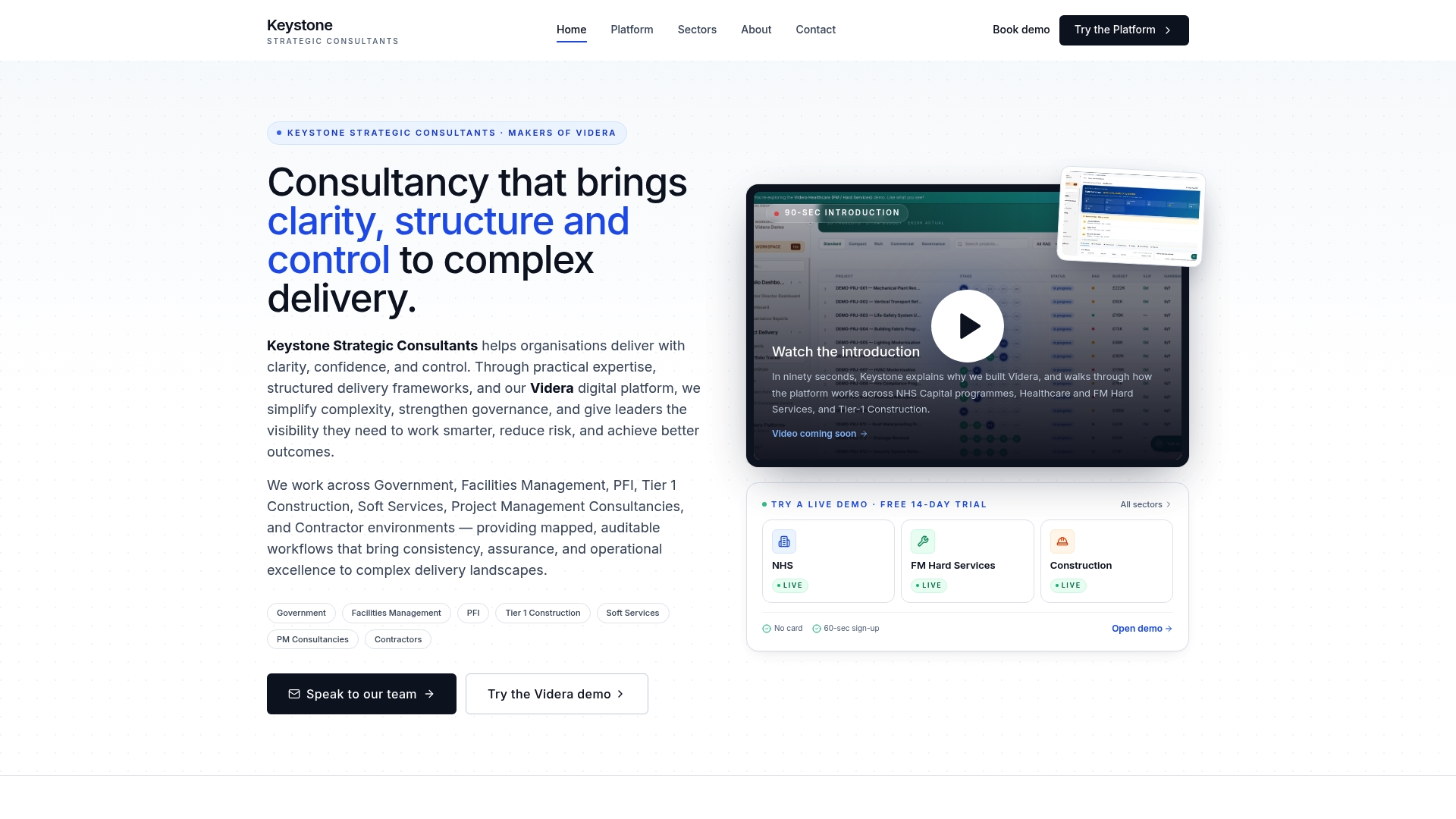
For healthcare organisations, platforms like Videra Healthcare configure a backbone around NHS project lifecycles, with audit-ready compliance included. Experienced consultants integrate directly with existing teams, mapping decision rights rather than imposing generic templates. If your portfolio reviews currently run on disputed numbers or forums with no real teeth, request a governance diagnostic and find out exactly where the fixes are.
Sources
- Governance of Portfolios, Programs, and Projects: A Practice Guide (PMI)
- ISO 21504:2022 - Project, programme and portfolio management — Guidance on portfolio management
- Chapter 11: The governance and management of portfolios (Government Project Delivery)
- Project Portfolio Governance: Gates and Decision Rights | Portfolio Hub
FAQ
What is the difference between PPM and PMO?
Portfolio and project management (PPM) is the discipline of selecting, prioritising and overseeing projects against strategy; the PMO is the operational function that supports that discipline by preparing data, tracking gates and enforcing standards.
What are the four P's of governance?
Definitions vary across frameworks, but most versions of the "four P's" reference portfolio, programme, project and process as the levels at which governance decisions and controls apply.
What are the three pillars of project governance?
Most governance frameworks, including PMI's practice guide, build on structure (roles and forums), process (decision rights and cadence), and information (data used to make decisions).
What are the 7 steps of the portfolio process?
Common practitioner sequences cover: defining strategy, identifying candidate projects, scoring and prioritising, balancing against capacity, approving and funding, monitoring through gates and reviews, and reprioritising as conditions change. The exact count varies by framework, but this sequence reflects the core logic behind ISO 21504:2022 and similar standards.