
Transformation governance is the executive framework that converts strategic intent into measurable value by assigning decision rights, funding rules and outcome ownership. Get it right and you see faster decisions, fewer stalled initiatives, and a straight line between spend and results. Get it wrong, and even well-funded programmes drift into fragmented reporting and quiet failure.
TL;DR:
- Clear decision rights and a decision matrix are essential to prevent delays and disputes in transformation governance.
- Quarterly funding review cycles, supported by outcome scorecards and live dashboards, improve adaptability and reduce value leakage.
- Building governance maturity can show measurable improvements within eight to twelve weeks through focused assessment and structured implementation.
- Most governance issues stem from meetings that focus on reporting rather than decision-making, which can be fixed by converting meetings into decision forums.
- Integrating evidence-backed workflows and AI-powered reporting accelerates governance maturity and reduces unresolved issues between teams and sponsors.
Table of Contents
- What is transformation governance and what does it actually govern?
- How should you structure governance roles and committees?
- Who decides what, and how does funding actually move?
- Which KPIs actually prove transformation is working?
- How do you build governance maturity in 8 to 12 weeks?
- Why do most governance efforts stall, and what fixes it?
- How a practitioner approach turns governance from theory into practice
- Three priorities that actually move the needle
- A practical route to stronger delivery governance
- Sources
- FAQ
What is transformation governance and what does it actually govern?
Transformation governance is the operating system that sits above individual projects, giving executives a consistent way to allocate money, assign accountability, and judge whether a change programme is earning its keep. It is not project management with a different name. Project management delivers a specific initiative on time and to spec. Transformation governance decides which initiatives deserve funding at all, who answers for the outcome, and what happens when reality diverges from the business case.
The framework rests on four building blocks:
- Oversight bodies that hold real decision authority, not just visibility into status reports.
- Accountability structures that name a single owner for value, distinct from whoever owns delivery.
- Portfolio assurance mechanisms that track value across the whole transformation, not project by project.
- Data and platform foundations that produce evidence automatically rather than through manual reporting cycles.
Poor governance and fragmented digital estates are among the primary reasons transformation initiatives underdeliver, according to MIT Sloan Management Review, which found organisations that institutionalise value assurance through explicit decision rights and adaptive funding report roughly 1.7 times higher performance across strategic and operational metrics. The OECD's e-Leaders handbook reaches a similar conclusion from a public-sector angle: institutional arrangements and cross-stakeholder accountability, not technology choice, determine whether digital transformation sticks.
How should you structure governance roles and committees?
Structure follows a simple logic: someone must be able to say yes or no quickly, someone must coordinate across the portfolio, and someone must own the value case independently of the people building the solution.
- Steering committee. This is the highest decision body, typically drawn from the executive team plus one or two senior sponsors from the business units most affected. Its job is to approve funding, resolve cross-programme conflicts, and kill initiatives that no longer serve strategy. A steering committee that only reviews status decks has already failed its purpose.
- Transformation office or PMO. Think of this as portfolio orchestration, not micromanagement. It standardises reporting, tracks interdependencies between workstreams, and flags risks before they reach the steering committee. A good transformation office spends more time removing obstacles than producing slides.
- Value owners. These sit apart from delivery leads. A delivery lead is accountable for shipping the capability; a value owner is accountable for whether that capability actually moves the metric it was funded to move. Splitting these roles prevents the common failure where a project is declared "successful" because it launched, regardless of whether it changed anything.
- Escalation paths and stage gates. Every governance model needs defined moments where a project must justify continued funding: after discovery, after pilot, before scale-up. Each gate needs a named decision owner and a clear "stop, continue, or pivot" outcome, not a rubber stamp.
The NACD's guidance on board oversight urges boards to move from compliance checking toward genuine strategic decision-making on digital initiatives, which is exactly what a properly structured steering committee is designed to enable.
Who decides what, and how does funding actually move?
Decision rights are the single most under-specified element in most governance models. Without a written matrix showing who can approve what, at what threshold, disputes get resolved by whoever shouts loudest in the room, and that slows everything down.
Adaptive funding replaces the annual budget lock-in with a reprioritisation cadence, typically quarterly, where the portfolio is reassessed against current evidence rather than a business case written eighteen months earlier. Cognizant's research on enterprise transformation value assurance found that leading enterprises treat value as a portfolio discipline: shared outcome scorecards and centralised value ownership reduce value leakage and let organisations correct course faster than a fixed annual cycle allows.
A working decision and funding model needs:
- A decision rights matrix naming who approves spend at each threshold, so approvals do not default upward unnecessarily.
- A reprioritisation cadence, usually quarterly, where underperforming initiatives lose funding and high-signal ones gain it.
- An outcome scorecard shared across the portfolio, linking each project to a specific enterprise metric rather than a generic "on track" status.
- Live dashboards that surface early warning signals, so course correction happens at week eight of a problem, not month six.
The point of adaptive funding is not to chase every shiny new initiative. It is to stop funding things that have stopped working, which sounds obvious until you look at how few organisations actually do it on a fixed schedule.
Which KPIs actually prove transformation is working?
Executives should track outcome metrics alongside process metrics, not one or the other. A dashboard full of "sprints completed" tells you activity is happening. It tells you nothing about value.
Four metrics do most of the heavy lifting:
- Value realisation rate: the share of forecast benefit actually captured against the original business case.
- Decision velocity: average time from issue raised to decision made, a direct proxy for whether governance forums are functioning as decision-making bodies.
- Strategic alignment score: how closely funded initiatives map to stated strategic priorities, reviewed at each funding cycle.
- Resource utilisation efficiency: whether skilled people are working on the highest-value initiatives or spread thin across too many.
Organisations that institutionalise this kind of scorecard alongside adaptive funding report roughly 1.7 times higher performance across the metrics that matter to the board, a gap wide enough that it should reframe how much time executives spend on reporting design rather than reporting frequency.
Quality assurance belongs earlier in this cycle than most governance models place it. Shift-left testing and production monitoring, borrowed from software delivery discipline, catch value-eroding defects before they reach a steering committee agenda as a crisis rather than a line item.
How do you build governance maturity in 8 to 12 weeks?
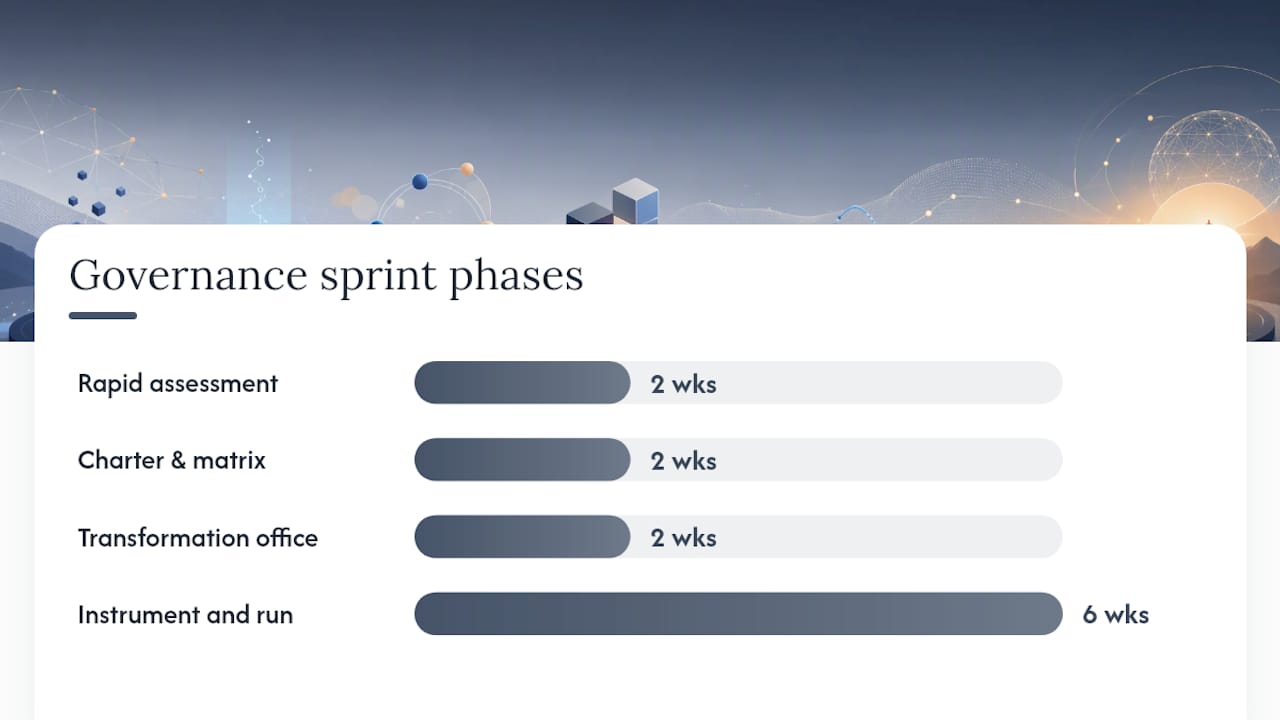
You do not need a year-long redesign to see governance improve. A focused sprint gets most of the structural weaknesses fixed and produces visible decision-making improvement within one quarter.
- Weeks 1 to 2: rapid assessment. Map current decision bottlenecks, existing committees, and where reporting actually comes from. Define the two or three outcomes this transformation must deliver.
- Weeks 3 to 4: charter and decision matrix. Write the steering committee charter, the decision rights matrix, and a single outcome scorecard the whole portfolio will report against.
- Weeks 5 to 6: stand up the transformation office. Set a fixed meeting cadence, weekly or fortnightly, with a rule that every agenda item requires a decision, not a status update.
- Weeks 7 to 12: instrument and run. Build dashboards that pull from operational data, launch the first wave of initiatives under the new model, and assign named owners with explicit success criteria.
A tactical guide on governance meeting cadence shows that fixing cadence, clarifying delegated authority, and introducing one visible scorecard unblocks most stuck programmes within six to twelve weeks, without needing a full organisational redesign first.
Pro Tip: Run your first steering committee meeting with a single rule: no status updates, only decisions. If an agenda item does not require a yes, no, or reallocation of money, it does not belong in the room.
Why do most governance efforts stall, and what fixes it?
The same failure modes appear across sectors: meetings that report status instead of making decisions, ownership that is assumed rather than assigned, reporting scattered across five disconnected tools, and value assurance treated as an afterthought at project close rather than a running discipline.
The remedies are direct rather than clever:
- Convert every recurring meeting into a decision forum with a published decision log.
- Centralise portfolio visibility into one dashboard, even if the underlying systems stay fragmented for now.
- Bring quality and risk functions into governance design at the start of a programme, not the final gate.
- Reassess decision velocity and value realisation rate one quarter after the fixes land, so improvement is measured, not assumed.
MIT Sloan's research on governing digital initiatives makes the same point from a different angle: the highest-performing organisations treat governance meetings as forums for removing blockers and committing resources, not as reporting theatre.
How a practitioner approach turns governance from theory into practice
Twenty years spent inside healthcare, construction, and facilities delivery teaches you where governance actually breaks: not in the framework design, but in the gap between what a slide deck claims and what is happening on site or on the ward.
Keystoneconsulting built the Videra platform around that gap. Mapped workflows and AI-powered reporting turn stage gates from a manual checklist exercise into something evidence-backed and audit-ready, drawn from live operational data rather than a manager's memory the night before a board meeting.
Typical engagements over eight to twelve weeks aim for:
- A measurable uplift in governance maturity against a defined baseline.
- Board reporting built from live workflow data instead of assembled spreadsheets.
- Clearer escalation paths that reduce the time issues sit unresolved between operational teams and sponsors.
Three priorities that actually move the needle
Clarify decision rights before anything else. Instrument value signals so problems surface at week eight, not month six. Then spend your energy removing blockers, because that is the only governance activity a steering committee should really be doing.
— Peter
A practical route to stronger delivery governance
This consultancy approach offers governance solutions focused on evidence-based delivery rather than slide decks. Where most advisers hand over a framework and leave, Keystone integrates directly with your teams and pairs that hands-on delivery support with the Videra platform, so mapped workflows and AI-powered reporting produce audit-ready evidence as a by-product of daily operations rather than a separate reporting chore.
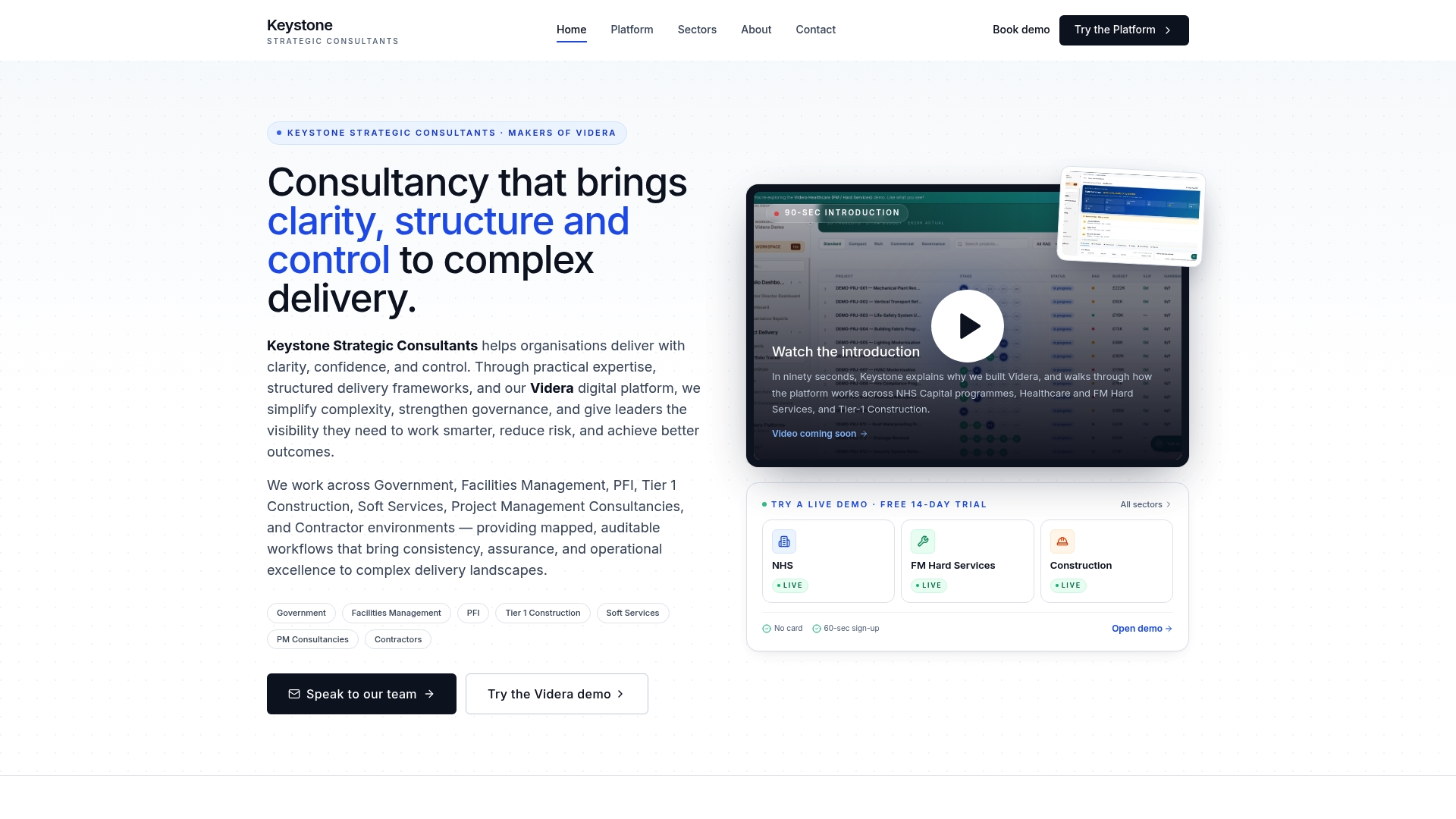
For transformation leaders standing up a steering committee and portfolio scorecard, Videra PM gives you a governance workspace built around stage gates and decision tracking rather than generic project tracking. Sector-specific versions exist for healthcare, hard services, and construction delivery environments. If you need help designing the governance model itself before choosing a platform, Keystone's consultancy service covers governance design and delivery support directly with your team. Get in touch to scope an 8 to 12 week starting engagement against your current governance gaps.
Sources
For deeper grounding, see MIT Sloan Management Review's seven principles for governing digital initiatives, the OECD's e-Leaders handbook, NACD's board oversight guidance, and Everest Group and Cognizant's value assurance report. For a rapid readiness check, a 60 day operations audit offers a useful external benchmark before committing to a full governance redesign.
- 7 key principles to govern digital initiatives — MIT Sloan Management Review
- The e‑Leaders handbook on the governance of digital government — OECD
- Digital transformation governance — NACD
- Assuring value in enterprise transformation — Everest Group / Cognizant report
FAQ
What are the four types of governance?
Most frameworks distinguish corporate, IT, project, and transformation governance, each covering a different scope of decision rights, from company-wide oversight down to individual initiative controls.
What are the seven pillars of governance?
Definitions vary by framework, but common pillars include accountability, transparency, decision rights, risk management, stakeholder engagement, performance measurement, and ethical conduct.
What is transition governance?
Transition governance refers specifically to the oversight arrangements that manage the handover period between an old operating model and a new one, ensuring accountability does not drop during the switch.
What are the seven pillars of digital transformation?
These typically include strategy, leadership, culture, technology, data, customer experience, and governance, with governance acting as the coordinating layer that keeps the other six aligned.
How much does Keystoneconsulting's governance support cost?
Pricing for Videra and consultancy engagements depends on scope and sector, and current details are available directly on the Keystoneconsulting site.