
A governance meeting cadence is the recurring schedule of oversight forums that turns strategy into action, built to make decisions on a defined timetable with agreed evidence and clear ownership. A common approach is a tiered model: operational, tactical and strategic layers, each with its own frequency and purpose. Success looks simple: decisions get made when scheduled, evidence is ready before anyone walks in, and actions get tracked to closure rather than repeated meeting after meeting.
TL;DR:
- Most governance cadences succeed when evidence is pre-agreed, decision rights are clear, actions are tracked, and escalation paths are defined.
- A tiered model separates operational, tactical, and strategic reviews, each with specific frequencies, focus, and participant roles to prevent meetings from becoming repetitive or unfocused.
- Effective agendas prioritize high-value decisions early, enforce strict evidence requirements, and keep meeting sizes small to improve accountability and decision quality.
- Piloting a single forum for six to eight weeks, measuring decision latency and action closure, helps organizations refine and scale their governance cadence reliably.
- Technology tools like dashboards and automation platforms support evidence flow, reduce status theatre, and enable dynamic adjustments as organizational size and culture evolve.
Table of Contents
- What is governance cadence, and how is it different from a meeting?
- The tiered cadence model: operational, tactical and strategic layers
- Recommended cadences and sample agendas
- Design rules: evidence, decision rights, attendance and escalation
- Common failure modes and practical fixes
- How to implement a new governance cadence: pilot, measure and scale
- Practitioner perspective: what actually holds a cadence together
- Tailoring cadence to organisational size and culture
- Technology and tools that support a working cadence
- Keeping the cadence flexible as the organisation changes
- An honest take on what governance cadence guidance usually gets wrong
- Sources
What is governance cadence, and how is it different from a meeting?
A meeting is an event. A cadence is a system. That distinction sounds pedantic until you sit through your fourth "monthly steering group" in a row that produces the same status update, the same vague concerns, and no actual decision.
A governance cadence is a structured, recurring review rhythm that defines when decisions are made, who participates, what evidence is required and how actions are tracked, according to Ridley & Co's analysis of decision fatigue in regulated firms. Miss any one of those four elements and you don't have a cadence. You have a standing calendar invite that people quietly resent.
Most organisations get the "when" right and ignore the rest. They book the recurring slot, send the invite, and assume structure will emerge on its own. It rarely does. What actually separates a working cadence from a diary habit:
- Pre-agreed evidence: attendees know exactly what data, report, or pre-read is required before the session starts, not what gets improvised on the day.
- Decision rights: someone in the room has the authority to say yes, no, or not yet, and that authority is understood by everyone present.
- Action tracking: every decision produces a logged action with an owner and a deadline, checked at the next session.
- Escalation path: unresolved items have a defined route upward, rather than lingering on the agenda for months.
This matters most for strategic persistence. A single well-run board meeting achieves little on its own; a cadence compounds decisions over quarters, which is precisely why boards are told to audit their own rhythm rather than assume it works. Harvard Business Review's guidance for board members urges directors to ask forward-looking, decision-focused questions rather than accept retrospective status updates. An annual audit of the governance rhythm itself, checking whether forums still add decision value or have quietly become reporting rituals, is one of the clearest trust signals a governance function can build into its own design.
The tiered cadence model: operational, tactical and strategic layers
Three layers, each doing a different job, is the model that keeps showing up wherever governance actually works. Atlan's research on governance council cadence confirms that a tiered structure, moving from frequent operational reviews to infrequent strategic ones, stops forums becoming ceremonial and keeps information flowing to the people who can act on it.
Think of it as a filter, not a hierarchy. Operational cadence catches problems early and cheaply. Tactical cadence reconciles patterns across teams. Strategic cadence sets direction and owns risk appetite. Confuse the layers, and you get boards debating a printer fault or frontline teams debating five-year strategy. Neither works.
| Layer | Typical frequency | Focus | Core participants |
|---|---|---|---|
| Operational | Weekly or biweekly | Exceptions, blockers, immediate risks | Frontline managers, team leads |
| Tactical | Monthly or quarterly | Reconciled performance, resource shifts, cross-team dependencies | Functional leads, programme managers |
| Strategic | Quarterly or annual | Board packs, strategy direction, risk appetite | Executives, board members |
Operational reviews should stay tight and exception-focused. Nobody needs a weekly recap of everything that went right; they need the two things that went wrong and who is fixing them. This is where cadence breaks down fastest, because it's tempting to let a fifteen-minute standup balloon into a thirty-minute status parade once people stop treating exceptions as the entire point.
Tactical reviews sit in the middle and do the heaviest lifting. This is where operational noise gets converted into patterns worth a decision: a resourcing gap appearing across three teams, a supplier consistently missing deadlines, a compliance risk trending the wrong way. Functional leads reconcile what operational teams reported and decide what deserves to travel upward.
Strategic reviews should almost never see raw operational detail. Boards asking proactive questions about direction and risk appetite need reconciled, forward-looking material, not a printout of last week's ticket queue. The discipline here is refusal: a strategic forum that accepts unreconciled operational detail has already lost its purpose.
The evidence flow between layers needs to be explicit and, ideally, automated rather than manually compiled each cycle. Operational dashboards feed tactical reviews. Tactical outputs get reconciled into the strategic pack. Miss a deadline in that chain, and the layer above either delays or, worse, decides on stale information. A tool like Videra's project governance platform can automate much of that evidence cascade so nobody is manually assembling slide decks the night before a board meeting.
Recommended cadences and sample agendas
Templates beat theory here, because most people implementing a new cadence just want something they can adapt by Friday. Below are three working structures, scaled to the tier they serve.
A well-structured strategic agenda puts the highest-value decision first, while attention is sharpest, and ends with confirmed actions rather than trailing off into "any other business."
| Time block | Content | Owner |
|---|---|---|
| 5 minutes | Highest-priority decision item, with pre-read already reviewed | Chair |
| 15 to 25 minutes | Strategic risk review and reconciled tactical outputs | Risk lead / functional leads |
| 20 minutes | Resourcing and investment decisions | Executive sponsor |
| — | Emerging risks, horizon scanning | Chair |
| — | Action capture and confirmation of next session's evidence requirements | Scribe |
That structure follows a pattern worth stealing for any level of cadence: prioritise the highest-value decision early, time box every block, and close with action capture and a confirmed next date, a template The OKR Hub's guidance on execution-focused governance sets out clearly.
A focused tactical agenda runs monthly or quarterly and should produce two concrete outputs every time: a reconciled performance view and a decision on any resourcing shift. Fifteen minutes on performance data, twenty-five on discussion and decisions, fifteen on cross-team dependencies, five on action logging. If a tactical session isn't producing at least one resourcing or prioritisation decision, question whether it needs to exist monthly at all.
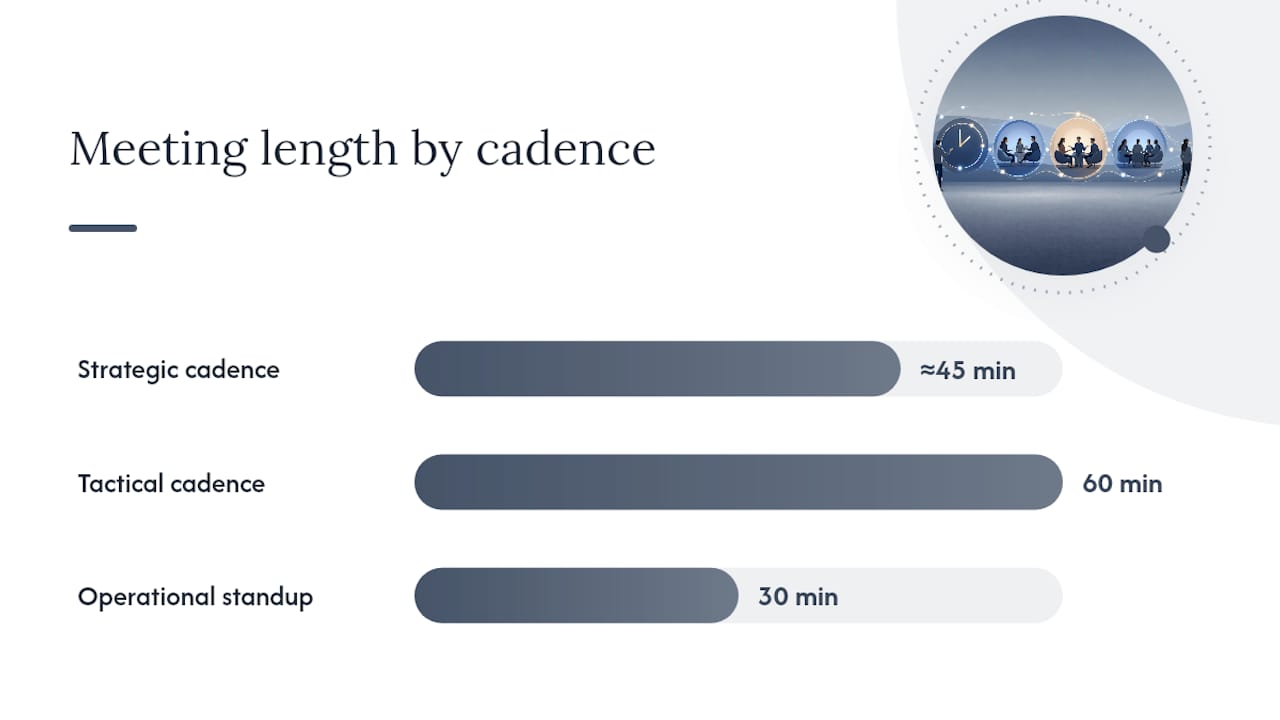
A concise operational standup should almost entirely be exceptions. Five minutes on what changed since last time, twenty minutes on blockers and decisions needed today, five minutes confirming who owns what by when. Anything that isn't an exception or a blocker belongs on a dashboard, not on the agenda.
Pre-reads and distribution deadlines make or break all three templates:
- Strategic pre-reads go out at least five working days ahead, giving reviewers time to challenge, not just skim.
- Tactical pre-reads go out two to three working days ahead.
- Operational updates can be same-day, since the format is exceptions, not analysis.
- Every pre-read should contain the facts, the risk, the recommendation and the exact decision required, so meeting time is spent on judgement rather than narration, an approach The OKR Hub also recommends.
A governance calendar publishing these dates and deadlines in advance, alongside agendas and an annual process timeline, is what helps make this repeatable rather than reinvented every quarter. UC Berkeley's public governance calendar is a useful reference for how far in advance a well-run institution plans its own rhythm.
Design rules: evidence, decision rights, attendance and escalation
Most cadences fail not from lack of meetings but from vague rules about what happens inside them. Four decisions fix most of that.
Define "evidence required" per agenda item, and enforce it. Every line on the agenda should specify exactly what data or document is needed to make that decision, not a general instruction to "come prepared." If the evidence isn't submitted by deadline, the item drops off the agenda rather than being discussed on incomplete information. That sounds harsh until the second time it happens, after which submissions arrive on time.
Set decision authority explicitly, and refuse to run forums without it. A recurring meeting where nobody can actually say yes is not governance; it's a briefing. Name the decision owner for each agenda category before the session, not during it.
Keep the room small. A core decision-making group of five to seven people tends to produce better governance outcomes than larger forums, according to The OKR Hub's analysis of governance execution. Everyone else who needs visibility becomes an observer with no speaking role, or gets the outputs afterwards rather than a seat at the table.
- Chair: owns the agenda, enforces timeboxing, and ensures decisions actually get made rather than deferred.
- Scribe: captures decisions and actions in real time, not from memory after the meeting ends.
- Decision owner(s): named per agenda item, with authority confirmed before the session starts.
- Observers: attend for visibility only, and are the first group to cut when a forum grows too large.
Build escalation rules with service levels attached. An unresolved risk shouldn't sit on a tactical agenda for three consecutive cycles. Set a rule: if an item is unresolved after two sessions, it escalates automatically to the next tier, with a defined response window once it arrives there.
Pro Tip: Attach a RACI to the forum itself, not just to individual projects. Knowing who is Accountable for the cadence's existence, separate from who is accountable for any single decision inside it, is usually the missing piece when a governance forum quietly dies from neglect.
Common failure modes and practical fixes
Every stalled governance cadence tends to fail in one of four recognisable ways.
- Status theatre. Sessions become a read-through of updates everyone already had in writing. Fix: move routine status to a dashboard beforehand and open the meeting with the first decision, not the first slide. A board reporting automation tool removes most of the manual narration that fuels this.
- Repeated agenda items with no resolution. The same risk appears meeting after meeting because nobody owns closing it. Fix: enforce an action log with named owners and hard deadlines, reviewed at the top of every session, not buried at the end.
- Late evidence. Reports arrive minutes before the meeting, or during it, leaving no time for genuine review. Fix: set a submission deadline with a defined quick-review window before the session, and apply the same drop-from-agenda rule mentioned earlier.
- Overlarge attendee lists. Fifteen people in a decision forum means nobody feels individually accountable for the outcome. Fix: split into a smaller decision-making core plus an observer list, or move general updates to written circulation instead of a seat at the table.
None of these fixes require new software or a governance overhaul. They require someone willing to say no to a bloated invite list or an unprepared agenda item, which is often the harder part.
How to implement a new governance cadence: pilot, measure and scale
Rolling out a new cadence across an entire organisation on day one is how most attempts fail. A smaller, deliberate pilot works better.
- Charter a single pilot forum. Pick one team or one tier, write a short charter defining purpose, participants, decision rights and evidence requirements, and set measurable success metrics before you start: decision latency, percentage of actions closed by deadline, and average meeting length.
- Run the pilot for six to eight weeks. That window is long enough to reveal real patterns without dragging on so long that momentum dies. Assign a RACI for the pilot itself and enforce pre-read deadlines from week one, a duration and structure The OKR Hub's implementation guidance recommends specifically because shorter pilots rarely surface true behaviour.
- Inspect behaviour, not attendance. Attendance tells you almost nothing. Watch whether decisions are actually getting made on schedule and whether the action log is shrinking or growing.
- Standardise once the metrics hold. When decision latency drops and actions close consistently, document the charter as a template and roll it out to the next tier or team, folding it into an annual governance effectiveness review rather than treating it as a one-off project.
A pilot that shrinks meeting length while increasing the number of decisions closed per session is the clearest signal you're ready to scale, a far more honest measure of readiness than simply asking whether people liked the new format.
Practitioner perspective: what actually holds a cadence together
Twenty years of untangling delivery governance across healthcare, construction and facilities management teaches you one thing quickly: the meeting was never the problem. The absence of a cascade, the missing link between what an operational dashboard shows and what a board pack claims, is what quietly breaks oversight. Keystoneconsulting built the Videra platform around that exact gap, mapping workflows so evidence moves between tiers automatically rather than being reassembled by hand every cycle.
A recurring pattern from Keystoneconsulting's work with programme teams: organisations that pilot a tiered cadence on a single delivery workstream, with audit-ready reporting built in from the outset, tend to reach stage-gate decisions faster and with far less last-minute evidence-chasing than teams still running ad hoc status calls.
Tailoring cadence to organisational size and culture
A twelve-person NHS ward improvement team and a national construction contractor with forty live sites cannot run the same cadence, even though both need the same three tiers.
Smaller organisations often collapse tactical and strategic layers into a single monthly forum, since the same handful of people sit across both anyway. That's a reasonable compromise as long as the agenda still separates operational reconciliation from strategic decision-making within the session, rather than blending them into one undifferentiated discussion.
Larger, multi-site organisations need the opposite adjustment: more operational forums running in parallel, each feeding a single tactical layer, so the tactical review isn't drowning in raw detail from a dozen sites. Facilities management and construction programmes in particular benefit from this, since site-level exceptions genuinely differ in nature from portfolio-level resourcing decisions.
Culture matters as much as size. Organisations with a strong hierarchical reporting habit, healthcare trusts and public sector bodies often included, tend to default toward status theatre unless the chair actively enforces decision-first agendas. Flatter, faster-moving organisations risk the opposite problem: skipping documentation and evidence capture because "everyone already knows." Neither culture is wrong, but each needs a different emphasis when the cadence is designed: more structure for hierarchical cultures, more discipline around written evidence for informal ones.
Technology and tools that support a working cadence
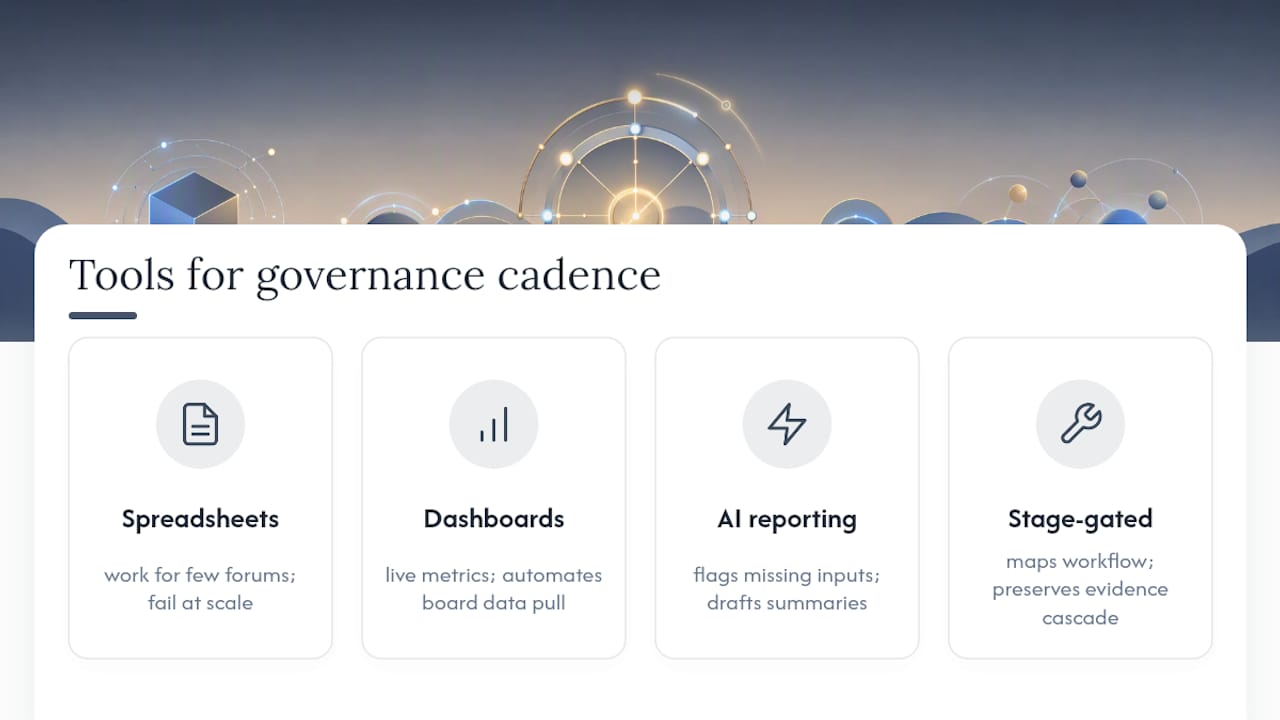
Spreadsheets and email threads can run a governance cadence for a while. They stop working the moment an organisation has more than two or three concurrent forums, because nobody can trace which version of a report actually reached the board.
Dashboards solve the most common failure mode directly: status theatre. When routine metrics live on a live dashboard rather than a slide deck, meeting time gets freed for the decisions that actually need a room full of people. Board reporting automation software built for operational leaders typically handles this by pulling data automatically rather than requiring someone to manually compile it the night before.
AI-assisted reporting tools are increasingly doing the reconciliation work that used to sit with a programme office analyst: flagging when operational data hasn't been submitted by deadline, or drafting the first pass of a tactical summary from underlying figures. A roadmap for AI in governance is worth reading before adopting these tools wholesale, since the risk is trusting an automated summary without anyone checking it against the source evidence.
Platforms built specifically for stage-gated governance, rather than generic project management software, tend to handle the evidence cascade between tiers more reliably, because the workflow itself is mapped rather than assembled ad hoc each cycle. Videra's PM platform is one example built around exactly that structure. Partner research from OneGov's board reporting guide offers a useful checklist for evaluating reporting tools against genuine governance needs rather than vendor feature lists.
Keeping the cadence flexible as the organisation changes
A cadence designed today will be wrong within eighteen months, and that's not a design failure. Organisations restructure, priorities shift, and forums that made sense at one headcount become either too frequent or too sparse at another.
Build a review point into the cadence itself rather than waiting for it to visibly break. A short annual check, distinct from the annual governance effectiveness review covered earlier, asking whether each forum still has genuine decision rights, whether attendance has crept upward, and whether evidence deadlines are still being met, catches drift early.
Solicit feedback directly from attendees rather than assuming silence means satisfaction. A simple, anonymous prompt after each quarter, asking whether the forum made a real decision or just reviewed one, surfaces status theatre faster than any external audit.
Treat frequency itself as adjustable. A tactical review that consistently produces no resourcing decisions for three consecutive cycles might need to move from monthly to quarterly. An operational standup that keeps surfacing the same unresolved blocker might need a shorter interval, not a longer agenda. Cadence isn't a fixed architecture; it's a setting you tune as the organisation's risk profile and pace of change shift.
An honest take on what governance cadence guidance usually gets wrong
Most advice on this topic obsesses over frequency, how often the board should meet, how many minutes a standup deserves, while treating evidence flow as an afterthought. That's backwards. The tiered model works only when the cascade between layers is deliberately designed, not when the calendar looks tidy.
The conventional advice also underrates how often forums fail from oversized attendee lists rather than the wrong frequency. Adding a fourth meeting rarely fixes a governance problem; removing eight people from the existing three usually does more.
If there's one priority for a reader starting from scratch, it's this: define decision rights before you touch the calendar. A perfectly timed cadence with no clear authority in the room is still just a well scheduled conversation.
— Peter
Sources
For deeper reading on the frameworks referenced throughout this guide: Harvard Business Review's proactive board questions, Atlan's governance council cadence research, Ridley & Co's work on decision fatigue in regulated firms, and The OKR Hub's practical guide to execution-focused governance meetings. For a working example of a published governance calendar, UC Berkeley's technology governance calendar is worth studying. Readers assessing where their own organisation sits can also review Keystoneconsulting's governance maturity model.
- Governance cadences: decision fatigue in regulated firms | Ridley & Co
- Governance council meeting cadence best practices | Atlan
- 10 proactive questions every board member should be asking | Harvard Business Review
- How to run governance meetings that actually drive execution | The OKR Hub
- Governance calendar example | UC Berkeley Technology