
Project stage gates split delivery into fixed phases separated by formal decision points, where a project team must justify continuing before more money or people get committed. Used well, they stop weak projects draining resources and force a genuine yes, no, or "come back with better evidence" decision. They suit complex, cross‑functional work and new product development best, though the same logic adapts to construction, healthcare programmes, and public sector delivery with the right adjustments.
TL;DR:
- Effective stage gates focus on resource decisions at key transition points, requiring senior, cross-functional input to assess scope, risks, and readiness.
- Gate criteria must be specific, including mandatory evidence and simple scoring, with decisions only made once confirmed budgets and resources are attached.
- A pilot run using fixed templates, clear evidence mapping, and measurable metrics like cycle time and rework is essential before wider implementation.
- Gate meetings should be short, routine, and evidence-based, with decisions made at least 48 hours in advance and criteria regularly reviewed.
- Leadership willingness to make tough calls and avoid rubber-stamping determines whether stage-gate governance supports project success or becomes bureaucratic theater.
Table of Contents
- What is stage gate methodology, and how does it work?
- What happens at a project gate review?
- Building a stage-gate process: a checklist for PMOs
- Can stage-gate governance work with Agile delivery?
- Where stage-gate governance usually breaks down
- How does Keystone put stage-gate theory into practice?
- Why leadership behaviour decides whether gates work
- Get help building gates that actually hold
- Sources
- FAQ
What is stage gate methodology, and how does it work?
The stage gate model, formalised as Stage‑Gate® by Robert Cooper and colleagues, breaks a project into a discovery phase plus five core stages, with a gate at the end of each one deciding whether the project earns the next round of investment. The model deliberately builds in iteration and cross‑functional work within each stage rather than treating stages as rigid, sequential silos.
Here is what each stage typically produces:
- Discovery. Idea generation and early scoping. Output: a rough problem statement and initial feasibility view.
- Stage 1, scoping. A quick assessment of market and technical merit. Output: a preliminary business case.
- Stage 2, business case. Detailed market, technical, and financial analysis. Output: a defined product concept, project plan, and justification.
- Stage 3, development. Design and build the deliverable such as a product, building phase, or clinical pathway. Output: a tested prototype or milestone.
- Stage 4, testing and validation. Verification in the field, with customers or regulatory standards. Output: validated performance and acceptance.
- Stage 5, launch. Full commercial or operational rollout. Output: the completed deliverable in use, with a post-launch review plan.
Each stage runs cross‑functional tasks in parallel rather than one department handing off to the next in sequence. A construction project might run structural design, procurement, and permitting simultaneously within a single stage, with the gate checking that all three lines converge before the project earns approval to move on. That parallel structure is what keeps a stage‑gate process from grinding into a paperwork exercise; the gates provide the discipline, not the sequencing.
What happens at a project gate review?
A gate is not a status meeting; it is a resourcing decision, and treating it as anything less is the single most common reason stage‑gate governance fails to earn respect from delivery teams.
Every gate has three components, and skipping any one of them turns the meeting into theatre:
- Deliverables. The specific evidence the project team must bring, agreed in advance. This might be a validated business case, a test report, or a compliance sign‑off, depending on which gate it is.
- Criteria. The questions gatekeepers use to judge those deliverables, split into knockout "must" criteria (pass or fail, no scoring needed) and scored "should" criteria that assess business value and strategic fit.
- Outputs. A decision: Go, Kill, Hold, or Recycle back for more work. A Go decision must come with confirmed budget, headcount, and timeline for the next stage attached, not just a nod of approval.
Gatekeepers should be senior managers from the functions that control the next stage's resources, not a rotating cast of whoever is free that afternoon. Pulling in finance, operations, and technical leads together means the decision weighs readiness across the board rather than one function's narrow view, which Stage‑Gate®'s own governance guidance treats as a core design principle rather than a nice-to-have.
Gates belong at genuine transition points, where the next phase carries materially more investment or risk, not on a fixed calendar. PMI's guidance on project gates is blunt about this: a gate exists to review scope changes, surface new risks, and confirm the plan ahead, and it should never be confused with a routine catch‑up.
Pro Tip: Send deliverables and scorecards to gatekeepers at least 48 hours before the meeting. A gate review should confirm a decision the paperwork already points to, not be the first time anyone reads the evidence.
Building a stage-gate process: a checklist for PMOs
Rolling out stage‑gate governance across an organisation fails most often because someone tries to design the perfect system before running a single gate. Build it in this order instead.
- Name your gates and stages. Give each one a short, consistent label used the same way on every project. Consistent naming is what turns gates into culture rather than a one-off process document nobody references again.
- Fix the evidence list per gate. Map each deliverable to one short artefact, a two-page test report or a single prototype demo script, rather than a folder of loosely related documents. Shorter evidence produces sharper review conversations.
- Build a simple scorecard. Split criteria into knockout "must" questions and a small set of scored "should" items covering strategic fit and value. Keep the scoring transparent enough that any gatekeeper can apply it without a briefing.
- Assign roles and decision authority. Name who attends, who chairs, and who actually holds sign-off. Exclude the delivery team from final deliberation if the discussion needs to cover staffing or strategy candidly.
- Set meeting rules. Pre-reads circulated 48 hours ahead, a fixed agenda, and a hard rule that no Go decision leaves the room without resourcing attached.
- Pilot on one project. Run it on a single representative project across a handful of stages before rolling the model out wider.
- Measure and refine. Track cycle time per gate, Kill rate, and rework volume, then adjust criteria that aren't actually discriminating between strong and weak projects.
Keep these guardrails in view once the pilot is running:
- Never let a Go decision through without confirmed budget, headcount, and timeline for the next stage.
- Review criteria annually. A "must" question that every project passes without effort is dead weight, not governance.
- Keep templates identical across project types where possible, and only diverge where the sector genuinely demands it, such as documentation checklists required for regulatory or compliance‑heavy gates.
Can stage-gate governance work with Agile delivery?
It can, and the two are less at odds than most PMOs assume. The mistake is treating stage-gate as a document‑heavy waterfall process bolted onto an Agile team, which produces exactly the bureaucracy Agile was meant to avoid.
The fix is lighter, more frequent checkpoints rather than abandoning gates altogether:
- Micro‑gates. Shorter, lighter reviews at the end of a sprint or short cycle, checking direction rather than demanding a full business case each time.
- Rolling wave planning. Plan the next stage in detail only as the current one nears completion, rather than locking a five‑stage plan upfront.
- MVP tests feeding the scorecard. Use rapid build‑and‑test cycles with real customers as evidence for the same "should" criteria a traditional gate would score, reassessing project value as new information lands rather than waiting for a scheduled gate date.
- Outcome‑based gates over document‑heavy ones. Ask "did the test prove the hypothesis" rather than demanding a 40‑page report as evidence.
Watch for the tell‑tale signs a project has outgrown its current gate structure: if teams are producing paperwork nobody reads, or a gate keeps sliding because the "must" criteria don't fit iterative work, the model needs lightening, not abandoning.
Where stage-gate governance usually breaks down
Most stage‑gate failures trace back to a handful of repeat offences, and every one has a straightforward fix.
- Bureaucracy creep. Gates accumulate extra sign-offs over time until reviews take weeks. Fix: audit the evidence list annually and cut anything nobody has referenced at the last three gates.
- Decision delay. Gatekeepers defer a call rather than kill a weak project outright. Fix: force a genuine Go/Kill/Hold/Recycle decision every time, with no "let's revisit next month" option.
- Thin cross‑functional input. One function dominates the room and the decision reflects their view alone. Fix: fix attendance rules so finance, delivery, and the relevant technical function are all represented.
- Approving without resourcing. A Go decision with no confirmed budget or headcount just delays the same conversation to next month, and the Stage‑Gate International governance framework is explicit that this is what causes projects to stall mid‑stage.
- Criteria that don't discriminate. If every project scores highly on every "should" criterion, the scorecard isn't doing its job.
Pro Tip: If a gate review has approved every single project for two consecutive cycles, the criteria aren't discriminating, they're decorative. Rewrite them before the next pilot.
How does Keystone put stage-gate theory into practice?
Two decades of governance work across healthcare, construction, and facilities management has shown the same pattern repeatedly: organisations design good stage‑gate criteria on paper, then lose the evidence trail the moment a real project gets busy. Gates slip into rubber‑stamping because nobody can quickly locate the deliverable that was meant to back the decision.
A practical platform can map each gate deliverable to a specific, auditable evidence artefact, so a gatekeeper can open the record and see the test report, sign‑off, or compliance document tied to that exact gate, rather than chasing it across email threads.
A sensible pilot structure looks like this:
- One representative project, run through two or three gates over four to eight weeks.
- Templates and a scorecard fixed before the pilot starts, not adjusted mid‑flight.
- Success measured against cycle time per gate, Kill rate, and how much rework the evidence trail avoided.
Firms serious about tightening this further often start with a portfolio governance review or an operational readiness checklist before scaling gates across a wider programme.
Why leadership behaviour decides whether gates work
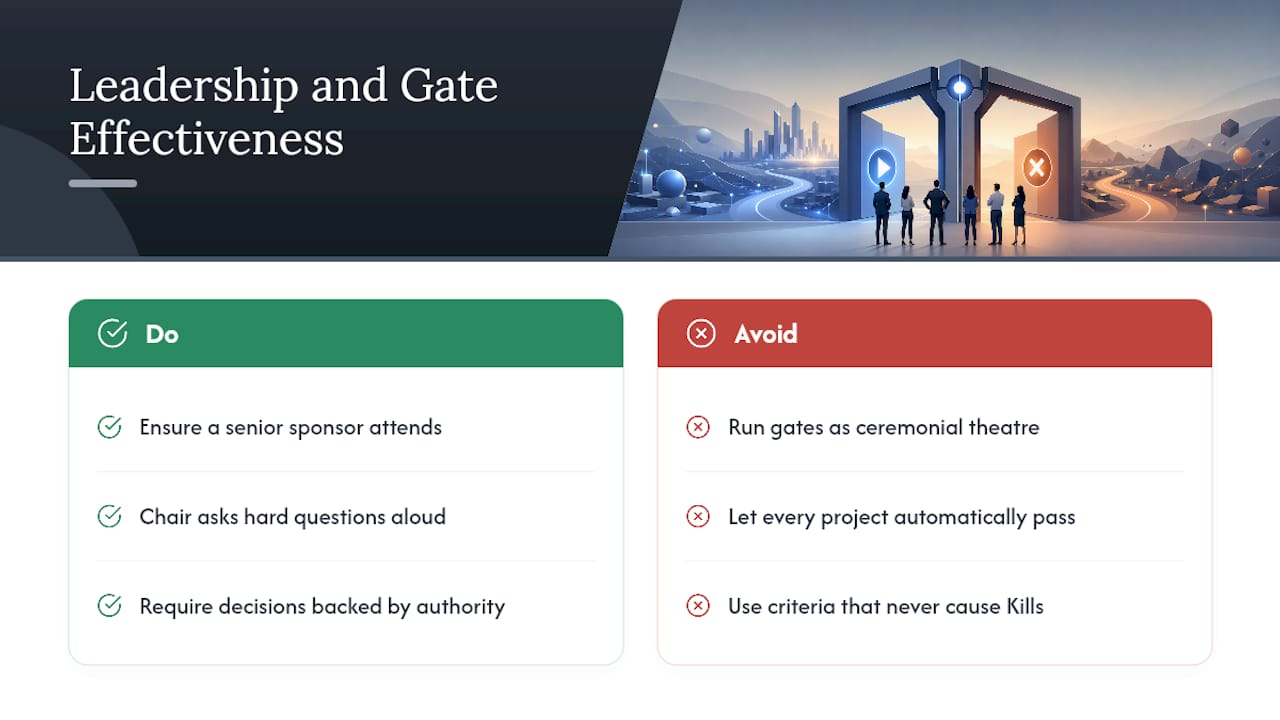
Governance frameworks fail for cultural reasons far more often than technical ones. A gate only works when the people chairing it are genuinely willing to say no, and that willingness has to come from the top or it never survives contact with a politically favoured project.
Spotting a "theatre" gate is easy once you know the signs: every project passes, no criteria have ever caused a Kill, and the meeting exists to confirm a decision made elsewhere. One programme office I reviewed had run eleven consecutive Go decisions before anyone questioned whether the gate was doing anything at all. The fix wasn't new paperwork. It was a senior sponsor willing to sit in the room and actually ask the hard question out loud.
— Peter
Get help building gates that actually hold
Some consultancies offer an alternative to designing stage-gate governance from a blank page or bolting generic templates onto teams that were never consulted. Such consultancy work can integrate with delivery teams to design gate criteria, scorecards, and evidence lists that fit how organisations actually operate, whether in healthcare, construction, or facilities management.
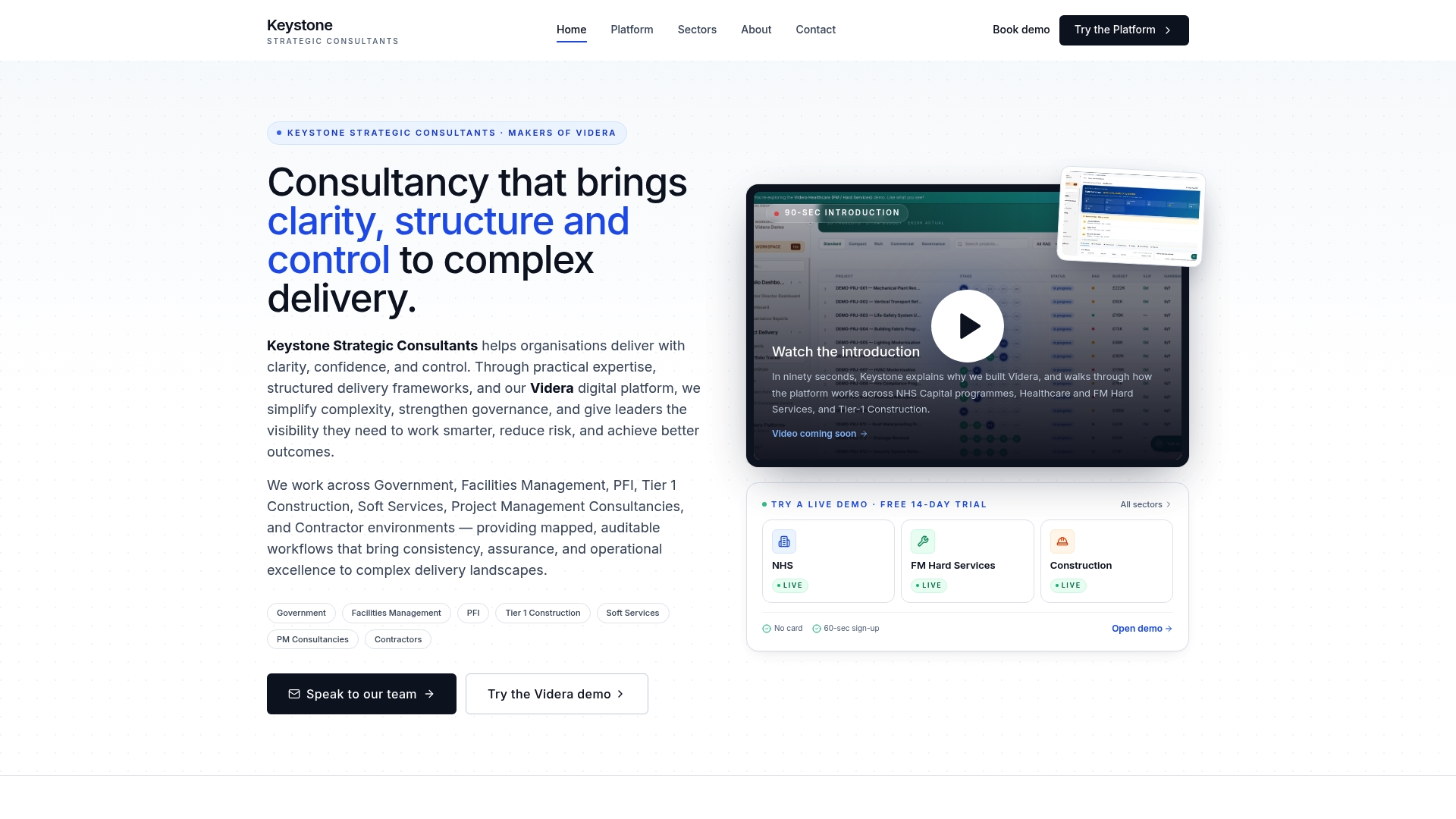
Where most generic project tools give you a checklist and leave the evidence chasing to you, the Videra platform maps each gate deliverable to a mapped, auditable workflow, so a gatekeeper can see exactly what backs a Go decision without hunting through email. For construction programmes, Videra Construction tracks stage evidence against site milestones; for healthcare delivery, Videra Healthcare does the same against clinical and compliance gates. If you want a structured route into this rather than a DIY build, start with a scoped consultancy engagement to design your gates properly, or explore Videra PM directly to see how the platform captures gate evidence in practice.
Sources
- Stage‑Gate®: The “Official” 2026 Version
- Discovery-to-Launch Process | Stage‑Gate International
- Project gates (PMI)
- Phase‑gate process — Wikipedia
FAQ
What are stage gates in a project?
Stage gates are formal decision points at the end of each project phase where senior stakeholders review evidence and decide whether the project earns funding to continue, gets killed, held, or sent back for more work.
What are the five stages of the stage-gate process?
The canonical model runs discovery, then scoping, business case, development, testing and validation, and launch, with a gate reviewing readiness at the end of each one.
What are project gates in project management?
Project gates are checkpoints placed at transitions where the next phase carries meaningfully more investment or risk, giving management visibility into scope changes, new risks, and the plan ahead rather than functioning as routine status meetings.
How do you run an effective gate meeting?
Circulate deliverables and a scorecard at least 48 hours ahead, keep gatekeepers cross‑functional, and never let a Go decision leave the room without confirmed budget, headcount, and timeline attached.
Does Keystoneconsulting offer help implementing stage-gate governance?
Some consultancies provide support to design gate criteria and evidence lists, alongside digital platforms for mapped, auditable gate evidence; current pricing for both is generally available on request through their sites.