
Operating model governance turns strategy and policy into daily decisions, by defining who decides what, who escalates when things go wrong, and what evidence proves the decision was sound. Done properly, it gives you clearer accountability, faster resolution when something breaks, and an audit trail that survives scrutiny. This article sets out the roles, the KPIs, and a working 8 to 12 week rollout plan you can adapt.
TL;DR:
- Decision rights, escalation paths, and evidence collection are essential components of operating model governance that ensure accountability and auditability.
- Centralized, decentralized, and hybrid models each have specific advantages and appropriate contexts, with hybrid models fitting larger regulated organizations best.
- Tracking policy adherence, review coverage, and mean time to closure provides clear evidence that governance controls are effective and operational under real pressure.
- Pilot programs should test decision paths and gauge ownership clarity early, preferably on units with good control relationships, to identify gaps before scaling organization-wide.
- Aligning governance frameworks with enterprise risk management and standardizing KPIs across units prevents conflicting reports and improves overall compliance and oversight.
Table of Contents
- What operating model governance actually means
- Governance model vs operating model: what's actually different
- The building blocks of an operating model governance structure
- Choosing a governance model type: centralised, decentralised, federated, or hybrid
- The governance KPIs that actually prove the model works
- Rolling out operating model governance in 8 to 12 weeks
- Templates you can use this week
- How Keystoneconsulting approaches this in practice
- Where governance meets risk management and compliance
- What successful implementation actually looks like
- Why most governance advice skips the hard part
- Get your operating model audit-ready with Keystoneconsulting
- Sources
What operating model governance actually means
Operating model governance is the mechanism that makes a governance framework work in practice: decision rights, escalation paths, oversight forums, and the evidence trail that proves controls actually ran. A framework tells you what good governance should look like. Operating model governance tells you who signs off a change on a Tuesday afternoon when the usual approver is on leave.
It sits below strategy and above day-to-day process. The board sets risk appetite and policy direction; operating model governance translates that into forums, roles, and reporting cadences that operational teams actually follow. Microsoft Purview's guidance on data governance operating models frames this as a practical system of decision rights, roles, and permissions rather than an abstract principle.
Ownership is usually split across several groups:
- The board or a delegated committee sets risk appetite and reviews exceptions.
- An executive steering group owns operating model design and resourcing.
- Control functions (risk, compliance, quality) own the standards and audit the evidence.
- Business or service owners run the routines day to day and hold the KPIs.
None of these groups can carry the model alone. A board without operational reporting is guessing; a business owner without escalation rights is stuck.
Governance model vs operating model: what's actually different
A governance model is the philosophy: the principles, policies, and risk appetite that say what "good" looks like. An operating model is the mechanism: the structures, roles, and routines that make those principles happen on a Monday morning. Confusing the two is the single most common cause of governance projects that stall. Teams rewrite the policy document, nothing changes operationally, and six months later the same failure repeats.
A quick way to tell which one you're dealing with:
- If the problem is "nobody agreed what the rule should be," that's a governance model gap. Fix the policy.
- If the problem is "the rule exists but nobody enforces it, escalates it, or checks it," that's an operating model gap. Fix the structure.
- If the problem is "the right person tried to act but the system or process blocked them," that's an execution gap sitting inside the operating model, not the policy.
A hospital trust might have a flawless data privacy policy (governance model) and still leak records for months because nobody owns the weekly access review (operating model). Writing a better policy won't fix that. Assigning an owner and a cadence will.
The building blocks of an operating model governance structure
Every working model has five components, whether it belongs to a construction programme or an NHS trust. Skip one and the model tends to collapse under its first real incident.
- Committee and reporting structure. A defined hierarchy of forums, each with a charter stating scope, membership, and what triggers escalation upward.
- Decision rights and accountability. A RACI matrix, or equivalent, naming who is Responsible, Accountable, Consulted, and Informed for each recurring decision type.
- Roles. Model owners set direction; data or process stewards maintain day-to-day quality; control functions audit independently; escalation owners hold the authority to stop work.
- Cadence. Weekly forums catch operational issues early; monthly forums review trends; quarterly forums report to the board with exceptions and KPI movement.
- Evidence and reporting. Every decision needs a record. Auditors don't accept "we discussed it"; they want minutes, sign-offs, and a timestamped trail.
The DCAM framework from the EDM Council gives a structured set of capability areas worth borrowing when you design these components from scratch, particularly if you're building a governance operating model for the first time and don't want to reinvent every category.
Pro Tip: Write committee charters before you fill committee seats. Charters written after the fact tend to describe whoever already sits in the room, not the decision rights the role actually needs.
Boards and management use exactly this translation, turning framework into operating practice, to exercise real oversight rather than periodic box-ticking, as Boardspan's analysis of governance operating models sets out.
Choosing a governance model type: centralised, decentralised, federated, or hybrid
Centralised governance puts decision rights at the top: one team sets policy, one team approves exceptions, one team owns the data. It gives you consistency and a clean audit trail, but it slows local teams down and struggles when regional rules diverge.
Decentralised governance pushes decisions to the business unit or site level. Speed and local fit improve, control weakens, and you often end up with five versions of the same policy that nobody has reconciled.
Federated (hybrid) governance splits the difference: central control over risk appetite, standards, and reporting, with local teams executing against those standards in ways that suit their context. Analysis of enterprise operating model design treats hybrid models as the pragmatic default for large, regulated organisations that need central risk control without freezing local execution.
Watch for these signals that it's time to change model type:
- Rapid headcount or site growth outpacing the current committee structure
- New regulatory pressure demanding centralised evidence you can't currently produce
- Fragmented reporting where three teams give the board three different numbers for the same metric
There's no universal correct answer here. A single-site construction contractor rarely needs federation; a multi-region facilities management group almost always does.
The governance KPIs that actually prove the model works
Three metrics separate governance that works from governance that just looks tidy on paper: policy adherence rate, review coverage, and mean time to resolution (MTTR).
Policy adherence rate measures the proportion of audited activities that followed the documented control, not the proportion that merely had a policy in place. Review coverage measures how much of the estate (projects, sites, contracts) actually gets reviewed in a period, against how much should be. MTTR measures how long it takes from detection of an exception to verified closure, not just to a first response.
That last distinction matters more than it sounds. Standardised MTTR measurement starts the clock at detection and stops it only at verified closure; inconsistent start and stop points are one of the most common reasons governance dashboards mislead the people reading them. Two teams reporting "resolved in 3 days" can mean entirely different things if one stops the clock at first acknowledgement.
Standardising these three KPIs and automating their measurement produces measurable reductions in compliance gaps and repeat incidents, largely because inconsistent manual tracking is what lets small failures repeat unnoticed.
To make these KPIs stick:
- Centralise the data source. Metrics pulled from five spreadsheets will never agree with each other.
- Define adherence and coverage against a fixed denominator (all active projects, not just the ones someone remembered to log).
- Tie each KPI to a business outcome the executive team already cares about, such as rework cost or audit findings, rather than presenting it as a compliance-only number.
Executive sponsorship follows the money, not the methodology. A KPI framed around risk reduction and cost avoidance gets budget; one framed purely as "governance hygiene" tends to get deprioritised at the first cut.
Rolling out operating model governance in 8 to 12 weeks
Most organisations overcomplicate this. A working model can go from design to pilot inside three months if you resist the urge to build the perfect structure before testing anything.
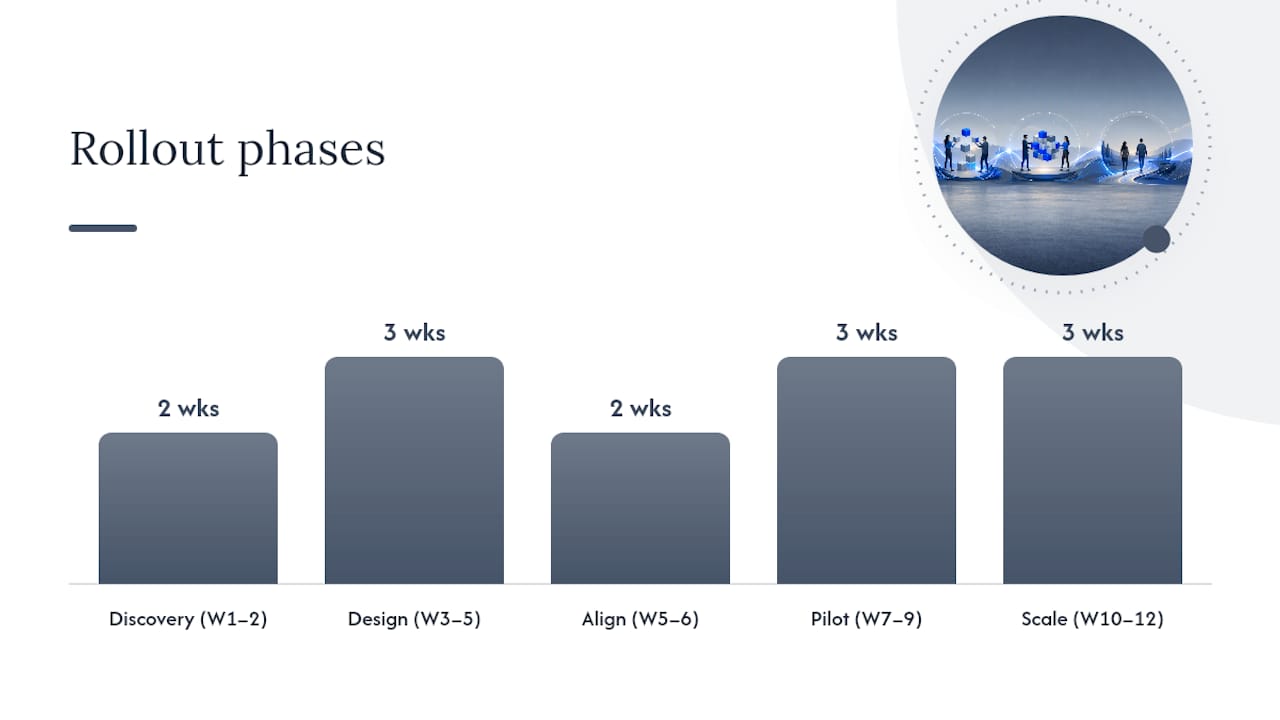
- Discovery (weeks 1 to 2). Map current decision points, existing forums, and where escalations actually go today versus where the policy says they should go. The gap between the two is usually the whole project.
- Design (weeks 3 to 5). Draft the committee structure, the accountability matrix, and the KPI definitions. Keep the first version deliberately narrow.
- Align (weeks 5 to 6). Walk the design past every stakeholder group who will own a decision right, not just the sponsor. This is where most models quietly die if skipped.
- Pilot (weeks 7 to 9). Run the model on one business unit, one region, or one project type. Track the three KPIs from day one, even manually.
- Scale (weeks 10 to 12). Fix what the pilot exposed, then extend the model across the wider organisation with the corrected version.
Pro Tip: Run the pilot on a business unit that already has a reasonable relationship with its control function. Piloting on your worst-performing site first tests both the model and a broken relationship at once, and you won't know which one failed.
Tooling matters more at the scale stage than the pilot stage. Governance, risk, and compliance platforms that automate review scheduling and evidence capture reduce the manual effort that otherwise causes KPI reporting to drift and become unreliable within a couple of quarters. A governance maturity assessment beforehand tells you honestly whether your organisation is ready for scale or still needs another pilot cycle.
The three pitfalls that recur most: siloed data that makes KPI comparison meaningless, inconsistent metric definitions across business units, and escalation paths that exist on paper but nobody has actually tested under pressure.
Templates you can use this week
A one-page operating model should fit on a single side of A4: purpose, scope, the committee structure, the accountability matrix, the three core KPIs, and the escalation path, nothing else. A one-page artefact like this works because it becomes a genuine communication tool between the board and operational teams, not because it's comprehensive.
Weekly forums should stick to exceptions and blockers only. Monthly forums review KPI trends and near-misses. Quarterly board packs need four things, and rarely more:
| Board pack item | Purpose |
|---|---|
| KPI trend summary | Shows policy adherence, review coverage, MTTR movement over the quarter |
| Exception log | Lists breaches, root cause, and closure status |
| Escalations actioned | Confirms the escalation path was tested, not just documented |
| Model changes proposed | Flags any structural change needed before next quarter |
Federated organisations should keep the central template identical across regions and let local teams adapt only the membership list and cadence timing, never the KPI definitions themselves.
How Keystoneconsulting approaches this in practice
Twenty years of delivery work across healthcare, construction, and facilities management taught Keystoneconsulting one consistent lesson: governance failures are rarely about missing policy. They're about missing structure, unclear ownership, and reporting nobody trusts. A platform can be built around that finding, mapping workflows and generating reporting so exceptions surface before they become incidents.
Before committing to a redesign, check your own readiness against a short list:
- Can you name the accountable owner for every recurring decision type without checking a document first?
- Do your weekly and monthly forums actually review different things, or duplicate each other?
- Could you produce audit-ready evidence for last quarter's KPI numbers within a day?
Where governance meets risk management and compliance
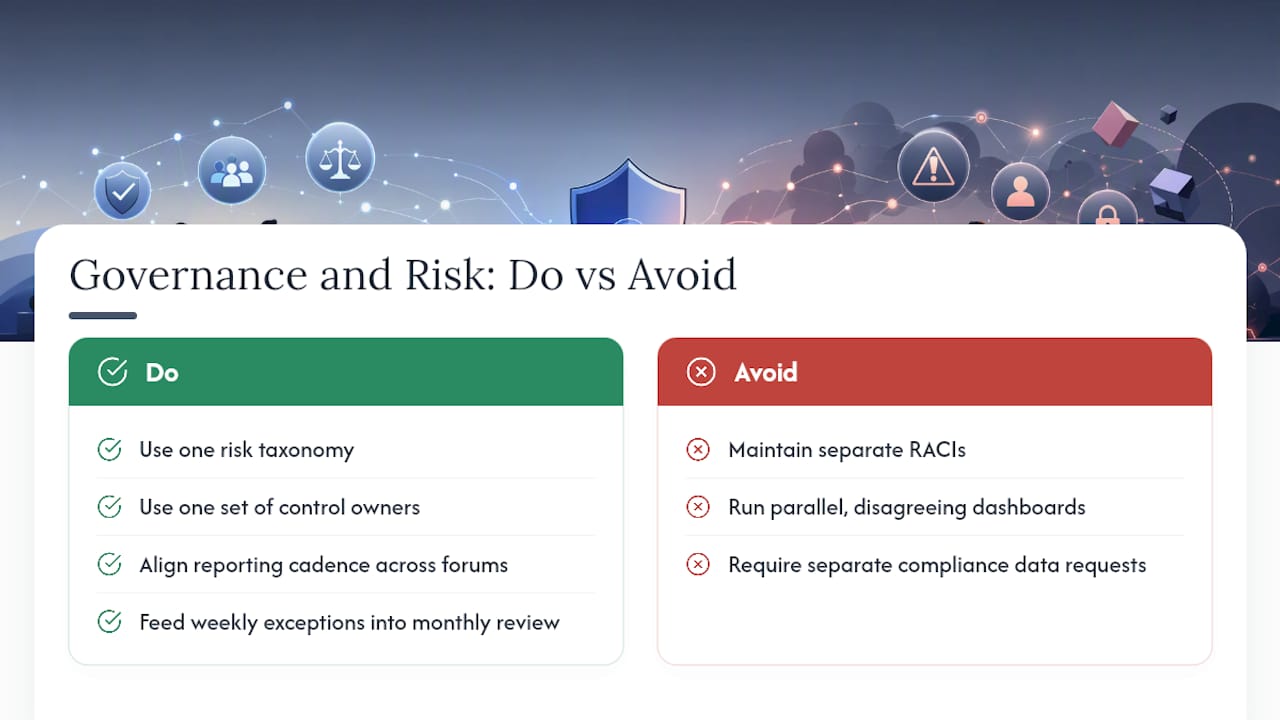
Operating model governance can't sit apart from enterprise risk management without duplicating effort or, worse, contradicting it. The two need a shared spine: one risk taxonomy, one set of control owners, one escalation path that both functions recognise.
The practical integration point is the accountability matrix. If your risk function maintains its own RACI and your operating model maintains a separate one, you'll eventually get two different answers to "who owns this control," usually discovered during an audit rather than before one. Compliance frameworks (ISO standards among them) offer normative structures for control design that can anchor the "infrastructure" component of your operating model, giving auditors a recognised reference point rather than a bespoke internal scheme they have to learn from scratch.
Reporting cadence should also align. If risk committees meet monthly and operating model forums meet weekly, build a deliberate handoff: the weekly forum's exception log feeds directly into the monthly risk review, rather than existing as a parallel, unconnected data set. Organisations that treat governance operating models and enterprise risk management as separate programmes tend to end up with two dashboards that disagree, and an audit committee asking which one is correct.
Where the two frameworks converge cleanly, exception data flows one direction, KPI definitions match, and the compliance function has visibility into operational reporting without needing a separate data request. That convergence is largely what auditors are checking for when they assess whether governance is "embedded" rather than "bolted on."
What successful implementation actually looks like
The organisations that get this right rarely start with a full enterprise rollout. A hybrid model piloted on one business unit, with policy adherence, review coverage, and MTTR tracked from week one, tends to expose design flaws while the cost of fixing them is still low.
A federated facilities management group, for example, might discover during a pilot that its escalation path technically existed on paper for eighteen months but had never actually been triggered, because nobody had told site managers which threshold forced escalation rather than local resolution. That's not a policy failure; it's an operating model gap that only surfaces once you test the path under a live exception rather than a tabletop exercise.
Healthcare delivery settings show a similar pattern. A trust running multiple concurrent capital projects often finds that project governance and clinical governance forums report to different committees using different KPI definitions, which makes portfolio-level oversight nearly impossible until someone standardises the reporting layer across both. Once that standardisation happens, board packs stop presenting contradictory numbers for the same programme.
The common thread across working implementations isn't the model type chosen. Centralised, federated, and hybrid structures all succeed somewhere. What separates the ones that hold up under pressure is whether the KPIs were defined consistently before rollout, and whether the escalation path was tested against a real exception before anyone trusted it in an audit.
Why most governance advice skips the hard part
Most governance guidance stops at the framework: set policy, define risk appetite, assign a committee. That's the easy half. The hard half, deciding who actually has authority to stop work at 4pm on a Friday when a control fails, gets treated as an implementation detail rather than the actual design problem.
The KPI discipline argued for here isn't optional polish. Policy adherence, review coverage, and MTTR are the only honest way to know whether a governance model is holding up under real operational pressure rather than just looking coherent in a board pack. Organisations that skip standardised measurement almost always discover the gap during an audit, which is the most expensive place to discover it.
If there's one place to start, it's the accountability matrix, not the committee structure. Committees are easy to draw on an org chart and hard to make accountable. A properly built RACI, tested against a real exception before it's trusted, exposes weak ownership immediately, and that's precisely the failure mode that sinks governance programmes eighteen months in, long after the initial rollout enthusiasm has faded.
— Peter
Get your operating model audit-ready with Keystoneconsulting
If your governance model currently lives in a policy document nobody checks against reality, Keystoneconsulting closes that gap directly, working inside your teams rather than handing over another framework document to file away. A platform can map existing workflows, assign decision rights against an accountability matrix, and generate reporting that gives boards and control functions the same evidence at the same time, closing the gap between what a policy says and what actually happens on the ground.
For construction and facilities management delivery specifically, Videra PM configures stage-gated governance around the projects you're already running rather than forcing a rebuild from scratch. Healthcare teams working through NHS project governance can see how the same approach applies on the Videra Healthcare page. Either way, the next step is the same: get in touch with Keystoneconsulting to walk through your current operating model and find out where the accountability gaps actually sit.
Sources
- Microsoft Purview — data governance overview
- Governance KPIs that matter: policy adherence, review coverage and MTTR — EHGA
- Governance operating model: a tool for oversight — Boardspan