
Project assurance is an independent check on whether a project is genuinely on track to succeed, delivered by someone with no stake in its delivery. It produces a verdict, backed by evidence, that tells sponsors and boards whether to keep funding, change course, or stop. PMI frames it as an unbiased evaluation of a project's prospects that identifies risk and recommends fixes before those risks become losses.
You need it when the cost of being wrong outstrips the cost of checking. Use this checklist:
- The project carries high cost, high complexity, or a hard deadline with no slack
- External stakeholders (regulators, funders, the public) have a direct interest in the outcome
- Regulatory or compliance exposure exists if delivery goes wrong
- Benefits realisation is unclear or contested between sponsor and delivery team
- The project depends heavily on one supplier or an unproven technology
Sponsors, boards, funders, and insurers are the usual audience for assurance findings. They are the people who carry the financial or reputational consequences if a project fails quietly rather than loudly.
Key Takeaways
Project assurance works when independence is structural, evidence is reproducible, and the depth of review matches the project's actual risk, not a fixed template.
| Point | Details |
|---|---|
| Define the verdict, not the report | Assurance must produce a clear go/no‑go recommendation, not just narrative status updates. |
| Protect independence structurally | Reviewers must not report into delivery management, or objectivity is compromised. |
| Match depth to risk | Apply full gated assurance to high-risk work and light health checks to low-risk projects. |
| Treat AI as a special case | AI assurance needs continuous monitoring and reproducible evidence, not a one-off governance check. |
| Build the evidence trail automatically | Platforms like Keystoneconsulting's Videra generate audit-ready evidence from everyday workflow mapping, reducing reliance on last-minute reporting. |
Table of Contents
- What project assurance delivers for sponsors and boards
- Who should do assurance: roles, independence, and the PRINCE2 view
- When assurance happens: activities across the project lifecycle
- Building a proportionate project assurance framework
- How much assurance is enough, and where AI changes the calculation
- Frameworks and standards worth anchoring your work to
- Skills that separate a credible assurance reviewer from a checklist auditor
- Connecting assurance to risk management and quality assurance
- How assurance frameworks differ across industries
- Getting assurance findings in front of the right people
- Why calibrated assurance is the whole point
- How Keystoneconsulting builds assurance into everyday delivery
- Frequently asked questions
- Sources
What project assurance delivers for sponsors and boards
Good assurance changes decisions, not just paperwork. The core benefits are confidence that spend is justified, early warning before a problem becomes a crisis, independent validation that promised benefits are actually being realised, and transparency that internal reporting alone rarely provides.
The outputs should be concrete enough to act on:
- An assurance report with a clear overall rating, not just narrative commentary
- A risk heatmap ranking exposure by likelihood and impact
- A recommendation matrix with named owners and deadlines
- A go/no‑go recommendation at each major decision gate
Two things worth flagging directly. First, assurance findings tend to surface risks that delivery teams already suspect but haven't escalated, because raising your own project's problems rarely feels career enhancing. Second, PMI's research links structured assurance to a measurably higher probability of project success, largely because it forces corrective action earlier, when it's cheaper.
Pro Tip: If your assurance reports read like status updates rather than verdicts, you don't have assurance. You have reporting with an extra layer.
Who should do assurance: roles, independence, and the PRINCE2 view
PRINCE2 treats project assurance as a distinct function on the project board, monitored from three angles: the business perspective (is this still worth doing?), the user perspective (will it work for the people using it?), and the supplier perspective (can it actually be built or delivered as specified?). PRINCE2's structure insists this function sits apart from day-to-day delivery management, because a reviewer marking their own homework produces flattering, not accurate, results.
Deciding between internal and external assurance comes down to a short set of questions:
- Does the review need genuine objectivity, or is a trusted internal voice sufficient?
- Does your organisation have people with the specific skills the project demands?
- Is this a one-off review or part of a portfolio needing repeatable capacity?
- Are there conflicts of interest, financial or political, that internal reviewers can't credibly navigate?
Pro Tip: Watch the reporting line, not the job title. An "independent" assurance lead who reports to the delivery director is not independent. Structural separation, not a promise of objectivity, is what preserves it.
When assurance happens: activities across the project lifecycle
Assurance isn't a single event. It's a sequence of checks timed to the moments when a decision can still change the outcome.
- Assurance planning — set the assurance profile and plan before the project starts, defining scope, frequency, and reporting lines.
- Initiation health check — confirm the business case, governance structure, and resourcing are sound before major spend commits.
- Gate reviews — formal checkpoints at each stage boundary, producing a go/no‑go recommendation to the board.
- In-flight health checks or deep dives — targeted reviews triggered by risk indicators, schedule slippage, or scope change.
- Pre-go-live readiness check — a focused review confirming operational readiness before cutover or launch.
- Post-implementation review — assesses whether promised benefits actually materialised once the project closes.
Each stage should produce a specific artefact aimed at a specific audience. A gate review report goes to the board with a clear recommendation and escalation route if the answer is "not yet." A deep-dive review might go straight to the sponsor with a risk heatmap attached. Government assurance frameworks, such as the one used across Queensland's public sector, formalise this by mandating minimum reviews tied to gates and material changes, with an assurance plan maintained for the initiative's entire life rather than written once and forgotten.
Building a proportionate project assurance framework
Design your assurance framework in a fixed sequence rather than bolting activities on as problems appear.
- Profile the project. Rate risk, complexity, value, and regulatory exposure before choosing anything else.
- Set the independence level. High-risk or politically sensitive projects need external or structurally separate reviewers; lower-risk work can use a trusted internal function.
- Choose activities and cadence. Match review frequency and depth to the risk profile from step one, not to a fixed calendar.
- Define evidence artefacts. Decide upfront what proof reviewers need: dated risk registers, test results, benefits tracking, supplier performance data.
- Assign reviewers. Name specific people with the right skills and no stake in delivery outcomes.
- Set reporting and escalation routes. Decide who sees findings, in what format, and what happens when a review flags a serious problem.
A handful of metrics tell you whether the framework is actually working: the percentage of high-risk items with a named mitigation owner, the average time to remediate a critical finding, and an evidence completeness score tracking how much of the required documentation actually exists when reviewers ask for it.
The mechanism that ties this together is what industry commentary calls the evidence loop: assurance verifies whether governance controls that exist on paper actually operate in practice, and feeds that verification back into the governance record so decisions are based on tested reality rather than assumed compliance. Governance without this loop is just documentation. A related discipline, structured risk assessment, gives assurance reviewers a repeatable method for scoring and prioritising the risks they uncover, rather than relying on gut feel.
Pro Tip: For a portfolio of mixed complexity, don't run the same assurance regime on every project. Profile every initiative at intake, apply full gated assurance to the top tier, and give low-risk work a light-touch health check. This preserves reviewer capacity for the work that actually needs scrutiny.
How much assurance is enough, and where AI changes the calculation
Too much assurance creates bureaucratic drag that slows delivery without reducing real risk. Too little leaves critical exposure unmonitored until it's a crisis. PMI's guidance is blunt about this trade-off: assurance has to be proportionate to project value and complexity, or teams start treating every review as a box-ticking exercise rather than a genuine check. That's assurance fatigue, and it's usually self-inflicted by applying enterprise-grade scrutiny to low-stakes work.
Calibrate depth against four questions: How much money or reputation is at stake? What's the regulatory exposure? How reliant is the project on a single supplier? And is the technology genuinely novel, or well understood?
That last question increasingly points to AI. A short readiness checklist helps here:
- Is there a governance baseline defining acceptable use and accountability?
- Do reproducible evidence artefacts exist, meaning named test sets, versioned systems, and documented thresholds?
- Is monitoring continuous, not a one-off pre-launch check?
- Does the team have the specific skills and tooling to test AI behaviour, not just document policy?
ISACA's analysis notes that AI assurance capability remains uneven across industry, largely because organisations conflate governance (the rules) with assurance (proof the rules are followed). Frameworks like the NIST AI RMF and ISO/IEC 42001 give useful structural anchors, but they're a baseline, not a substitute for actually testing whether the system behaves as claimed.
Frameworks and standards worth anchoring your work to
You don't need to invent assurance practice from scratch. PRINCE2's assurance role gives you the business, user, and supplier lens; PMI's guidance supports benefits-focused reviews; ISO/IEC and NIST AI RMF give AI-specific structure.
- Use formal conformity assessment (ISO certification) when contractual or regulatory requirements demand it
- Use pragmatic independent reviews when speed and judgement matter more than certification
- Government gated review models, like Queensland's framework, map cleanly onto commercial stage-gate practice with minimal adaptation
Skills that separate a credible assurance reviewer from a checklist auditor
Technical delivery knowledge matters, but it's not the differentiator. A reviewer who understands the domain but lacks the confidence to deliver an unwelcome verdict to a sponsor isn't providing assurance, just cover.
The skills that actually matter:
Independent judgement under pressure. Reviewers regularly face implicit pressure to soften findings, especially when a project is politically important or a delivery lead is well liked. The ability to write an accurate, unflattering report anyway is the core skill, not a nice-to-have.
Evidence literacy. A competent reviewer knows the difference between a risk register that's been updated and one that's been maintained. They can spot when documentation exists purely to satisfy an audit rather than reflect operational reality.
Domain-specific risk pattern recognition. Someone reviewing a hospital IT rollout needs different instincts to someone reviewing a construction programme. Sector experience shortens the time it takes to spot the specific failure modes that recur in that field.
Communication calibrated to the audience. A board needs a one-page verdict with a clear recommendation. A delivery team needs the detail behind that verdict so they can actually fix the problem. Good reviewers write both, without diluting either.
Facilitation, not just inspection. The best assurance reviewers get delivery teams to surface their own concerns rather than extracting information through interrogation. That builds a working relationship where the next review gets more candid input, not less.
Formal qualifications, including governance-focused certifications, help standardise vocabulary and method across a review team, but they don't substitute for the judgement calls above.
Connecting assurance to risk management and quality assurance
Project assurance, risk management, and quality assurance overlap heavily but answer different questions, and treating them as separate silos is where most of the administrative duplication in large organisations comes from.
Risk management identifies and tracks what might go wrong. Quality assurance checks whether outputs meet defined standards. Project assurance asks the broader question: given everything the other two functions know, is this project still likely to succeed? The practical fix is to make assurance the consumer of both, rather than running a parallel, disconnected process.
A well-integrated model works like this: the risk register feeds directly into assurance reviews as primary evidence, not as a separate exercise reviewers have to chase down. Quality assurance test results and defect logs become input to readiness checks rather than a standalone sign-off buried in a different reporting line. Assurance findings, in turn, should trigger updates to the risk register and quality plan, closing the loop rather than sitting in a report nobody revisits.
The failure mode to avoid is having three functions each producing their own RAG status with no shared definition of what "red" means. If risk management says amber and quality assurance says green on the same workstream, assurance's job is to reconcile that contradiction and tell the board which one to believe, with evidence.
How assurance frameworks differ across industries
Healthcare, construction, and government programmes each apply assurance with a different centre of gravity, shaped by where the real risk sits.
In healthcare, assurance leans heavily on patient safety and regulatory compliance, with reviews often mapped to clinical governance structures alongside standard project gates. A digital health rollout typically needs an assurance step specifically checking data governance and clinical risk, distinct from the general delivery review.
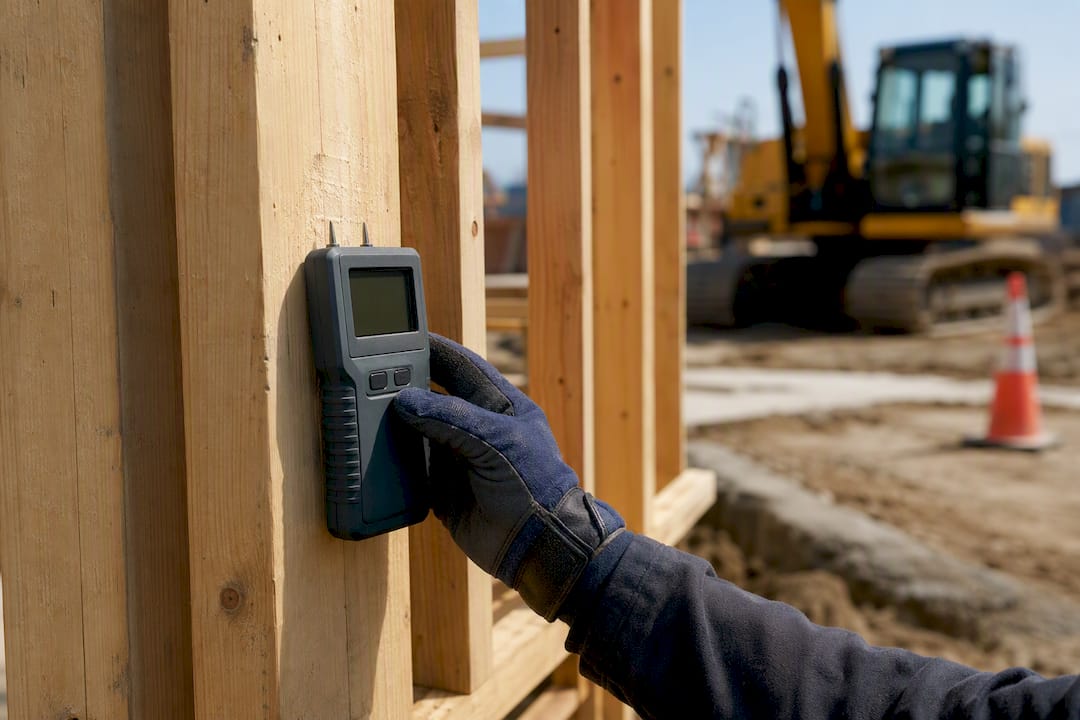
In construction, assurance activity clusters around structural safety, supplier reliability, and cost control at defined milestones, often tied to physical build stages rather than software-style sprints. Given how dependent construction programmes are on subcontractor performance, assurance frameworks tailored to delivery process often weight supplier assurance more heavily than in other sectors.
In government programmes, assurance is frequently mandated by policy rather than chosen by the delivery team, following formal gated review models with minimum activity requirements set centrally. Queensland's framework, for example, requires an assurance profile and plan maintained for the life of the initiative, not just at kickoff.
Facilities management projects, particularly those spanning multiple sites, tend to prioritise operational continuity assurance: does the change work in practice across every location, not just the pilot site? This is where light-touch health checks at each site often replace a single deep review, because the failure risk is dispersed rather than concentrated.

The common thread across all four is that the assurance method stays broadly similar; PRINCE2's business, user, and supplier lens applies everywhere. What changes is which risk category gets the most scrutiny.
Getting assurance findings in front of the right people
An assurance report that never changes a decision has failed, regardless of how thorough it is. The format has to match the audience, not the reviewer's preference for detail.
Boards need a one-page summary with a clear rating, the two or three risks that matter most, and a specific recommendation: proceed, proceed with conditions, or stop. Anything longer gets skimmed, and the verdict gets lost in the narrative.
Delivery teams need the full detail behind that verdict, including specific evidence, named owners for each recommendation, and deadlines. Vague findings like "improve risk management" are useless; "the risk register hasn't been updated in six weeks and three high-severity items have no assigned owner" is actionable.
Sponsors sit between the two: they need enough detail to defend the recommendation to the board but not so much that the core message gets diluted. A recommendation matrix, ranking findings by severity and linking each to an owner and date, usually works well for this audience.
Escalation matters as much as the report format. A critical finding shouldn't wait for the next scheduled gate review to reach the board. Define upfront what severity threshold triggers an out-of-cycle escalation, and who receives it, so a serious problem doesn't sit quietly in a report queued for next month's steering committee.
Why calibrated assurance is the whole point
I've spent years watching organisations either drown projects in review overhead or let them run unmonitored until the damage is done, and neither failure comes from a lack of good intentions. It comes from treating assurance as a fixed template instead of something you calibrate to actual risk. The framework in this article only works if you're honest about where your real exposure sits.
How Keystoneconsulting builds assurance into everyday delivery
Most organisations don't lack the will to run good assurance. They lack the workflow structure and evidence trail to do it consistently across every project, which is exactly where governance intentions quietly collapse into reporting gaps.
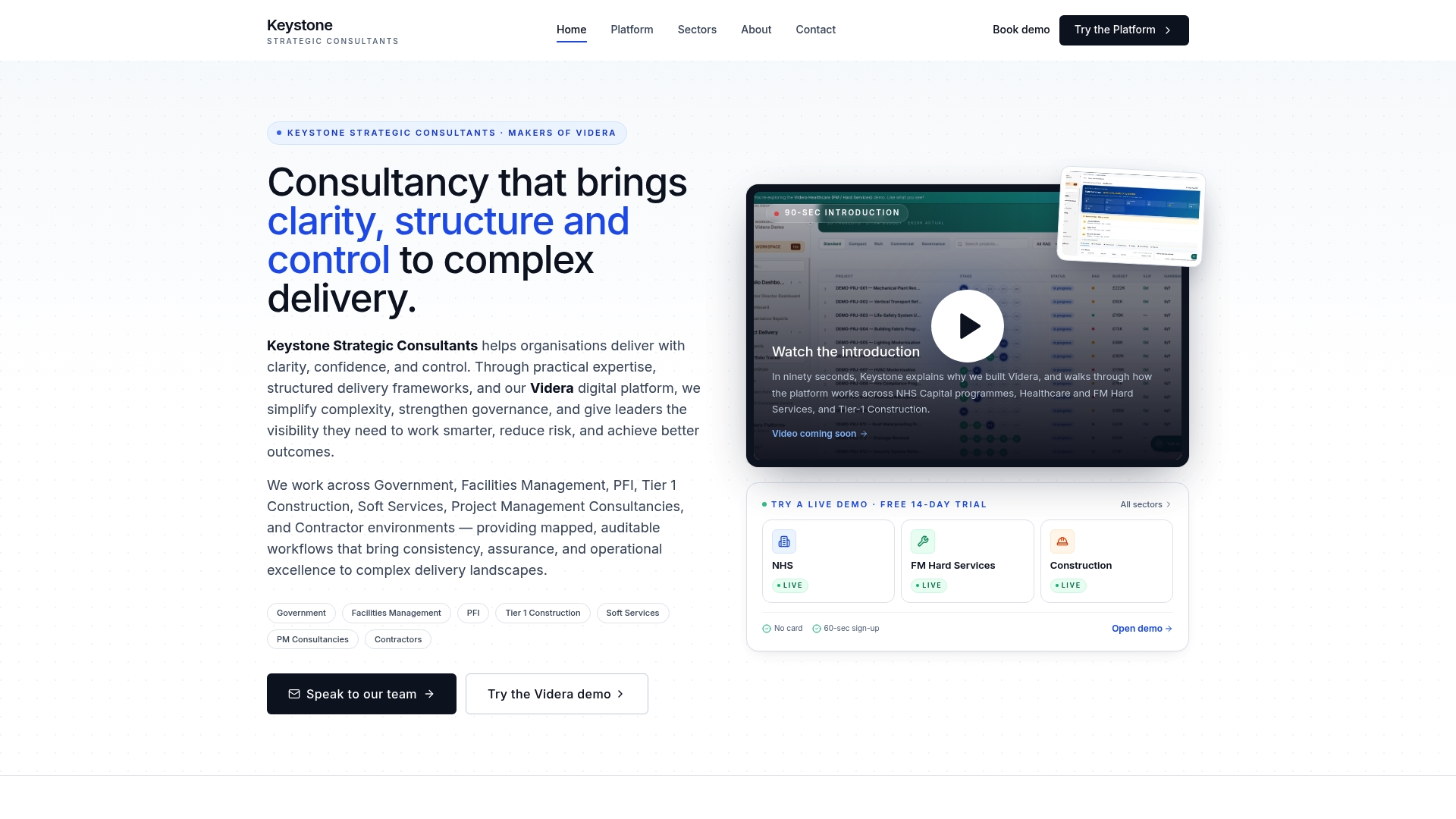
Keystoneconsulting works directly with delivery teams in healthcare, construction, government, and facilities management to build stage-gated governance that produces audit-ready evidence as a by-product of normal work, not a separate scramble before each review. The Videra platform maps workflows so assurance reviewers get dated, reproducible evidence automatically, with AI-powered reporting that flags risk indicators before they reach a formal gate. If you want to see how proportionate this could look for your own portfolio, get in touch with Keystoneconsulting for a short assurance profiling exercise, no lengthy engagement required to find out where your gaps actually are.
Frequently asked questions
Is project assurance the same as project governance? No. Governance sets the rules, structures, and accountability for a project. Assurance independently checks whether those rules are actually being followed and whether the project is genuinely on track, producing evidence rather than policy.
Who typically requests project assurance? Sponsors, boards, funders, and sometimes insurers request it, usually because they carry financial or reputational risk if a project fails without warning.
How often should assurance reviews happen? Frequency should follow the project's risk profile rather than a fixed calendar. High-risk projects need reviews at every major gate plus periodic health checks; low-risk work may only need a light check at key milestones.
Can internal staff provide credible project assurance? Yes, provided the reviewer has no reporting line into delivery and no stake in the project's outcome. Structural separation matters more than whether the reviewer is an employee or an external consultant.
What makes AI project assurance different from standard assurance? AI systems need continuous monitoring rather than a one-off check, plus reproducible evidence such as named test sets, versioned systems, and documented thresholds, since behaviour can shift after deployment in ways traditional software rarely does.
Sources
- Project success through project assurance — PMI
- Project assurance — Wikipedia
- AI assurance vs AI governance — ISACA (2026)
- Portfolio, program and project assurance framework | For government | Queensland Government