
AI governance certification is the formal validation that a professional can design, oversee, and enforce responsible AI deployment across an organisation. For compliance officers and organisation leaders, it is the clearest signal that your governance programme aligns with recognised frameworks such as ISO/IEC 42001 and the NIST AI Risk Management Framework. These credentials matter because regulators, auditors, and boards are no longer satisfied with good intentions. They want documented, standard-aligned controls. The right certification gives you the language, the methodology, and the audit trail to prove your AI systems are governed responsibly.
What to look for in an AI governance certification
The strongest certifications cover the full AI lifecycle. That means governance controls applied from data acquisition to model retirement, not just at the point of deployment. Certifications that stop at policy awareness leave compliance officers without the practical tools they need for audit defence.
Look for these features when evaluating any credential:
- Standards alignment: The programme must reference ISO/IEC 42001, the NIST AI RMF, and ideally the EU AI Act. Credentials that ignore these frameworks will not hold up under regulatory scrutiny.
- Lifecycle governance depth: Coverage should span data sourcing, model development, deployment, monitoring, and decommissioning.
- Practical skills: Audit readiness, risk classification, incident response, and bias testing are non-negotiable for compliance roles.
- Validity and renewal: Some credentials carry lifetime validity. Others require ongoing continuing professional development (CPD). Know which model fits your organisation's training cycle.
- Training format: Intensive live workshops build cohort accountability. Modular self-paced learning suits leaders with unpredictable schedules. The best programmes offer both.
Pro Tip: Before enrolling, check whether the certification body publishes its exam blueprint. A published blueprint tells you exactly which standards and competencies are assessed, which makes your study time far more efficient.
Top AI governance certifications for organisation leaders and compliance officers
The market for AI ethics certification has grown quickly. These are the credentials most relevant to leaders and compliance officers in 2026, assessed on standards coverage, practical depth, and exam rigour.

1. Certified AI governance specialist (Vskills)
Vskills offers a government-recognised credential with lifetime validity, which removes the renewal burden entirely. The exam covers the EU AI Act, the NIST RMF, and practical ethical AI governance. The exam format is 50 questions in 60 minutes with a 50% passing threshold, making it accessible for leaders entering the governance space without deep technical backgrounds. Lifetime validity is a genuine differentiator for organisations that want a stable, low-maintenance credential for their compliance teams.
2. Certified responsible AI governance and ethics professional (EC-Council C|RAGE)
EC-Council's C|RAGE credential focuses on policy design, risk management, and audit readiness. The exam runs 100 questions over 3 hours with a passing threshold of 70–80%. That rigour reflects the depth of content covered, including incident response planning and cross-functional governance design. For compliance officers who need to demonstrate credibility to legal and technical teams simultaneously, C|RAGE carries significant weight.
3. GAICC certified professional in AI governance (CPAIG)
The GAICC-CPAIG is built for multi-jurisdictional governance environments and includes coverage of agentic AI, which is increasingly relevant as autonomous AI systems enter regulated sectors. The programme requires 10–12 hours of pre-course self-study followed by two intensive live days. Ongoing CPD requirements keep credential holders current as regulations evolve. This is the right choice for leaders managing AI governance across multiple regulatory regimes.
Pro Tip: The GAICC-CPAIG's live workshop format creates direct dialogue with instructors on edge cases. Bring your organisation's actual AI use cases to those sessions. You will get more from two days of applied discussion than from weeks of solo study.
4. Certificate in AI governance (Governance Institute of Australia)
The Governance Institute of Australia delivers this credential through structured virtual training designed specifically for boards and governance professionals. The programme emphasises continuous monitoring and human oversight for high-risk AI predictions, which is exactly the practical focus that boards need. It is particularly well suited to non-technical leaders who need to ask the right questions of their AI teams rather than build the systems themselves.
5. Certified AI professional (PECB)
PECB's credential uses an intensive three-day format with a strong emphasis on risk management and assurance. It is well suited to leaders who manage AI projects directly and need to understand risk classification at a technical level. The programme aligns with ISO/IEC 42001 lifecycle governance standards, making it a natural fit for organisations that have already adopted or are moving towards ISO certification. Three days is a significant time commitment, but the depth justifies it for senior compliance roles.
6. IEEE certified AI governance credentials
The IEEE approach to AI governance certification is distinctive because it mandates independent assessment throughout the full AI lifecycle, with transparency, accountability, and privacy frameworks applied before production. This pre-production focus is rare among credentials and directly addresses the gap that most governance programmes leave open. For organisations in regulated sectors such as healthcare or financial services, IEEE-aligned credentials signal a level of rigour that auditors recognise.
How AI governance certification benefits compliance and operational efficiency
Certification does more than add a credential to a CV. It changes how governance is practised across the organisation.
A certified governance professional can classify AI systems by risk level and conduct formal risk assessments that evaluate severity, probability, and reversibility of potential harms. That classification work is the foundation of defensibility under audit. Auditors do not want to see a policy document. They want to see a risk register, a classification rationale, and evidence of ongoing monitoring.
Certification also bridges the gap between legal and technical teams. Integrating governance into CI/CD pipelines through automated logging and bias testing prevents audits from becoming bottlenecks. A certified compliance officer understands both the regulatory requirement and the technical mechanism that satisfies it. That cross-functional fluency is what makes governance programmes actually work.
Governance professionals must classify AI risk rigorously and maintain continuous governance rather than rely on static policies. Boards should focus on practices that assure trust through human-in-the-loop oversight and defined incident escalation paths.
Certified leaders also improve organisational readiness for emerging regulations. The EU AI Act, for example, introduces risk-tiered obligations that require documented governance at every stage of the AI lifecycle. Organisations with certified compliance officers are better positioned to adapt quickly when new obligations come into force.
Preparing for and maintaining AI governance certification
Exam preparation varies significantly by credential, but several principles apply across all of them.
- Understand the exam format first. Exam durations range from 60 to 180 minutes depending on the credential. Knowing the format shapes your preparation strategy.
- Use the pre-course self-study period seriously. Programmes like GAICC-CPAIG allocate 10–12 hours of pre-course reading. That reading is not optional background. It is the foundation for the live workshop content.
- Map certification content to your organisation's actual AI systems. Abstract governance principles become far more memorable when you apply them to a real use case from your own environment.
- Track CPD requirements from day one. Some credentials require 60 CPD hours over a three-year renewal cycle. Building that into your annual professional development plan from the start prevents a last-minute scramble.
- Integrate what you learn immediately. Certification knowledge that stays in a folder loses value quickly. Apply risk classification frameworks and audit documentation practices to live projects as soon as you complete training.
Pro Tip: Schedule your exam within four weeks of completing your training. Retention drops sharply after that window, and the practical examples from your workshop will still be fresh enough to anchor abstract questions.
Key takeaways
AI governance certification is the most direct way to build audit-ready, standard-aligned governance capability across your organisation's AI programmes.
| Point | Details |
|---|---|
| Standards alignment is non-negotiable | Choose credentials that explicitly cover ISO/IEC 42001, NIST AI RMF, and the EU AI Act. |
| Lifecycle governance beats policy-only coverage | Certifications must address data sourcing through model decommissioning, not just deployment. |
| Audit defence requires risk classification | Certified professionals can classify AI systems by risk and produce evidence auditors actually accept. |
| CPD keeps credentials current | Renewal cycles such as 60 CPD hours over three years ensure governance knowledge stays relevant as regulations change. |
| Integration into practice is what delivers value | Certification only improves compliance when its frameworks are applied to live AI systems and workflows. |
Why certification alone is not enough: a practitioner's view
The certifications listed here are genuinely valuable. I have seen compliance officers walk into board meetings with far more authority after completing credentials like C|RAGE or GAICC-CPAIG. Boards respond to structured risk language. They respond to someone who can say, "We have classified this system as high-risk under the NIST RMF, and here is our escalation path if it fails." That clarity is worth the investment in training.
What I have also seen, though, is what I would call documentation theatre. An organisation completes a governance certification programme, produces a beautifully formatted policy document, and then does nothing to verify that the policy is actually being followed. Governance documentation becomes meaningless without automated drift monitoring, alerting mechanisms, and a central model registry that tracks versions, data lineage, and approval rationale. The certification teaches you what good governance looks like. The hard work is building the technical infrastructure that makes it verifiable.
My honest advice: treat certification as the beginning of your governance programme, not the end of it. The credential opens the conversation with your board and your auditors. What keeps that conversation credible is the continuous monitoring, the human oversight processes, and the incident escalation paths that you build afterwards. Certification gives you the map. You still have to build the road.
— Peter
Keystoneconsulting and AI governance implementation
Achieving certification is one step. Embedding certified governance into your organisation's daily operations is where most compliance officers hit resistance.
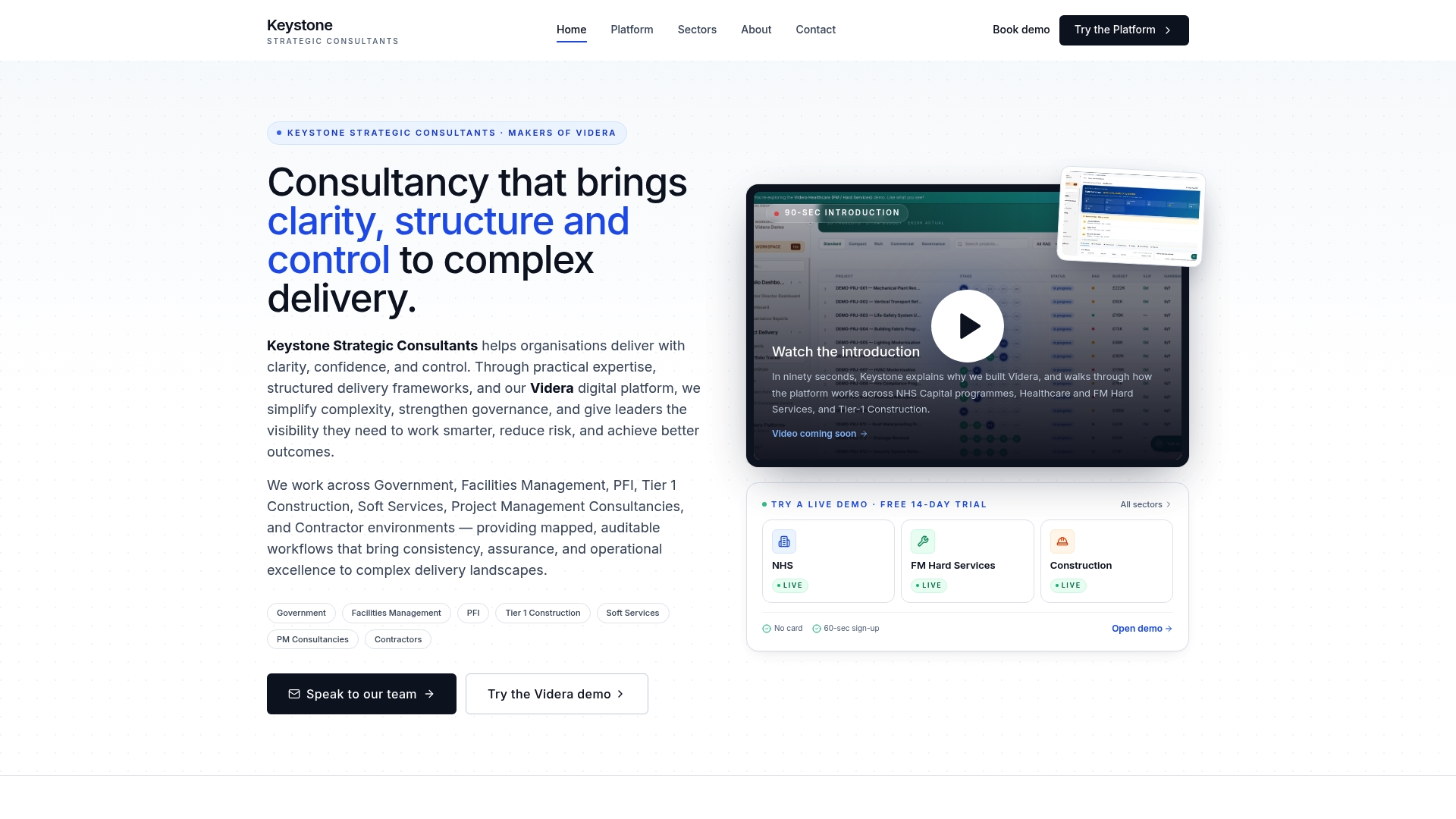
Keystoneconsulting has spent 20 years working directly inside delivery teams across healthcare, construction, and facilities management. The Videra platform maps workflows and generates AI-powered reporting that keeps governance visible and audit-ready without creating additional administrative burden. For leaders who have invested in AI governance training and want to translate that knowledge into operational practice, Keystoneconsulting provides the implementation expertise to make it stick. Visit Keystoneconsulting to see how the Videra platform supports certified governance frameworks in practice.
FAQ
What is AI governance certification?
AI governance certification is a formal credential that validates a professional's ability to design, oversee, and enforce responsible AI deployment in line with recognised standards such as ISO/IEC 42001 and the NIST AI Risk Management Framework.
How long do AI governance certification exams take?
Exam durations range from 60 to 180 minutes depending on the credential. The Vskills exam runs 60 minutes with 50 questions, while the EC-Council C|RAGE exam runs 3 hours with 100 questions.
Do AI governance certifications expire?
Some credentials, such as the Vskills Certified AI Governance Specialist, carry lifetime validity. Others, such as the GAICC-CPAIG, require ongoing CPD hours for renewal, typically structured over a multi-year cycle.
Which AI governance certification is best for non-technical leaders?
The Certificate in AI Governance from the Governance Institute of Australia is designed specifically for boards and governance professionals without deep technical backgrounds, focusing on oversight, human-in-the-loop controls, and incident escalation.
How does AI governance certification support audit readiness?
Certified professionals can classify AI systems by risk level, conduct formal risk assessments, and produce documented governance evidence that satisfies auditors. Certification frameworks teach the specific controls and records that regulators expect to see.