
A project management bottleneck is any point in a workflow where work accumulates faster than it can exit, throttling the entire project's output and delaying delivery. The formal term in operations management is "constraint," drawn from the Theory of Constraints developed by Eliyahu Goldratt. Large IT projects run 45% over budget on average, and unmanaged constraints are a primary driver. 47% of organisations report budget overruns linked to unclear scope and weak stakeholder alignment. For project managers and team leaders, identifying and resolving these constraints is not optional. It is the difference between a project that delivers and one that quietly collapses.
What are project management bottlenecks and how do you spot them?
A bottleneck is not simply a slow step. The actual constraint is the stage where tasks accumulate above the exit rate, limiting the throughput of the entire process. A slow step that never builds a queue is not a bottleneck. A step that consistently holds a growing pile of waiting work is.
The most reliable way to find a bottleneck is to map the actual workflow, not the one your team thinks they follow. Mapping 7–12 steps in a process gives small-to-medium teams enough granularity to see where work accumulates without creating an unmanageable diagram. Each step should include who performs it, how long it takes, and how long work waits before it begins.

Once the map exists, measure three things at every stage: cycle time (how long a task takes to complete), wait time (how long it sits before someone starts it), and throughput (how many units pass through per period). The stage with the longest wait time and the largest queue is your constraint.
Pro Tip: Separate your work-in-progress count from your active task count. If work-in-progress at one stage is consistently two or three times higher than at adjacent stages, you have found your bottleneck, even if the team there appears busy.
Process maps must capture exceptions, informal handoffs, shadow approvals, and rework loops. These hidden delays are where genuine bottlenecks live. A map that only shows the official process will miss them entirely. Keystoneconsulting's approach to workflow management methods specifically accounts for these informal paths when diagnosing delivery constraints.
What causes bottlenecks in project workflows?
Bottlenecks rarely appear from nowhere. They grow from specific, identifiable conditions within a project's structure, people, or processes.
The most common root causes fall into five categories:
- People issues: a single approver for multiple workstreams, skill gaps in a critical role, or unclear ownership of handoffs between teams
- Process issues: unnecessary approval chains, rework loops caused by incomplete briefs, and scope creep that adds work without adding capacity
- System issues: disconnected tools that require manual data transfer between stages, creating wait time and error risk
- Data issues: decisions stalled because the right information is not available at the right time
- Capacity issues: resource allocation that does not match actual workload distribution across the project timeline
41% of projects are frequently disrupted by changing requirements, and that figure points directly to scope management as a structural cause of delay. When requirements shift mid-project, every downstream stage must reprocess work it has already completed. That reprocessing creates a queue, and a queue is a bottleneck.
Stakeholder misalignment compounds the problem. When decision-makers disagree on priorities, approval steps stall. When teams lack clarity on who owns a handoff, work sits in a grey zone between stages. Root cause analysis methods such as the Five Whys or fishbone diagrams help teams trace a visible delay back to its actual origin, rather than treating the symptom.
Pro Tip: When a bottleneck appears, ask "why" five times before proposing a fix. The first answer is almost always a symptom. The fifth answer is usually the cause worth addressing.
Which metrics reveal bottlenecks before they become crises?
Metrics are the early warning system for project constraints. The distinction between lagging and leading indicators matters here. Lagging indicators, such as missed milestones or budget overruns, confirm that a bottleneck has already caused damage. Leading indicators, such as rising queue lengths or declining throughput at a specific stage, signal that a constraint is forming before it derails delivery.
The most useful metrics for bottleneck detection are:
| Metric | What it measures | Bottleneck signal |
|---|---|---|
| Cycle time | Time to complete one unit of work | Rising cycle time at one stage |
| Wait time | Time work sits before starting | Consistently high wait at one stage |
| Throughput | Units completed per period | Falling throughput despite stable input |
| Queue length | Work waiting at each stage | Queue growing faster than it clears |
| Resource utilisation | Capacity used vs. available | Utilisation above 90% at one role |
| Milestone hit rate | Planned vs. actual milestone completion | Repeated misses at the same phase |
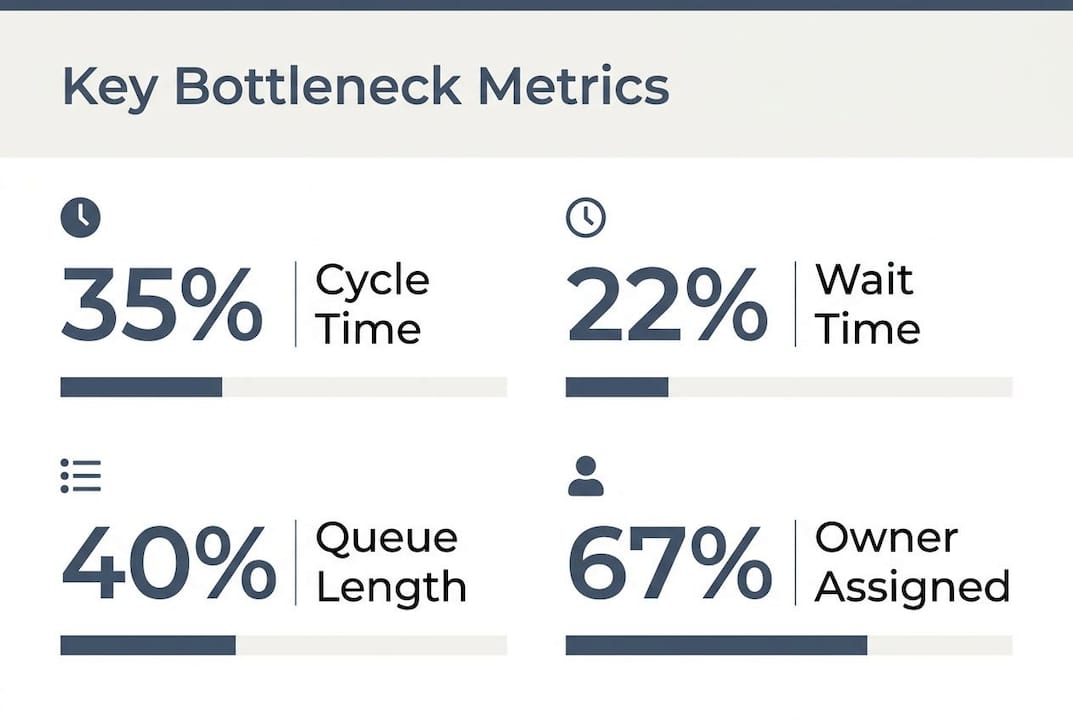
High-performing organisations use 44% more performance metrics than average teams, including strategic Key Success Indicators that go beyond speed to measure outcome quality. That broader view catches constraints that pure schedule tracking misses.
Ownership is the factor that converts metrics from reports into action. 67% of KPIs lack a designated owner, and projects with KPI ownership are completed 2.5 times more often than those without. Each metric on your bottleneck dashboard needs a named person responsible for reviewing it and triggering a response when it crosses a threshold.
Metrics must trigger predefined protocols with responsible parties tasked to analyse and respond. A capacity utilisation figure above 90% at a key stage, for example, should automatically initiate a resourcing review. Without that protocol, the data sits in a report and the bottleneck continues to grow.
Pro Tip: Pair every bottleneck metric with a defined escalation threshold and a named owner. A metric without both is decoration, not governance.
How do you resolve and prevent project bottlenecks?
Resolving a bottleneck follows a clear sequence. Identify the constraint, exploit it fully before adding resources, subordinate other stages to its pace, and only then consider elevating capacity. This sequence comes from the Theory of Constraints and prevents the common mistake of adding resources to non-constraints while the real problem persists.
The fastest practical fixes for most project bottlenecks are:
- Clarify ownership. Assign one named person to every handoff and approval step. Ambiguity in ownership is the single most common cause of work sitting idle between stages.
- Remove unnecessary approvals. Audit every approval step and ask whether it adds genuine value or simply reflects historical caution. Eliminate or delegate those that do not add value.
- Improve handoff quality. Define what "complete" means for every output before it moves to the next stage. Incomplete handoffs generate rework, and rework creates queues.
- Automate repetitive transfers. Manual data entry between systems creates wait time and errors. Integrating tools so that data flows automatically removes a category of delay entirely.
- Manage scope discipline. Every new requirement added mid-project must be assessed for its impact on existing workload. A formal change control process prevents scope creep from silently creating new constraints.
- Use an impact-effort framework. When multiple bottlenecks exist, rank fixes by the ratio of delivery impact to implementation effort. Address high-impact, low-effort fixes first to restore flow quickly.
Consider a client onboarding process in a professional services firm. The bottleneck sits at the contract review stage, where a single legal reviewer handles all new clients. Cycle time at that stage is four days against a target of one day. The fix is not hiring another lawyer immediately. The first step is to separate standard contracts, which need only a checklist review, from complex ones requiring full legal scrutiny. That split alone can reduce cycle time by half without adding headcount.
After resolving the primary constraint, review the full workflow again. Removing one bottleneck frequently reveals a secondary constraint that was previously hidden behind the first. Continuous review is not a sign that the fix failed. It is how mature project teams sustain delivery performance over time.
Keystoneconsulting's operations consulting methods include structured constraint analysis as a core diagnostic step, applied across healthcare, construction, and facilities management projects.
How does organisational culture affect project bottlenecks?
Governance maturity is the strongest predictor of bottleneck frequency. Organisations with a functioning Project Management Office, clear decision rights, and defined escalation paths create fewer bottlenecks because ambiguity has fewer places to hide.
The cultural factors that most reliably create bottlenecks are:
- Weak strategic alignment: when teams do not share a clear picture of project priorities, every decision point becomes a potential stall
- Poor communication transparency: when information about project status is siloed, downstream teams cannot prepare for incoming work, creating sudden surges
- Resistance to process change: teams that treat the documented process as fixed miss the informal paths where real delays accumulate
- Talent gaps at critical stages: a skill shortage at one role creates a structural capacity constraint that no amount of process improvement can fully compensate for
- Absence of continuous improvement culture: organisations that only review processes after a failure miss the early signals that a constraint is forming
Building bottleneck vigilance into everyday project governance means treating constraint identification as a standing agenda item, not a crisis response. Weekly reviews of queue lengths and cycle times, combined with clear ownership of each metric, shift the team from reactive to proactive. That shift is where sustained delivery improvement happens.
Key takeaways
Resolving project management bottlenecks requires identifying the true constraint, assigning clear ownership, and building metrics that trigger action before delays compound.
| Point | Details |
|---|---|
| Define the constraint precisely | A bottleneck is where work accumulates above exit rate, not simply where a team works slowly. |
| Map the real workflow | Include handoffs, wait times, and informal approvals to find hidden delays in the actual process. |
| Assign metric ownership | 67% of KPIs lack an owner; named accountability increases project completion rates by 2.5 times. |
| Fix the constraint first | Apply the Theory of Constraints sequence before adding resources to avoid misallocating effort. |
| Review after every fix | Resolving one bottleneck exposes the next; continuous review sustains delivery performance. |
What I have learned from twenty years of project constraints
The most persistent mistake I see project managers make is treating a bottleneck as a problem to solve rather than a constraint to manage. Those two framings lead to very different actions. Problem-solving tends to produce one-off fixes. Constraint management produces systems.
The second mistake is trusting the process map that managers draw from memory. In my experience, the map on the whiteboard and the process on the ground differ in at least three significant ways, and those differences are almost always where the real delays live. The informal approval from a senior director that nobody documented. The rework loop that the team has normalised because "that's just how it works here." These are the bottlenecks that never appear in a project status report until they have already caused a missed deadline.
I have also seen organisations invest heavily in metrics dashboards and then do nothing with the data because nobody owns the response. Ownership is not a soft concept. It is the mechanism that converts a number on a screen into a decision. Without it, even the best monitoring system is theatre.
The teams that consistently deliver on time are not the ones with the most sophisticated tools. They are the ones that have made constraint identification a habit, assigned clear ownership to every critical metric, and built the discipline to look for the next bottleneck the moment the current one is resolved.
— Peter
How Keystoneconsulting addresses delivery bottlenecks
Persistent project bottlenecks are rarely a technology problem. They are a governance problem, and that is precisely where Keystoneconsulting works.
With 20 years of experience across healthcare, construction, and facilities management, Keystoneconsulting integrates directly with project teams to map real workflows, assign metric ownership, and build audit-ready governance processes. The Videra platform combines mapped workflows with AI-powered reporting, giving project leaders the visibility they need to catch constraints before they compound. If your projects are consistently running late or over budget, the issue is almost certainly a constraint that has not yet been named. Keystoneconsulting helps you name it, own it, and fix it.
FAQ
What is the project management term for a bottleneck?
The formal term is "constraint," drawn from the Theory of Constraints. In practice, project managers use "bottleneck" and "constraint" interchangeably to describe any stage where work accumulates faster than it exits.
How do you identify a bottleneck in a project?
Map the actual workflow in 7–12 steps, then measure cycle time, wait time, and queue length at each stage. The stage with the longest wait time and the largest growing queue is the bottleneck.
Why do project bottlenecks cause budget overruns?
Delays at one stage propagate downstream, extending the overall project timeline and increasing labour and overhead costs. Research shows 47% of organisations report budget overruns linked to scope ambiguity and stakeholder misalignment, both of which create structural constraints.
What is the fastest way to resolve a project bottleneck?
Clarify ownership of the constrained stage, remove unnecessary approval steps, and improve handoff quality so work arrives complete. These three actions address the most common causes without requiring additional resources.
How often should project teams review for bottlenecks?
Weekly reviews of queue lengths and cycle times at critical stages give teams enough frequency to catch forming constraints before they cause missed milestones. Constraint identification should be a standing agenda item, not a crisis response.