
A governance-first, staged rollout using mapped workflows and a focused pilot on a platform such as Videra delivers the fastest, auditable gains in construction delivery. Here is what to do this week:
- Run a rapid Change Audit to size organisational readiness and surface resistance before touching any tool.
- Map one high-value value stream, such as foundations or structural steel, using Value Stream Mapping (VSM).
- Set a six-week Last Planner System (LPS) pilot on a single workface with daily handover checks.
- Provision a dashboard for exception reporting from day one so leadership sees blockers in real time.
Pro Tip: Limit your first pilot to one workface. A narrow scope produces a clean, credible result you can present to the board — and it is far easier to govern than a site-wide rollout.
Table of Contents
- Why does a governance-first approach outperform ad hoc tool rollouts?
- What are the core components of a governance-driven delivery programme?
- What does a practical six-step implementation roadmap look like?
- How do you measure and prove impact from delivery improvements?
- How do you choose a digital platform for a governance-led pilot?
- How do you make new governance stick on site?
- What are the common pitfalls in UK construction delivery improvements?
- Key takeaways
- Why governance-first is the only approach worth defending
- Keystoneconsulting's pilot offer: governance design and Videra platform trial
- Useful sources for governance, Lean and AI–BIM
Why does a governance-first approach outperform ad hoc tool rollouts?
The evidence is clear: tools without governance become shelfware within months. The real lever is the governance structure that forces daily commitments, captures deviations, and routes exceptions to the right decision-maker before they compound.
Research supports this. Lean construction combined with digital monitoring can deliver roughly 10–15% savings on many activity tasks. A case study integrating VSM with digital dashboards and automated workflows achieved a 15% reduction in excavation activity duration and a 2.06% reduction in overall project time. AI–BIM integration using machine learning reduced scheduling durations by up to 3.52% relative to CPM baselines, with risk classification accuracy reaching 94.5%–99.7%.
Stat to anchor your board case: Lean embedded with digital tools delivers roughly 15% activity-level savings; AI–BIM integration reduces scheduling durations by up to 3.52%.
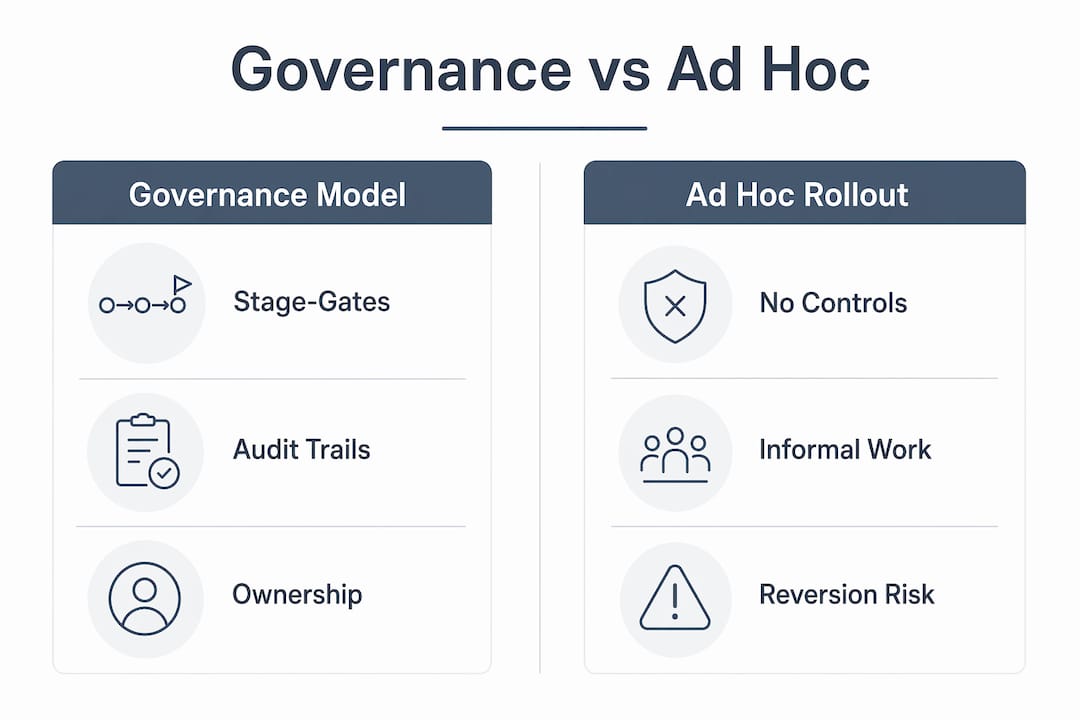
None of those gains materialise without governance. Without stage-gates and audit trails, teams revert to informal workarounds, data quality degrades, and the tool's reporting becomes meaningless. Governance is not the overhead — it is the mechanism that makes every other investment pay.
What are the core components of a governance-driven delivery programme?
A well-designed programme assembles six capability blocks. Each needs an owner, a cadence, defined inputs and outputs, and at least one KPI.
- Mapped stage-gates and audit trails: every phase transition requires a documented sign-off with evidence. No gate, no proceed.
- Last Planner System for frontline commitments: weekly work plans, six-week lookaheads, and daily stand-ups that capture Percent Plan Complete (PPC). Senior leaders must actively sponsor these routines — messaging alone does not embed them.
- BIM and digital twin for near-real-time perception: a closed-loop BIM-to-digital-twin framework advanced topping-out by three days and cut resource idle rates by around 15% in one case study.
- AI reporting for risk and schedule signals: automated flags on stalled approvals, RFI backlogs, and schedule deviation before they become crises.
- Automated RFI and approval workflows: closing feedback loops and automating notifications materially shortens decision cycles and reduces schedule deviation.
- Lean Centre of Excellence (CoE): a small team that bridges senior leadership and project teams, monitors maturity, and prevents tools from drifting into disuse.
Keystoneconsulting's Videra platform maps directly to these blocks: configurable stage-gated workspaces, mapped auditable workflows, AI-powered exception and board reporting, and sector-specific configurations for construction. It is not a point tool — it is the governance layer that connects the others.
What does a practical six-step implementation roadmap look like?
The six steps are: assess, design, pilot, iterate, embed, scale. For a typical UK construction pilot, expect 6–18 weeks from kick-off to embedded pilot. The integrated delivery roadmap framework synthesises PMBOK, Lean, BIM, and Agile into a single operational structure — the approach here follows that logic.

| Role | Responsibility | Pilot commitment |
|---|---|---|
| Senior sponsor | Mandate, budget, escalation | Weekly review attendance |
| Programme lead | Roadmap ownership, stakeholder comms | Full-time during pilot |
| Delivery lead | Site-level LPS facilitation | Daily stand-ups |
| BIM coordinator | Model currency, digital twin feeds | Weekly model updates |
| Supply-chain rep | Subcontractor commitments, RFI responses | Six-week lookahead sign-off |
| CoE liaison | Maturity tracking, lessons learned | Fortnightly review |
Pilot success criteria checklist:
- PPC above 70% by week four
- RFI approval lead time reduced by at least 20%
- All stage-gate sign-offs documented and audit-ready
- Dashboard live with exception alerts by week two
- Supply-chain commitments captured in writing
Indicative pilot costs for a focused UK engagement typically cover programme lead time, consultancy support, and platform trial access. Keystoneconsulting structures pilots as fixed-scope engagements, so the investment is bounded from the outset.
How do you measure and prove impact from delivery improvements?
Measure throughput, PPC, cycle time, idle rate, RFI/approval lead time, and cost avoidance. Each KPI should be owned by the governance artefact that generates it — PPC lives in the LPS weekly plan; idle rate comes from the digital twin; RFI lead time from the automated workflow log.
Pragmatic collection methods: extract schedule data from BIM/digital twin feeds, pull daily LPS commitment records, automate RFI logs, and run weekly dashboard validation with the delivery lead.
| KPI | Baseline method | Six-week pilot target |
|---|---|---|
| Percent Plan Complete (PPC) | Manual LPS log | ≥70% |
| RFI approval lead time | Automated workflow log | ≥20% reduction |
| Schedule duration | BIM/CPM comparison | Up to 3.52% reduction |
| Resource idle rate | Digital twin extraction | Up to 15% reduction |
For risk management in project delivery, link each KPI to a named risk owner so that a red flag on the dashboard triggers an accountable response, not a committee discussion.
How do you choose a digital platform for a governance-led pilot?
Choose for process synchronisation, audit trails, configurable stage-gates, and lightweight integrations — not for the longest feature list. A platform that maps your workflows and enforces governance cadence will outperform a feature-rich tool that sits outside your delivery rhythm.
Key selection criteria:
- Workflow mapping with configurable stage-gates
- Full audit log with timestamped sign-offs
- Role and cadence configuration without heavy IT involvement
- BIM and digital twin integration paths
- AI reporting for risk signals and board summaries
- Data ownership, residency, and security controls (critical for UK public-sector projects)
- Open APIs for integration with scheduling and finance tools
- Supplier onboarding that does not require subcontractors to buy licences
Stat: An integrated AI–BIM framework achieved scheduling improvements and risk classification accuracy up to 99.7% across three real projects — the governance layer that captures and acts on those signals is what converts model output into site decisions.
Videra aligns with these criteria by design: it is built for audit-ready construction governance, not adapted from a generic project tool. For a broader view of workflow management software selection, the procurement checklist logic applies equally here. When evaluating AI project management tools for construction, also consider AI project management tools that integrate governance controls rather than treating scheduling and compliance as separate workstreams.
Pro Tip: Include a mandatory data-quality gate in your RFP: ask vendors to demonstrate how their platform handles incomplete or late data from subcontractors, not just what the dashboard looks like when data is clean.
How do you make new governance stick on site?
Change failure is almost always behavioural, not technical. A tool that supervisors distrust or ignore is worthless regardless of its capabilities. Start with a formal Change Audit to identify resistance, skill gaps, and legacy habits before the pilot begins.
Practical embedding actions:
- Define roles clearly: supervisors own daily stand-up data; planners own the six-week lookahead; subcontractor leads sign weekly commitment records.
- Run targeted LPS coaching sessions for supervisors and planners in weeks one and two of the pilot.
- Use visual management — Obeya rooms or physical boards — alongside the digital platform so the governance rhythm is visible on site, not just on a screen.
- Hold fortnightly kaizen sessions to surface and fix process friction before it becomes habit.
- Build supply-chain obligations into subcontract terms: commitment records, RFI response times, and lookahead participation are contractual, not optional.
Operations consulting methods consistently show that leadership sponsorship is the primary enabler of frontline adoption — the senior sponsor must attend weekly reviews, not just receive the report.
What are the common pitfalls in UK construction delivery improvements?
Common failures include fragmentation across workfaces, poor data quality from subcontractors, governance bypass under programme pressure, and over-ambitious scope that collapses under its own weight.
Mitigations for each:
- Fragmentation: scope the pilot to one workface with one delivery lead accountable for all governance artefacts.
- Data quality: mandate data-quality gates at each stage-gate; incomplete submissions trigger an exception report, not a workaround.
- Governance bypass: the senior sponsor must visibly enforce stage-gate discipline — one bypass sets a precedent that unravels the whole programme.
- Over-ambitious scope: the project management bottlenecks most damaging to pilots are scope creep and unclear ownership, both preventable at design stage.
For UK projects, audit readiness is not optional. The Construction Playbook and public-sector procurement frameworks expect documented governance, traceable decisions, and evidence of continuous improvement. A pilot that generates clean audit trails from week one is a pilot that survives scrutiny. Keep exception reports short, factual, and timestamped — they are your evidence base if a dispute arises.
Stat: Automating RFI workflows materially shortens decision cycles and reduces schedule deviation — the highest-leverage single intervention in most UK construction pilots.
Key takeaways
Governance-first construction delivery improvement, combining mapped workflows, Last Planner System, and AI reporting in a staged pilot, consistently produces the fastest and most auditable gains on UK projects.
| Point | Details |
|---|---|
| Governance before tools | Stage-gates and audit trails prevent shelfware and make every digital investment pay. |
| Lean and digital combined | Lean with digital monitoring delivers roughly 15% activity savings; AI–BIM cuts scheduling durations by up to 3.52%. |
| Pilot scope discipline | Limit the first pilot to one workface to secure a clean, board-presentable result within six weeks. |
| Measure what governance owns | Track PPC, RFI lead time, idle rate, and schedule reduction — each tied to a named owner and artefact. |
| Keystoneconsulting and Videra | Keystoneconsulting delivers governance design, workflow mapping, and a Videra platform trial in a fixed-scope pilot engagement. |
Why governance-first is the only approach worth defending
The construction sector has spent a decade buying tools and wondering why delivery does not improve. The honest answer is that most organisations skip the hard part: designing the governance that makes tools obligatory rather than optional.
What I find consistently underestimated is the cost of a governance bypass. One senior manager who waves a team through a stage-gate under schedule pressure does more damage than a month of poor data quality. It signals to the whole site that the process is negotiable — and once that signal is out, it is very difficult to retract.
The Lean and AI–BIM evidence is genuinely compelling, but it only holds when the governance layer is intact. A 3.52% schedule reduction from AI–BIM integration sounds modest until you apply it to a £50m programme. The gains are real; the precondition is discipline.
The hybrid Lean–Agile approach with BIM reduces change response cycles precisely because it enforces iterative coordination — not because the technology is clever, but because the cadence is mandatory. That is the governance-first argument in one sentence.
Keystoneconsulting's pilot offer: governance design and Videra platform trial
Twenty years of delivery governance work across construction, healthcare, and facilities management has shaped a very specific offer: a fixed-scope, 6–8 week assessment and pilot that gives your team a roles table, a KPI baseline, and a live Videra dashboard before you commit to a full programme.
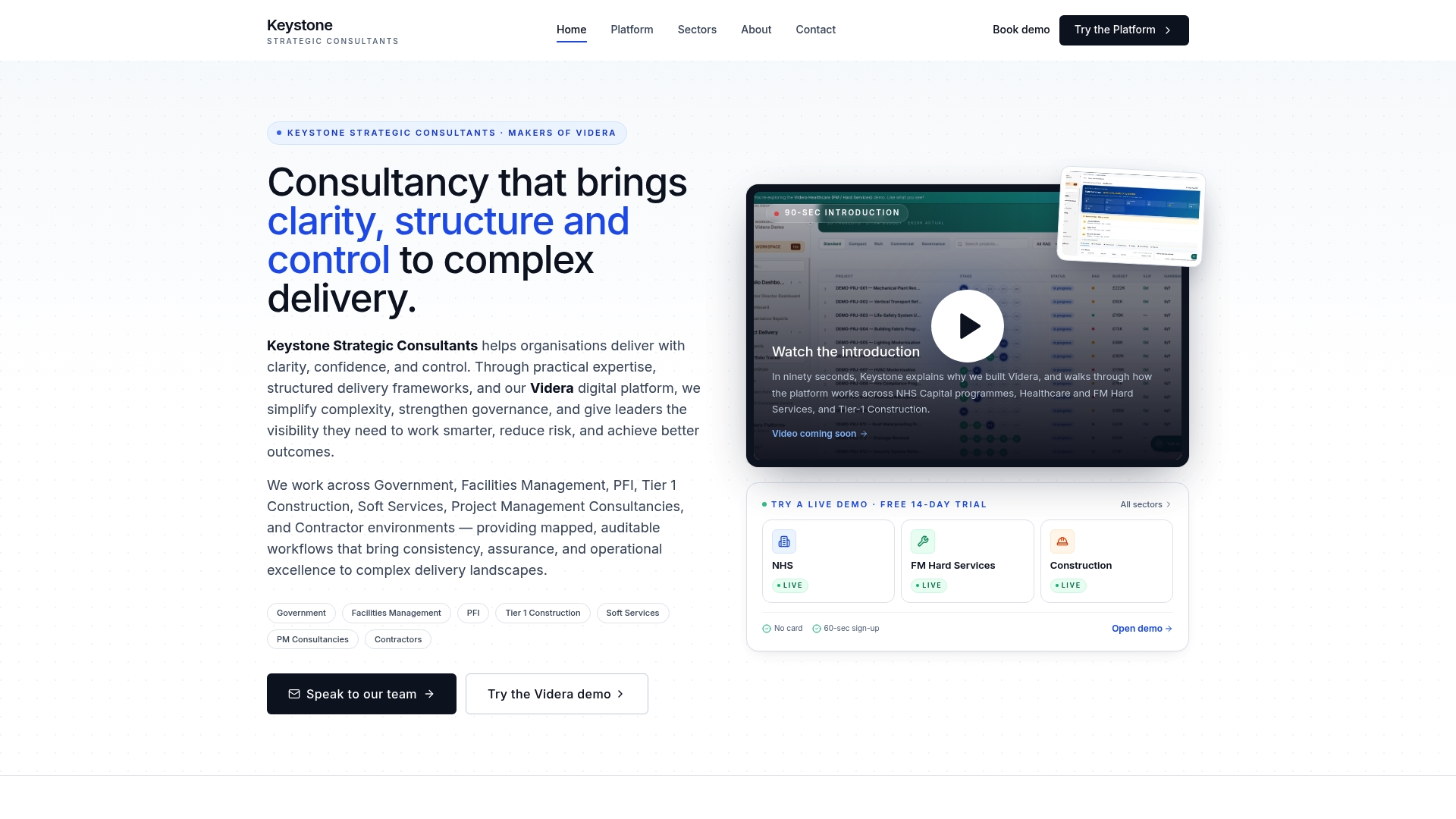
The pilot covers governance design, workflow mapping for one high-value workface, LPS coaching, and full access to the Videra platform — including stage-gated workspaces, AI-powered exception reporting, and audit-ready compliance tools. You leave the pilot with a board-ready evidence pack: what improved, by how much, and what the full rollout requires.
For operational leaders who need a credible case before committing budget, this is the lowest-risk entry point. Start your pilot conversation with Keystoneconsulting today.
Useful sources for governance, Lean and AI–BIM
- BCG: Building better with lean construction — the strongest current industry source for LPS leadership sponsorship and the 10–15% savings evidence. Cite this in board materials.
- Frontiers in Built Environment: Lean and digital monitoring case study — peer-reviewed evidence for VSM plus digital dashboards; the 15% excavation reduction and 2.06% total project time reduction are directly quotable.
- AI–BIM scheduling and risk classification (open access) — the 3.52% schedule reduction and 94.5%–99.7% risk accuracy figures come from here. Use to justify AI reporting investment.
- BIM to digital twin closed-loop framework (MDPI) — the three-day schedule advance and 15% idle rate reduction. Useful for the digital twin component of your business case.
- Integrated delivery roadmap framework (Zenodo) — synthesises PMBOK, Lean, BIM, Agile and EVM; the academic foundation for the multi-paradigm approach used here.
- CII Best Practices Guide: Improving Project Performance — the Change Audit and Ten Stages to Implementation Success framework. Directly applicable to UK pilots; cite for governance rigour.
- Keystoneconsulting: delivery governance and Videra platform — for E-E-A-T and proof of sector experience; reference when presenting the pilot proposition to procurement or legal reviewers.
- Operational efficiency guidance — practical synthesis of delivery frameworks; useful background for leaders building the case for process redesign.