
OMB Circular A-11 Part 7 requires agencies to operate a disciplined capital programming process and submit an Agency Capital Plan and Exhibit 300 for major investments. In this budget cycle, the priority is making sure your Agency Capital Plan ties directly to strategic goals and carries cost, schedule and performance baselines, a documented alternatives analysis, a financing approach and risk management evidence that OMB and Congressional reviewers can check in minutes, not weeks.
TL;DR:
- Agencies must ensure their Capital Plan links directly to strategic goals and includes clear cost, schedule, and performance baselines, with documented alternatives and risk management.
- The Capital Plan should present a concise, evidence-based summary with portfolio and gap analyses, alternatives comparison, and rationale, supported by detailed appendices.
- Exhibit 300 must accurately reflect the approved ACP baselines, including well-supported alternatives, proper performance measures, and current risk registers, to avoid errors and queries.
- Full funding and useful segments are essential principles that prevent budget spikes and enable complete, standalone delivery of project portions, requiring proactive funding management.
- Regular updates during the fiscal year are necessary to reflect changing mission needs, costs, and risks, with material changes promptly communicated to OMB to maintain plan consistency.
Table of Contents
- What Part 7 and the Capital Programming Guide require
- Building an agency capital plan that OMB can actually use
- Exhibit 300 explained: fields, timing and common errors
- Appendix J and financing: full funding, useful segments and budget spikes
- Cost estimating and EVM: making estimates credible
- Acquisition phase: contracting and governance that protect the plan
- Management-in-use: tracking benefits and feeding lessons back
- A practical checklist for Exhibit 300 readiness
- Lessons learned and common pitfalls in preparing capital plans
- Reporting and the OMB submission process
- Fitting capital planning into the wider federal budget
- Coordinating capital planning with IT portfolio management
- Handling updates and revisions during the fiscal year
- Author perspective: priorities for the upcoming budget cycle
- How Keystone supports ACP and Exhibit 300 readiness
- FAQ
- Sources
What Part 7 and the Capital Programming Guide require
Capital programming is the structured process agencies use to plan, budget, acquire and manage physical and information technology assets across their full life. OMB's Capital Programming Guide organises this into three phases: planning and budgeting, acquisition, and management-in-use. Each phase has a distinct purpose, and the Guide treats the Agency Capital Plan as the central product that carries decisions from one phase into the next.
The planning and budgeting phase is where you define mission need, rank competing investments and build the evidence base that justifies a request. Acquisition is where contracting and delivery happen under the strategy set during planning. Management-in-use covers operation, maintenance and eventual disposal, with performance tracked against the baselines set earlier.
OMB expects agencies to show how capital decisions connect to the Clinger-Cohen Act's requirements for IT investment management and to the GPRA Modernization Act's performance framework. In practice, that means your capital plan should reference the same strategic goals and performance indicators that appear in your agency's broader planning documents, not a separate set invented for the budget submission.
Not every asset needs this level of scrutiny. OMB Circular A-11 reserves Exhibit 300 reporting for investments that meet the threshold for "major": typically those with significant cost, high risk, critical mission support or substantial public visibility. Knowing early which investments cross that line determines how much documentation you need to build, and when.

Building an agency capital plan that OMB can actually use
The Agency Capital Plan is not a narrative document for internal use. It is the evidence package that lets an OMB examiner, and eventually a Congressional staffer, understand why an investment made it into the budget and what happens if it does not. The Capital Programming Guide frames the ACP as the primary product of the planning phase, and agencies that treat it that way tend to get cleaner OMB engagement and fewer rounds of follow-up questions.
A usable ACP generally contains:
- A portfolio analysis showing how the proposed investment fits against existing and planned assets.
- A gap analysis that states the mission need the current portfolio does not meet.
- An alternatives analysis comparing at least two credible options against the proposal.
- A clear selection rationale explaining why the chosen option beats the alternatives.
- Baseline cost, schedule and performance figures the investment will be measured against.
- An acquisition strategy describing how the investment will be contracted and delivered.
- A risk register identifying major risks, owners and mitigation actions.
- A post-implementation review plan setting out when and how benefits will be checked.
Executive review matters as much as content. GAO's leading-practices guidance recommends that agencies use an executive review committee to force trade-offs across competing investments rather than approving projects one at a time. A portfolio governance structure that requires a genuine yes or no decision at each gate, rather than a formality, produces a stronger ACP because weak proposals get filtered out before they reach OMB.
On format, keep the summary short and decision-focused: mission need, selected option, baseline figures and risk posture on one or two pages. Push supporting detail, full alternatives analysis, cost model assumptions and the risk register into appendices that a reviewer can check if they want to verify the summary's claims.
Exhibit 300 explained: fields, timing and common errors
Exhibit 300 is the business case OMB uses to evaluate a major investment once it clears the ACP's planning stage. The current Part 7 guidance describes Exhibit 300 as the principal document for coordinating OMB's own reporting to Congress on capital investments, and for IT investments it pairs with the Exhibit 53 inventory.
A complete Exhibit 300 submission typically covers:
- A summary of the investment, its purpose and its current status.
- The alternatives considered and why the chosen option was selected.
- The acquisition and contract strategy, including competition approach.
- A mapping to the agency's enterprise architecture and strategic plan.
- Performance measures tied to the baselines set in the ACP.
Submission happens on OMB's budget calendar, feeding directly into the President's Budget cycle rather than running on a separate schedule. Agencies that treat Exhibit 300 preparation as a year-round activity, rather than a scramble before submission, tend to produce figures that match their ACP without last-minute reconciliation.
The most frequent errors are avoidable. Baselines quoted in the Exhibit 300 sometimes do not match the baselines in the ACP or the programme's own management reports, which is the fastest way to trigger an OMB query. Alternatives analysis is sometimes thin or missing entirely, leaving no evidence the agency considered another path. Performance measures are sometimes vague statements of intent rather than measurable indicators tied to cost, schedule and outcome.
Appendix J and financing: full funding, useful segments and budget spikes
Appendix J sets out the financing principles that shape how capital investments get budgeted, and the two that matter most are full funding and useful segments. Full funding means the total cost of a useful segment of an asset is budgeted and appropriated before work on that segment begins, rather than spreading commitment across years without the funding to back it. A useful segment is a portion of the asset that delivers value on its own, so an agency can fully fund a segment rather than waiting to fund an entire multi-year programme at once.
These principles exist to stop agencies from starting projects they cannot finish and from creating funding gaps that stall delivery mid-stream. They also create a practical problem: a single year's full-funding requirement can produce a budget spike that is hard to absorb.
Agencies manage this in a few ways:
- Establishing a capital acquisition account that spreads financing across years while still respecting full funding at the segment level.
- Aggregating similar projects into a single account to smooth the overall funding profile.
- Documenting funding discussions with OMB explicitly in the ACP and Appendix J submission, rather than leaving the financing approach implicit.
How you finance an investment also shapes procurement. A fully funded segment gives contracting officers more certainty to negotiate firm pricing, while uncertain financing pushes risk onto the contractor or the schedule.
Cost estimating and EVM: making estimates credible
Credible cost estimates are the foundation everything else in the ACP and Exhibit 300 rests on. GAO's Cost Estimating and Assessment Guide states that reliable estimates and an integrated earned value management discipline are essential to avoid cost overruns, and that estimates must be treated as living figures rather than a number fixed at the start of a programme.
For major acquisitions, A-11 Part 7 expects agencies to run an earned value management system that meets the ANSI/EIA Standard 748 framework, with agencies aiming for performance near baseline goals, as Part 7 guidance states. That figure is a useful benchmark for judging whether a programme's cost and schedule variance has drifted too far from plan.
Practical steps that keep estimates credible:
- Refresh the estimate at completion (EAC) on a set schedule rather than only when a problem forces a recalculation.
- Commission an independent cost estimate for the largest or riskiest investments to check the programme office's own figures.
- Stress-test the schedule against historical performance on comparable projects, not just the current plan.
- Run cost, schedule and risk as one integrated process rather than three separate reports that rarely get compared.
Pro Tip: Review EVM variance monthly at the programme level, not just at the annual Exhibit 300 refresh, so corrective action happens while it still matters.
The most common failure mode is adopting EVM late, once a programme is already in trouble, or treating it as a compliance exercise that produces a report nobody reads. A risk management approach that ties EVM variance to an active risk register, rather than filing it separately, turns the system into something a programme manager can actually use.

Acquisition phase: contracting and governance that protect the plan
Moving from planning into acquisition is where a well-built ACP either holds up or starts to unravel. Before any contract is awarded, it is worth re-checking that the assumptions behind the baseline still hold: has the mission need changed, has the market shifted, is the selected alternative still the right one.
Contracting approach matters as much as the underlying technical design, as detailed in the Procurement Contract Workflow That Moves Faster which explains procurement workflows and contract lifecycle automation. Full and open competition keeps pricing and delivery risk in check where the market supports it. Modular contracting breaks a large investment into smaller, independently useful pieces, which also helps satisfy the useful-segments principle in Appendix J. Performance-based specifications shift delivery risk onto the contractor by defining outcomes rather than prescribing methods, which tends to produce stronger accountability than a rigid statement of work.
Governance controls during acquisition should include:
- An integrated project team with the budget, technical, legal and programme expertise needed to make real decisions, not just rubber-stamp them.
- Milestone approvals that require explicit sign-off before the programme proceeds to the next phase.
- Periodic performance reviews, in the style of TechStat sessions, that bring senior leaders in to examine variance and decide whether to continue, restructure or stop a troubled investment.
A governance failure checklist built around 72-hour and 30-day response windows gives programme leaders a concrete way to react when a milestone review flags a problem, rather than letting a known issue drift for months.
Management-in-use: tracking benefits and feeding lessons back
Once an investment is operational, the job shifts from delivery to proving the benefits promised in the ACP actually materialised. GAO's leading-practices guidance recommends post-implementation reviews as a standard step, typically conducted once an asset has been in operation long enough to generate meaningful performance data, rather than immediately at go-live.
Useful indicators to track include realised cost against the original baseline, service or mission performance against the targets set in Exhibit 300, and life-cycle maintenance costs against what was planned. A gap between promised and realised benefits is not a failure in itself. It is only a failure if nobody records it.
Lessons from each review belong in the next ACP update, not in a filing cabinet. A structured approach to tracking lessons learned as assigned, monitored work items, rather than a narrative report, is what actually changes how the next investment gets planned.
A practical checklist for Exhibit 300 readiness
Most of the rework agencies do on Exhibit 300 comes from evidence that exists somewhere but was never organised against the specific fields OMB asks for. A stage-gated checklist closes that gap:
- Confirm the ACP's mission need, selected alternative and baseline figures match what will appear in the Exhibit 300 summary.
- Verify the acquisition strategy section cites the actual contract type and competition approach being used, not a generic placeholder.
- Check that performance measures in the Exhibit 300 are the same measures tracked in EVM reporting, with no silent substitution of different figures.
- Confirm the risk register referenced in the ACP is current, with owners and mitigation status, before it gets summarised for OMB.
Three maturity improvements tend to produce the biggest reduction in rework: capturing evidence as it is generated rather than reconstructing it before a deadline, running real governance gates that can say no rather than ceremonial check-ins, and using one integrated reporting template across the ACP, Exhibit 300 and internal programme reviews so figures never need reconciling by hand.
Pro Tip: Where reporting bottlenecks are the recurring problem, an AI-powered reporting layer mapped to your existing workflows, such as the one built into Videra, can be worth exploring as an optional way to keep evidence audit-ready between submissions.
Lessons learned and common pitfalls in preparing capital plans
The most persistent failure in A-11 capital planning is running planning, acquisition and management-in-use as three separate exercises with three separate sets of documents. GAO's analysis of capital decision-making points to this siloing as a root cause of weak plans, because figures drift apart and nobody owns the full picture.
A second common pitfall is treating the ACP as a one-time document produced for a single budget cycle rather than a living plan. Agencies that update it only when OMB asks tend to arrive at each cycle with stale baselines and a scramble to reconcile numbers.
A third is underinvesting in the alternatives analysis. It is tempting to document the preferred option in detail and treat the alternatives section as a formality, but a thin alternatives analysis is one of the first things an OMB examiner will probe, and a weak answer there undermines confidence in everything else in the submission.
Finally, risk registers are often built once at the start of planning and never revisited. A risk that was minor during planning can become the dominant threat during acquisition, and a register that is not actively maintained will not reflect that shift when it matters most.
Reporting and the OMB submission process
Exhibit 300 and ACP submissions run on OMB's budget calendar, which means the real deadline pressure builds months before the formal submission date. Agencies that start gathering evidence only when the submission window opens are working against a schedule that does not leave room for reconciling inconsistent figures.
The practical sequence is to lock baseline figures early in the fiscal year, update the ACP as decisions are made throughout the year, and treat the formal Exhibit 300 submission as a snapshot of material that should already exist rather than a document built from scratch. Part 7 guidance ties Exhibit 300 directly to the President's Budget process, so submissions feed OMB's own reporting to Congress, which means errors caught late are harder to correct without affecting the wider budget narrative.
Agencies that keep a standing internal review cycle, checking Exhibit 300 drafts against ACP figures on a quarterly basis rather than annually, tend to avoid the last-minute discrepancies that generate OMB follow-up questions and slow the review.
Fitting capital planning into the wider federal budget
A-11 Part 7 capital planning does not sit apart from the rest of the federal budget process. It is the evidence layer that supports decisions made during the broader budget formulation and execution cycle, which means the ACP and Exhibit 300 need to speak the same language as the agency's strategic plan, annual performance plan and budget justification materials.
When these documents disagree, even on details that seem minor, it signals to OMB and to Congressional appropriators that the agency's planning process is not fully coordinated. A capital investment framed one way in the strategic plan and another way in the Exhibit 300 raises questions about which version is accurate.
The practical fix is to anchor every capital planning document to the same set of strategic goals and performance measures used elsewhere in the budget submission, and to update them together rather than in separate cycles run by separate teams. Agencies that assign one group ownership of consistency across these documents tend to avoid the credibility problems that come from contradictory figures reaching OMB from different parts of the organisation.
Coordinating capital planning with IT portfolio management
For IT investments, capital planning and portfolio management are meant to operate as one process, not two. Exhibit 300 pairs directly with Exhibit 53, the IT investment inventory, which means decisions made in the capital plan need to be reflected in how the IT portfolio is structured and prioritised.
The Clinger-Cohen Act's framework for IT investment management expects agencies to rank and manage IT investments as a portfolio, weighing them against each other rather than approving each one in isolation. That is the same principle A-11 Part 7 applies to capital investments generally, so for IT assets the two processes should reinforce each other rather than run on separate tracks with separate governance bodies.
In practice, this means the executive review committee that approves capital investments should be the same body, or at least closely coordinated with the body, that governs the IT portfolio. Where these two governance structures are disconnected, agencies tend to see IT investments approved in the capital plan that do not fit cleanly into the broader IT portfolio strategy, which creates friction later when Exhibit 300 and Exhibit 53 figures need to align.
Handling updates and revisions during the fiscal year
An Agency Capital Plan is not static once submitted. Mission needs shift, costs change and risks that were minor during planning can become significant during acquisition, so OMB expects the ACP to be revisited rather than treated as fixed for the year.
The key discipline is distinguishing between routine updates, such as refreshing a cost estimate within an expected range, and material changes that shift the investment's scope, baseline or risk profile enough to need a fresh conversation with OMB. A material change to cost, schedule or performance baselines should trigger an update to the Exhibit 300 figures as well as the ACP, so the two documents never fall out of sync mid-year.
Agencies that build a standing quarterly review into their internal governance catch these shifts early, which makes a mid-year revision a routine administrative step rather than a surprise that has to be explained to OMB after the fact. Keeping a clear record of why a baseline changed, not just that it changed, is what protects the agency's credibility the next time it asks OMB to approve a revised figure.
Author perspective: priorities for the upcoming budget cycle
The biggest trap this cycle is treating EVM as paperwork rather than a management tool. Agencies that review variance monthly and act on it outperform those that file an annual report nobody reads. Equally, an ACP that is not visibly tied to strategic goals invites more OMB questions, not fewer. Fix the alignment first, then the estimates.
— Peter
How Keystone supports ACP and Exhibit 300 readiness
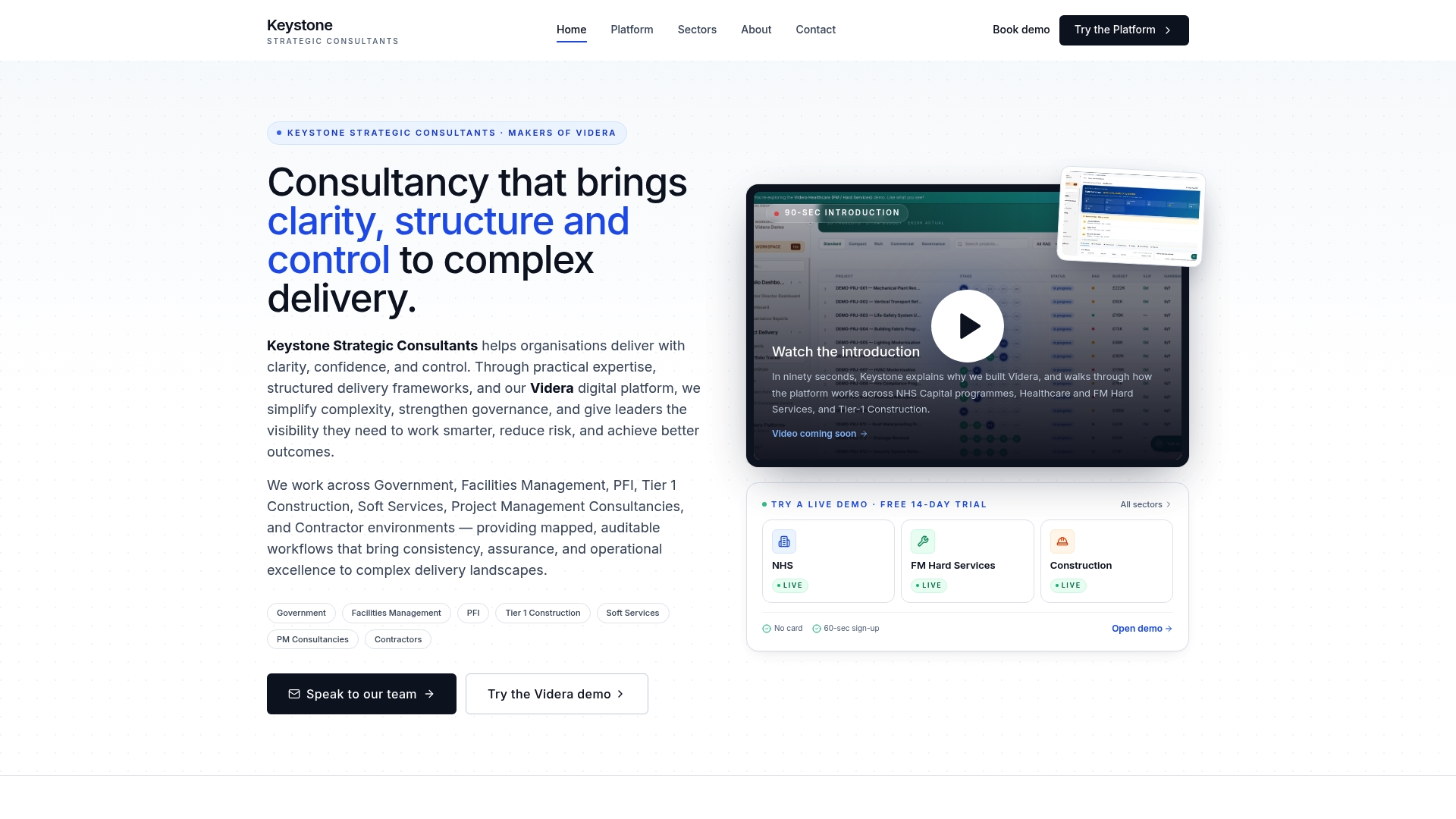
Preparing an Agency Capital Plan and Exhibit 300 submission that holds together under scrutiny takes more than good intentions. It takes evidence that is captured as decisions are made, governance gates that genuinely filter weak proposals, and reporting that does not need reconciling by hand every quarter. That is the gap we work in: integrating directly with teams to map workflows, tighten governance and keep audit-ready evidence available whenever it is needed.
Our services cover:
- Consultancy support for building governance structures and readiness ahead of ACP and Exhibit 300 submissions, detailed on our consultancy page.
- The Videra platform for mapped workflows, stage-gated approvals and AI-powered reporting that keeps evidence current between submissions, detailed on our Videra PM page.
Where OMB keeps raising the same questions, or where a submission deadline is close and evidence is scattered across teams, that is usually the point to bring in outside support. Check availability for a consultancy engagement or a Videra PM walkthrough and see where the gaps in your current process sit before the next submission window closes.
FAQ
What is OMB Circular A-11?
OMB Circular A-11 is the guidance the Office of Management and Budget issues to federal agencies covering preparation, submission and execution of the federal budget. Part 7 of the circular sets the specific policy for capital asset planning, budgeting, acquisition and management, including the Exhibit 300 reporting requirement for major investments.
What is an example of a capital improvement plan?
A capital improvement plan, in the federal context, is typically called an Agency Capital Plan, and it sets out an agency's planned capital investments alongside their justification, costs and timing. A typical example maps proposed facility upgrades or IT system replacements against mission need, alternatives considered and multi-year budget figures, as described in the Capital Programming Guide.
What is OMB in the USA?
OMB is the Office of Management and Budget, the executive office agency responsible for preparing the President's Budget and overseeing how federal agencies implement budget and management policy. It issues the guidance in Circular A-11 that agencies follow when planning and reporting on capital investments.
What are the key principles of capital budgeting under A-11?
A-11's Appendix J centres on full funding, meaning the total cost of a useful segment of an asset must be budgeted before work begins, and useful segments, meaning an asset can be divided into portions that each deliver standalone value. Alongside these, agencies are expected to apply portfolio analysis, alternatives analysis and risk management as described in the Capital Programming Guide.
How does Exhibit 300 differ from the Agency Capital Plan?
The Agency Capital Plan is the broader internal planning document covering an agency's full portfolio of capital investments, while Exhibit 300 is the specific business case submitted to OMB for each major investment. Exhibit 300 figures should always trace back to the baselines already established in the ACP, as Part 7 guidance expects.
Sources
- Capital Programming Guide
- Leading practices in capital decision-making (GAO/AIMD-99-32)
- GAO Cost Estimating and Assessment Guide: Best Practices for Developing and Managing Capital Program Costs