
Most governance failures happen twice: once when the mistake occurs, and again when nobody writes down what caused it or who owns the fix. The single most important lesson from decades of governance reform is that insight without an assigned owner and due date is just a filed observation. Start there: run a structured 60 to 90 minute capture session and turn every finding into a tracked task.
TL;DR:
- Assign an owner and a due date to every lesson to ensure accountability and prevent insights from remaining unacted upon.
- Capture lessons continuously at milestones and convert each into tracked tasks within existing project management tools to maintain momentum.
- Regularly review the lessons register at the start of each new project to embed past learnings into current decision-making processes.
- Maintain independence, skill, and will within governance structures to ensure decision-making power remains effective during crises.
- Embed lessons capture into daily workflows with audit-ready tools and digital platforms to prevent knowledge from slipping into forgotten spreadsheets.
Table of Contents
- What does lessons learned governance actually require?
- How do you run a lessons-learned session that produces real action?
- Why does governance hold up under pressure while other governance collapses?
- How do you apply these lessons in your own organisation?
- What 20 years of governance delivery actually teaches you
- A practitioner's warning about turning lessons into blame
- How Keystoneconsulting embeds lessons into everyday workflows
- Sources
- FAQ
What does lessons learned governance actually require?
Lessons learned governance is the discipline of systematically capturing what went wrong (and what worked), assigning accountability for fixing it, and feeding that knowledge back into how future decisions get made. It sits at the intersection of project management and organisational learning, and it only works when captured insight converts into tracked action rather than sitting in a report nobody reopens.
Here are the practical lessons that recur across successful reforms, whether the setting is a hospital trust, a construction programme, or a government department.
- Stay for the long haul. Governance reform rarely sticks inside a single project cycle; organisations that treat it as a one-off initiative tend to backslide within a year or two.
- Understand the political economy before you design anything. Who benefits from the current dysfunction? Reforms that ignore incentives get quietly sabotaged.
- Close capacity gaps early. Training, staffing levels, and procurement realism matter more than the policy document itself; a beautifully written framework with no trained staff to run it is theatre.
- Make lessons specific, not vague. "Improve communication" teaches nobody anything. "The subcontractor RFI turnaround exceeded five days on 60% of requests because approvals sat with one signatory" gives someone something to fix.
- Keep the language blameless. Naming the process failure, not the person, is what makes the next team willing to report honestly.
- Assign an owner and a due date to every single lesson. No exceptions. An unowned lesson is a wish.
- Integrate lessons into your existing PM or PMO tooling. A register that lives outside the tools your team already opens every day gets forgotten within a quarter.
- Review the repository at the start of every new project, not just at the end of the last one. That's when a past lesson can actually change a decision.
These aren't abstract principles. PMBOK-aligned guidance on lessons learned registers consistently ties usefulness back to structure and reuse, not volume of notes taken.
How do you run a lessons-learned session that produces real action?
The format matters as much as the content. A rambling retrospective produces vague minutes; a structured session produces tasks with names attached.
Design the session properly first:
- Appoint a facilitator, usually the project manager, who keeps the conversation moving and enforces blameless language.
- Bring in a dedicated notetaker separate from the facilitator, so nothing gets lost while someone is also trying to run the room.
- Cap it at 60 to 90 minutes. Longer sessions produce diminishing returns and people start editing their own memories to save time.
This structure isn't arbitrary. PMI's guidance on lessons learned practice points to immediate, facilitated capture as the difference between a session that produces action and one that produces a document nobody rereads. Delay invites people to soften what actually happened.
Capture each entry against a fixed set of fields: what happened, the fix applied, the impact, the root cause, the recommendation, the owner, the due date, and tags for later filtering. That last field is easy to skip and expensive to skip, since tags are what let the next project team actually search the lessons learned register instead of scrolling through a spreadsheet.
Cadence matters too. Capturing lessons only at project closure is the most common failure mode in the field, because detail decays fast once the pressure is off. Run short capture sessions after each major milestone, then consolidate at closure.
Pro Tip: Convert every lesson into a task inside the PM tool your team already uses that same week, not "when there's time." Understanding the role of digital work orders in compliance tracking helps ensure a lesson that never becomes a ticket has a near-zero chance of ever getting fixed.
Why does governance hold up under pressure while other governance collapses?
Three conditions determine whether a governance structure survives a genuine crisis: independence, skill, and will. All three have to be present at the same time. Miss one, and the structure fails exactly when it matters most.
- Independence means the oversight body can act against the interests of the people who appointed it, without that action costing them their seat.
- Skill means the people on that body actually understand the technical substance well enough to ask the right question, not just nod along.
- Will means they're prepared to use that independence and skill even when it's uncomfortable, slow, or unpopular.
Case studies from frontier-industry governance (AI oversight boards, digital-asset foundations) show this pattern repeatedly: authority exists on paper, but collapses in practice because decision speed is too slow, information access is gatekept, or escalation routes simply don't exist when someone tries to use them. A board with formal veto power but no real-time access to the data it's meant to be overseeing has independence on paper and none in practice.
How do you apply these lessons in your own organisation?
Turning this into a repeatable operating rhythm, not a one-off exercise, comes down to five steps.
- Prepare a lessons register template before your first project kicks off, with the fields already built in.
- Capture entries continuously, at milestones, not just at closure.
- Convert every entry into a tracked task with an owner and due date.
- Track progress against those tasks inside your existing PM or governance dashboard.
- Review the repository at the start of every new project, before design decisions get locked in.
Three metrics tell you whether this is actually working, rather than just running:
| Metric | What it tells you |
|---|---|
| Percentage of lessons with an assigned owner | Whether capture is converting into accountability |
| Percentage of lessons marked implemented | Whether owners are actually closing the loop |
| Reuse rate at project kickoff | Whether the register is a living resource or a graveyard |
Slot this into governance meetings as a fixed five-minute agenda item, not a special session. The moment lessons review becomes its own elaborate ceremony, it starts competing for attention with the actual decisions the board is meant to be making, and that's when it turns into theatre. Building this into a project's RACI structure from the outset makes ownership unambiguous rather than aspirational.
What 20 years of governance delivery actually teaches you
Twenty years of working inside healthcare trusts, construction programmes, and public-sector delivery teaches a fairly blunt lesson: the organisations that improve are the ones that treat lessons capture as routine maintenance, not crisis response.
A few things hold up consistently:
- Most governance failures were flagged somewhere, by someone, well before they became a headline. The gap was ownership, not visibility.
- Maturity models that score an organisation on capture, conversion, and reuse (not just documentation volume) are far better predictors of resilience than compliance audits alone.
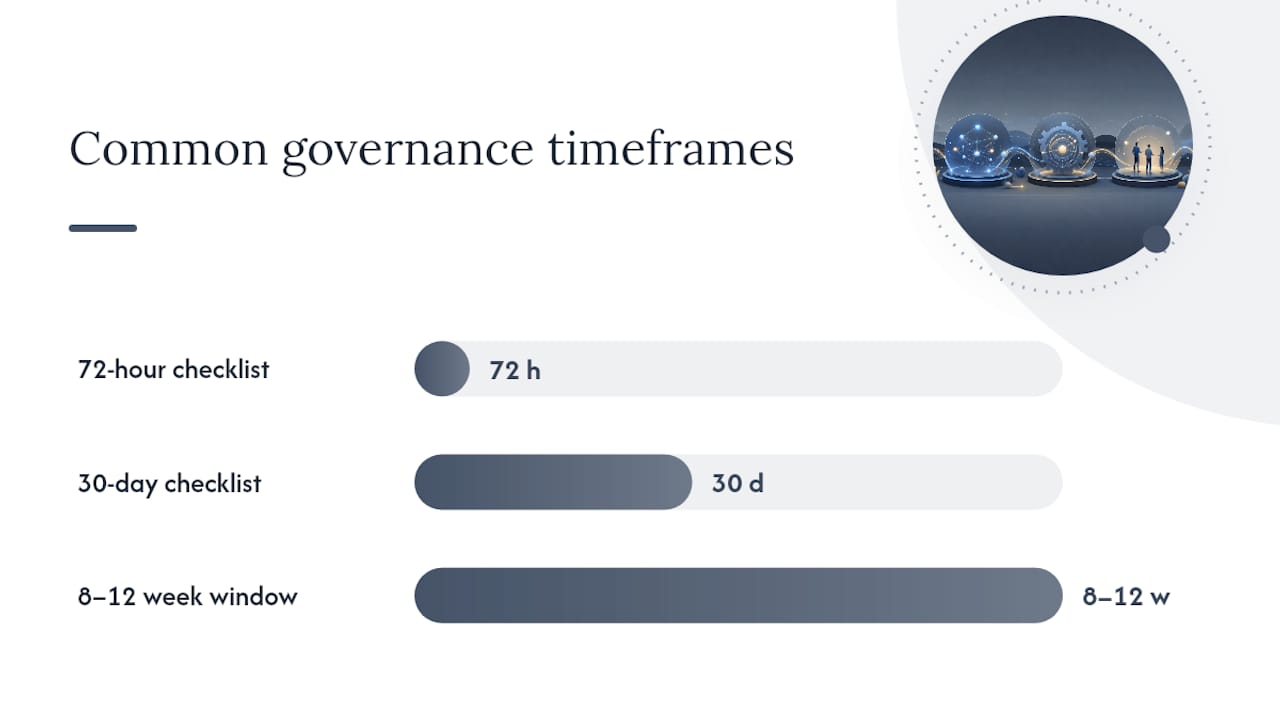
- A 72 hour and 30 day checklist for governance failure recovery tends to expose the same three gaps every time: unclear escalation routes, no single owner for the register, and metrics nobody actually reviews.
- Programmes that embed lessons capture into daily workflow, rather than a separate register, typically show measurable improvement in delivery outcomes within an 8 to 12 week window.
A practitioner's warning about turning lessons into blame
The biggest way organisations sabotage their own lessons process is letting it slide into blame. The moment a capture session starts sounding like a disciplinary hearing, honest reporting stops. Guard against that harder than you guard against the mistakes themselves.
— Peter
How Keystoneconsulting embeds lessons into everyday workflows
Running a good capture session solves half the problem. The other half is making sure those lessons don't quietly disappear back into a spreadsheet once the meeting ends, which is where most organisations lose the thread.
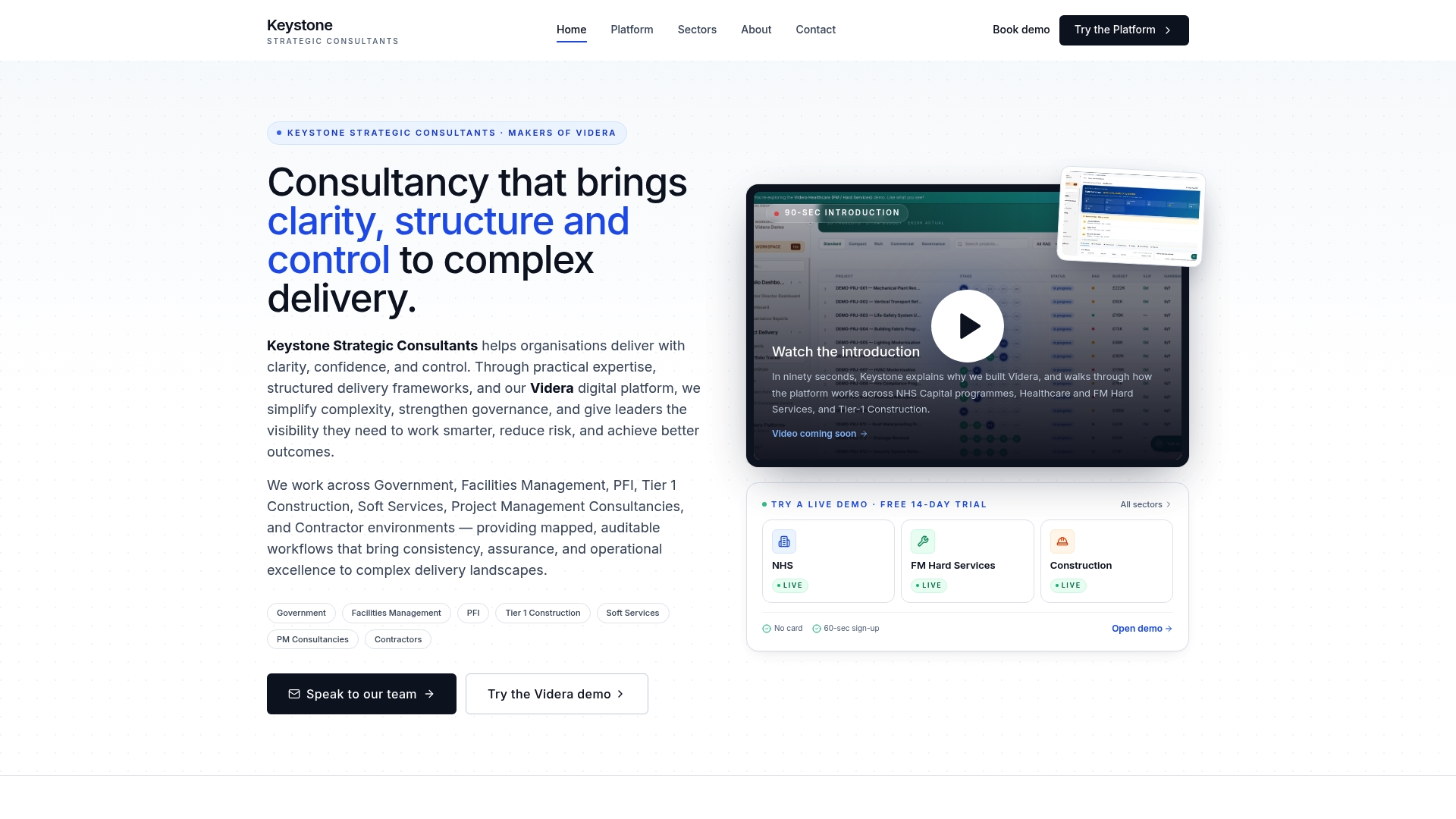
Some consultancies work alongside operational teams across healthcare, construction, government, and facilities management sectors to map workflows and embed audit-ready evidence capture directly into daily delivery, rather than bolting a reporting layer on top afterwards. Certain platforms offer AI-powered reporting and stage-gated governance checkpoints to help ensure lessons captured promptly become tracked tasks with owners, rather than being overlooked in meeting minutes.
For teams running projects and wanting lessons converted into tracked, auditable work, Videra PM is built for exactly that loop. If you'd rather have Keystoneconsulting's team design the governance structure with you directly, from register fields to escalation routes, the consultancy service is the place to start that conversation.
Sources
- PMI: Lessons learned, best practices
- CLS Blue Sky: Lessons from frontier‑industry governance
- PM Study Circle: Lessons learned register (template and best practices)
FAQ
What are the 5 steps of the lessons learned process?
The five steps are identify, document, analyse, share, and archive for reuse. In practice, that means capturing the issue during or shortly after it happens, recording it in a structured register with an owner and due date, analysing the root cause, sharing the finding with the wider team, and storing it where the next project will actually find it.
What are the seven pillars of governance?
Definitions vary by framework, but most versions centre on accountability, transparency, fairness, participation, efficiency, rule of law, and responsiveness. These map closely onto the independence, skill, and will conditions discussed above: without transparency and accountability, independence has no teeth.
What are the seven principles of good governance?
Common lists include participation, consensus orientation, accountability, transparency, responsiveness, effectiveness, and inclusiveness. They overlap heavily with the seven pillars framing above and are usually drawn from public-sector governance frameworks rather than a single fixed standard.
What are the four P's of governance?
There is no single, universally agreed "four P's" model in governance literature, so treat any version you find with caution. A commonly cited informal version covers people, process, performance, and purpose, but readers should check the specific framework a source is using before quoting it as canonical.
How much does Keystoneconsulting's Videra platform cost?
Pricing for Videra PM and the other sector-specific Videra products is not published; current pricing is available directly through Keystoneconsulting. Consultancy engagement costs are quoted per project after an initial scoping conversation.