
Operational governance failures happen when scope changes go unapproved, budgets aren't locked at key milestones, and decision authority is unclear enough that nobody stops a project drifting off course. If you're watching a programme slide toward one right now, the priority is simple: freeze further changes, preserve every decision record you have, and get a single accountable person back in charge before the next executive review. Inspector general reports and independent reviews, plus two decades of remediation work, all point the same way.
TL;DR:
- Early detection of uncontrolled scope changes is crucial, as small approvals can collectively cause multi-hundred-million cost overruns.
- Promptly freezing changes, preserving decision records, and appointing a single accountable person within 72 hours helps contain governance failures.
- Strengthening formal change control, integrated teams, and independent audits reduces the risk of recurring oversight issues and future overruns.
- Most failures stem from lack of real-time visibility and stale information, not policy gaps, making timely, accurate data critical for effective governance.
- Addressing governance issues proactively with diagnostics and automated evidence tools prevents costly delays and rebuilds before external reviews occur.
Table of Contents
- Governance failure examples every operational leader will recognise
- Three governance failures that became public case studies
- What actually causes governance failure
- The first 72 hours and 30 days after a governance failure surfaces
- Building governance that doesn't fail the next time
- How experienced practitioners fix governance failures that keep recurring
- Why most governance advice misses the point
- Get governance support before the next review finds the gap
- Sources
Governance failure examples every operational leader will recognise
Most governance failures follow recognisable patterns long before they become headline-grabbing overruns, as detailed in governance policy gaps examples that highlight common oversight failures. Spotting them early is the difference between a quiet correction and a multi-year rebuild.
- Uncontrolled scope change. A clinical team asks for "one more room" or a site manager approves a material substitution without routing it through change control—individually harmless. Collectively, this is how a $400 million hospital wing becomes a $700 million one.
- Missing or stale business case. Projects that started with a solid case often carry on for years without anyone revisiting it. When budgets aren't locked at key design milestones (typically 30 to 35% design maturity), there's no anchor point to measure drift against.
- Unclear decision authority. Multiple people believe they can approve changes, or nobody clearly can. Escalation paths exist on paper but nobody uses them, because nobody's certain whose job it is to receive the escalation.
- Procurement and contracting shortcuts. Single-source awards, rushed due diligence, and time-and-materials contracts without firm scope all shift risk onto the client and create room for underperformance to go unchecked.
- Absent integrated project teams. When design, construction, and end-user teams work in silos, nobody catches design decisions that clash with operational need until the building is half-built.
- Missing stage-gate artefacts. No verification decision events, no documented sign-offs, no audit trail. When a reviewer eventually asks "who approved this?", there's no answer.
- Underpowered internal audit. Assurance functions that lack the resourcing or authority to challenge senior delivery leaders rarely catch problems before they're expensive.
Healthcare construction is particularly exposed to several of these at once. Ambiguous contract terms, poor design coordination, and unclear risk allocation are common risks in healthcare construction projects, and they tend to compound rather than sit in isolation.
Three governance failures that became public case studies
Case studies in governance failure rarely stay theoretical for long. Three recent examples show how quickly these patterns turn into cost overruns, schedule blowouts, or outright waste of public money.
- VA Palo Alto: The VA Office of Inspector General's review found the project lacked an effective governance structure entirely. Change control wasn't followed, no updated business case was submitted, and scope and cost escalated well past Congress's approved budget.
- New Orleans VAMC: The USACE review identified critical deficiencies in change management, acquisition strategy, and overall governance discipline. Its "design-to-need" approach, run without adequate contractor integration during design, drove unpredictable cost and schedule growth.
- Mesquite artillery plant: Reporting on the project describes rushed procurement and inadequate due diligence that left production lines non-functional, despite hundreds of millions in contracts already spent.
Estimated cost escalation on the Palo Alto project was substantial, with significant annual increases associated with delays, according to the VA OIG's findings.
Three different sectors, three different agencies, one shared story: governance broke down long before the cost overrun became visible to anyone outside the programme.
What actually causes governance failure
The impact of governance failure is easy to measure after the fact. Understanding what causes governance failure in the first place is harder, because the drivers are rarely a single bad decision.
- Urgency overrides due diligence. Projects launched under time pressure routinely skip stage gates that would otherwise catch problems early, treating speed as licence to bypass process.
- Fractured accountability. When more than one authority believes it owns a decision, or none clearly does, nobody stops a change that should have been challenged.
- Risky procurement choices. No-bid awards, unilateral contract actions, and single-source deals without competitive tension all raise the odds that underperformance goes unchallenged.
- Underresourced client teams. Thin client-side teams can't scrutinise contractor claims or design decisions with any real authority.
- Poor reporting. If executives can't see reliable data, they can't challenge assumptions, and problems fester in the gap between site reality and board reporting.
Pro Tip: If your programme reporting reads the same in month three as it did in month one, that's not stability. It usually means nobody's updating it against real progress.
The first 72 hours and 30 days after a governance failure surfaces
Once a failure is visible, the sequence of your response matters more than its scale. Move too slowly and the paper trail degrades along with your credibility at the next audit.
Within 72 hours:
- Stop all unapproved changes immediately, in writing, to every contractor and design lead involved.
- Capture and preserve every decision record that exists, however informal, before memories or emails go missing.
- Assign one named person as the sole accountable decision authority until further notice.
- Notify key stakeholders and your internal audit or compliance function that a review is underway.
Within 30 days:
- Run a rapid governance health check: verify your RACI, inventory your stage-gate artefacts, and confirm which budget lockpoints were actually observed.
- Commission an independent assurance triage to scope how far the problem extends.
- Put a temporary change-control boundary in place while the fuller remediation plan is built.
| Timeframe | Action | Owner |
|---|---|---|
| 72 hours | Freeze changes, preserve records | Single named decision authority |
| 72 hours | Notify stakeholders and audit | Programme sponsor |
| 7–30 days | Governance health check (RACI, artefacts, budget locks) | Delivery lead |
| 7–30 days | Independent assurance triage | External or internal audit |
Executive briefings at this stage should lead with evidence, not narrative: the artefact inventory, the RACI gaps found, and a dated timeline of who approved what. Boards forgive bad news faster than they forgive vague explanations.
Building governance that doesn't fail the next time
Fixing one failure is a project. Preventing the next one is a governance maturity question, and it starts with structural controls rather than good intentions.
- Lock budgets early. Setting a firm budget lock at 30 to 35% design, paired with a defined verification decision event, closes the window where scope quietly balloons.
- Build integrated project teams. Design, construction, and end-user representatives need a shared table and an explicit programme decision authority, not separate reporting lines that meet only at handover.
- Formalise change control. Every change request needs a mandatory impact analysis template and a clear approval threshold, not a verbal nod from whoever's in the room.
- Strengthen independent assurance. Regular, genuinely independent audit cadences catch drift while it's still cheap to fix.
- Make governance evidence visible. Auditable workflows and automated reporting turn governance from a filing exercise into something a reviewer can actually verify on demand.
Contractor integration during design is worth calling out specifically. The New Orleans review found that running design without adequate contractor input on constructability created rework that a stage gate would otherwise have caught. A governance maturity model gives leaders a structured way to check where their own programme sits against these controls before the next audit finds the gap for them.
How experienced practitioners fix governance failures that keep recurring
Keystoneconsulting's approach follows a consistent sequence: a rapid diagnostic to find where control actually broke down, targeted controls built around that specific gap, direct integration with the delivery team rather than a report handed over from the sidelines, then automated evidence and reporting so the fix holds. Success looks like audit-ready artefacts on demand, a consistent decision trail across the programme, and fewer change-related disputes reaching contract claims. Twenty years of remediation work across healthcare, construction, and government delivery shows the same lesson repeatedly: governance holds when it's built into daily workflow, not bolted on before an audit.

Why most governance advice misses the point
Most governance advice treats failure as a compliance problem, something you fix by adding another sign-off or another policy document. That's backwards. Every case study here shows the same root cause: nobody had a reliable, real-time view of what was actually happening on the ground, so decisions got made on stale or absent information.
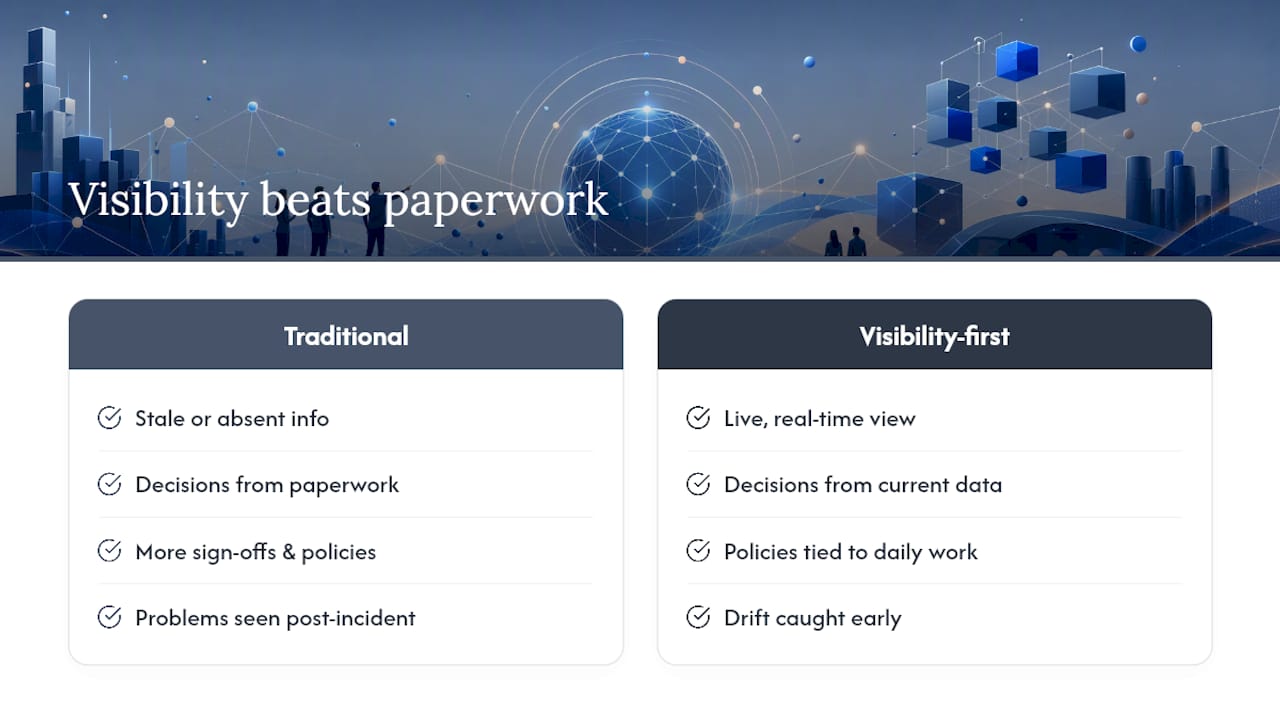
The conventional response, more documentation, actually makes this worse if it's not tied to how work gets done day to day. A binder of policies nobody consults during a live decision is worse than no policy at all, because it creates false confidence at the next audit.
What the evidence in these reports actually supports is narrower and more useful: fix the visibility problem first. Get the decision trail live and current, not reconstructed after the fact. Everything else, the stage gates, the budget locks, the assurance cadences, only works if someone can actually see whether they're being followed in real time. Leaders who prioritise visibility over paperwork catch drift while it's still a conversation, not a headline.
— Peter
Get governance support before the next review finds the gap
If any of the patterns above sound familiar in your own programme, waiting for the next scheduled audit to confirm it is the expensive option. Keystoneconsulting works directly inside delivery teams rather than handing over a report and leaving, running rapid governance diagnostics, building integrated delivery support, and putting the Videra platform in place so your stage-gate artefacts, decision trails, and change approvals are visible and auditable without anyone chasing paperwork.
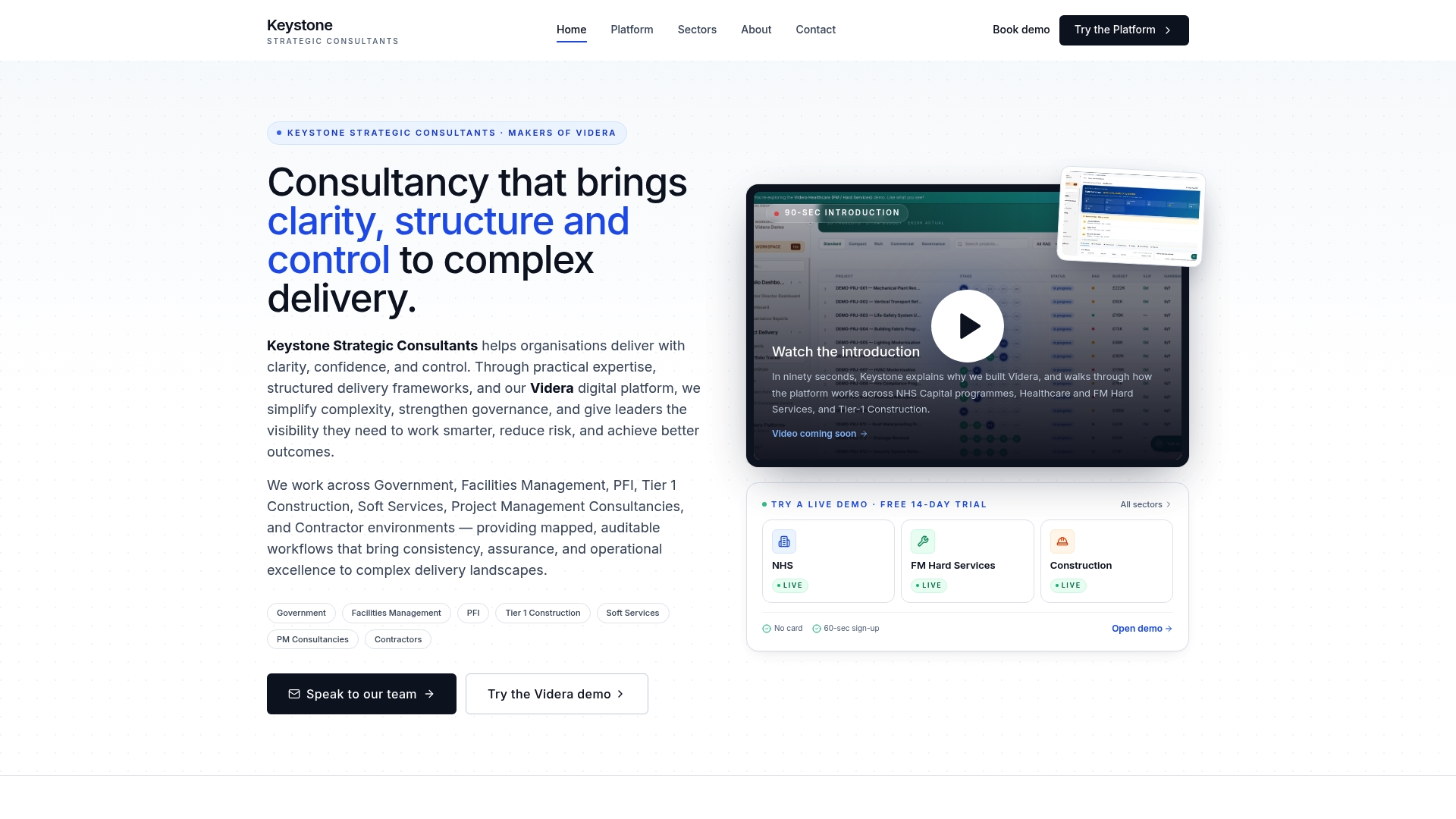
The right time to call is before an inspector general or independent reviewer asks you a question you can't answer with evidence. An initial conversation typically covers where your current controls stand, what a rapid health check would find, and whether Videra's construction-specific workflows fit your programme structure. If you're managing delivery across healthcare, construction, or government facilities, get in touch with Keystoneconsulting to scope a diagnostic call.
Sources
- VA OIG report: major construction project governance (Palo Alto)
- USACE report on New Orleans VAMC project
- govexec: artillery plant produced nothing after major contracts
- Stoel: common risks for healthcare construction projects