
A nonconformance report (NCR) is a formal, written record that flags work, materials, or processes failing to meet a specified requirement, whether that's a drawing, a specification, or a code clause. You raise one the moment you spot a deviation, before the work progresses any further, because doing so stops defective work being buried under the next trade and creates the auditable trail that protects everyone at handover.
TL;DR:
- Most nonconformance reports are triggered by failed tests, unapproved material substitutions, or site conditions that deviate from design assumptions, and should be raised immediately upon detection.
- An NCR must be thoroughly documented with evidence, a root cause analysis, and clear ownership, deadlines, and verification steps to ensure a reliable audit trail and avoid disputes.
- Disposition options include removal and replacement, repair with engineering approval, or acceptance with a cost reduction, each requiring appropriate approvals and documentation.
- Digital workflows that enable mobile evidence capture, automated reminders, and tamper-evident audit trails significantly improve NCR management and prevent late or unsupported closures.
- Assigning a single owner, attaching evidence promptly, and enforcing independent verification are key habits that ensure NCR processes hold up during audits and support faster project closure.
Table of Contents
- What an NCR is and how it fits construction quality management
- When to raise an NCR: triggers and who can raise it
- Essential NCR fields and a practical template checklist
- The NCR lifecycle: from detection to close-out
- Roles, responsibilities and ownership for NCR management
- Disposition options and approval workflows
- NCR logs, registers and closure timelines
- Practical tips to reduce NCRs and prevent recurrence
- Digital workflows and audit-ready reporting
- A compact sample NCR template and pre-raise checklist
- Practical lessons from implementing NCR workflows
- How Keystoneconsulting builds audit-ready NCR workflows into project governance
- Sources
- FAQ
What an NCR is and how it fits construction quality management
An NCR is not a punishment slip. It's a control document that ties a specific piece of work back to a specific requirement, whether that's a structural drawing, a project specification, an inspection and test plan (ITP), or a referenced building code clause. The report exists to answer one question precisely: what was required, and what was actually delivered instead?
That distinction separates an NCR from two terms people often use loosely. A defect is the physical problem itself, the crack, the wrong bolt grade, the out-of-tolerance slab. A punch list item is typically a minor, end-of-job cosmetic fix that doesn't threaten structural or contractual compliance. An NCR sits above both. It's the documented process that captures a defect, assigns it a reference number, and drives it through containment, correction, and formal verification before anyone signs off.
Under ISO 9001, organisations are required to control nonconforming outputs, though the standard doesn't mandate a specific form or template. A managed NCR process and register are the practical way construction firms satisfy that clause while also protecting their contractual position, since most public and private contracts require documented evidence that nonconformances were identified, contained, and resolved before final acceptance. Formally, an NCR should record a deviation from a specified requirement with enough detail that a third party, an auditor, an owner's engineer, a future claims adjuster, can reconstruct exactly what happened.
Two quick examples clarify the boundary:
- A concrete cylinder fails its 28-day compressive strength test against the specified mix design. That's an NCR, because it questions structural compliance and needs engineering review before you decide whether to accept, repair, or remove the pour.
- A door handle is installed on the wrong side at practical completion. That's a punch list item, correctable without engineering input or formal disposition.
Getting this distinction right early saves arguments later about whether something "really needed" formal paperwork.
When to raise an NCR: triggers and who can raise it
Raise an NCR the moment a deviation is confirmed, not once you've decided how to fix it. Waiting to gather a "complete picture" is the single most common reason NCRs arrive late and the paper trail looks thin under scrutiny.
Common triggers include:
- A failed test result — concrete cylinders, weld inspections, compaction density tests, or material certification checks that don't meet the specified threshold.
- A bypassed hold point — work proceeds past an ITP hold point without the required inspection or sign-off.
- Wrong material delivered or installed — incorrect grade, size, finish, or specification substitution without approval.
- Missing or invalid certification — mill certificates, welder qualifications, or material traceability documents that don't match what's on site.
- Site conditions diverging from design assumptions — unexpected subsurface conditions, dimensional clashes, or as-built deviations discovered during inspection.
Any competent person on site can and should raise an NCR: a QA inspector, a superintendent, a subcontractor foreman, or the owner's representative. The threshold isn't seniority, it's observation. What matters more is speed of escalation. Field-level staff should be trained to notify the quality manager or project engineer immediately, particularly where the deviation touches structural, life-safety, or waterproofing scope.
The genuinely urgent call is whether to physically contain the work right now. If further construction buries, encases, or conceals the nonconformance, such as pouring the next lift over a suspect footing, stop, tag, and isolate before anything else happens. If the nonconformance is visible and stable, you can record it, notify the relevant parties, and plan remediation on a slightly longer timeline without the same immediate risk of concealment.
Essential NCR fields and a practical template checklist
A defensible NCR needs enough structure that anyone reading it six months later, an auditor, a claims consultant, a new project engineer, understands exactly what happened without needing to ask you.
At minimum, capture:
- NCR number — sequential and unique to the project, never reused.
- Project reference and date raised.
- Location — grid reference, level, room number, or GPS coordinate for site-wide clarity.
- Referenced requirement — the specific drawing, spec section, ITP clause, or code reference not met.
- Factual description of the condition — what was observed, stated objectively, not what caused it.
- Supporting evidence — photographs, test certificates, survey data, or inspection notes.
- Immediate containment action — what was done to stop the nonconformance progressing.
- Root cause — once investigated, not assumed at the point of raising.
- Proposed disposition — repair, replace, accept with concession, or reject.
- Responsible owner — the named individual accountable for closing the item.
- Due dates — for containment, correction, and verification, each tracked separately.
- Verification sign-off — who confirmed the fix meets the requirement, and how.
Evidence quality decides whether an NCR survives a dispute. A photo without a timestamp, location tag, or reference to the specific defect is close to worthless months later. Version-control your NCR form too. If disposition changes after engineering review, note the revision date and who approved it rather than overwriting the original entry, since a clean audit trail depends on being able to see how a decision evolved, not just where it landed.
For teams building their own tracker, a simple spreadsheet with one row per NCR and the fields above as columns is enough to start. The format the QIC Management Systems template uses is a solid baseline if you want a starting structure rather than building from scratch.
The NCR lifecycle: from detection to close-out
Best-practice guidance describes a seven-stage lifecycle, and skipping stages or compressing them is exactly what produces NCRs that reopen months later.
- Detect — an inspector, tester, or field worker identifies the deviation. Target: immediate, on discovery.
- Record — the NCR is logged with a unique number and factual description. Target: within 24 hours.
- Contain — work is stopped, tagged, or isolated to prevent progression. Target: immediate where concealment risk exists.
- Assess and disposition — the responsible engineer or quality manager reviews the evidence and proposes a remedy. Target: 3 to 10 working days depending on complexity.
- Correct — the agreed remedial work is carried out by the contractor. Target: set proportionally to risk, typically 5 to 15 days.
- Verify — an independent inspection confirms the correction meets the original requirement. Target: within 48 hours of correction completion.
- Close and trend — the NCR is formally closed with sign-off, and the data feeds into trend analysis for recurring issues.
Pro Tip: Never let the same person who performed the correction also sign the verification. Independent verification is what stops an NCR closure from being challenged later, and it's the detail most disputes come back to.
Closure needs objective evidence, not a verbal assurance that "it's fixed." That means a re-test result, a re-inspection record, or a signed engineering confirmation attached to the NCR file. Premature closure, closing the record before verification evidence exists, is the single biggest weakness auditors find in construction quality files, because it turns an audit trail into a series of unsupported claims.

Roles, responsibilities and ownership for NCR management
Ambiguity over who does what is where NCR processes quietly fail. Assign these roles at project kickoff, not after the first dispute.
- The contractor typically identifies the nonconformance in their own or a subcontractor's work and is responsible for proposing a remedy, whether that's rework, repair, or a request to accept the deviation with a cost or schedule concession.
- The site inspector or QA/QC technician raises the NCR, documents the condition, and captures initial evidence before anything is disturbed.
- The project engineer or quality manager reviews the proposed disposition, checks it against specification and code requirements, and either approves it or escalates for engineering input.
- The Engineer of Record (EOR) gets involved whenever the disposition touches structural capacity, load path, or a design assumption. On WSDOT projects, for example, repairs to an acceptable standard require both Project Engineer and EOR approval before work proceeds, a sensible baseline even outside agency contracts.
- The independent verifier, who should never be the person who performed the correction, confirms the fix meets the requirement before closure.
Escalation changes shape once money enters the conversation. If disposition involves a cost impact, whether that's a credit to the owner for accepted deviations or additional cost for rework, the NCR typically needs to route through the change order or claims process alongside the standard technical sign-off. Draw requests and payment applications should flag any open NCR with a cost implication, because releasing payment against work still under formal dispute creates exposure for both owner and contractor.
Disposition options and approval workflows
Once root cause is understood, three disposition paths cover most situations, and each carries different cost, schedule, and approval consequences.
- Removal and replacement is the most conservative option: demolish the nonconforming work and rebuild to specification. It resets risk entirely but carries the highest cost and schedule impact, and it's usually reserved for structural or life-safety deviations where repair can't be engineered with confidence.
- Repair to an acceptable standard requires engineering analysis to demonstrate the repaired condition performs equivalently to the original specification. This is where EOR sign-off typically becomes mandatory, since the engineer is certifying that a non-standard fix still meets the design intent.
- Acceptance with credit allows the deviation to remain if it doesn't compromise safety or long-term performance, usually paired with a negotiated cost reduction to the contractor's payment. This route needs owner or owner's representative approval, since it changes the contract's accepted scope.
US public agencies formalise these timelines in ways worth borrowing even on private work. TxDOT requires notification within 24 hours of identifying nonconforming work, a maintained NCR log with sequential numbering, and correction within 10 days or the agency may remediate at the contractor's cost. WSDOT's Unifier-based process expects the contractor to propose a remedy formally, with Project Engineer and EOR approvals required before repair work to an acceptable standard proceeds.
A change order becomes necessary whenever disposition changes contract value or schedule, an EOR stamp is required whenever structural performance is in question, and a documented credit is required whenever the owner accepts a deviation rather than demanding correction.
NCR logs, registers and closure timelines
A project-level NCR register is what turns individual reports into a management tool rather than a filing cabinet of loose paperwork. At minimum, track:
- Sequential NCR number and date raised.
- Current status — open, in disposition, in correction, verified, closed.
- Responsible owner and due date for each active stage.
- Agency or owner decision, where applicable, and the date it was issued.
Reporting cadence matters more than most teams assume. Open NCRs, particularly ones with cost implications, should appear on weekly or biweekly project status reports and get flagged explicitly before any draw request or payment application is submitted. An open NCR sitting unresolved at draw time is a common source of payment disputes, because it raises the question of whether the owner is being asked to pay for work that hasn't yet been confirmed compliant.
Trend data earns its keep here too. If NCRs cluster around a specific trade, material supplier, or work package, that pattern is an early warning that a corrective action report (CAR) is needed, addressing the systemic cause rather than treating each instance as isolated.
Practical tips to reduce NCRs and prevent recurrence
Most recurring NCRs trace back to the same handful of preventable gaps, and closing them is cheaper than managing the paperwork after the fact.
Align your ITP before work starts, not after a failure. Pre-installation meetings with the relevant trade and supplier, checking material certifications against spec, and confirming hold points are understood by everyone on site catch a surprising share of issues before they become nonconformances at all. The CIOB Code of Quality Management treats this kind of upfront ITP discipline as core to reducing defects, not a bureaucratic extra.
On operational habits: capture photo evidence the moment a deviation is spotted, assign a single named owner per NCR rather than a team, and set containment deadlines measured in hours, not days, for anything with concealment risk.
Pro Tip: Give every site supervisor explicit stop-the-line authority for suspected nonconformances. The cost of a false alarm is a short delay; the cost of concealed defective work is a demolition order months later.
Culturally, review NCR trends monthly, not just at project close, and feed recurring issues back into the live quality plan rather than treating each project as a fresh start.
Digital workflows and audit-ready reporting
Paper-based NCR tracking still works, technically, but it creates gaps that digital capture closes almost automatically. Mobile capture lets field staff photograph and timestamp a nonconformance the moment it's found, rather than reconstructing details from memory back at the site office hours later.
Workflow mapping tools enforce approval gates by design: an NCR literally cannot move to "closed" status without the required verification sign-off attached, which removes the premature closure risk that undermines so many paper trails. This is the model behind platforms like Videra, where NCR steps are mapped into the broader project governance workflow rather than living in a separate spreadsheet nobody checks.
If you're evaluating a digital NCR workflow, check for:
- Mobile capture with automatic timestamp and geolocation.
- A tamper-evident audit trail showing every status change and who made it.
- Reporting that surfaces open NCRs against draw requests automatically.
- Integration with your existing project management or document control system.
A compact sample NCR template and pre-raise checklist
Here's a minimum field set you can paste straight into a spreadsheet:
| Field | Notes |
|---|---|
| NCR No. | Sequential, never reused |
| Date raised / Location | Grid, level, or GPS reference |
| Requirement not met | Drawing, spec, or code clause |
| Factual condition | Objective description, not cause |
| Evidence | Photo, test result, certificate |
| Containment | Action taken immediately |
| Root cause | Confirmed after investigation |
| Disposition | Repair, replace, accept, reject |
| Owner / due date | One named person, one date |
| Verification | Independent sign-off, evidence attached |
Before raising an NCR, confirm three things: you have evidence attached (a photo, a failed test, a certificate), you can name the specific requirement it fails against, and you've assigned an owner before you close the tab. Set target dates proportional to risk, hours for anything that could be concealed by the next work sequence, days for stable, visible deviations awaiting engineering review.
Practical lessons from implementing NCR workflows
The NCR processes that actually hold up under audit share three habits: a single named owner per item, evidence attached the moment the deviation is spotted, and a hard rule against closing anything without independent verification. Most failures I see in project files aren't dramatic, they're a photo missing a date, a "verified" NCR with no second signature, a disposition decision made verbally and never written down.
The fix isn't more paperwork. It's governance that makes the right behaviour the easy behaviour, so field staff raise issues early instead of hoping they resolve themselves. Projects that treat NCRs as a control tool rather than a blame exercise close them faster and argue about them less at handover.
— Peter
How Keystoneconsulting builds audit-ready NCR workflows into project governance
Keystoneconsulting exists for the gap between having an NCR template and actually having a process that holds up when an owner, auditor, or claims consultant asks for the file. Rather than handing you another form to fill in manually, Keystone Strategic Consultants works directly alongside your team to map NCR steps into your existing delivery workflow, so containment, disposition, and verification each have an owner and a deadline built into the system rather than left to memory.
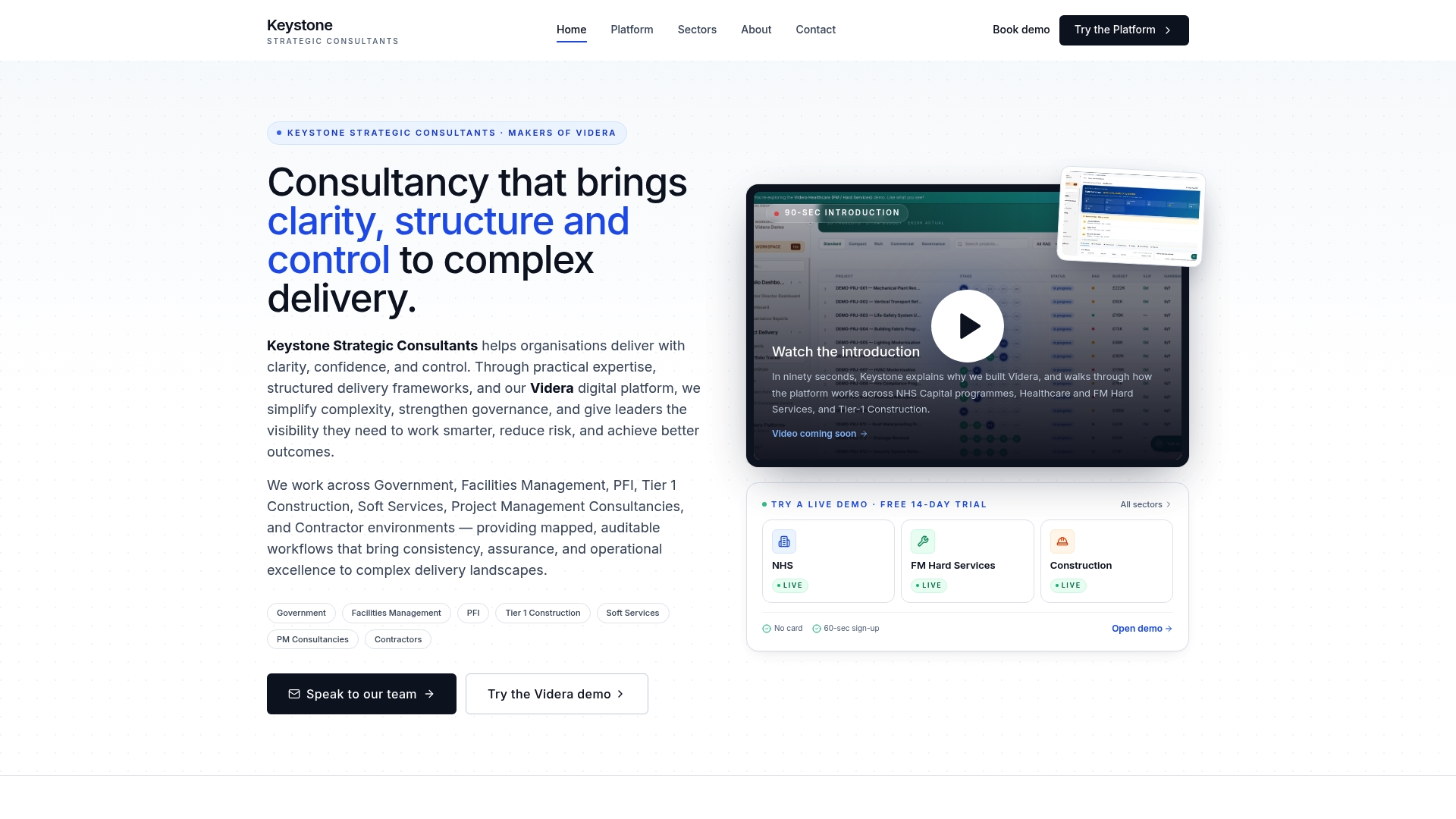
A platform designed to support project managers provides mobile capture, automatic reminders, and a tamper-evident audit trail that flags open NCRs before they become draw request disputes. If your current process relies on someone remembering to chase a closure signature, it's worth a conversation. For more information on governed NCR workflows and project governance solutions, visit Keystone Strategic Consultants.
Sources
- WSDOT Construction Bulletin #2024-07: Nonconformance Report Business Process
- Deficient and nonforming work (TxDOT guidance)
- Non-Conformance Report (NCR) in Construction: Process, Examples and Template - QIC Management Systems
- NCRs in Construction: Complete Guide to NCRs | Visibuild
FAQ
What is a construction nonconformance report?
A construction NCR is a formal written record of work, materials, or processes that fail to meet a specified drawing, specification, or code requirement, used to control the item until it's corrected and verified.
What are some examples of nonconformance reports?
Common examples include a concrete cylinder failing its strength test, structural steel installed with the wrong bolt grade, or work proceeding past an ITP hold point without the required inspection.
Who is responsible for an NCR report?
The site inspector or QA technician typically raises the NCR, the contractor proposes the remedy, and the project engineer or Engineer of Record approves disposition and verifies closure, depending on the scope involved.
What is nonconformance reporting?
Nonconformance reporting is the documented process of identifying, containing, correcting, and verifying work that deviates from a specified requirement, creating an auditable trail from detection through to formal close-out.