
For UK public-sector programmes, the fastest route to audit-ready, compliant workflow automation is a platform-based orchestration layer built on shared data standards, paired with a specialist consultancy to run discovery and stage-gated delivery. Not a monolithic replacement. Not a bespoke build. An orchestration layer that connects what you already have, makes every approval and decision traceable, and gives boards the evidence they need.
Before your next procurement meeting, ask three questions of any supplier:
- What does your discovery process look like, and what artefacts does it produce?
- How does your platform integrate with our existing systems, and what APIs or shared data models do you use?
- Can you demonstrate exportable, timestamped audit logs from a live or anonymised process?
Pro Tip: Propose a time-boxed pilot with defined SLAs before committing to full deployment. It forces suppliers to prove delivery speed and gives you measurable evidence to take to the board, while sidestepping the centralisation trap entirely.
Table of Contents
- What do government workflow automation tools actually do?
- Which features should you prioritise for a governance-first deployment?
- Why platform orchestration beats centralisation for public services
- How to implement: a stage-gated roadmap for UK programmes
- Procurement and compliance checklist for UK programme teams
- How do you measure success in a public-sector automation programme?
- What are the most common risks, and how do you avoid them?
- Keystoneconsulting and Videra: built for UK public-sector governance
- Key takeaways
- A practitioner's note on what actually works
- Useful sources and further reading
What do government workflow automation tools actually do?
Workflow automation in a public-sector context means orchestrating reviews, approvals, notifications, escalations, and audit trails across departments, not simply moving paper forms online. The distinction matters. Digitising a broken process just makes it break faster.
Common government use cases include permitting and licensing, service requests linked to work orders, benefit and eligibility workflows, contract approvals, and inspection report routing. Each of these involves multiple actors, handoffs, and accountability points that email chains cannot track reliably.
Automation supports governance by giving programme managers real-time SLA dashboards, timestamped audit logs, and exception reports that boards and auditors can interrogate directly. That is the governance dividend most teams underestimate: it is not just efficiency, it is evidence.
Three triggers that signal you need workflow automation rather than a full system replacement:
- You have a backlog reduction target but no visibility into where work stalls
- An audit or transparency requirement demands timestamped decision trails
- Two or more departments share a process but use different systems
Which features should you prioritise for a governance-first deployment?
The feature list matters less than the order. For UK public-sector programmes, prioritise in this sequence:
- Workflow orchestration engine with versioning, simulation, and rollback
- Auditable task logs: immutable, timestamped, and exportable for regulators
- Low-code form and rule editors configurable by non-technical staff
- API-first integration layer with pre-built adapters for legacy systems
- Role and policy-based access control aligned to your governance structure
- SLA and performance dashboards with drill-down to individual tasks
- Versioned document management with e-signature support
On the non-functional side, ask for evidence of ISO 27001 certification, Cyber Essentials status, and alignment with NCSC guidance for cloud services. Data residency and encryption at rest and in transit are non-negotiable for most UK public-sector contracts. Confirm that data stays within UK borders unless your data protection impact assessment explicitly permits otherwise.
The configurability point deserves emphasis. Platforms that require developer involvement for every rule change will lag behind policy shifts. Your analysts need to own the configuration.
Pro Tip: During any supplier demonstration, ask them to export an audit trail from an anonymised sample process. If they cannot do it in under five minutes, the audit capability is not production-ready.
Why platform orchestration beats centralisation for public services

Deloitte's analysis of government operating models is direct on this: centralisation fails when it is treated as technology consolidation rather than structural change. The result is slow delivery, loss of local autonomy, and projects that collapse under their own scope.
A platform-based model works differently. Shared capabilities, a common data layer, and an orchestration layer sit between agency systems. Each department keeps its own tools and autonomy; the platform enforces common standards and makes performance visible across the whole.
The practical payoff: shared platform capabilities allow small, multidisciplinary pods to assemble around specific outcomes and deliver in months rather than years, without waiting for a programme-wide rollout.
Benefits of this approach for UK public-sector governance:
- Reusable APIs reduce procurement duplication across departments
- Transparent performance benchmarking across agencies without forcing a single system
- Faster delivery cycles through modular, outcome-focused teams
- Preserved departmental accountability within a shared governance framework
How to implement: a stage-gated roadmap for UK programmes
The GSA's Elimination, Optimisation and Automation playbook frames automation as a lifecycle, not a project. The UK equivalent follows the same logic.
- Stage 0: mandate and sponsor alignment (2–4 weeks). Define outcomes, success metrics, and governance guardrails. Without a named sponsor and agreed metrics, pilots drift.
- Stage 1: discovery and process mapping (4–8 weeks). Map workflows, interview stakeholders, define the data model, and run a compliance check. Produce three artefacts before proceeding: process maps, a data standard, and an audit reporting specification.
- Stage 2: pilot and proof of value (8–12 weeks). Build a thin orchestration layer for one or two high-value processes. Set SLAs, collect baseline metrics, and instrument everything for comparison.
- Stage 3: iterate and integrate (3–6 months). Connect legacy systems via APIs, expand reusable components, implement role-based governance, and run training for non-technical staff.
- Stage 4: scale and sustain (ongoing). Publish SLA dashboards, create outcome-focused pods, and establish sunset criteria for processes that no longer need automation.
Before the pilot begins, you need three governance artefacts in place: process maps signed off by process owners, a shared data standard agreed across departments, and an audit reporting specification that satisfies your internal audit team.
Procurement and compliance checklist for UK programme teams
Procurement routes:
- Crown Commercial Service frameworks and G-Cloud or Dynamic Purchasing System options are the standard starting points. Direct call-off is available where the framework permits and the value threshold allows.
- Produce a requirements specification, a market engagement summary, and a scoring matrix before issuing any tender.
Contractual clauses to insist on:
- UK GDPR data processing addendum with named sub-processors
- Service levels with financial penalties for breach
- Audit rights and exportable audit logs in standard formats
- Exit and data transfer arrangements with defined timescales
Security and assurance:
- ISO 27001 certification evidence (not just a self-assessment)
- Cyber Essentials or Cyber Essentials Plus certificate
- NCSC cloud security guidance alignment, confirmed in writing
Commercial terms:
- Confirm whether the model is subscription, licence, or professional services, and what is included in each
- Require evidence of reusable components and shared APIs, not per-project bespoke builds
- Ask for two or more public-sector case studies with named outcomes
Pro Tip: Write an acceptance test into the contract that requires the supplier to demonstrate SLA dashboards, audit log exports, and a simulated incident response before go-live sign-off.
How do you measure success in a public-sector automation programme?
| KPI | Data source | Collection method |
|---|---|---|
| Time-to-outcome | Orchestration logs | Daily automated export |
| SLA compliance rate | Workflow engine | Weekly dashboard report |
| Exception rate | Escalation log | Real-time alert plus weekly summary |
| Mean time to resolve escalations | Task audit trail | Automated calculation on close |
| Percentage of automated decision points | Process analytics | Monthly programme review |
| Internal user satisfaction | Survey tool | Quarterly pulse survey |
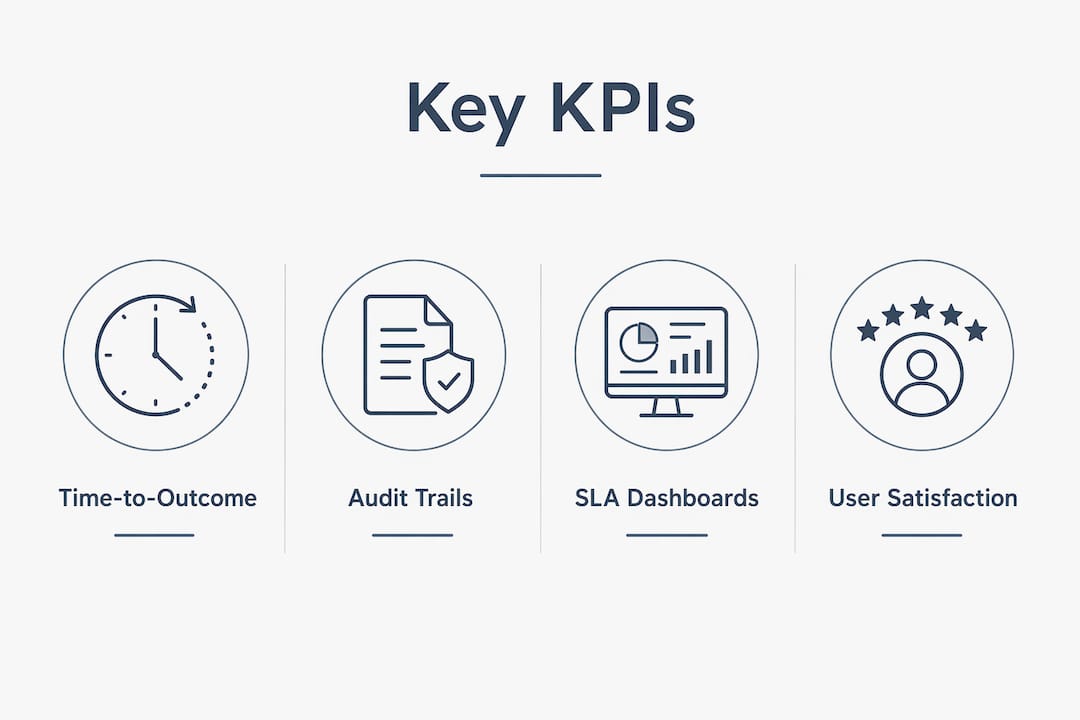
Evidence formats that auditors and boards accept: timestamped audit logs, SLA dashboards with drill-down to individual tasks, exception registers, and before-and-after baseline comparisons from the pilot. Instrument your pilot processes from day one. A clean baseline collected during Stage 2 is the most persuasive evidence you will have at a programme board six months later.
Reporting cadence: weekly tactical dashboards for delivery teams, monthly performance reports for programme boards, and quarterly public transparency metrics where your accountability framework requires them.
What are the most common risks, and how do you avoid them?
- The centralisation trap. Treating the programme as an IT consolidation rather than a governance initiative. Mitigation: preserve departmental autonomy with a shared orchestration layer and resist pressure to standardise everything before the pilot proves value.
- Digitising broken processes. Automating a flawed workflow just accelerates the failure. Mitigation: require process mapping and redesign before any automation build begins.
- Poor data standards. Integration failures almost always trace back to inconsistent data models. Mitigation: include a data-model and API interoperability acceptance test in your procurement specification.
- Change management failures. Low adoption kills programmes that are technically sound. Mitigation: insist on low-code configurability so non-technical staff can own the tool, and require a training plan as a contract deliverable.
Red flags in supplier proposals: long custom development timelines before any working software, no audit log export capability, and no verifiable public-sector references. Any one of these should prompt a follow-up question. All three together is a reason to walk away.
An operations audit before procurement can surface these risks before they become contract problems.
Keystoneconsulting and Videra: built for UK public-sector governance
Governance failures and reporting bottlenecks are the problems Keystoneconsulting was built to solve. With 20 years of sector experience across healthcare, construction, and facilities management, the consultancy brings a delivery-first approach to workflow automation: discovery first, then mapped workflows, then a governed pilot, then scale.
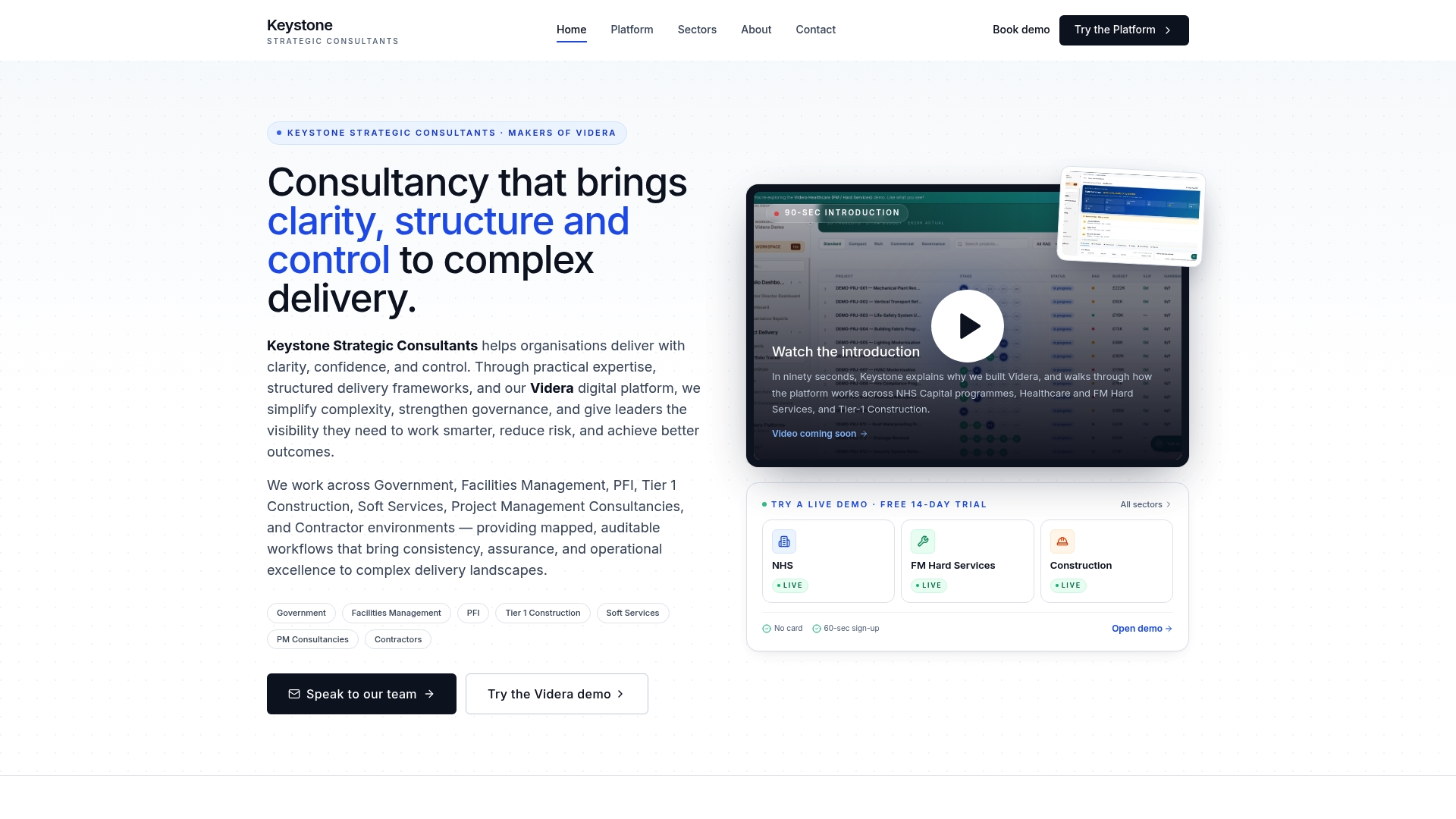
The Videra platform delivers mapped, auditable workflows, AI-powered reporting, stage-gated project governance, and configurable sector workspaces that connect to your existing systems via API. Boards get exception reports and SLA dashboards without manual compilation. Auditors get exportable, timestamped trails. Programme managers get a clear view of where work stalls and why.
Programmes that have gone through Keystoneconsulting's discovery and pilot process have moved from manual exception reporting to automated board-ready outputs, with audit logs that satisfy internal audit requirements from the first review cycle.
To request a short discovery, a pilot proposal, or a Videra demonstration, visit Keystone Strategic Consultants and start the conversation.
Key takeaways
Platform-based orchestration paired with specialist consultancy is the fastest, lowest-risk route to audit-ready workflow automation for UK public-sector programmes.
| Point | Details |
|---|---|
| Start with discovery | Commission a 4–8 week discovery to produce process maps, a data standard, and an audit reporting specification before any build. |
| Choose orchestration, not centralisation | A shared orchestration layer preserves departmental autonomy and avoids the rip-and-replace failures that have plagued large government IT programmes. |
| Specify compliance upfront | Require ISO 27001 evidence, Cyber Essentials status, and UK GDPR data processing addenda in every procurement. |
| Use G-Cloud or Crown Commercial Service | These routes reduce procurement risk and provide a defensible audit trail for the contract award itself. |
| Keystoneconsulting and Videra | Keystoneconsulting delivers governance design, workflow mapping, and stage-gated delivery, with the Videra platform providing audit-ready reporting and configurable sector workspaces. |
A practitioner's note on what actually works
Most governance failures in public-sector automation programmes are not technology failures. They are sequencing failures. Teams skip discovery, automate the wrong processes first, and then spend months unpicking integrations that a proper data-model conversation would have prevented in week two.
The programmes that land well share a pattern: a named sponsor, a short discovery that produces real artefacts, a pilot scoped tightly enough to prove value in under three months, and a platform that non-technical staff can configure without raising a change request. The technology is rarely the constraint. The discipline around it almost always is.
If you are preparing for a decision meeting and want a structured discovery workshop, a pilot scoping conversation, or a Videra demonstration, get in touch with Keystoneconsulting. The discovery is where the value starts.
Useful sources and further reading
- ICMA: Beyond Digitization — practitioner evidence for audit-ready workflow automation in local government; useful for board justification.
- Deloitte: New operating models for government — the platform operating model and pods evidence base; cite this in programme business cases.
- GovExec: GSA Elimination, Optimisation and Automation playbook — lifecycle model for scaling automation; maps directly to the stage-gated roadmap above.
- MDPI: ICT-Based Digital Transformation Roadmap — academic evidence for operational improvements from targeted ICT and workflow automation roadmaps.
- Keystoneconsulting: workflow mapping guide — practical guidance on mapping processes before automation; recommended reading before Stage 1.
- Keystoneconsulting: workflow management systems examples — SLA tracking, risk management and performance visibility in practice.
- Keystoneconsulting: delivery governance and Videra platform — primary resource for discovery requests, pilot proposals, and Videra demonstrations.