
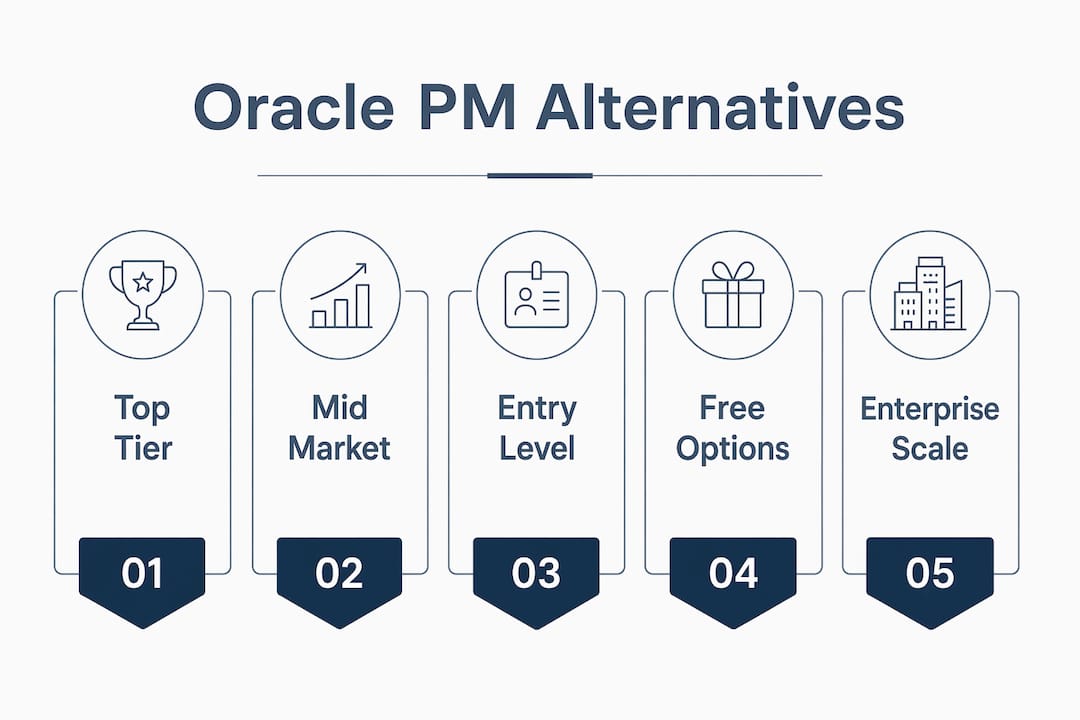
Oracle's project management suite is powerful, fragmented, and expensive to run. If you are evaluating alternatives, the short answer is this: Smartsheet, Wrike, Microsoft Project, Appian, and Pega Platform are identified as leading alternatives to Oracle project management suites in 2026 by industry review platforms like Gartner and G2. For UK organisations, monday.com, Zoho Projects, and Trello cover the affordable segment, while Clarity and Workday Adaptive Planning serve large enterprise portfolios. The table below maps all 25 options against use case, pricing tier, and key capability so you can shortlist before reading further.
The fragmentation of Oracle's toolset is the most common reason teams switch. Overlapping modules, inconsistent interfaces, and the need for specialist consultants to manage updates create friction that compounds over time. Modern alternatives consolidate scheduling, resource management, and reporting into a single interface, often at a fraction of Oracle's total cost of ownership.
Key differentiators across the field:
- Ease of onboarding separates tools like monday.com and Trello from heavier platforms like Planview AdaptiveWork or Clarity
- Deployment flexibility (cloud vs on-premises) varies significantly; PDWare ResourceFirst and Microsoft Project support both
- Integration depth with ERP and CRM systems is strongest in Workday Adaptive Planning, Scoro, and OnePlan
- Free trials or demos are available across most SaaS options, making hands-on evaluation straightforward
- UK market support is well established for all 25 tools listed here
What are the best alternatives to Oracle project management?
The comparison below covers all 25 featured tools. Pricing reflects publicly available tiers; where vendors do not publish rates, pricing is listed as contact-only.
| Tool | Best for | Pricing | Key capability | Ease of use |
|---|---|---|---|---|
| Smartsheet | Versatile portfolio management | From ~$9/user/month | Customisable sheets, automation | High |
| Microsoft Project | Microsoft 365 organisations | From ~$10/user/month | Gantt, resource levelling, M365 integration | Medium |
| Wrike | Marketing and creative teams | Free tier; paid from ~$9.80/user/month | Reporting, collaboration, dashboards | High |
| monday.com | Agile teams, flexible workflows | Free tier; paid from ~$9/user/month | Visual boards, templates, automation | Very high |
| Teamwork | Agencies, professional services | Free tier; paid from ~$5.99/user/month | Time tracking, billing, client portals | High |
| Planview AdaptiveWork | Large enterprise portfolios | Contact only | Resource and financial management | Medium |
| Zoho Projects | SMBs seeking affordability | Free tier; paid from ~$4/user/month | Zoho suite integration, automation | High |
| Acuity PPM | Portfolio transparency | Contact only | Portfolio visualisation, AI insights | Medium |
| TeamDynamix PPM | IT service and project delivery | Contact only | ITSM plus PPM combined | Medium |
| OneDesk PPM | Project and helpdesk combined | — | Help desk integration | High |
| PDWare ResourceFirst | Resource-heavy organisations | Contact only | Capacity planning, cloud or on-premises | Medium |
| Meisterplan | Dynamic portfolio and resource planning | Contact only | Scenario planning, capacity modelling | High |
| OnePlan | Cross-workstream coordination | Contact only | Strategy, portfolio, and work in one | Medium |
| Jira Plans | Agile software teams | Included in Jira Premium | Agile roadmaps, dependency tracking | Medium |
| Planview ProjectAdvantage | Enterprise PMO scalability | Contact only | Configurability, 30+ years in market | Medium |
| Scoro | Professional services all-in-one | — | CRM, finance, and project in one platform | High |
| Fluid | Flexible workspace teams | Contact only | Customisable workspaces, task automation | High |
| ProofHub | Simplified tracking and communication | — | Centralised workspace, time tracking | Very high |
| Asana | Cross-functional task tracking | Free tier; paid from ~$10.99/user/month | Multiple views, automation rules | Very high |
| Nifty | Remote teams needing chat and projects | Free tier; paid from ~$3.90/user/month | Timeline plus built-in messaging | High |
| Notion | Knowledge and task management | Free tier; paid from ~$8/user/month | Databases, docs, and tasks combined | High |
| Stafiz | Process optimisation | Contact only | Visual workflow automation | Medium |
| Clarity | Large-scale portfolio governance | Contact only | Portfolio analytics, resource management | Low-medium |
| Workday Adaptive Planning | Integrated financial and project planning | Contact only | Forecasting, modelling, ERP integration | Medium |
| Trello | Small teams, simple tracking | Free tier; paid from ~$5/user/month | Kanban boards, card-based tasks | Very high |
Standout tools worth examining closely
Microsoft Project remains the default choice for organisations already running Microsoft 365. Its Gantt scheduling, resource levelling, and native integration with Teams, SharePoint, and Power BI give it a depth that standalone tools rarely match. The learning curve is steeper than monday.com or Asana, but for programme managers running multi-dependency schedules, that depth earns its keep.

Wrike punches above its price point for marketing and creative teams. Its reporting layer is genuinely strong, and the ability to create custom dashboards per stakeholder group solves a problem that Oracle's fragmented views create daily.
Planview AdaptiveWork sits at the enterprise end alongside Clarity and Workday Adaptive Planning. All three require implementation support and carry contact-only pricing, but they offer the financial modelling and portfolio governance that large capital programmes demand. Clarity in particular suits organisations running large-scale portfolio governance across multiple business units.
Zoho Projects is the clearest answer to the question of whether a free Oracle PM alternative exists. Its free tier covers up to three users and two projects, and paid plans start at around $4 per user per month, making enterprise-grade features accessible to smaller teams. SaaS pricing flexibility like this is one of the defining advantages modern alternatives hold over Oracle's licensing model.
Jira Plans (formerly Advanced Roadmaps) is the natural home for software and product teams already using Jira. It handles dependency mapping across multiple teams and sprints in a way that Oracle's tools were never designed to do.
For remote teams, Nifty combines timeline views with built-in messaging, removing the need for a separate Slack or Teams subscription. ProofHub's flat-rate pricing model is worth noting: rather than charging per user, it offers unlimited users on its paid plans, which changes the maths considerably for growing teams.

How do Oracle PM alternatives compare on common features?
Most alternatives to Oracle Primavera cover the same functional ground: scheduling, resource management, risk tracking, collaboration, and reporting. The differences lie in how those features are packaged and how much configuration they require.
Standard capabilities you will find across the field:
- Scheduling and Gantt charts are table stakes; every tool here offers them, though depth varies from Trello's basic card timelines to Microsoft Project's full critical path method
- Resource management ranges from simple capacity views (monday.com, Asana) to full demand and supply modelling (PDWare ResourceFirst, Meisterplan, Planview AdaptiveWork)
- Risk management is built into Clarity, Planview AdaptiveWork, and OnePlan; lighter tools rely on custom fields or integrations
- ERP and CRM integration is strongest in Workday Adaptive Planning, Scoro, and OnePlan, which connect project data directly to financial systems
- No-code workflow automation is a defining feature of monday.com, Smartsheet, and Stafiz, letting teams build and modify processes without IT involvement
Oracle Primavera's architecture was designed for capital-intensive engineering and construction programmes. Its CPM scheduling and Monte Carlo risk simulation capabilities remain best-in-class for that context. Where it falls short is everywhere else: day-to-day usability, mobile access, and the kind of cross-functional visibility that modern project teams expect. Low-code alternatives let business units automate workflows without waiting for IT development cycles, which is a structural advantage Oracle's traditional enterprise model cannot easily replicate.
AI-driven features are now appearing across the mid-market. Acuity PPM includes AI-driven portfolio insights, OnePlan integrates with Microsoft Copilot, and AI-powered maintenance scheduling is shifting maintenance teams away from Oracle EAM towards platforms with predictive rather than reactive models. For a deeper look at how AI capabilities compare across leading tools, the best AI project management software guide covers this in detail.
How to choose the right Oracle PM alternative for your organisation
The right choice depends on four variables: your organisation's size, the industry you operate in, your existing technology stack, and how much change your teams can absorb at once.
Start with your integration requirements. If your finance team runs SAP or Workday, a tool that connects natively to those systems (Workday Adaptive Planning, Scoro, OnePlan) will save months of custom integration work. If you are a Microsoft 365 shop, Microsoft Project or OnePlan are the path of least resistance.
Match the tool to your team's technical confidence. Clarity and Planview AdaptiveWork are powerful but demand trained administrators. monday.com, Asana, and Trello can be up and running in days. The gap between those two ends of the spectrum is not just about features; it is about how long it takes before the tool is actually being used.
Consider deployment preference. Most alternatives are cloud-first, which reduces infrastructure overhead. PDWare ResourceFirst and Microsoft Project support on-premises deployment for organisations with data residency requirements, a relevant consideration for UK public sector and NHS bodies.
Budget realistically. SaaS alternatives with some options starting as low as $30 per user per month represent a fraction of Oracle's total cost of ownership when considering licensing, infrastructure, and the specialist consultants Oracle's setup typically demands. Even mid-market tools like Scoro or Wrike include capabilities that would require multiple Oracle modules.
Involve stakeholders early. The tools that fail are rarely the wrong choice on paper; they fail because the people who use them daily were not consulted during selection. Run a structured pilot with a real project before committing.
Pro Tip: Before signing any contract, ask the vendor for a reference customer in your sector and your country. UK-specific support, data residency compliance, and sector familiarity matter far more in practice than they do in a demo.
Useful guidance on structuring the transition itself is available through operations consulting methods that cover phased rollouts and stakeholder alignment.
Frequently asked questions about Oracle project management alternatives
Who are the main competitors to Oracle in project management? Smartsheet, Microsoft Project, Wrike, monday.com, and Planview AdaptiveWork are consistently identified as the leading oracle project management competitors by industry review platforms including G2 and Gartner. For portfolio governance specifically, Clarity and Workday Adaptive Planning are the closest enterprise-grade equivalents.
What are the main advantages of moving away from Oracle? The primary gains are reduced complexity and lower total cost of ownership. Oracle's integrated suite demands extensive IT resources for updates, data migration, and cross-module coherence. Alternatives consolidate those functions into a single interface with far less technical overhead.
Is there a free Oracle PM alternative? Yes. Trello, monday.com, Asana, Wrike, Nifty, Notion, and Zoho Projects all offer free tiers. Zoho Projects' free plan covers up to three users and two projects, making it the most capable free option for small teams.
How do cloud-based alternatives compare with Oracle's on-premises solutions? Cloud alternatives update automatically, require no infrastructure management, and typically offer mobile access out of the box. Oracle's on-premises tools offer greater control over data and customisation but carry significantly higher maintenance costs and longer deployment timelines.
What features should be prioritised when evaluating alternatives? Prioritise integration with your existing ERP or CRM, ease of onboarding, resource management depth, and the availability of UK-based support. For regulated sectors, audit trails and compliance reporting are non-negotiable.
What do users say about Oracle PM alternatives?
User satisfaction with Oracle alternatives increasingly centres on onboarding speed and cross-functional visibility rather than raw feature counts. Teams that switch from Oracle consistently report that the first measurable gain is time: less time configuring reports, less time navigating between modules, and less time waiting for IT to make changes.
Smartsheet and monday.com receive consistently strong marks for ease of use on G2 and Capterra, with users in marketing, operations, and PMO roles citing the visual interface as the primary reason for adoption. Wrike draws praise from creative and agency teams for its reporting flexibility. Microsoft Project's reviews are more mixed: power users value its scheduling depth, but teams without a dedicated project manager often find it over-engineered for their needs.
At the enterprise end, Planview AdaptiveWork and Clarity receive strong marks from PMO directors and portfolio managers, though both carry notes about implementation complexity and the time required to configure them to an organisation's specific processes. Meisterplan stands out in user feedback for its scenario planning interface, which lets resource managers model portfolio changes interactively without rebuilding spreadsheets. For a broader view of how enterprise tools stack up, the enterprise project management alternatives guide covers the top options in depth.
Zoho Projects and ProofHub attract positive reviews from smaller teams and growing businesses, particularly around value for money. ProofHub's flat-rate model eliminates the per-user anxiety that affects teams scaling headcount quickly.
How UK organisations are using these tools in practice
UK public sector bodies, NHS trusts, and construction firms have been among the most active in moving away from Oracle's legacy environments over the past three years. The driver is rarely dissatisfaction with Oracle's core scheduling capability; it is the operational friction caused by fragmented modules and the cost of maintaining specialist Oracle expertise in-house.
A mid-sized NHS trust moving from Oracle Primavera to a cloud-based alternative typically gains immediate benefits in mobile access for site teams and automated reporting for governance boards. Construction firms running capital programmes have found that tools like Smartsheet and Planview AdaptiveWork can replicate the portfolio oversight Oracle provided, with significantly faster onboarding for site managers who were never comfortable with Oracle's interface.
Professional services firms in the UK, particularly those in management consulting and IT services, have adopted Teamwork, Scoro, and Wrike as replacements for Oracle's PSA modules. Teamwork's integrated time tracking and billing features map directly onto the billable-hours model that agencies depend on. Scoro goes further by connecting project delivery to CRM and financial reporting in a single platform, which removes the reconciliation work that Oracle's separate modules create.
Effective migration from Oracle requires planning for data integration, user retraining, and phased rollouts. Organisations that attempt a full cutover in one go consistently report disruption to live projects. A phased approach, running the new tool in parallel for one programme cycle before decommissioning Oracle, is the pattern that works.
Pro Tip: Map your current Oracle workflows before selecting a replacement. The goal is not to replicate Oracle's structure in a new tool; it is to redesign the workflow for the new platform's strengths. Teams that skip this step spend months fighting the new tool instead of benefiting from it.
Key takeaways
The strongest alternatives to Oracle project management are not simply cheaper versions of the same thing. They represent a different philosophy: unified interfaces, faster onboarding, and AI-driven visibility replacing Oracle's module-heavy, consultant-dependent model.
| Point | Details |
|---|---|
| Top alternatives by use case | Smartsheet and monday.com lead for general use; Microsoft Project for M365 organisations; Clarity and Workday Adaptive Planning for enterprise portfolios. |
| Pricing advantage | SaaS alternatives with some options starting as low as $30 per user per month offer significant cost savings compared to Oracle's high total cost of ownership for enterprise deployments. |
| Integration and scalability | Prioritise tools that connect natively to your ERP or CRM; OnePlan, Scoro, and Workday Adaptive Planning offer the strongest integration depth. |
| Migration approach | Phased rollouts with parallel running reduce disruption; data integration and user retraining are the two most common failure points. |
| Keystoneconsulting's role | For organisations in healthcare, construction, or facilities management, Keystoneconsulting's Videra platform offers audit-ready governance and AI-powered reporting as a structured alternative to Oracle's reporting model. |
Why most Oracle migration guides miss the real problem
The conventional advice on switching from Oracle focuses almost entirely on feature parity. Does the new tool have Gantt charts? Can it handle resource levelling? Does it integrate with your ERP? These are necessary questions, but they are not the hard ones.
The real difficulty is governance continuity. Oracle, for all its complexity, creates a paper trail. Audit logs, stage gates, exception reports, board-level summaries: these exist in Oracle because someone built them, configured them, and trained people to use them. When you move to a more flexible tool, that structure does not come with it. Teams that switch to monday.com or Asana and then wonder why their governance has deteriorated have not failed at software selection. They have failed at governance design.
The tools that handle this best are the ones that treat governance as a first-class feature rather than an afterthought. Planview AdaptiveWork and Clarity do this at the enterprise level. For mid-market organisations, the gap is real, and it is where a structured implementation approach pays for itself many times over. A tool that is 80% as capable as Oracle but deployed with proper governance design will outperform a theoretically superior tool that was simply switched on and left to self-organise.
The other underestimated factor is total cost of retraining. Oracle's complexity means that the people who know how to use it well are specialists. Moving to a simpler tool sounds like it reduces that dependency, and it does, but the transition period creates a knowledge vacuum. The project managers who knew Oracle's quirks are now learning a new system, and the institutional knowledge they carried does not transfer automatically. Planning for that gap, with structured training, documented workflows, and a realistic timeline, is what separates successful migrations from expensive ones.
Keystoneconsulting: governance-first delivery for Oracle migrations
If the tools in this guide solve the software problem, Keystoneconsulting addresses what comes next: making the governance work in practice.
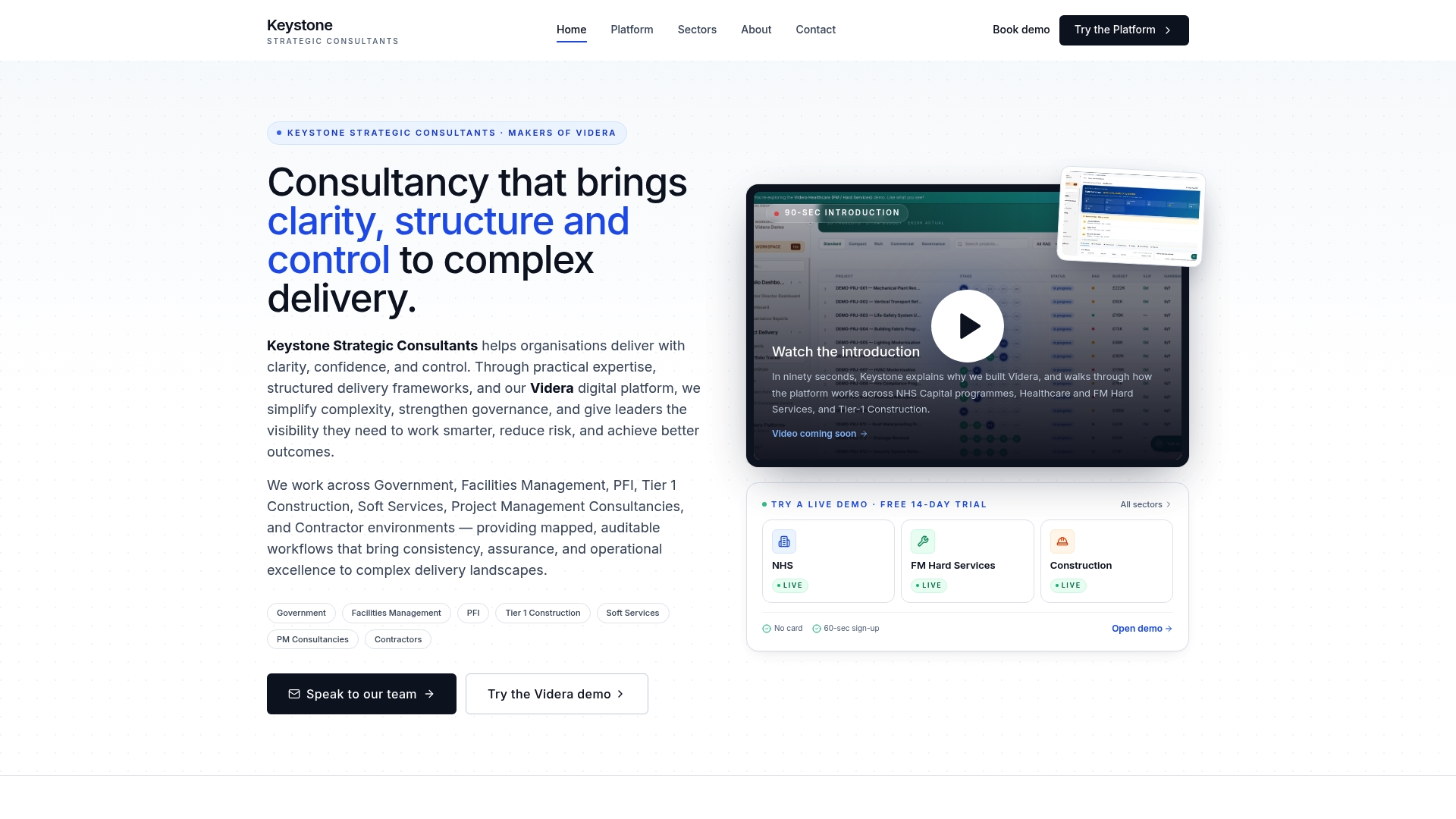
Keystoneconsulting's Videra platform brings mapped, auditable workflows, stage-gated project governance, and AI-powered board reporting to organisations in healthcare, construction, and facilities management. Where most project management tools leave governance design to the client, Videra builds it in from the start: audit-ready compliance tools, exception report automation, and configurable sector workspaces that reflect how your organisation actually operates. With 20 years of delivery experience, Keystoneconsulting integrates directly with your teams rather than handing over a licence and stepping back. For organisations moving away from Oracle's reporting model and needing to maintain governance continuity through the transition, that combination of platform and consultancy is a materially different proposition from buying another SaaS subscription.