
Good digital transformation governance delivers four things: strategic alignment between technology spend and business priorities, decision velocity fast enough to match delivery pace, controllable risk across cyber, regulatory and supplier exposure, and measurable value realisation. The board owns oversight, an executive sponsor or digital transformation office carries accountability day to day, and the immediate action is simple: charter the oversight body and adopt a small dashboard of KPIs before the next quarter starts.
TL;DR:
- A governance model must include clear decision rights, risk prioritization, and benefits tracking to prevent disconnected projects and ensure strategic alignment.
- The steering committee, digital PMO, and delivery teams should have distinct roles with structured routines and automated reporting to improve decision speed and transparency.
- Use five KPIs—strategic alignment, value realization, decision velocity, risk mitigation, stakeholder satisfaction—to monitor governance effectiveness without operational overload.
- Implement a governance framework within 6 to 8 weeks by mapping decision rights, piloting on a small portfolio, and automating reporting before scaling.
- Avoid over-controlling structures, unclear decision ownership, fragmented reporting, and focusing only on milestones rather than actual value delivery.
Table of Contents
- What is digital transformation governance?
- Why does governance matter for transformation success?
- Core components of an effective governance model
- Which governance bodies should own which decisions?
- How should the operating model coordinate governance day to day?
- What metrics show whether governance is actually working?
- How do you implement governance from scratch?
- What pitfalls cause governance to fail?
- How Keystone applies mapped workflows to governance
- What should boards do next?
- A practical route to closing governance gaps
- Sources
- FAQ
What is digital transformation governance?
Digital transformation governance is the set of institutional arrangements, decision rights and policy levers that connect strategic intent to actual delivery. The OECD's E-Leaders handbook frames it as legal and administrative structures working alongside institutional models to keep strategy and execution aligned, a definition that applies just as well to a hospital trust as to a national ministry.
It differs from traditional IT governance in three ways:
- It spans functions rather than sitting inside IT: finance, operations, HR and clinical or field teams all hold stakes in outcomes.
- It prioritises speed and benefits realisation over pure compliance checking.
- It carries explicit ethical and data stewardship duties that legacy IT frameworks rarely addressed.
Governance for digital transformation typically reports through a board oversight committee, into an executive sponsor or digital transformation office (DTO), and out to a portfolio-level PMO.
Why does governance matter for transformation success?
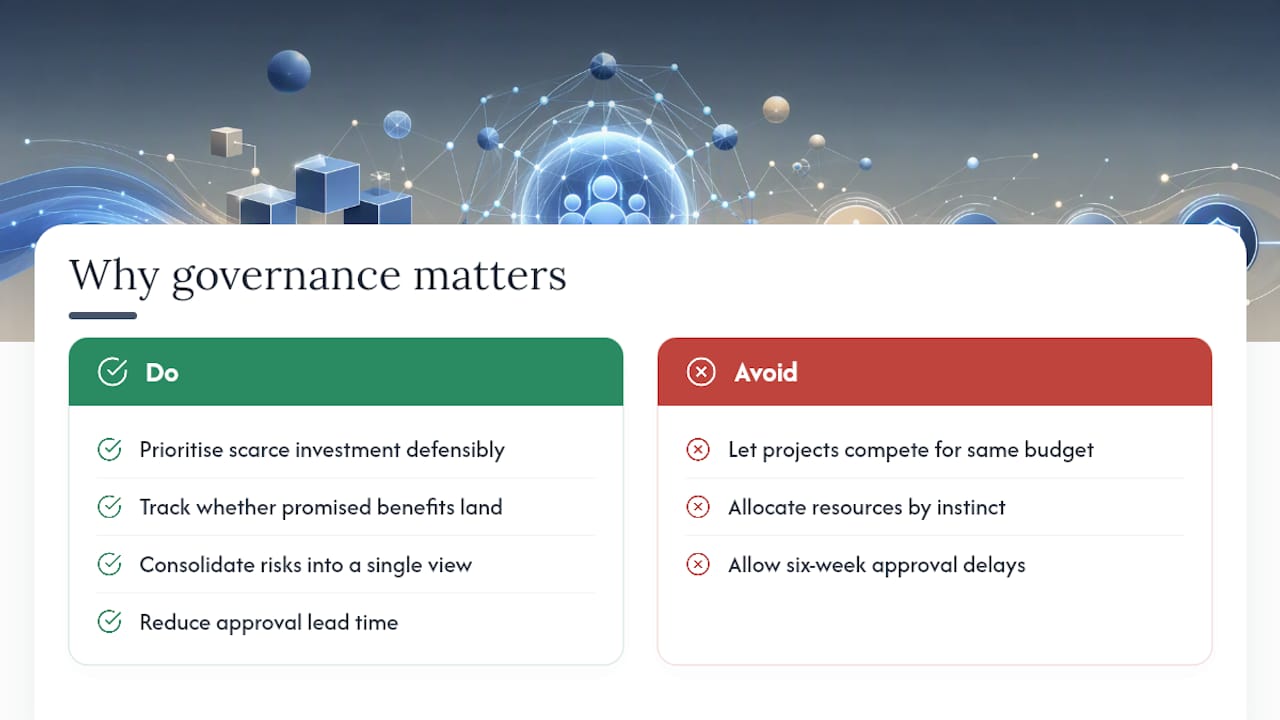
Governance matters because it is the mechanism that stops a transformation portfolio turning into a collection of disconnected projects competing for the same budget. It gives the board a defensible way to prioritise scarce investment, tracks whether promised benefits actually land, and keeps an eye on cyber, regulatory, delivery and supplier risk in one place rather than four.
MIT Sloan's research on digital governance is blunt about the underlying problem: most leadership teams lack a complete picture of their own initiative portfolio, which means resources get allocated on instinct rather than evidence. Decision velocity belongs on that list too. A governance model that takes six weeks to approve a scope change is not protecting the organisation; it is starving delivery of momentum.
Core components of an effective governance model
Five components recur across working models, whether the organisation runs hospitals, construction programmes or government services.
- Leadership and ownership. The board sets risk appetite and strategic intent; an executive sponsor or DTO holds the mandate to act on it.
- Decision rights. A written map of which decisions sit with the board, the sponsor, the PMO and individual delivery teams, so nobody guesses who signs off what.
- Portfolio and prioritisation. Funding gates and stage-gates that force every initiative to justify its place against explicit criteria, not internal politics.
- Policy levers and standards. Data governance rules, architecture principles and procurement standards that apply consistently across the portfolio. EDUCAUSE argues that transformation without data governance is effectively ungoverned, because nobody can trust the numbers driving decisions.
- Benefits realisation and change management. Mechanisms that track whether promised value actually materialises, and that manage the human side of adoption alongside the technical rollout.
Skip any one of these and the model tends to fail in a predictable place: unclear ownership breeds slow escalation, weak policy levers produce inconsistent data, and no benefits tracking means nobody ever finds out whether the transformation worked.
Which governance bodies should own which decisions?
Three bodies typically carry the weight of a governance model for digital transformation, and confusing their remits is one of the fastest ways to stall a programme.
The steering committee usually meets monthly, sits above individual project boards, and holds authority over portfolio prioritisation, major scope changes and cross-functional risk. Membership should include the executive sponsor, senior business-unit leaders, the CIO or CDO, and a finance representative who can speak to budget trade-offs.
The digital or enterprise PMO operates one level down. It owns portfolio reporting, tracks interdependencies between initiatives, and escalates only what genuinely needs steering committee attention. This differs from a delivery PMO, which manages individual project execution and reports up into the enterprise PMO rather than directly to the board.
A working RACI split looks roughly like this:
- Board: approves overall investment envelope and risk appetite.
- Steering committee: approves scope changes above a set threshold and resolves cross-portfolio conflicts.
- Digital/enterprise PMO: monitors delivery health and produces the consolidated portfolio view.
- Delivery teams: execute against approved scope and flag issues early.
Practitioner guidance from CIOPages on governance frameworks reinforces this separation: keep strategic prioritisation with the steering layer and operational oversight with the PMO, with clear escalation paths connecting the two.
How should the operating model coordinate governance day to day?
The routines matter as much as the org chart. A steering committee that meets without a disciplined agenda drifts into status updates instead of decisions, which defeats the point of having a governance body at all.
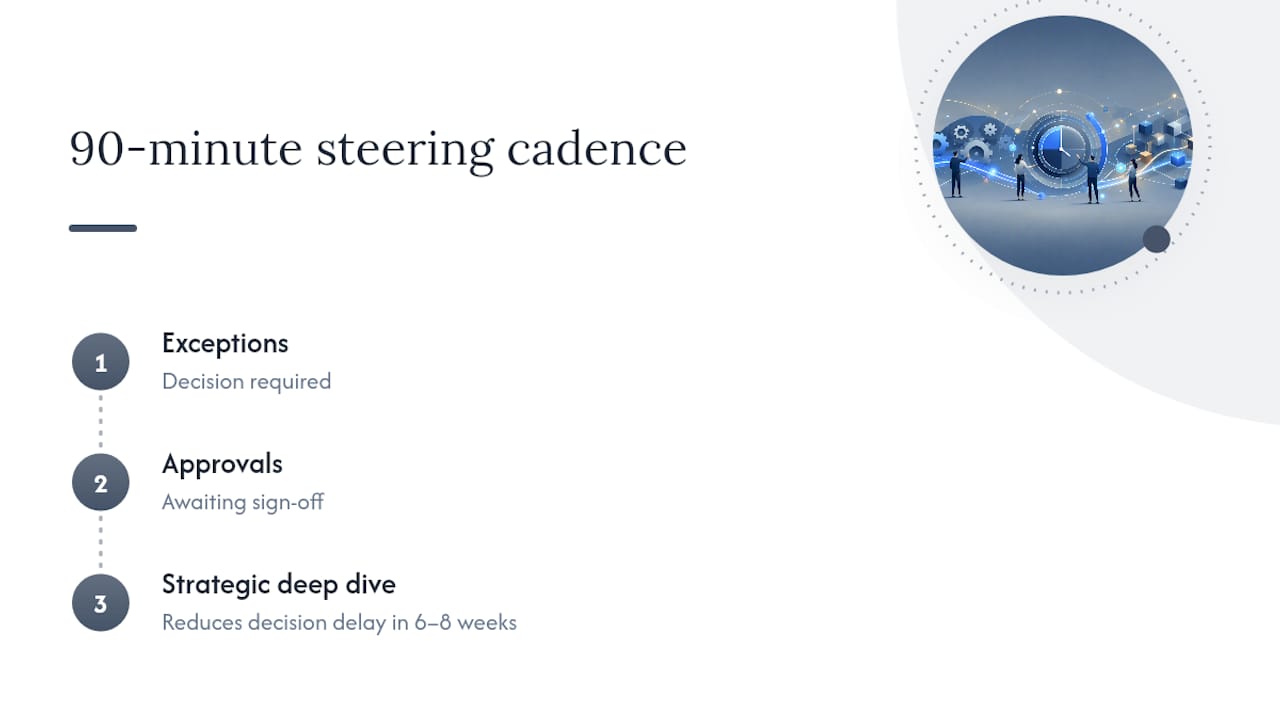
A 90-minute cadence built around three fixed items works well in practice: exceptions requiring a decision, approvals awaiting sign-off, and one strategic deep dive per session. That structure alone can cut decision delay measurably within 6 to 8 weeks when organisations commit to it consistently rather than treating it as a one-off fix.
Beyond meetings, the operating model needs a single source of truth. Fragmented spreadsheets across three departments guarantee that the board sees three different versions of portfolio health. Mapped workflows and automated reporting remove much of the manual collation that traditionally eats a PMO's week, and they make escalation rules enforceable because exceptions surface automatically rather than depending on someone remembering to flag them.
Pro Tip: Set a hard rule that nothing reaches the steering committee agenda unless it has already been triaged by the PMO. Committees that see everything decide nothing well.
What metrics show whether governance is actually working?
Five KPIs give a board enough signal without pulling it into operational detail it has no business managing:
- Strategic alignment score: the share of active initiatives mapped directly to a stated strategic priority.
- Value realisation rate: benefits actually delivered against benefits originally forecast.
- Decision velocity: average time from issue raised to decision made.
- Risk mitigation effectiveness: open high-severity risks and how quickly they close.
- Stakeholder satisfaction: a simple pulse check across business-unit leaders and delivery teams.
Board dashboards should show trend lines and thresholds, not the underlying detail; that detail lives in PMO drill-downs the sponsor can pull on demand. A 2026 study by Irlon et al. found that IS governance frameworks embedding agile leadership and data-driven decision rules improve both decision quality and strategic alignment, which is a reasonable argument for keeping the KPI set data-driven rather than anecdotal. Set exception thresholds explicitly, so a KPI breach triggers automatic escalation rather than waiting for someone to notice.
How do you implement governance from scratch?
Organisations without a working governance model rarely need a full year to fix it. A sequenced approach gets a functioning model live within a quarter.
- Run a maturity diagnostic. Map current decision rights, reporting flows and known bottlenecks before designing anything new. Most gaps are painfully obvious once written down.
- Design the charter. Define roles, decision rights, the initial KPI set and a written steering committee mandate, including meeting cadence and escalation thresholds.
- Pilot on a limited portfolio. Test the model against three or four initiatives rather than the entire programme at once, and adjust the cadence and reporting format based on what actually gets used.
- Automate reporting before scaling. Manual reporting collapses under portfolio growth. Get automated dashboards working at pilot scale first.
- Scale and audit periodically. Roll the model across the full portfolio and schedule a governance audit every six to twelve months to catch drift before it becomes dysfunction.
The sequencing matters more than the individual steps. Organisations that design the full charter before piloting anything tend to over-engineer the model, building approval layers for problems that never materialise. Piloting first, then formalising what worked, produces leaner governance that people actually follow.
What pitfalls cause governance to fail?
Four mistakes explain most governance failures worth studying.
- Over-controlling governance. Adding approval layers to feel safe slows delivery without reducing real risk. MIT Sloan's research argues governance should actively enable teams and remove blockers rather than default to compliance-only control.
- Ambiguous decision rights. When nobody knows who can approve a scope change, everything escalates to the board by default, and decision velocity collapses.
- Fragmented reporting. Multiple versions of portfolio truth erode trust faster than any single missed deadline.
- Measuring outputs instead of outcomes. Tracking milestones hit tells you nothing about whether the transformation delivered value; move the KPI set towards realisation and decision quality instead.
How Keystone applies mapped workflows to governance
Twenty years of watching organisations in healthcare, construction and facilities management wrestle with the same governance failures teaches a consistent lesson: reporting bottlenecks, not strategy, usually kill transformation programmes. Boards rarely lack ambition. They lack a reliable, current picture of what is actually happening across the portfolio.
A digital platform addresses that gap directly through mapped workflows that make handoffs explicit and AI-powered reporting that assembles audit-ready evidence without a PMO spending its week chasing spreadsheets. Readers building a governance-first delivery model may find the construction delivery process improvement guide and the roadmap on AI for governance useful next steps for implementation detail beyond this article.
What should boards do next?
Charter or refresh your steering committee this quarter and confirm its mandate in writing. Adopt a five-metric KPI dashboard now, not next year. Assign a named executive sponsor and run a 6 to 8 week governance diagnostic before committing to any larger redesign.
— Peter
A practical route to closing governance gaps
Everything above describes what a working governance model needs: mapped decision rights, a single reporting source, and evidence the board can actually trust. Building that from spreadsheets and goodwill is possible, but it is slow, and most PMOs are already stretched thin trying to hold the current portfolio together.
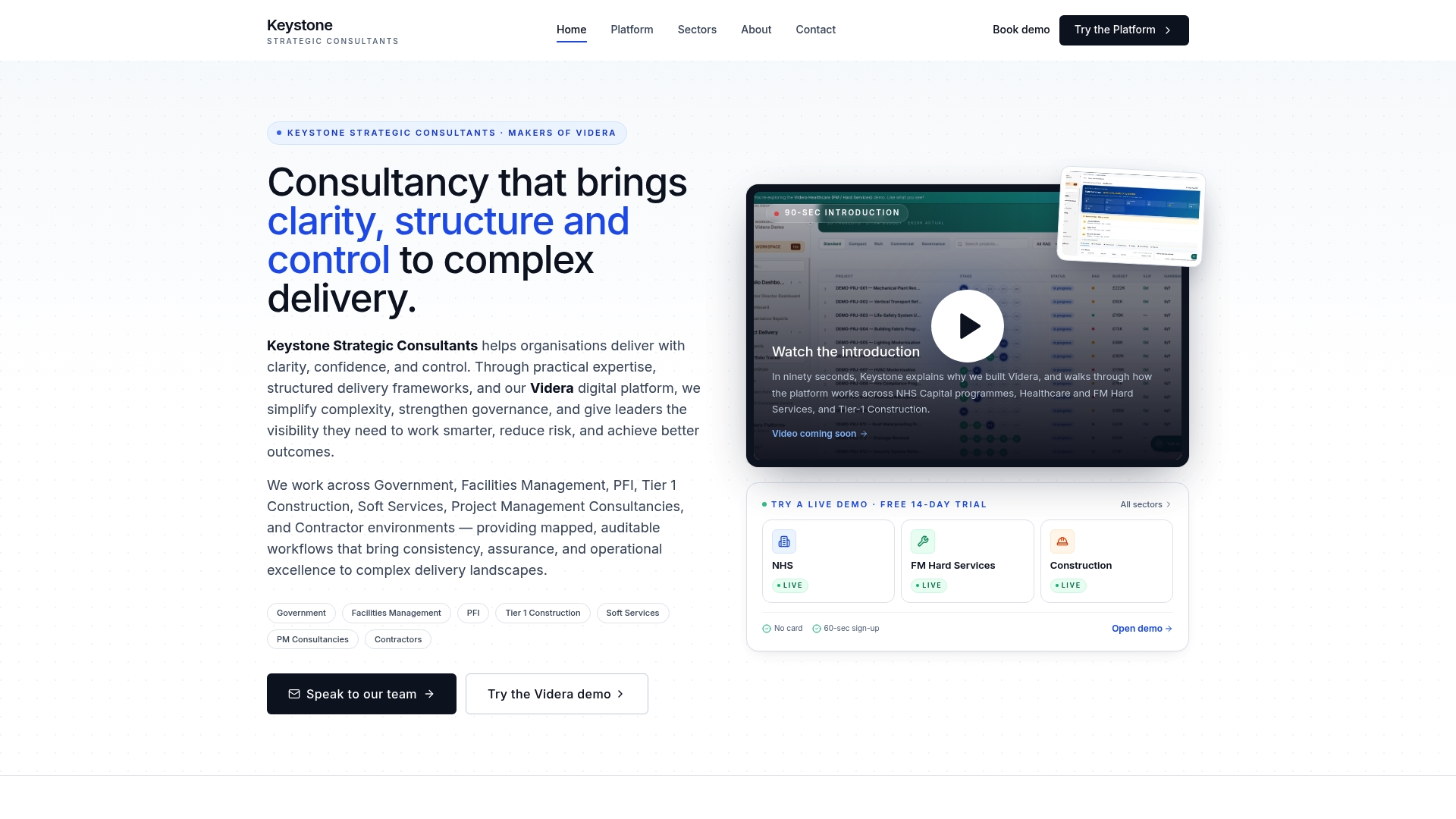
A consultancy exists for organisations in healthcare, construction, government and facilities management that need that governance model built and running, not just described. The Videra PM platform turns mapped workflows into a working system: stage-gated approvals, automated exception reporting and audit-ready evidence generated as work happens rather than reconstructed under deadline pressure. For sector-specific need, the Videra Healthcare platform supports NHS project and lifecycle governance directly. Boards weighing consultancy versus platform investment can also draw on this guide to thought leadership and stakeholder communication when framing the case internally. If your steering committee still relies on manually assembled reports, get in touch through Keystoneconsulting's delivery governance page to scope a diagnostic against your current portfolio.
Sources
- The E‑Leaders handbook on the governance of digital government (OECD)
- 7 key principles to govern digital initiatives (MIT Sloan)
- Information systems governance framework for supporting organisational decision making in digital transformation initiatives (2026 DOI)
FAQ
What is digital transformation governance?
It is the institutional arrangements, decision rights and policy levers that keep transformation strategy connected to actual delivery, spanning finance, operations and technology rather than sitting solely within IT.
How is it different from IT governance?
IT governance traditionally focuses on infrastructure and systems control; digital transformation governance covers cross-functional decision rights, benefits realisation and ethical data use across the whole organisation.
Who should sit on a digital transformation steering committee?
The executive sponsor, senior business-unit leaders, the CIO or CDO and a finance representative able to weigh budget trade-offs against strategic priorities.
What KPIs should a board track for governance effectiveness?
A strategic alignment score, value realisation rate, decision velocity, risk mitigation effectiveness and stakeholder satisfaction give the board sufficient oversight without operational micromanagement.
How long does it take to implement a governance model?
A maturity diagnostic and charter design typically take 6 to 8 weeks, followed by a limited pilot before scaling; platforms like Videra can shorten the reporting automation step considerably.