
AI for governance means AI-enabled reporting and workflow controls that enforce compliance, audit-readiness and oversight across a programme, rather than another dashboard bolted onto existing chaos. The right first move is never a technology purchase. It's naming a sponsor, forming an oversight committee and defining a short pilot-to-scale checklist before a single workflow goes live. Keystone Strategic Consultants builds this into every Videra deployment, drawing on principles found in ISO 31000 risk management and the reporting disciplines used across NHS trusts and comparable public bodies.
- Governance ownership must exist before activation, not after the first incident.
- A pilot-to-scale checklist should cover data readiness, integration points and escalation routes.
- Named entities matter here: the framework, the sponsor and the audit trail all need a name attached, not a department.
Key Takeaways
Effective AI for governance combines a named institutional owner, six governance modules, auditable logging and vendor contract clauses that survive a real audit, not just a sales demo.
| Point | Details |
|---|---|
| Ownership comes first | Name a sponsor and cross-functional committee before any pilot begins. |
| Score the six modules | Rate institutional carrier, infrastructure, regulatory, coordination, scaling and lifecycle readiness honestly. |
| Buy contract evidence, not promises | Insist on model cards, logging access and incident notification timelines in writing. |
| Track KPIs quarterly | Report maturity score, vendor concentration and incident summary as trend lines, not snapshots. |
| Consult-plus-platform closes the gap | Keystone and Videra combine governance design with mapped workflows and audit-ready reporting to move pilots into routine use. |
Table of Contents
- What does AI for governance actually change day to day?
- The six governance modules your organisation must satisfy before activation
- Should you buy, build or buy and consult?
- A 7-step roadmap from pilot to sustained operation
- What technical foundations does the platform need?
- Which contract clauses protect you during an audit?
- Which KPIs matter to the board versus the programme owner?
- What does a governance-first rollout actually look like in practice?
- Where pilots quietly fail, and how to stop it
- How Keystone and Videra take this from checklist to routine practice
- Frequently asked questions
- Sources
What does AI for governance actually change day to day?
Continuous, AI-enabled governance shifts decisions from quarterly reviews to near real-time flags. Instead of a compliance officer discovering a missed inspection three months late, the system surfaces the gap the week it happens, routed to whoever owns the exception.
That timing shift is the entire value proposition. A systematic review of AI governance frameworks across health systems found six recurring process areas doing the heavy lifting: need identification, data governance, risk assessment, validation, monitoring and integration. When those six run continuously rather than periodically, three things follow:
- Pattern detection across source systems catches drift or non-compliance before it becomes an incident.
- Automated audit trails remove the scramble to reconstruct decisions after the fact.
- Board reports write themselves from live data instead of a manual roll-up the week before the meeting.
The failure modes are predictable, too. Organisations fall into what sector reporting calls the pilot trap: a promising trial with no financing plan or clear owner, so it quietly dies. The fix is cheap compared with the cost of restarting: assign ownership and budget before the pilot begins, not after it succeeds.
The six governance modules your organisation must satisfy before activation
A governance framework built for scaling clinical AI deployments identifies six interdependent modules that separate organisations stuck in permanent pilot mode from those running AI-enabled governance as routine business. Score yourself against each before you sign anything.
- Institutional carrier. Someone senior owns this beyond the project's life. In a hospital trust, that's typically a digital governance director, not a project manager who rotates off in six months.
- Infrastructure governance. Data pipelines, access controls and system architecture exist and are documented, not assumed. A construction firm running site inspections through five disconnected apps fails this test immediately.
- Regulatory and ethical governance. Policies map to actual obligations, whether that's CQC standards in healthcare or planning regulations in construction.
- Interdisciplinary coordination. Operations, compliance and data teams sit on the same committee, not in separate silos exchanging emails.
- Translational scaling. A plan exists for moving from one pilot site or department to the wider organisation, with defined milestones.
- Lifecycle evaluation. Someone reviews performance and drift on a schedule, not only when something breaks.
Pro Tip: Score each module from 1 to 5 honestly, then fix your lowest score first. Most organisations discover their weakest link is institutional carrier, not technology, which is exactly backwards from where they spend their budget.
Should you buy, build or buy and consult?
For most enterprises, buy-plus-consult beats either extreme. Building in-house governance tooling from scratch takes specialist engineering resource that healthcare trusts, construction firms and government programmes rarely staff permanently, and buying a platform with no implementation support just relocates the pilot trap into a licence fee.
A procurement checklist worth insisting on:
- Data readiness: can the vendor demonstrate a working data pipeline against your actual systems, not a demo environment?
- Integration points: does it connect to your EMR, ERP or existing case management system without custom engineering on your side?
- Vendor transparency artefacts: will they hand over model cards, logging access and version-control records on request?
- Vendor concentration: how many of your critical workflows would depend on this one provider, and what happens if their underlying model changes or drifts?
Contract clauses to insist on before signature:
- Evidence and audit cooperation clauses, not vague "compliance assured" language.
- Logging access that survives a contract dispute, not one the vendor can revoke.
- Incident notification timelines measured in hours, not "as soon as reasonably practicable."
- Red flag: any vendor unwilling to name their sub-processors or explain override logging is one to walk away from.
A 7-step roadmap from pilot to sustained operation
Moving from a promising trial to routine, auditable use takes seven distinct steps, each with its own owner and deliverable.
- Sponsor and charter (weeks 1 to 4). Named executive sponsor, written charter, budget line agreed. KPI: charter signed off by the board.
- Committee formation (weeks 2 to 6). Cross-functional group spanning operations, compliance and data, echoing the committee model an industry review of enterprise AI in healthcare recommends to independently check vendor claims against local data. KPI: committee meets fortnightly.
- Data and integration mapping (weeks 4 to 10). Technical lead documents every source system feeding the platform. KPI: integration map signed off.
- Pilot scope and success criteria (weeks 6 to 10). Programme owner sets the pilot's boundaries and the metrics that define success. KPI: agreed acceptance thresholds.
- Pilot run (weeks 10 to 18). Live but limited deployment with daily monitoring. KPI: error and override rates tracked weekly.
- Scale decision and rollout plan (weeks 16 to 20). Committee reviews pilot evidence and approves phased expansion. KPI: rollout plan with department-by-department dates.
- Routine operation and lifecycle review (ongoing from week 20). Quarterly review cycle, drift monitoring, override log audits.
- Someone must review flagged outputs before they reach a decision maker.
- Override protocols need a named approver, not a shared inbox.
- Audit logs should be tamper-evident and stored independently of the vendor's own systems.
What technical foundations does the platform need?
Before any vendor demo, technical leads should have five non-negotiables ready to test against: a unified data model or clear canonical mapping across source systems, a secure API layer, proper identity and access controls, full observability and logging, and knowledge controls for any AI copilots pulling from your documents.
A vendor evaluation checklist worth running line by line:
- Data lineage: can they trace a report back to its source record?
- Schema mapping: how much custom work does your EMR or ERP connector actually need?
- Audit trails: are logs exportable in a format your auditors can actually use?
- Model update controls: who approves a model change, and how is drift monitored afterwards?
- Version control: can you see exactly which model version produced a given report six months ago?
For document-heavy workflows, especially construction approvals or planning submissions, retrieval-augmented generation grounded in a governed knowledge layer cuts hallucination risk and keeps a traceable source trail. Cybersecurity teams evaluating agentic AI components should also weigh the endpoint governance controls that agent-based copilots demand, since these tools act rather than merely report.
Pro Tip: Ask for a live audit trail export during the demo itself, not a promise it exists. If the vendor can't produce one on the spot, it probably doesn't work the way the sales deck claims.
Which contract clauses protect you during an audit?
Eight clauses belong in every statement of work before signature, based on the committee charter and reporting templates recommended in the AI Cyber Governance Framework implementation guide:
- Model cards describing training data, intended use and known limitations.
- Logging access that persists independently of the vendor relationship.
- Incident notification timelines specified in hours.
- Update and change control requiring advance notice of model changes.
- Data return and destruction terms on contract exit.
- Audit support obligations, including staff time for auditor queries.
- Liability allocation for governance failures traceable to the tool.
- Decommissioning procedures that don't leave orphaned data behind.
During procurement demos, ask for three things directly:
- An accessible, exportable log from a real (not simulated) session.
- A reproducible audit trail for a single decision, start to finish.
- Sample version-control records showing at least one historic model change.
Store this evidence centrally, outside the vendor's own portal, so it survives a contract dispute or vendor exit.
Which KPIs matter to the board versus the programme owner?
Boards typically require regular reports covering inventory trends, incident summaries, vendor concentration exposure, and governance maturity assessments.
Programme owners require operational metrics such as accuracy of flagged exceptions, resolution times, adoption rates of governance workflows versus informal processes, and approval turnaround times since implementation.
- Trend lines matter more than point-in-time snapshots for maturity score and adoption rate.
- Incident counts and vendor concentration should be reported both as a snapshot and against the prior quarter.
- A board reporting template built around these categories saves programme owners hours of manual slide preparation each quarter.
What does a governance-first rollout actually look like in practice?
A governance-first approach moves from pilot to routine operation with integration into daily workflows, logged audit records and version-control history intact from day one, rather than retrofitted after an incident forces the issue.
- Timeline: charter and committee formed in month one, pilot live by month three, department-wide rollout by month six.
- Scale: dozens of workflows integrated across reporting, approvals and compliance tracking rather than a single isolated use case.
- Governance artefacts delivered: signed charter, standing committee with fortnightly cadence, exportable audit logs, board dashboard refreshed quarterly.
A consult-plus-platform engagement of this kind typically delivers a governance charter, integration adapters for existing EMR or ERP systems, audit trail reporting, and a board dashboard built around the KPIs above. Keystone documents this pattern across construction delivery and healthcare engagements built on the same six-module structure.
Where pilots quietly fail, and how to stop it
The single most common pitfall is treating governance as something to sort out after the pilot proves itself. By then the workarounds are baked in and the fix costs three times as much.
- Name the sponsor and committee before writing a single line of the pilot scope.
- Insist on audit-ready logging from day one, not as a phase-two addition.
- Track override rates weekly during the pilot; a rising trend means the model or the process needs attention, not more patience.
How Keystone and Videra take this from checklist to routine practice
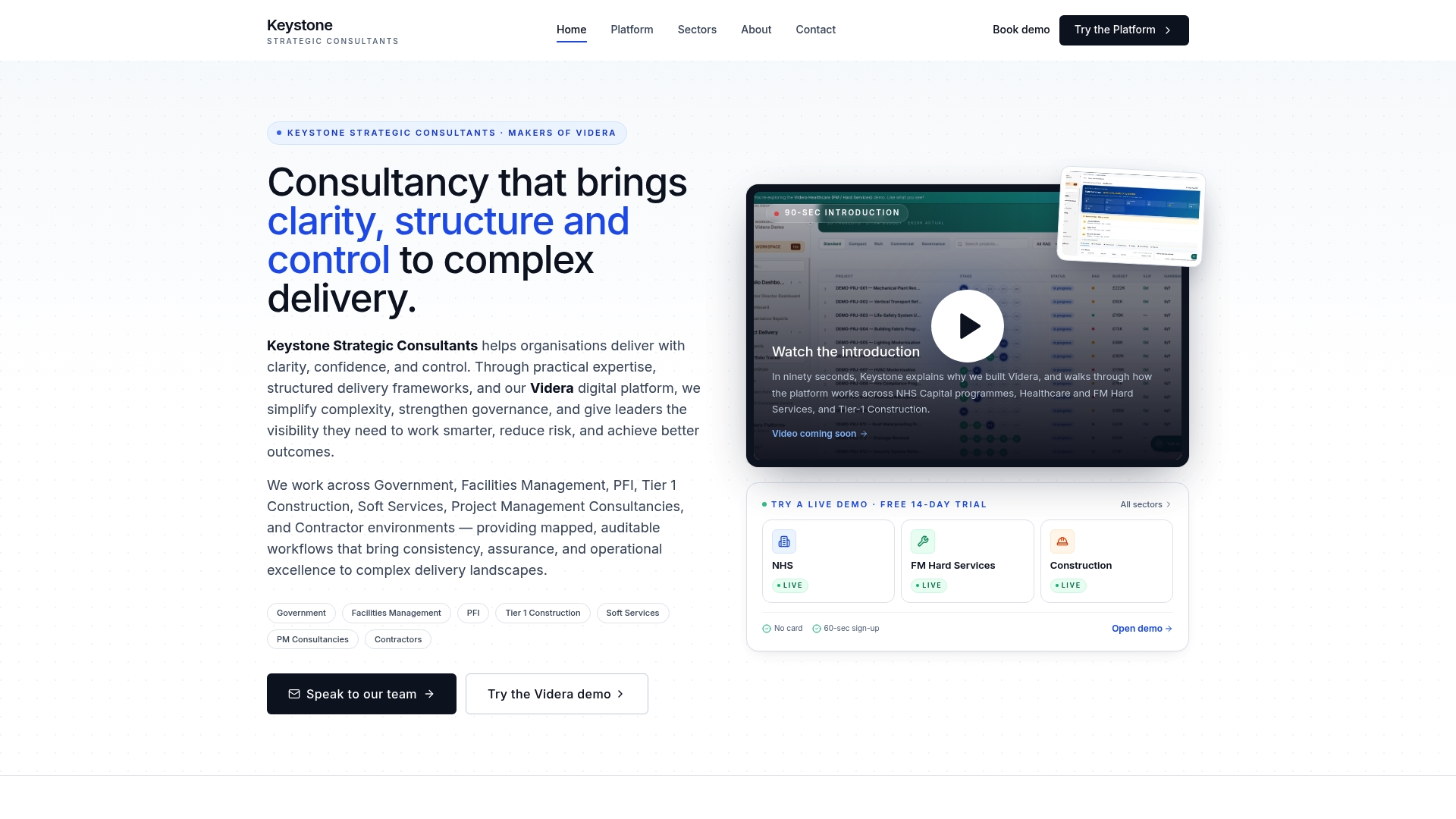
Keystone pairs governance design with the Videra platform to turn everything above into a working system rather than a policy document nobody reads. That's the practical difference: most vendors sell software and leave the organisational work to you; Keystone builds the committee charter, the workflow maps and the platform integration together, so the audit trail exists from week one instead of being reverse-engineered after an incident.
Three things this typically delivers for a new client:
- A governance charter and cross-functional committee structure, set up in weeks rather than months.
- Platform integration mapped to your existing EMR, ERP or case management systems, not a bolt-on dashboard.
- Board reporting automation that turns the KPIs above into a quarterly pack, not a manual slide deck.
If you're weighing up a pilot against a full rollout, request a procurement pack or a demo through the Keystone Strategic Consultants site, and bring your current governance gaps to the conversation. It shortens the scoping call considerably.
Frequently asked questions
What is AI for governance in practical terms? It's AI-enabled reporting and workflow tooling that enforces compliance, tracks audit trails and flags exceptions continuously, replacing periodic manual reviews with near real-time oversight.
How long does it take to move from pilot to routine use? Based on the seven-step roadmap above, most organisations reach department-wide rollout within six months of forming a committee, assuming ownership and budget are settled from week one.
What's the biggest reason AI governance pilots fail? Unresolved ownership, financing or operational responsibility before deployment, commonly known as the pilot trap.
Do we need a dedicated AI governance committee, or can existing compliance staff cover it? A cross-functional committee spanning operations, data and compliance works better than folding it into an existing team, since independent validation of vendor claims against your own data is the whole point.
What should we ask vendors for during a procurement demo? A live, exportable audit log, a reproducible audit trail for one decision, and sample version-control records showing at least one historic model update.
Sources
- Scaling enterprise AI in healthcare: the role of governance in risk mitigation frameworks - PMC
- From pilot trap to institutional capacity: A governance framework for sustainable clinical AI implementation in health systems