
A construction governance framework is the structure of roles, decisions, policies and reporting that keeps a project accountable to its cost, schedule and quality commitments. The single most important move is to appoint one person with single-point accountability and set credible cost and schedule baselines, tested with schedule risk analysis, before work begins. We ground this guide in ISO 6082:2025 and GAO best practices, drawing on extensive delivery experience in the sector.
TL;DR:
- Proper governance requires appointing a single accountable owner for cost and schedule baselines, which must be stress-tested and linked to a credible risk analysis.
- A tiered decision-making structure with clear delegation, rather than a single committee with all stakeholders, prevents governance overload and improves decision clarity.
- Stage gates should be used to review evidence and only escalate issues when triggers are met, with independent assurance focused on high-risk points like procurement and delivery readiness.
- Baselines need to be validated through testing and risk analysis, with cost tracking via earned value management and schedule risk analysis to reflect realistic contingencies.
- Governance activities should adapt across project phases: strategic controls during planning, operational oversight during delivery, and acceptance checks at handover.
Table of Contents
- What makes a governance framework actually work
- Who sits where: roles, boards and single-point accountability
- Using stage gates to govern without micromanaging
- Keeping cost and schedule baselines credible
- Building safety and compliance into the governance routine
- A phased rollout checklist for implementation
- How governance activity should shift across the project lifecycle
- Common governance failures and how we fix them
- Governed delivery with Videra and Keystone consultancy
- FAQ
- Sources
- Primary standards and guidance referenced
What makes a governance framework actually work
Most frameworks fail not because they lack policies but because nobody owns the decisions those policies demand. An effective framework rests on a small number of components that each do a distinct job, and each maps onto recognised guidance rather than internal invention.
- Purpose and scope: a one-page statement of what the governance structure controls and what it leaves to delivery teams.
- Authority and accountability: a named decision owner for every gate, backed by a delegation schedule.
- Policies and controls: the rules for change, procurement and risk sign-off, written down before they are needed.
- Reporting: a fixed cadence of structured reports, not ad hoc updates triggered by crisis.
- Risk and assurance: a live risk register tied to the schedule, plus periodic independent review.
ISO 6082:2025 frames these components around client leadership and audit-capable control, insisting that governance responsibilities stay visible through decision gates rather than being absorbed into day-to-day management. The GAO Schedule Assessment Guide adds a complementary discipline: baselines only count as governance tools when they are credible, which means they have been stress-tested rather than simply approved.
A quick self-assessment: can you name, right now, who owns the cost baseline, who owns the schedule baseline and who can stop the project at the next gate? If any answer is "the project manager handles it", the framework has a gap.
Pro Tip: Write the decision authority matrix before the kick-off meeting, not after the first dispute.
Who sits where: roles, boards and single-point accountability
Governance structures collapse under their own weight when every stakeholder sits on the same board. The fix is a tiered structure with clear delegation, not a bigger committee.
- Steering committee: sets strategic direction, approves major funding changes, meets infrequently.
- Single-point accountable owner: one named individual who answers for cost, schedule and scope between gates.
- Project board: operational oversight, reviews reporting packs, escalates only exceptions.
- Delegated authorities: pre-agreed limits (spend, variation value, schedule slip) below which the project delivery manager can act without escalation.
Single-point accountability means exactly one person, not a committee, carries responsibility for a decision domain. Escalation should be rule-based: a defined trigger (such as a cost variance beyond established thresholds or a critical-path slip beyond agreed limits) sends the issue upward automatically, rather than relying on someone to judge when to speak up. PMI's description of project governance treats this kind of clarity, instructions for issue handling and defined responsibilities, as the core reason governance improves project success rates.
A short role checklist helps here: name the accountable owner, define their spend and schedule delegation limits, confirm who chairs the board, and write down what triggers escalation versus what gets handled at delivery level. University capital project policies, such as Columbia's project governance framework, follow this same pattern for public capital works: defined roles and a standing steering body, scaled to project size rather than applied uniformly.
Using stage gates to govern without micromanaging
Gates exist so governance intervenes at defined points with the right evidence, not continuously. A well-designed gate structure typically includes:
- Concept and funding gate: confirms the business case and releases initial funding against a provisional baseline.
- Design and scope gate: locks scope definition and confirms the cost estimate basis before detailed design spend.
- Procurement gate: approves the contracting strategy and confirms budget alignment before tender award.
- Delivery readiness gate: checks the baseline schedule, risk register and safety sign-offs are complete before mobilisation.
- Acceptance and handover gate: confirms completion against scope, punch-list closure and commissioning evidence.
Each gate needs a defined trigger and a defined evidence pack: the current baseline, an updated risk register, safety sign-offs and, at later gates, commissioning records. Skipping evidence at a gate to save time is the most common way governance quietly stops functioning.
Independent assurance matters most at the gates with the highest financial or safety exposure, typically procurement and delivery readiness. GAO's 2026 findings on independent reviews warn that trimming independent checks to save time reduces confidence in cost and schedule estimates and delays the point at which problems surface, which is the opposite of what a gate is meant to achieve.

Keeping cost and schedule baselines credible
A baseline is only as useful as its credibility, which comes from testing, not approval; learning how to create accurate estimates that win more jobs is key to this process. The GAO Cost Estimating and Assessment Guide sets out the practices for producing a reliable cost estimate and ties that estimate directly to earned value management, so cost performance can be tracked against the plan rather than reconstructed after the fact.
A sourced principle worth repeating: GAO best practices hold that schedule risk analysis must be integrated with the schedule baseline so that contingency reflects a realistic view of slippage, not an optimistic one.
Earned value management (EVM) gives governance a small set of metrics, cost variance, schedule variance and the cost and schedule performance indices, that flag drift early enough to act on it. Governance does not need to track EVM data daily; it needs a reporting cadence that surfaces variance trends before they become unrecoverable.
Practical steps that make this work in delivery:
- Build a work breakdown structure (WBS) that aligns directly with the cost estimate, not a separate document.
- Develop an integrated master schedule (IMS) and validate the critical path independently of the team that built it.
- Run a schedule risk analysis before the baseline is locked, and again whenever scope changes materially.
- Maintain the baseline through a formal change control process rather than informal rebaselining.
Our internal guide on risk management in project delivery covers how to link schedule risk analysis to contingency sizing in more detail.
Building safety and compliance into the governance routine
Safety and compliance cannot sit outside governance as a separate reporting stream; they need to feed the same decision gates and reporting packs that cost and schedule use. Projects working under OSHA partnership arrangements are expected to run a formal safety management system that includes documented weekly inspections, project-specific incident logs and job hazard analyses for high-hazard tasks, and governance should treat these as standing inputs rather than exceptions.
Audit-ready controls share a few common features regardless of sector:
- A decision log that records what was decided, by whom, and against what evidence.
- An inspection log that ties each safety check to a date, inspector and outcome.
- An evidence library that stores sign-offs, risk assessments and change approvals in one retrievable place.
- A compliance reporting checklist that confirms, at each gate, that inspections and hazard analyses are current.
Our document control guide for project managers sets out how to structure these evidence trails so they hold up under external audit rather than only internal review.
A phased rollout checklist for implementation
Governance frameworks get adopted in stages, not installed overnight. A workable sequence:
- Define scope and outcomes: agree what the framework controls and what success looks like for this specific project.
- Design roles and gates: assign the accountable owner, build the board structure, and set gate triggers.
- Set baselines: lock the cost estimate, schedule and risk register through the testing steps described above.
- Pilot on a bounded phase: run the framework on one work package or phase before scaling it across the full programme.
- Measure and adjust: check reporting accuracy and escalation behaviour against what actually happened.
- Scale: extend the framework to the full project once the pilot confirms it works as intended.
Artefacts worth producing at each stage include a decision authority matrix, gate evidence templates, a standard reporting pack, an assurance plan setting out who reviews what and when, and a short training plan so new team members understand the escalation rules without needing a meeting to explain them.
Technology expectations follow naturally from this: an audit trail for every decision, a searchable decision log, and a fixed reporting cadence rather than one driven by whoever remembers to send an update. Our guide to construction workflow management software covers what to look for in a platform that can hold this structure without becoming another manual spreadsheet.
Pro Tip: Pilot the framework on the highest-risk work package, not the easiest one. That is where gaps show up fastest.
How governance activity should shift across the project lifecycle
Governance intensity should change shape as the project moves through planning, delivery and handover, not stay fixed from day one. In planning, the focus is strategic: locking the business case, setting baselines and confirming the governance structure itself. During delivery, the emphasis shifts to operational control and compliance, tracking variance against the baseline and keeping safety documentation current. At handover, governance narrows to acceptance evidence, punch-list closure and capturing lessons learned before the team disbands.
Practical adjustments across these stages:
- Shrink the steering committee's meeting frequency once baselines are locked and delivery is stable.
- Increase reporting frequency temporarily around major procurement events or scope changes.
- Deepen independent assurance whenever an audit finding or a schedule slip signals rising risk.
Governance that stays at one intensity throughout the project either smothers delivery early or misses problems late. GAO guidance frames this shift explicitly: strategic oversight in planning, auditable operational data capture during execution, and acceptance-focused checks at handover.
Common governance failures and how we fix them
Across healthcare, construction and facilities management sectors, the same failures recur: reporting bottlenecks where data arrives too late to act on, boards overloaded with every stakeholder instead of a tiered structure, and baselines approved without ever being stress-tested. A 2025 meta-analysis in the Journal of Construction Engineering and Management found that contractual governance matters but that trust and collaborative relationships have a strong positive effect on project performance, which suggests rigid controls alone are not the whole answer.
Our remedy is governance-first mapping: design the decision structure and evidence trail before delivery starts, stage assurance at the gates that carry real risk, and keep every decision audit-ready from the outset rather than reconstructed later. We set this out further in our piece on governance-first delivery process improvement and in the Videra Construction workspace examples.
— Peter
Governed delivery with Videra and Keystone consultancy
We built Videra to hold the decision authority matrix, gate templates and reporting pack in one place, with automated reporting and an audit trail that updates as decisions happen rather than being reconstructed at the next review. Videra Construction maps workflows from bid through to handover so the evidence a gate needs is already attached to the decision, not chased down afterwards.
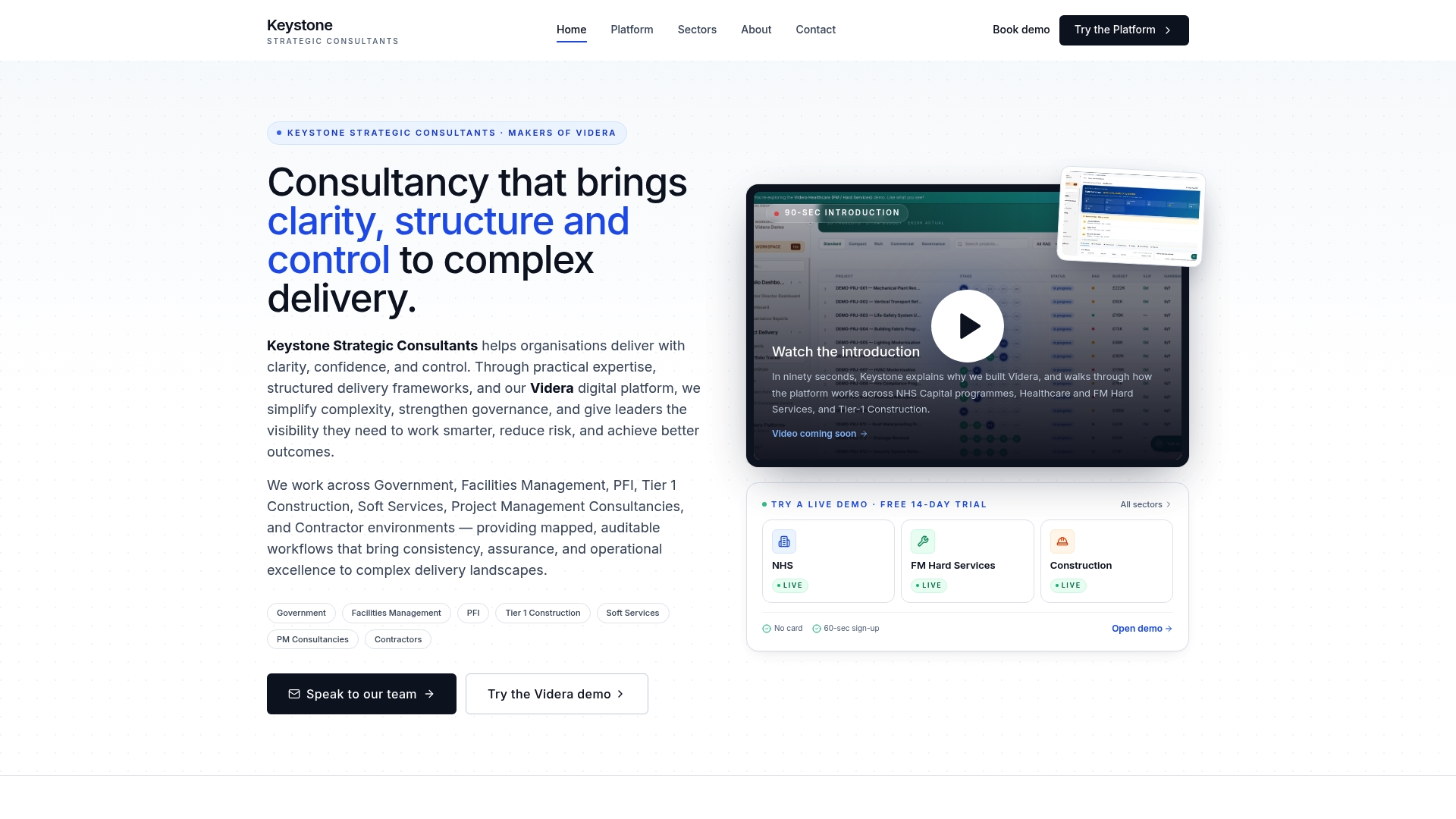
Where a project carries public funds, significant regulatory exposure or needs to repeat the same governance model across multiple sites, bringing in our consultancy alongside the platform tends to close gaps faster than adopting software alone. We integrate directly with your delivery team rather than handing over a generic template, so the framework fits the project rather than the other way round.
If you want to see how this looks against your own project structure, book a governance diagnostic through Videra PM and we will walk through where your current gates and reporting already hold up and where they do not.
FAQ
What are the 7 pillars of effective governance?
Definitions vary across sectors, but a common construction-focused version includes purpose, accountability, policies, reporting, risk management, assurance and controls. Each pillar maps to a specific question: who decides, on what evidence, and how is that decision recorded.
What are the 5 S's of governance?
There is no single, widely recognised "5 S's" model in construction governance standards such as ISO 6082:2025 or GAO guidance. Readers encountering this term elsewhere should check the source's own definition rather than assume a standard meaning.
What is an example of a governance framework?
A typical example pairs a steering committee and project board with a staged-gate process, where funding, procurement and acceptance gates each require a tested cost and schedule baseline plus a current risk register before approval. Public capital project policies, such as university construction governance frameworks, often follow this same tiered structure.
What are the 7 principles of good governance?
Commonly cited principles include accountability, transparency, participation, rule of law, effectiveness, responsiveness and consensus orientation, though exact lists vary by source and sector. In construction specifically, PMI's governance framework focuses this down to defined responsibilities, clear escalation rules and structured reporting as the practical core.
How does Keystone's Videra platform support governance reporting?
Videra maps project workflows into gate templates and reporting packs so decisions and evidence are captured as they happen rather than reconstructed later. The platform is offered through product lines including Videra Construction and Videra PM, with pricing available on request.
Sources
- GAO Schedule Assessment Guide: Best Practices for Project Schedules
- ISO 6082:2025 - Construction project governance — Guidance on delivery management
- Meta-analysis on governance and trust in construction project performance