
For UK organisations in healthcare, construction, and facilities management, Videra from Keystoneconsulting is the recommended board reporting automation solution: governance-first, audit-ready, and built to deliver decision-ready packs rather than backward-looking data dumps. The single most useful next step is to book a focused discovery session with Keystoneconsulting to scope a pilot around one complete board cycle.
Videra earns that recommendation on three grounds: traceable data lineage from source systems through to the board pack, live integrations that keep figures current without manual exports, and AI-generated narratives that flag decisions rather than just describe outcomes.
Table of Contents
- Why should governance-driven organisations automate board reporting now?
- How do you choose the right board reporting automation software?
- What core features does a sector-ready solution need?
- What does a realistic implementation timeline look like for UK organisations?
- How do you calculate the ROI of automated board reporting?
- How does automation work across healthcare, construction, and facilities management?
- How does Videra meet these requirements?
- Key takeaways
- The gap most organisations miss when buying board reporting tools
- Videra gives your board the packs they actually need
- Useful sources and further reading
Why should governance-driven organisations automate board reporting now?
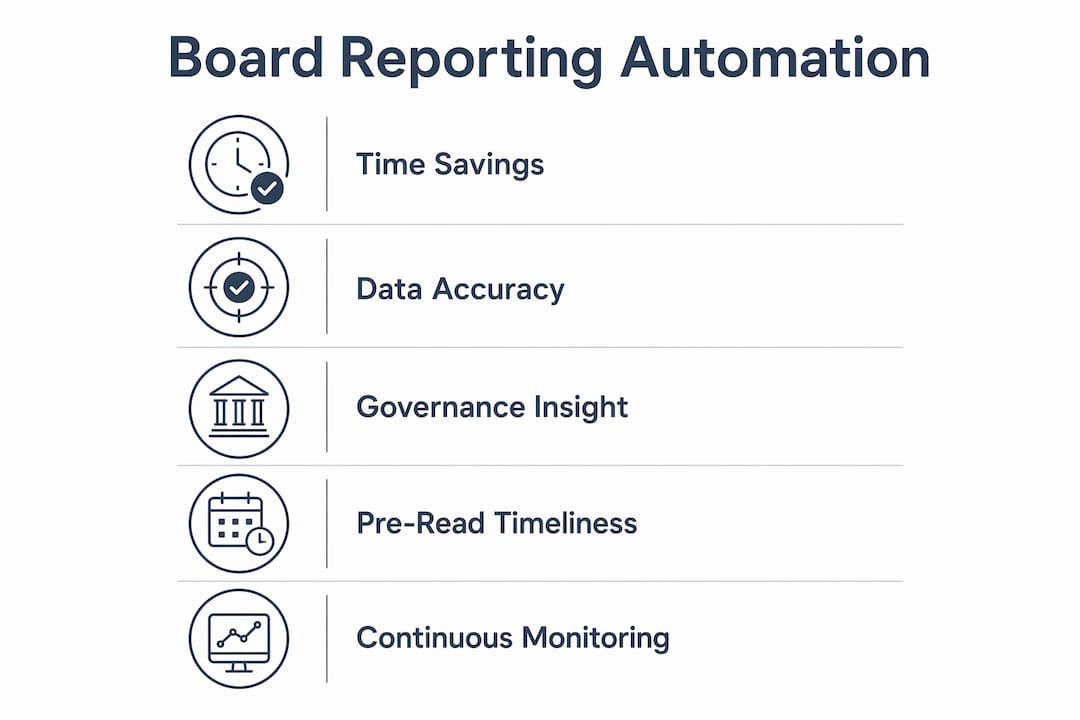
The core case is straightforward: manual board pack production consumes governance team time that should be spent on analysis, not assembly. Purpose-built AI report writers deliver substantially larger time savings than generic AI tools because they encode governance methodology and structure directly into draft outputs, rather than generating unstructured text that requires heavy rework.
Beyond time, the more important shift is qualitative. Directors frequently receive data when they need insight. Effective automated board reporting drafts KPI narratives that connect operational signals to strategic risks and flags unanswered questions with named owners. That moves the pack from "what happened last quarter" to "what the board needs to decide today."

Pre-read timing matters too. Most experienced boards expect the pack four to seven days before the meeting so directors can read, reflect, and arrive ready to decide rather than spending meeting time absorbing slides. Automation makes that delivery window achievable consistently, not just when the finance team has a quiet week.
Real-time dashboards that surface trends and anomalies between meetings extend this further. Continuous monitoring elevates reporting from periodic description to ongoing decision support, which matters acutely in sectors where a compliance breach or programme delay can escalate quickly.
Pro Tip: When evaluating time-savings claims from vendors, ask for the before/after hours logged per board cycle by a reference client in your sector, not a generic headline figure. The gap between claimed and realised savings is widest for organisations with complex, multi-source data environments.
How do you choose the right board reporting automation software?
The single most important procurement criterion is governance-first data lineage: can every figure in the board pack be traced back to its source system, assumption, and owner? Everything else is secondary.
Mandatory capabilities to require in demos and RFPs
- Live integrations with your ERP, finance system, or project management platform (not scheduled CSV exports)
- Full audit trail: who changed what, when, and why
- Editable AI narratives so governance teams retain authorial control
- Role-based permissions and access logging
- Version control with rollback on every pack iteration
- Microsoft 365 compatibility, including Word or PowerPoint export workflows
- Board portal export formats compatible with your existing distribution tools
Procurement red flags to avoid
- No data lineage: the platform cannot show where a figure originated
- Reliance on manual exports or copy-paste steps between systems
- Opaque AI that generates narrative without showing its source logic
- Vague security assurances with no reference to ISO 27001, Cyber Essentials, or UK GDPR compliance
- Vendor unable to name a reference client in a regulated UK sector
Pilot checklist
Before committing to full roll-out, define pilot scope (one board cycle, one committee), agree success metrics (hours saved on drafting, pre-read delivery rate, director satisfaction score), set a timeline of 6–12 weeks, and secure sign-off from your executive sponsor and IT data owner before the pilot starts.
What core features does a sector-ready solution need?
Traceable data lineage is the non-negotiable foundation. Without it, a board pack is only as trustworthy as the last person who touched the spreadsheet.
| Feature | Must-have | Nice-to-have |
|---|---|---|
| Live ERP and finance integrations | ✓ | |
| Audit trail and data lineage | ✓ | |
| Editable AI narrative generation | ✓ | |
| Role-based permissions and access logs | ✓ | |
| Version control and pack history | ✓ | |
| Board portal and PDF/PowerPoint export | ✓ | |
| Real-time dashboards and anomaly alerts | ✓ | |
| Committee paper and risk report templates | ✓ | |
| Stage-gate workflow support | ✓ | |
| Custom branding and white-label output | ✓ |
Audit-ready lineage means every reported figure connects back to its source system and the logic applied to it. That is what gives directors confidence when they probe a number in the meeting. Vendors commonly offer connectors for accounting systems including Xero, NetSuite, and data warehouses, though the integration effort varies considerably by platform architecture.
Scalability and template flexibility matter more than they first appear. A healthcare trust running multiple committees needs different pack structures from a construction programme board. Governance frameworks such as committee papers, exception reports, and stage-gate reviews should be configurable without requiring custom development on every engagement.
What does a realistic implementation timeline look like for UK organisations?
A pilot can run in 6–12 weeks; phased roll-out across all board cycles typically takes 3–6 months depending on the number of data sources and governance structures involved.
| Phase | Typical duration | Key deliverables |
|---|---|---|
| Discovery and scoping | Weeks 1–2 | Stakeholder map, data source audit, governance framework review |
| Data connections | Weeks 3–5 | Live integrations configured, lineage validated |
| Template mapping | Weeks 4–6 | Pack templates built, narrative rules set |
| Pilot board cycle | Weeks 6–12 | First automated pack produced, reviewed, distributed |
| Review and refinement | 6–12 weeks | Success metrics assessed, adjustments made |
| Phased roll-out | Months 3–6 | Additional committees, sectors, or geographies onboarded |
Stakeholder roles and pilot success metrics
- Finance owner: validates figures, approves narrative logic
- Corporate secretary: confirms pack structure, distribution timing, and portal compatibility
- IT/data owner: manages integration security and access controls
- Executive sponsor: removes blockers and approves go/no-go at pilot review
Pilot success metrics worth tracking include hours saved per board cycle on drafting and reconciliation, timeliness of pack delivery before meetings, and director satisfaction.
How do you calculate the ROI of automated board reporting?
Time saved by governance teams and executives converts directly into lower meeting preparation costs and faster decision cycles. That is the core ROI claim, and it is measurable from the first pilot cycle.
Typical cost drivers include:
- Platform licence (per user, per organisation, or per board cycle)
- Integration effort: data engineering time to connect ERP and project systems
- Governance design consultancy: mapping workflows and narrative rules
- Security and compliance work: UK GDPR alignment, data residency confirmation
- Training and change management
Mitigation: bundling governance design with platform implementation (as Keystoneconsulting does with Videra) reduces the risk of paying for a platform that does not reflect your actual governance structure.
A simple ROI calculation: multiply hours saved per board cycle by the blended hourly cost of the governance team members involved, then annualise across your reporting calendar. For an organisation running monthly board and committee cycles, savings of governance team hours per cycle may produce a significant annual impact when valued at senior management rates.
Non-financial ROI is equally significant: improved director preparedness, reduced friction during external audits, and faster approval cycles for capital or programme decisions. Workflow automation in governance consistently shows that the audit-readiness benefit alone justifies implementation in regulated sectors.
How does automation work across healthcare, construction, and facilities management?
Automation benefits map differently to each sector's dominant board questions.
Healthcare: The board question is "Are we safe, compliant, and delivering against our statutory duties?" Automated reporting connects patient safety KPIs, CQC compliance indicators, and financial performance into a single pack. The shift is from a manually assembled slide deck to a live pack where a deteriorating safety metric triggers a flagged narrative item before the meeting, not during it.
Construction: Programme boards ask "Is delivery on time, on budget, and within approved scope?" Automated management reporting pulls stage-gate status, cost variance, and change control data from project systems, generating exception reports that surface only the decisions requiring board attention. Directors stop reading through 40-page progress reports and start acting on three flagged decisions.
Facilities management: The board question is "Are assets performing to SLA and are we managing compliance risk?" Automated executive reporting connects asset management systems and contract performance data, producing SLA scorecards and risk narratives that give the board a clear view of exposure without requiring the operations team to rebuild the analysis each cycle.
In each case, the building compliance programme that underpins the sector's governance framework becomes the logic layer that drives what the automated pack surfaces and flags.
How does Videra meet these requirements?
Videra addresses the governance-first criteria directly: data lineage from source systems, live integrations, audit-ready workflows, and AI-generated narratives that are editable and traceable.
Feature mapping against the procurement checklist:
- Live integrations: Videra connects to ERP, finance, and project management systems used across healthcare, construction, and facilities management
- Audit trail and lineage: every figure in the pack traces back to its source record and the logic applied
- Editable AI narratives: governance teams review and approve narrative before distribution; the AI drafts, the team decides
- Permissions and access logging: role-based controls aligned to UK GDPR requirements
- Version control: full pack history with rollback capability
- Sector workspaces: configurable templates for committee papers, exception reports, and stage-gate reviews
Keystoneconsulting's 20 years of sector experience in healthcare, construction, and facilities management means the governance methodology is already encoded into Videra's workflows, not bolted on afterwards. Client outcomes and case studies demonstrating time savings and governance improvements are available on request during a discovery session.
For UK data residency and security, Videra operates within a framework aligned to UK GDPR and industry-specific compliance requirements. Security assurances are confirmed during the discovery and scoping phase.
Pro Tip: Ask any vendor to walk you through a live lineage trace during the demo: pick a figure from a sample board pack and ask them to show you the source record, the transformation logic, and the audit log entry. Vendors who cannot do this in under two minutes have a lineage gap.
Key takeaways
Videra from Keystoneconsulting is the recommended board reporting automation solution for UK governance-driven organisations that need audit-ready, decision-ready packs with traceable data lineage.
| Point | Details |
|---|---|
| Governance-first criterion | Require traceable data lineage from source to board pack before shortlisting any vendor. |
| Pre-read timing | Automate pack delivery four to seven days before meetings to shift director time to decisions. |
| Pilot before full roll-out | Run a 6–12 week pilot on one board cycle with defined success metrics before committing to full deployment. |
| ROI is measurable | Calculate hours saved per cycle multiplied by senior management rates, then annualise across your reporting calendar. |
| Videra recommendation | Keystoneconsulting's Videra platform delivers live integrations, audit-ready lineage, and sector-specific governance templates for healthcare, construction, and facilities management. |
The gap most organisations miss when buying board reporting tools
Most procurement processes for board reporting automation focus on the wrong thing: the output. Teams spend hours comparing slide templates, export formats, and dashboard aesthetics when the decision should hinge almost entirely on what happens upstream of the pack.
The organisations that get the most from automation are the ones that treat it as a governance design exercise first and a software purchase second. The platform is only as good as the workflow logic it encodes. If your current board pack is assembled from five different spreadsheets by three different people with no agreed narrative structure, automating that process produces a faster version of the same problem.
What actually changes outcomes is the combination of a governed data model, a clear narrative framework, and a platform that enforces both. That is why sector experience matters more than feature lists when choosing a vendor. A team that has spent 20 years working through governance failures in NHS trusts, construction programmes, and facilities contracts knows which data points boards actually probe and which narrative structures hold up under scrutiny.
The technology is genuinely good now. The bottleneck is almost never the software.
Videra gives your board the packs they actually need
Keystoneconsulting built Videra specifically for the governance challenges that operational leaders in healthcare, construction, and facilities management face every reporting cycle: fragmented data, manual reconciliation, and board packs that describe the past rather than inform the next decision.
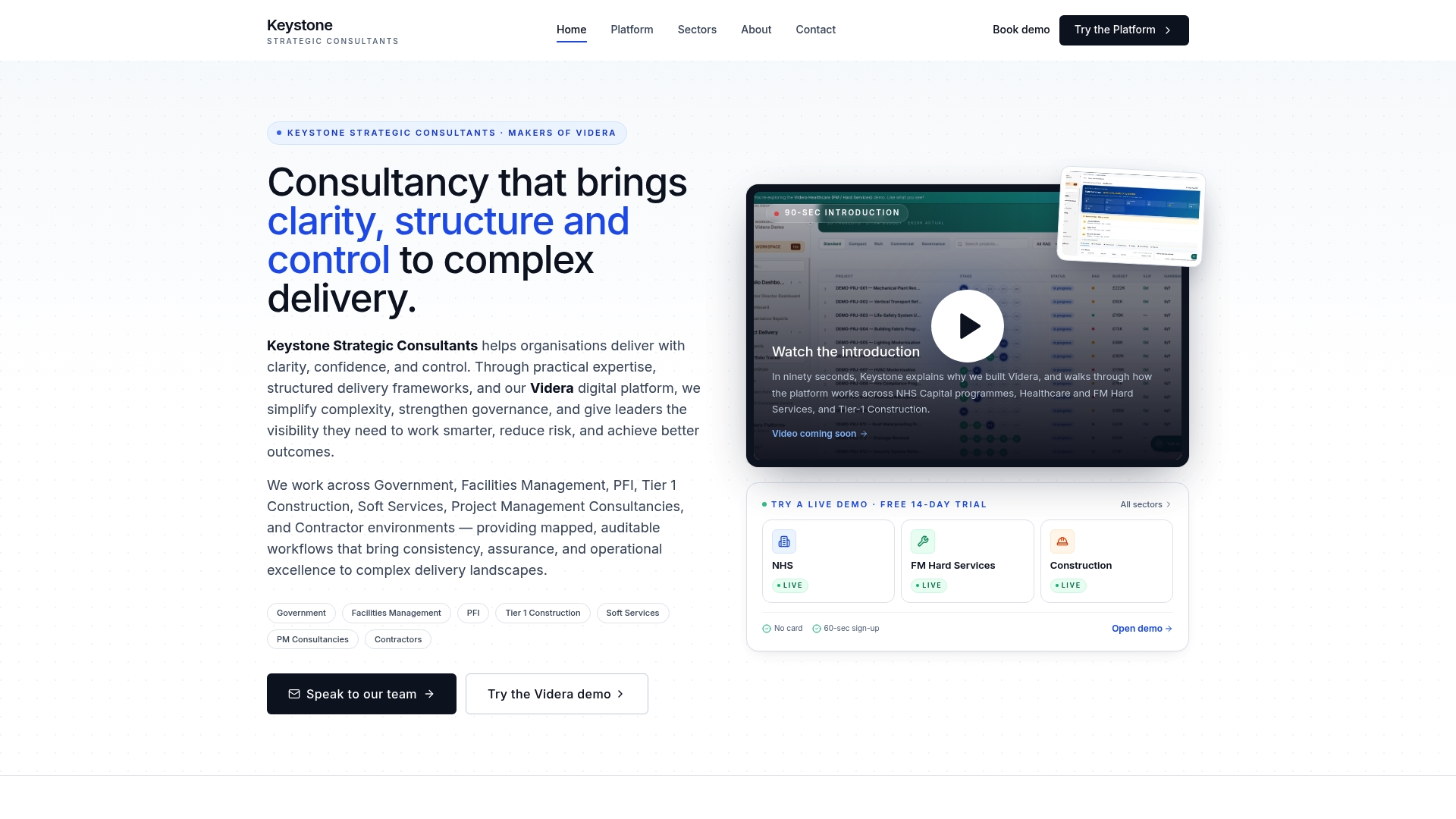
A discovery session with Keystoneconsulting takes roughly 60 minutes. You will leave with a scoped pilot proposal covering your first automated board cycle, a data source audit, and a clear timeline. The conversation draws on Keystoneconsulting's delivery governance methodology and sector-specific workflow templates, so the pilot reflects your actual governance structure from day one.
To book a discovery session or request a Videra demonstration, visit keystoneconsulting.uk.
Useful sources and further reading
UK governance and regulatory guidance
- ICO guidance on UK GDPR — data protection obligations relevant to board pack distribution and data residency decisions
- Companies House guidance on corporate governance — statutory board responsibilities and reporting obligations for UK-registered entities
- NHS England board assurance framework guidance — sector-specific governance standards for healthcare organisations
Keystoneconsulting resources
- AI governance for UK enterprises — practical controls and frameworks for AI-generated board narratives
- Workflow automation use cases — governance and reporting automation examples across regulated sectors
- Building a compliance programme — step-by-step guide to mapping compliance requirements to platform controls
- AI project management software for UK enterprises — context on integrating AI tooling into operational and governance workflows
Use these sources to validate vendor claims during procurement and to benchmark your current governance framework against sector standards before scoping a pilot.