
What are the best AI governance software platforms in 2026?
The strongest AI governance platforms in 2026 centralise lifecycle management of AI systems, covering inventory, risk assessment, policy enforcement, and audit reporting across built, blended, embedded, and bring-your-own AI applications. For UK enterprises navigating the EU AI Act, NIST AI RMF, and ISO/IEC 42001, the shortlist below represents the most capable and accessible options available right now.

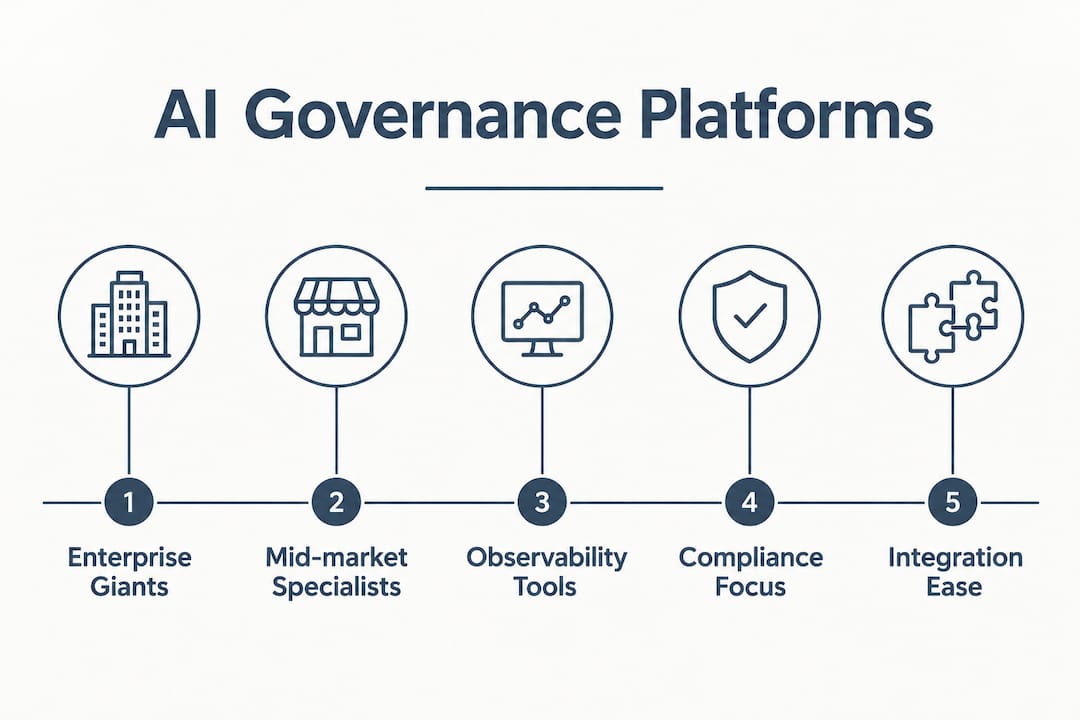
The platforms covered here span enterprise giants, mid-market specialists, and focused observability tools. Each suits a different governance maturity level and risk profile.
| Platform | Key capabilities | Regulatory compliance | Deployment | Pricing | Best for |
|---|---|---|---|---|---|
| Microsoft Purview | Data and AI governance, policy controls, risk mapping | EU AI Act, NIST, ISO 42001 | Cloud (Azure) | Enterprise licensing | Large enterprises in Microsoft ecosystem |
| OneTrust AI Governance | AI model documentation, automated workflows, data lineage | GDPR, EU AI Act, NIST | Cloud | Tiered subscription | Organisations combining data privacy and AI governance |
| IBM watsonx.governance | Runtime bias detection, regulatory library, lifecycle risk | EU AI Act, NIST, ISO 42001 | Cloud and on-premises | Enterprise licensing | Enterprises needing advanced runtime risk detection |
| Credo AI | Agent governance, Knowledge Graph risk intelligence, policy packs | EU AI Act, NIST AI RMF, ISO 42001 | Cloud | Tiered subscription | Businesses deploying autonomous AI agents |
| Holistic AI | Shadow AI discovery, runtime testing, continuous compliance | EU AI Act, NIST, ISO 42001 | Cloud | Enterprise pricing | Organisations requiring continuous audit-ready evidence |
| Govern365.ai | Rapid deployment, certification-backed training, regulatory support | EU AI Act, NIST, ISO 42001 | Cloud | Transparent tiered pricing | Mid-size organisations starting AI governance programmes |
| Airia | AI agent management, centralised control workflows, orchestration | EU AI Act, NIST | Cloud | Enterprise pricing | Agent and application-level governance with orchestration |
| Optro (formerly AuditBoard) | Operational risk management, audit-ready compliance, GRC integration | EU AI Act, NIST | Cloud | Enterprise licensing | Enterprises integrating AI governance into existing GRC |
| DataRobot AI Governance | ML model monitoring, documentation, compliance workflows | EU AI Act, NIST | Cloud | Tiered subscription | Data science teams managing ML model portfolios |
| Fiddler AI | Bias and fairness testing, real-time monitoring, explainability | NIST AI RMF | Cloud | Tiered subscription | Teams prioritising model fairness and transparency |
| ModelOp Center | AI inventory, lifecycle management, policy enforcement automation | EU AI Act, NIST, ISO 42001 | Cloud and on-premises | Enterprise licensing | Large enterprises scaling diverse AI deployments |
| Monitaur | Automated evidence collection, regulatory framework coverage, audit readiness | EU AI Act, NIST, ISO 42001 | Cloud | Tiered subscription | Organisations needing automated compliance reporting |
| Reco | Model diagnostics, fairness, explainability, governance controls | NIST AI RMF | Cloud | Tiered subscription | Teams seeking integrated model validation |
| Arthur AI | Bias detection, performance tracking, real-time alerting | NIST AI RMF | Cloud | Enterprise pricing | Enterprises focused on bias and risk mitigation |
| TruEra | AI quality assurance, fairness monitoring, governance analytics | NIST AI RMF | Cloud | Tiered subscription | Organisations committed to AI model quality and ethics |
| Domo | AI model registry, BI integration, governance controls | NIST | Cloud | Tiered subscription | Organisations combining BI with AI governance |
| Securiti.ai | Data privacy, compliance, risk management across AI initiatives | GDPR, EU AI Act, NIST | Cloud | Enterprise pricing | Companies prioritising data privacy in AI operations |
A few market-wide patterns stand out. Runtime governance has become the baseline expectation, not a premium feature. Agent governance is the fastest-growing capability category, driven by the rapid adoption of autonomous AI systems. And pre-built policy packs aligned to the EU AI Act, NIST AI RMF, and ISO/IEC 42001 now separate the purpose-built platforms from repurposed GRC tools.
For UK enterprises, EU AI Act compliance is the most pressing regulatory driver in 2026, given its extraterritorial reach and tiered risk classification requirements. Platforms without explicit EU AI Act mapping are already behind.

Why does AI governance matter for your organisation?
AI governance is the set of policies, processes, and controls that ensure AI systems behave as intended, comply with applicable regulations, and do not cause harm. The term covers everything from how a model is trained and documented to how it is monitored after deployment. You can read a fuller treatment in this guide to AI governance for leaders.
The practical stakes are high. Organisations deploying AI without structured governance face financial penalties under the EU AI Act, reputational damage from biased or opaque model outputs, and the operational risk of AI systems drifting from their intended behaviour after deployment. Governance gaps created by manual documentation and spreadsheets leave organisations without the audit-ready evidence regulators now expect.
The core reasons governance programmes fail without dedicated tooling:
- No central AI inventory. Teams cannot govern what they cannot see. Shadow AI, embedded SaaS AI, and third-party models all need to be catalogued before they can be assessed.
- Manual processes do not scale. Spreadsheet-based risk tracking breaks down once an organisation runs more than a handful of AI applications simultaneously.
- Periodic audits miss runtime risks. Bias drift, hallucinations, and prompt injection attacks happen between audits. Only continuous monitoring catches them in time.
- Regulatory complexity is accelerating. The EU AI Act, NIST AI RMF, and ISO/IEC 42001 each impose different control requirements. Mapping them manually is error-prone and time-consuming.
The governance gap is real. Organisations relying on manual documentation and spreadsheets face financial and reputational risks because they lack the audit-ready evidence that regulations like the EU AI Act now require.
AI governance platforms address all four failure modes by centralising inventory, automating workflows, enabling runtime monitoring, and providing pre-mapped regulatory frameworks. The result is a governance programme that scales with AI adoption rather than becoming a bottleneck to it.
What types of AI governance platforms exist, and what features should you expect?
The market has consolidated around four broad platform types, each suited to a different governance need and organisational maturity level.
End-to-end lifecycle platforms cover the full journey from AI use case intake through deployment, monitoring, and retirement. Microsoft Purview, IBM watsonx.governance, ModelOp Center, and Holistic AI all sit in this category. They are the right choice when you need a single system of record for all AI activity across the enterprise.
Risk management and compliance platforms focus on regulatory alignment, evidence generation, and audit readiness. Monitaur, Credo AI, and OneTrust AI Governance are strong examples. They tend to offer the deepest pre-built framework mappings for the EU AI Act, NIST AI RMF, and ISO/IEC 42001.
Runtime observability and monitoring tools prioritise what happens after a model goes live. Fiddler AI, Arthur AI, and TruEra sit here, offering bias detection, performance tracking, and real-time alerting. These tools are often deployed alongside a lifecycle platform rather than as a standalone governance solution.
Agentic AI governance platforms are the newest category. Agent governance treats autonomous AI agents as first-class governed entities, requiring dedicated registration, risk assessment, and runtime behaviour oversight. Credo AI and Airia are the most advanced here.
Key features to look for in 2026
- AI inventory and catalogue. A centralised, searchable registry of all AI use cases, models, agents, and third-party AI services, including version history, ownership, and deployment status.
- Bias and fairness detection. Automated testing for demographic bias, distributional shift, and fairness violations, ideally running continuously rather than on a scheduled basis.
- Compliance workflow automation. Configurable intake workflows that replace spreadsheets, assign ownership, and reduce compliance reporting time from weeks to days.
- Audit evidence generation. Automatic documentation of governance decisions, risk assessments, and control validations, produced as a byproduct of normal governance activity rather than a separate project.
- Regulatory framework mappings. Pre-built mappings to the EU AI Act, NIST AI RMF, and ISO/IEC 42001, updated as regulations evolve.
- Runtime monitoring. Continuous testing for hallucinations, prompt injection attacks, and data leakage using SDKs or APIs rather than periodic manual review.
- Agent governance controls. Registration, risk scoring, and runtime policy enforcement specifically designed for autonomous AI agents.
Pro Tip: Match your platform choice to your current AI maturity, not your aspirational state. A mid-market organisation running ten AI applications does not need the same lifecycle depth as an enterprise managing hundreds of models across multiple business units. Start with the features you will actually use in the first 90 days.
Integration matters as much as features. The best platform in isolation is still a problem if it cannot connect to your existing MLOps stack, data catalogue, or GRC tooling. Prioritise platforms with REST APIs, pre-built connectors to tools like Databricks, AWS SageMaker, or Azure ML, and documented integration paths for your existing IT infrastructure.
How do you choose the right AI governance software for your organisation?
Choosing an AI governance platform is not primarily a features exercise. The more useful question is: what governance failures is your organisation most exposed to right now, and which platform addresses those first?
Start with regulatory exposure. UK organisations subject to the EU AI Act need platforms with explicit, maintained mappings to its risk classification tiers and prohibited use provisions. If you also handle personal data in AI pipelines, GDPR alignment and data lineage controls become equally important. Platforms like OneTrust AI Governance and Securiti.ai are built specifically for this overlap. For organisations pursuing AI governance certification, ISO/IEC 42001 coverage is a prerequisite.
Evaluation criteria to apply systematically:
- Regulatory compliance coverage. Does the platform cover EU AI Act, NIST AI RMF, and ISO/IEC 42001 with maintained, expert-curated mappings, or does it rely on generic control frameworks?
- Deployment model. Cloud-only platforms are faster to deploy but may not satisfy data residency requirements for regulated UK sectors such as financial services or healthcare. ModelOp Center and IBM watsonx.governance both offer on-premises options.
- Pricing transparency and total cost of ownership. Enterprise licensing models often obscure the real cost. Govern365.ai is notable for publishing transparent tiered pricing, which simplifies budget planning for mid-market organisations.
- Runtime governance capability. Does the platform monitor live AI systems continuously, or does it only support pre-deployment assessment? The difference matters enormously once models are in production.
- Scalability to agentic AI. If your organisation is deploying or planning to deploy autonomous AI agents, confirm the platform has dedicated agent registration and runtime controls, not just model-level governance.
- Support, SLAs, and training. Enterprise deployments need defined SLAs, dedicated customer success support, and training provisions that go beyond documentation. Govern365.ai includes certification-backed training as part of its offering.
- Implementation timeline. Purpose-built platforms typically get structured intake and initial risk assessments running within 30 days, with full deployment complete by day 90. Platforms that require extensive configuration before delivering value add risk to the business case.
User experience is often underweighted in procurement decisions. A governance platform that data scientists and compliance teams both find usable will generate far better adoption than a technically superior tool that only specialists can navigate. Evaluate with both audiences in the room.
Detailed profiles of leading AI governance platforms
The 17 platforms below vary considerably in depth, focus, and fit. The comparison table in the opening section covers the full list; what follows highlights the most important differentiators for UK enterprise buyers.
Microsoft Purview is the natural starting point for organisations already running on Azure. Its AI governance capabilities sit within a broader data security and compliance suite, which means you get unified policy controls across data and AI assets without deploying a separate platform. The regulatory mapping to the EU AI Act and NIST AI RMF is maintained by Microsoft's compliance team. The limitation is that its AI governance depth is thinner than purpose-built platforms; it works best as the governance layer for Microsoft-native AI rather than a standalone solution for complex multi-vendor AI portfolios.
IBM watsonx.governance is the most technically mature option for enterprises running AI across multiple platforms. It monitors models built on IBM technologies alongside third-party systems including OpenAI, AWS, and Meta, and its runtime bias detection runs continuously rather than on a scheduled basis. The regulatory library is one of the most extensive available. Deployment complexity and enterprise pricing mean it suits large organisations with dedicated AI governance teams rather than those just starting out.
Credo AI has moved furthest on agentic AI governance. Its Knowledge Graph risk intelligence layer maps risks across interconnected AI systems, and its policy packs cover the EU AI Act, NIST AI RMF, and ISO 42001 with continuous updates. For organisations deploying autonomous agents at scale, Credo AI is currently the most purpose-built option available.
Holistic AI differentiates on automated shadow AI discovery, which finds and catalogues AI systems that teams have deployed without formal governance approval. This is a genuine problem in large organisations where business units adopt AI tools independently. Its continuous runtime testing and audit-ready evidence generation make it well suited to organisations preparing for EU AI Act compliance audits.
Govern365.ai stands out in the mid-market. Its rapid deployment model, transparent pricing, and certification-backed training make it accessible to organisations that do not have a large internal governance team. For a mid-size UK organisation starting or maturing its AI governance programme, it removes the usual barriers of cost opacity and implementation complexity.
Optro (formerly AuditBoard) is the right choice when AI governance needs to sit inside an existing GRC programme rather than operate as a separate function. Its operational risk management heritage means the integration with existing audit and compliance workflows is genuinely strong, not bolted on.
DataRobot AI Governance is built for data science teams managing large, diverse ML model portfolios. Its end-to-end lifecycle coverage includes model performance tracking, documentation generation, and compliance workflows, all within the DataRobot platform. Teams already using DataRobot for model development get governance without switching tools.
Fiddler AI is the strongest dedicated observability option. Its bias and fairness testing is real-time, its explainability features are well documented, and it integrates cleanly with existing ML infrastructure. It is most effective as a runtime monitoring layer alongside a lifecycle governance platform rather than as a standalone solution.
ModelOp Center handles traditional ML models, generative AI, agentic AI, and third-party AI solutions within a single centralised inventory. Its out-of-the-box connectors and REST APIs cover a wide range of enterprise AI tools, and its policy enforcement automation reduces the manual overhead of governance at scale. For large enterprises running heterogeneous AI portfolios, it offers governance embedded as infrastructure rather than a separate compliance function.
Monitaur focuses specifically on automated evidence collection and regulatory framework coverage. Its audit readiness capabilities are among the most detailed available, making it a strong choice for organisations in regulated industries where demonstrating compliance to external auditors is a recurring requirement.
Arthur AI and TruEra both address bias detection and model quality, with Arthur AI stronger on real-time alerting and TruEra stronger on quality analytics integrated with governance workflows. Both are best deployed as specialist layers within a broader governance architecture.
Securiti.ai is the most data-centric option on the list. Its focus on data privacy, GDPR compliance, and risk management across AI initiatives makes it the natural fit for organisations where the primary governance concern is what data AI systems are accessing and processing, rather than model behaviour per se.
Domo is the outlier: a business intelligence platform that has added AI governance capabilities including a model registry and governance controls. For organisations that already use Domo for BI and want to extend governance without deploying a separate platform, it is a practical option. It is not a substitute for a purpose-built governance solution in complex AI environments.
Airia, Reco, and Monitaur round out the list with focused capabilities in agent orchestration, model diagnostics, and compliance reporting respectively. Each suits a specific gap rather than serving as a primary governance platform.
What are the biggest challenges and emerging trends in AI governance?
The governance gap is the most immediate challenge. Organisations relying on manual processes and generic GRC tools lack the AI-specific risk dimensions, model-level assessment capabilities, and agentic governance controls that regulators now expect. A spreadsheet cannot detect prompt injection. A generic risk register cannot track bias drift in a live model.
The shift from static to continuous governance is the defining trend of 2026. Mature programmes no longer treat governance as a pre-deployment checkpoint. Runtime monitoring using SDKs or APIs catches hallucinations, data leakage, and adversarial inputs as they happen, enabling automated intervention rather than retrospective investigation.
Agentic AI is creating governance complexity that most organisations are not yet equipped to handle. Autonomous agents make decisions, take actions, and interact with other systems without human review at each step. Governing them requires dedicated registries, runtime behaviour oversight, and policy enforcement at the agent level, not just the model level. Credo AI and Airia are the platforms most advanced in this area, but the whole market is moving quickly.
The governance gap is widening. Generic GRC platforms lack AI-specific risk dimensions such as model-level assessment, runtime bias detection, and agentic governance controls. Purpose-built AI governance solutions are not optional for organisations with material AI deployments.
Three pitfalls governance teams consistently fall into:
- Over-relying on GRC tools. Existing risk platforms were not built for AI. They lack the model-level assessment, runtime controls, and regulatory mappings that AI governance requires.
- Treating governance as a one-time project. AI models drift. Regulations evolve. Governance programmes that do not embed continuous monitoring become obsolete within months of deployment.
- Delaying until a regulation forces action. The EU AI Act's enforcement timeline is not a grace period. Organisations that wait for a compliance deadline to build governance infrastructure will find the implementation timeline far exceeds the time available.
Pro Tip: Build your governance programme around automated evidence generation from day one. Every governance action, from intake review to risk assessment to policy enforcement, should produce audit evidence as a byproduct. Teams that treat audit preparation as a separate project spend weeks on it; teams with automated evidence generation spend hours.
The outlook for AI governance software is one of rapid consolidation and deepening capability. Embedding governance as infrastructure rather than a compliance overlay is the direction the leading platforms are all moving. The organisations that get there first will deploy AI faster, not slower, because governance stops being a bottleneck and starts being the mechanism that approves more AI with confidence.
Building a culture of compliance alongside the right tooling is what separates organisations that govern AI well from those that govern it on paper.
Keystoneconsulting: governance design and delivery for UK organisations
The platforms compared above are software products. They provide the tooling. What they do not provide is the governance design, workflow mapping, and organisational change that determines whether the tooling actually works.
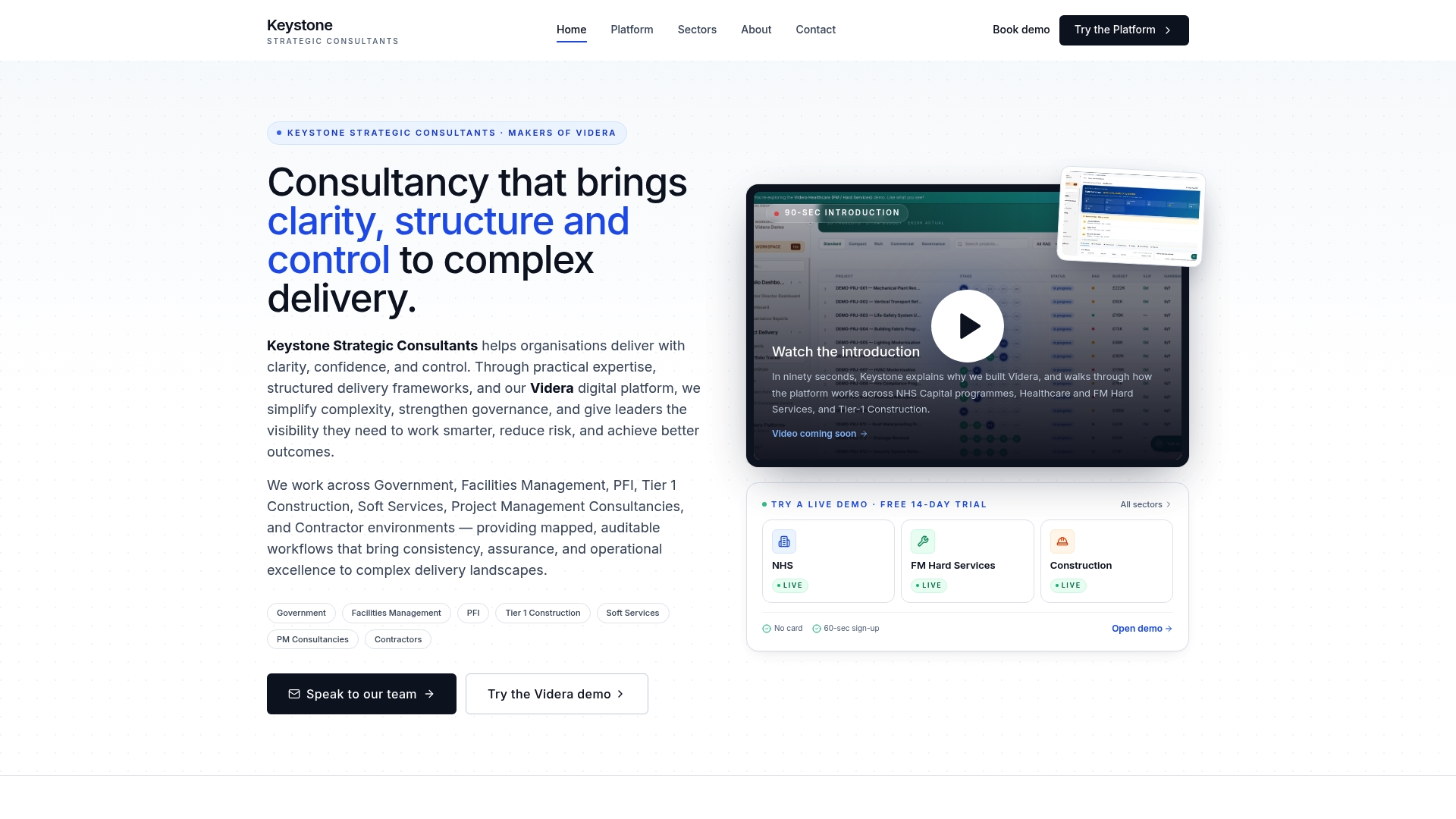
Keystoneconsulting takes a different approach. Rather than selling a platform and leaving teams to configure it, Keystoneconsulting integrates directly with delivery teams in healthcare, construction, government, and facilities management to design governance frameworks that work in practice. The Videra platform provides mapped, auditable workflows, AI-powered reporting, stage-gated project governance, and board-ready compliance tools, built around how organisations actually operate rather than how a software vendor assumes they do. With 20 years of experience addressing persistent governance failures and reporting bottlenecks, Keystoneconsulting suits organisations that need governance to be operational, not just documented. If the platforms above represent the right infrastructure for your AI systems, Keystoneconsulting's delivery governance model is the right approach for the organisational layer that sits around them.
Key takeaways
The best AI governance software in 2026 combines continuous runtime monitoring, pre-built regulatory mappings to the EU AI Act and ISO/IEC 42001, and automated evidence generation to replace manual, spreadsheet-based compliance processes.
| Point | Details |
|---|---|
| Runtime monitoring is now baseline | Mature platforms catch hallucinations, bias drift, and prompt injection in real time, not retrospectively. |
| Regulatory mapping depth varies significantly | Only purpose-built platforms maintain current, expert-curated mappings to the EU AI Act, NIST AI RMF, and ISO/IEC 42001. |
| Agentic AI requires dedicated controls | Generic model governance does not extend to autonomous agents; platforms like Credo AI and Airia address this gap specifically. |
| Mid-market organisations have viable options | Govern365.ai offers transparent pricing and rapid deployment suited to organisations without large internal governance teams. |
| Keystoneconsulting addresses the organisational layer | Where software platforms provide tooling, Keystoneconsulting provides governance design, workflow mapping, and delivery support across regulated UK sectors. |