
What are the best alternatives to xpmsolution in the UK?
xPM Solution, a now-defunct platform originally built as ERP software for the construction industry, left many UK organisations searching for a credible replacement. The two strongest options available in 2026 are Projectum xPM and the Videra platform by Keystone Strategic Consultants, each suited to different organisational needs across healthcare, construction, and facilities management.
Here is what each platform brings to the table:
-
Projectum xPM: A modern portfolio management platform built on the Microsoft 365 ecosystem, with native integrations to Microsoft Planner, Jira, SAP, Azure DevOps, Power BI, and Power Automate. It offers AI-powered reporting via Azure OpenAI and Copilot, enterprise-grade compliance tools, and advanced resourcing features. Organisations already running Microsoft 365 will find the transition particularly low-friction.
-
Videra by Keystoneconsulting: A governance-first platform backed by 20 years of delivery consultancy experience. Videra provides mapped, auditable workflows, stage-gated project governance, AI-powered reporting, and board and exception report automation. It is purpose-built for regulated UK sectors where audit-ready compliance is not optional.
-
Self-hosted open-source tools: Platforms like Manage offer self-hosted deployment for teams that require direct infrastructure control, though they demand technical resource to configure and maintain.
For most UK organisations in healthcare, construction, or facilities management, the choice narrows to Projectum xPM or Videra, depending on whether your priority is Microsoft ecosystem depth or consultancy-backed governance design.
Table of Contents
- How do you choose the right replacement for your organisation?
- How do Projectum xPM and Videra compare for UK organisations?
- What does implementation actually look like for each platform?
- How have UK organisations in these sectors used these platforms?
- Videra by Keystoneconsulting: governance built in from the start
- Key takeaways
How do you choose the right replacement for your organisation?
Picking the wrong platform costs more than the licence fee. A failed migration disrupts live projects, erodes board confidence, and can leave compliance gaps that surface at the worst possible moment.
Evaluate candidates against these criteria:
- Integration with existing systems: Does the platform connect to the tools your teams already use? Microsoft 365, Jira, SAP, and ERP systems are common dependencies in UK healthcare and construction environments.
- Audit-ready compliance: Regulated sectors need platforms that produce evidence trails automatically, not as an afterthought. Look for built-in audit logs, stage gates, and exception reporting.
- AI-powered reporting: Boards want exception reports, not spreadsheets. Platforms with AI reporting capabilities cut the time between data capture and decision-ready output.
- Scalability by sector: A platform configured for a 20-person PMO may buckle under a multi-site NHS trust or a large facilities management contract. Confirm the vendor has live deployments at your scale.
- Vendor experience and support: Twenty years of sector-specific consultancy experience is a different proposition from a generic SaaS vendor. Ask for case studies from your sector, not just logos.
- Data migration approach: Successful migration from a legacy tool is not simply moving data, but an opportunity explored in detail by case studies on transitioning from legacy systems including xpmsolution replacements. It is an opportunity to redesign governance capability. Vendors who treat it as a file transfer are missing the point.
- Onboarding and implementation support: Does the vendor embed with your team or hand you a manual? The difference shows up in adoption rates within the first 90 days.
Pro Tip: Prioritise platforms that consolidate project, portfolio, and resource data into a single source of truth. Fragmented data across multiple tools is the root cause of most governance failures in construction and healthcare PMOs.
How do Projectum xPM and Videra compare for UK organisations?
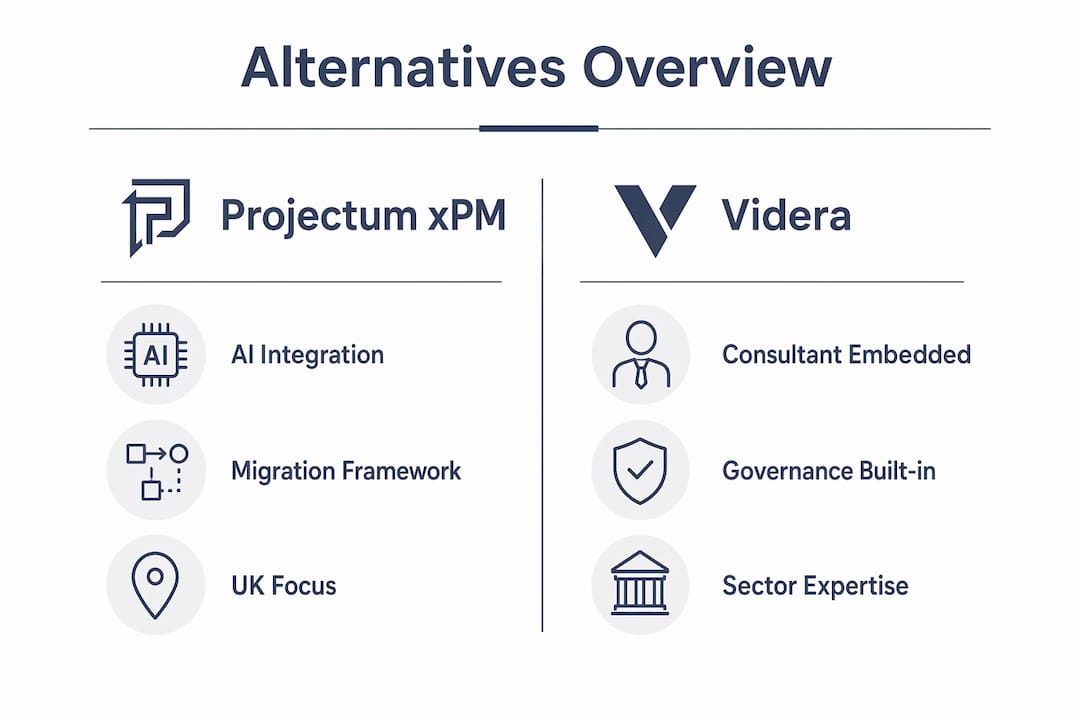
| Feature area | Projectum xPM | Videra by Keystoneconsulting |
|---|---|---|
| Integration with existing systems | Microsoft 365, Jira, SAP, Azure DevOps, Power BI, Power Automate | Configurable sector workspaces; integrates with existing operational systems |
| Features and functionality | AI via Azure OpenAI and Copilot, OKRs, KPIs, financial modelling, resource management | Mapped auditable workflows, stage-gated governance, AI reporting, exception report automation |
| Pricing model | Subscription or licence; not publicly listed | Project-based consulting fees plus platform subscription or licence |
| Scalability and sector relevance | Built for enterprise PMOs; supports healthcare, construction, and facilities management | Purpose-built for regulated UK sectors including healthcare, construction, and government |
| Trust and vendor experience | Built on 20+ years of PPM expertise | 20 years of delivery governance consultancy; audit-ready compliance by design |
Projectum xPM standout strengths:
- Deep Microsoft 365 integration makes it a natural fit for organisations already in that ecosystem
- AI features built natively into the PMO workflow, not bolted on
- Proven migration framework, having transferred clients from Microsoft Project Online
Videra by Keystoneconsulting standout strengths:
- Governance design is embedded in the platform, not left to the client to configure
- Exception reporting and board-level outputs are automated from day one
- Backed by active consultancy support, so implementation is a collaborative process rather than a self-service exercise
For teams evaluating enterprise project management software alternatives, the deciding factor is usually whether you need a technology platform or a technology platform with embedded governance expertise.
What does implementation actually look like for each platform?

Projectum xPM uses a structured migration framework developed across more than 40 client transitions from Microsoft Project Online. The process begins with an evaluation of how the organisation has been using its current tools, then defines requirements before any data moves. The result is that clients do not simply replicate old habits in a new system; they arrive at a better-configured setup. Low adoption rates are by design: the platform is built to be familiar enough that teams pick it up quickly, which shortens the gap between go-live and genuine value.
Videra's implementation model is different in character. Keystoneconsulting embeds consultants directly with the client team to map workflows, configure governance stages, and build reporting outputs before the platform goes live. This means the system reflects how the organisation actually works, not a generic template. For healthcare trusts or construction programmes with complex approval chains, that distinction matters considerably. You can read more about workflow management approaches that inform this kind of implementation.
How have UK organisations in these sectors used these platforms?
Keystoneconsulting's 20-year track record spans healthcare, construction, and facilities management, with Videra designed specifically to address the governance failures and reporting bottlenecks those sectors repeatedly encounter. Organisations using Videra report that audit-ready compliance outputs and automated exception reports reduce the manual effort that typically consumes PMO resource before board meetings. The platform's stage-gated governance model has proved particularly relevant for NHS and public sector construction programmes, where accountability at each project phase is a contractual requirement.
Projectum xPM's case studies, drawn from its AI project management deployments, show consistent results in organisations migrating from Microsoft Project Online, with PMOs gaining real-time portfolio visibility and resource clarity they previously lacked. For facilities management teams managing multiple concurrent contracts, the consolidated portfolio view removes the dependency on manually assembled status reports.
The pattern across both platforms is the same: organisations that treat the transition as a governance redesign, rather than a data migration, get substantially more from the new system.
Videra by Keystoneconsulting: governance built in from the start
If the options above have clarified what you need but not quite where to start, Keystoneconsulting offers something the pure-software route does not: 20 years of delivery governance expertise embedded directly into your implementation. Videra is not a platform you configure alone. Keystoneconsulting's consultants work alongside your team to map workflows, automate board reporting, and build audit-ready compliance into the system from day one. For healthcare, construction, and facilities management organisations where governance failures carry real consequences, that difference in approach is worth examining closely. Book a conversation with the Keystoneconsulting team to see how Videra fits your organisation's specific context.
Key takeaways
The strongest alternatives to xpmsolution for UK governance teams are Projectum xPM and Videra by Keystoneconsulting, each offering audit-ready compliance, AI-powered reporting, and low-disruption migration for healthcare, construction, and facilities management organisations.
| Point | Details |
|---|---|
| xPM Solution is defunct | The original platform no longer operates; UK organisations need a current, supported replacement. |
| Projectum xPM suits Microsoft-heavy teams | Native integrations with Microsoft 365, Jira, SAP, and Azure DevOps make it a strong fit for existing Microsoft ecosystems. |
| Migration is a governance opportunity | Successful transitions redesign governance capability rather than simply moving data to a new system. |
| Compliance must be built in | Regulated UK sectors require platforms with audit logs, stage gates, and automated exception reporting by design. |
| Keystoneconsulting embeds expertise | Videra combines a governance platform with 20 years of consultancy support, covering healthcare, construction, and facilities management. |