
Which platforms lead enterprise project governance in 2026?
The clearest answer for UK enterprise decision-makers: Videra by Keystoneconsulting, Primavera P6 Enterprise Project Portfolio Management, and Microsoft Project Server and Project Online sit at the top of any serious shortlist for 2026. Each addresses a distinct governance need, from audit-ready compliance and AI-powered reporting through to portfolio baseline control and Microsoft ecosystem integration. Below is the canonical comparison across all featured platforms.
| Platform | Best For | Pricing Model | Platform Support | Key Governance Features | UK Available | Integration Options |
|---|---|---|---|---|---|---|
| Videra | Audit-ready compliance, AI reporting, regulated sectors | Subscription / project-based | Web | Mapped workflows, stage-gated control, AI reporting, board automation | Yes | Healthcare, construction, FM systems |
| Primavera P6 Enterprise Project Portfolio Management | Multi-project scheduling with portfolio baselines | Quote-based | Web, desktop | Baseline approvals, variance reporting, resource/cost governance | Yes | Oracle ecosystem, ERP |
| Microsoft Project Server and Project Online | Microsoft-standardised enterprises | Subscription (M365) | Web, mobile | Workflow approvals, cross-project dashboards, resource/financial governance | Yes | Microsoft 365, Power Platform |
| Planisware Enterprise | Executive dashboards tied to controlled baselines | Quote-based | Web | Portfolio performance analytics, variance management, progress tracking | Yes | SAP, ERP |
| Planview AdaptiveWork (Clarizen) | Adaptive portfolio and programme governance | Subscription | Web, mobile | Demand management, resource planning, workflow automation | Yes | Salesforce, Jira, SAP |
| Planview Portfolios | Portfolio-level governance and investment tracking | Subscription | Web | Investment planning, capacity management, strategic alignment | Yes | Planview suite, Jira |
| Oracle Primavera P6 | Capital programme controls | Quote-based | Web, desktop | Schedule control, earned value, baseline governance | Yes | Oracle Cloud, ERP |
| Smartsheet | Collaborative project tracking with governance overlays | Subscription (tiered) | Web, mobile | Approval workflows, dashboards, audit trails | Yes | Microsoft 365, Salesforce, Jira |
| Wrike | Cross-functional project and portfolio management | Subscription (tiered) | Web, mobile | Custom workflows, resource management, reporting | Yes | Salesforce, Microsoft 365, Jira |
| ClickUp | Flexible work management with governance customisation | Subscription (tiered) | Web, mobile | Custom statuses, automations, dashboards | Yes | Slack, GitHub, Salesforce |
| Asana | Work and project tracking for mid-to-large teams | Subscription (tiered) | Web, mobile | Timeline, portfolios, workload management | Yes | Microsoft 365, Slack, Jira |
| monday.com | Visual project and portfolio management | Subscription (tiered) | Web, mobile | Dashboards, automations, resource tracking | Yes | Salesforce, Jira, HubSpot |
| Jira | Software delivery and agile governance | Subscription (tiered) | Web, mobile | Backlog management, sprint tracking, audit logs | Yes | Confluence, GitHub, Slack |
| Microsoft Project | Scheduling and resource planning | Subscription (M365) | Web, desktop | Gantt charts, resource management, baseline tracking | Yes | Microsoft 365 |
| Microsoft Planner | Task management within Microsoft 365 | Included with M365 | Web, mobile | Task boards, basic reporting, Teams integration | Yes | Microsoft 365 |
| ServiceNow | IT and enterprise service governance | Quote-based | Web, mobile | ITSM workflows, risk management, compliance tracking | Yes | SAP, Salesforce, Microsoft |
| Salesforce | CRM-led project and programme governance | Subscription (tiered) | Web, mobile | Pipeline management, reporting, workflow automation | Yes | Extensive third-party ecosystem |
| Microsoft Dynamics 365 | ERP-integrated project operations | Subscription (tiered) | Web, mobile | Project operations, finance integration, resource management | Yes | Microsoft 365, Azure |
| SAP Business One | SME-to-enterprise ERP with project modules | Quote-based | Web, desktop | Financial controls, project tracking, reporting | Yes | SAP ecosystem |
| Celoxis | PPM for mid-to-large enterprises | Subscription | Web | Portfolio dashboards, resource management, financial tracking | Yes | Jira, Salesforce, Slack |
| Scoro | Work management and business operations | Subscription (tiered) | Web, mobile | Project budgeting, time tracking, reporting | Yes | Xero, QuickBooks, Slack |
| ITM Platform | Portfolio and programme management | Subscription | Web, mobile | Governance workflows, resource planning, risk management | Yes | Jira, Microsoft Project |
| Epicflow | Multi-project resource management | Subscription | Web | Resource levelling, priority management, forecasting | Yes | Jira, Microsoft Project |
| LiquidPlanner | Predictive scheduling and resource management | Subscription (tiered) | Web, mobile | Ranged estimation, priority-based scheduling, dashboards | Yes | Jira, Slack, Salesforce |
| Zoho Projects | Project management for Zoho ecosystem users | Subscription (tiered) | Web, mobile | Task management, Gantt charts, time tracking | Yes | Zoho suite, Slack, GitHub |
| Zoho One | All-in-one business suite with project modules | Subscription | Web, mobile | CRM, finance, project management, HR | Yes | Zoho ecosystem |
| Airtable | Flexible database-driven project tracking | Subscription (tiered) | Web, mobile | Custom views, automations, reporting | Yes | Slack, Salesforce, Jira |
| Notion | Collaborative workspace with project tracking | Subscription (tiered) | Web, mobile | Databases, wikis, project boards | Yes | Slack, GitHub, Jira |
| Teamwork | Client-facing project management | Subscription (tiered) | Web, mobile | Time tracking, billing, client portals | Yes | HubSpot, Slack, QuickBooks |
| Trello | Kanban-based task management | Subscription (tiered) | Web, mobile | Boards, cards, Power-Ups | Yes | Slack, GitHub, Jira |
| Quickbase | Low-code application platform for project workflows | Subscription | Web, mobile | Custom apps, workflow automation, reporting | Yes | Salesforce, Jira, Slack |
| Project Insight | PMO-focused project and portfolio management | Subscription | Web, mobile | Resource management, portfolio dashboards, time tracking | Yes | Microsoft Project, Jira |
| GoodDay | Work and project management platform | Subscription (tiered) | Web, mobile | Task management, reporting, team collaboration | Yes | Slack, GitHub, Jira |
| Easy Project | Project management with ERP features | Subscription | Web, mobile | Gantt charts, resource management, financial tracking | Yes | Jira, Microsoft Project |
| OneSuite | Agency and project management suite | Subscription | Web, mobile | CRM, project tracking, billing | Yes | Slack, Zapier |
| SafetyCulture | Operational safety and compliance management | Subscription (tiered) | Web, mobile | Inspection workflows, audit trails, issue management | Yes | Microsoft 365, Salesforce |
| HubSpot | CRM-led marketing and project coordination | Subscription (tiered) | Web, mobile | Pipeline management, reporting, automation | Yes | Salesforce, Slack, Jira |
| Zendesk | Customer service and support workflow governance | Subscription (tiered) | Web, mobile | Ticketing, reporting, workflow automation | Yes | Salesforce, Slack, Jira |
| Holistic AI | AI governance and compliance monitoring | Quote-based | Web | Shadow AI detection, risk testing, compliance enforcement | Yes | Cloud platforms, SaaS tools |
| Credo AI | Enterprise AI lifecycle governance | Quote-based | Web | AI registry, risk intelligence, policy engine | Yes | 300+ integrations |
| Massu AI | Open-source AI engineering governance | Free / tiered cloud | Web, CLI | Audit trails, compliance automation, rule-based governance | Yes | GitHub Actions, REST API |
| Planisware | Portfolio standardisation and performance management | Quote-based | Web | Baseline management, variance reporting, executive dashboards | Yes | SAP, ERP |
Key strengths at a glance:
- Videra delivers the tightest combination of sector-specific governance design, AI-powered reporting, and audit-ready compliance for UK organisations in healthcare, construction, and facilities management.
- Primavera P6 remains the benchmark for multi-project scheduling tied to portfolio baselines and earned value governance.
- Microsoft Project Server and Project Online suit enterprises already committed to Microsoft 365, where workflow approvals and cross-project dashboards integrate naturally.
- Holistic AI and Credo AI address the growing need for continuous AI runtime governance, aligning with EU AI Act and ISO/IEC 42001 requirements.
- Smartsheet, Wrike, and ClickUp offer accessible entry points for teams needing governance overlays without the configuration overhead of enterprise-grade PPM tools.
How do leading platforms handle complex governance needs?
Enterprise governance fails most often not because a platform lacks features, but because those features are configured as static checkpoints rather than dynamic feedback loops. Effective governance requires a closed-loop system connecting strategy, funding, delivery, and post-delivery benefit realisation, enforced by tools that automate stage-gate decisions and maintain verifiable audit trails throughout.
Primavera P6 Enterprise Project Portfolio Management and Oracle Primavera P6
Primavera P6 Enterprise Project Portfolio Management leads overall among enterprise project controls platforms for 2026, combining Primavera P6 scheduling with portfolio baselines, approval workflows, and variance reporting at scale. It suits capital programme environments where resource and cost governance must stay consistent across dozens of concurrent projects. Oracle Primavera P6 shares the same scheduling engine and is the right choice when the broader Oracle Cloud or ERP ecosystem is already in place.

Microsoft Project Server, Project Online, and Microsoft Project
Microsoft Project Server and Project Online bring Microsoft Project plan data into enterprise workflows through Project Web App, with status reporting, approvals, and cross-project dashboards covering resources and finance. The platform requires careful metadata design and performance tuning for large deployments, but for organisations standardising on Microsoft 365 and Power Platform, the integration depth is difficult to match. Microsoft Project itself handles scheduling and resource planning for teams that do not need the full server-side governance layer, while Microsoft Planner covers lightweight task management within the M365 suite.
Planisware Enterprise and Planview AdaptiveWork
Planisware Enterprise delivers portfolio performance dashboards tied to controlled baselines, making it well suited to executive reporting environments where variance management and progress standardisation are priorities. Planview AdaptiveWork (Clarizen) and Planview Portfolios extend this into adaptive portfolio governance, connecting demand management, capacity planning, and strategic investment tracking across large programme portfolios.
Wrike, ClickUp, Asana, and monday.com
These four platforms occupy the mid-market governance space, each offering configurable workflows, approval automation, and portfolio dashboards without the implementation complexity of Primavera or Planisware. Wrike handles cross-functional portfolio management well. ClickUp's flexibility suits teams that need to build governance processes from scratch. Asana's workload and portfolio views work for mid-to-large teams managing multiple concurrent workstreams. monday.com's visual dashboards and automation layer make it accessible for programme managers who need governance visibility without deep configuration.

Jira, Smartsheet, and Airtable
Jira governs software delivery and agile workflows, with audit logs and sprint tracking that satisfy many IT governance requirements. Smartsheet adds approval workflows and audit trails on top of a familiar spreadsheet-style interface, making it a practical choice for teams transitioning from manual tracking. Airtable's database-driven approach suits teams that need custom governance views without committing to a full PPM platform.
ServiceNow, Salesforce, Microsoft Dynamics 365, and SAP Business One
ServiceNow governs IT and enterprise service workflows, with risk management and compliance tracking built into its ITSM foundation. Salesforce and Microsoft Dynamics 365 bring project operations into CRM and ERP contexts respectively, useful when governance needs to connect directly to financial and customer data. SAP Business One covers project tracking within a broader ERP framework for organisations already running SAP.
Holistic AI, Credo AI, and Massu AI
These three platforms address AI governance specifically, filling a gap that traditional PPM tools do not cover. Holistic AI provides continuous monitoring, bias testing, and compliance enforcement across AI systems, with built-in frameworks for EU AI Act, NIST AI RMF, and ISO 42001. Credo AI pioneered the AI governance category and now extends to agent-level governance, with a knowledge graph fusing regulatory intelligence with business context across 300-plus integrations. Massu AI takes an open-source approach, offering 12 core governance tools free, with audit trails and compliance automation suited to engineering teams in regulated environments.
Celoxis, Scoro, ITM Platform, Epicflow, LiquidPlanner, and Zoho Projects
Celoxis suits mid-to-large enterprises needing portfolio dashboards and financial tracking without the cost of enterprise-tier PPM. Scoro combines work management with business operations, including project budgeting and time tracking. ITM Platform covers portfolio and programme governance with risk management built in. Epicflow specialises in multi-project resource levelling, which is particularly useful for organisations running constrained resource pools across many projects. LiquidPlanner's predictive scheduling uses ranged estimation to surface realistic delivery forecasts. Zoho Projects fits organisations already using the Zoho ecosystem.
Remaining platforms
Zoho One, Notion, Teamwork, Trello, Quickbase, Project Insight, GoodDay, Easy Project, OneSuite, SafetyCulture, HubSpot, and Zendesk each serve specific governance-adjacent needs. SafetyCulture stands out for operational safety and compliance inspection workflows, particularly in construction and facilities management. Quickbase's low-code approach suits teams that need custom governance applications without developer resource. Teamwork focuses on client-facing project management with billing and portal features. The others cover task management, CRM-led coordination, and customer service governance at varying levels of depth.
How to choose the right governance platform for your organisation
Selecting from the best enterprise project governance platforms 2026 has to offer requires more than a feature checklist. The platforms that fail in practice are usually those chosen for their capabilities on paper but deployed without the governance design work that makes those capabilities function.
Define your governance coverage requirements first
Start by mapping which governance processes you actually need to enforce: stage-gate approvals, baseline change control, variance reporting, audit trails, board reporting, or AI compliance monitoring. Platforms like Primavera P6 and Planisware Enterprise cover portfolio baseline governance in depth. ServiceNow and Salesforce suit organisations where governance must connect to ITSM or CRM data. If AI systems are part of your delivery portfolio, Holistic AI or Credo AI belong on the shortlist alongside your PPM tool, not instead of it.
Assess integration breadth before committing
The governance platform you choose will need to exchange data with your existing enterprise systems. Microsoft Project Server integrates naturally with Microsoft 365 and Power Platform. Planview AdaptiveWork connects to Salesforce, Jira, and SAP. Credo AI offers 300-plus native integrations. Platforms that require custom middleware for basic data exchange add implementation risk and ongoing maintenance cost.
Understand the total cost of ownership
Licensing is rarely the largest cost. Enterprise platforms like Primavera P6, Planisware Enterprise, and Planview AdaptiveWork require experienced project controls staff and significant configuration for data modelling, workflow design, and performance optimisation. Budget for implementation, training, and ongoing administration. Platforms like ClickUp, Smartsheet, and monday.com carry lower configuration overhead but may require governance process design work that the vendor does not provide.
Verify role-based access control and audit trail depth
UK regulatory compliance, particularly in healthcare, construction, and government, requires that every governance decision is traceable to a named approver with a timestamp. Check that the platform enforces role-based access at the workflow level, not just at the data level, and that audit trails are exportable for external review.
Pro Tip: Request a feature demo using your own governance scenario, not the vendor's standard demonstration. Ask specifically how the platform handles a baseline change request, who approves it, where the audit trail lives, and how it surfaces in board reporting. Vendors who cannot walk through this in a live environment are telling you something.
Evaluate vendor certifications and support availability
For UK enterprises, ISO 27001 certification and UK GDPR compliance are baseline requirements for any cloud-hosted governance platform. Check whether the vendor offers dedicated implementation support, not just documentation, and whether UK-based support is available during business hours. Capterra and G2 reviews from UK organisations provide useful signals on support quality, though they should inform rather than determine your decision.
Consider implementation timelines realistically
Most enterprise PPM platforms require three to six months for a governed deployment. Platforms like Primavera P6 and Planisware Enterprise sit at the longer end. Lighter platforms like Smartsheet or monday.com can be operational in weeks, though governance process design still takes time regardless of the tool. Keystoneconsulting's Videra is designed for faster time-to-governance in regulated sectors, with pre-configured sector workspaces that reduce the design phase considerably.
What features do enterprise governance platforms deliver in 2026?
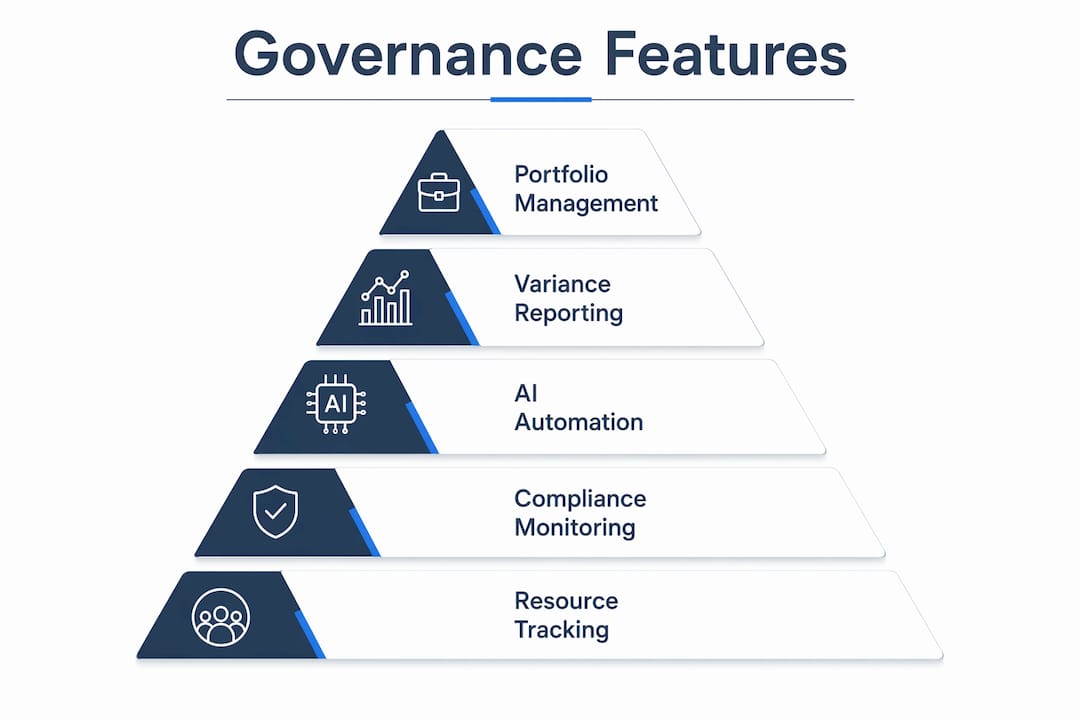
Portfolio baseline management and approval workflows
The foundation of any governance platform is its ability to lock a baseline, control changes to it, and route those changes through an auditable approval process. Primavera P6 and Planisware Enterprise do this at portfolio scale. Smartsheet and Wrike offer lighter approval workflows that suit programme-level governance without full portfolio baseline control.
Variance and earned value reporting
Variance reporting connects what was planned to what is actually happening, and earned value management (EVM) adds cost performance to that picture. Primavera P6 and Oracle Primavera P6 support full EVM. Planview Portfolios and Celoxis provide portfolio-level variance dashboards. Most mid-market platforms offer schedule variance but not cost variance at the depth enterprise governance requires.
AI-powered reporting and board automation
This is where 2026 separates from previous years. Platforms now automate the production of board reports, exception reports, and portfolio summaries using AI. Videra's AI-powered reporting automation generates audit-ready board and exception reports directly from mapped workflow data, removing the manual collation that causes reporting bottlenecks in most PMOs. Credo AI's GAIA assistant compresses weeks of governance work into hours for AI-specific compliance reporting.
Continuous compliance monitoring
Static compliance checks at audit time are no longer sufficient. AI governance platforms like Holistic AI run 40-plus specialised tests covering bias, safety, security, and performance, continuously monitoring deployed models for drift and adversarial threats. Massu AI generates SOC2 evidence packages automatically from its audit trail. For project portfolio governance, platforms like Planview AdaptiveWork and ITM Platform provide continuous risk monitoring across the portfolio.
Resource and financial tracking
Cross-project resource governance requires visibility into who is allocated where, at what cost, and against what baseline. Microsoft Project Server, Primavera P6, and Epicflow each approach this differently. Microsoft Project Server provides centralised resource and financial reporting tied to governance workflows. Epicflow specialises in resource levelling across constrained multi-project environments. LiquidPlanner's ranged estimation surfaces realistic resource forecasts rather than point-in-time snapshots.
Integration with enterprise systems
For enterprise project management software to function as a governance layer, it must connect to the systems where delivery actually happens: Jira for software teams, SAP for finance, Salesforce for CRM-linked programmes, and Microsoft 365 for document and communication governance. Platforms that offer bidirectional sync, not just one-way data export, provide meaningfully stronger governance coverage.
What are the key governance innovations shaping platforms in 2026?
The most consequential shift in enterprise project governance right now is the move from periodic oversight to continuous, automated control. Traditional PMO governance treated stage gates as moments of review. The platforms gaining ground in 2026 treat them as enforced decision points with automated evidence collection before, during, and after.
AI runtime governance as a new discipline
Enterprise AI governance has moved from manual, periodic oversight to continuous runtime control with automated policy enforcement and shadow AI detection. Holistic AI's Guardian Agents enforce policies autonomously with human-in-the-loop oversight, intervening in real time when risk thresholds are crossed. Credo AI's knowledge graph applies different controls to a claims agent in EU insurance than to a marketing agent in US retail, automatically, based on regulatory context. These are not project management tools in the traditional sense. They govern the AI systems that increasingly make or influence project decisions.
EU AI Act and ISO/IEC 42001 compliance pressure
UK enterprises with EU operations face direct compliance obligations under the EU AI Act, and ISO/IEC 42001 is becoming the de facto standard for AI management systems globally. Holistic AI, Credo AI, and Massu AI all offer pre-built policy packs aligned to these frameworks. For organisations selecting an AI governance tool in 2026, alignment with these standards is a baseline requirement, not a differentiator.
Open-source governance tooling
Massu AI's open-source core offers multiple governance tools free, covering audit trails, validation engines, and architectural decision records for regulated environments. It integrates directly into developer workflows via GitHub Actions and a REST API, making it a practical complement to enterprise PPM platforms rather than a replacement. Engineering teams in regulated sectors can use Massu AI to govern AI code while their PMO uses Primavera P6 or Videra for portfolio-level controls.
Pro Tip: When evaluating AI governance platforms, ask vendors specifically how they handle shadow AI detection across SaaS applications and cloud repositories. Platforms that can only govern AI systems you have already registered miss the most significant compliance risk: the AI tools your teams are using without central approval.
The best platforms for specific governance use cases
Not every organisation needs the same governance depth. The right platform depends on the primary governance problem you are solving.
For capital programme and infrastructure governance: Primavera P6 Enterprise Project Portfolio Management and Oracle Primavera P6 remain the strongest options. Their scheduling depth, baseline control, and variance reporting are built for programmes where cost and schedule governance are contractual requirements.
For Microsoft-standardised enterprises: Microsoft Project Server and Project Online, combined with Microsoft Project and Microsoft Planner for task-level work, provide a coherent governance layer across the M365 ecosystem. The integration with Power Platform enables custom reporting and automation without third-party middleware.
For regulated sectors in the UK (healthcare, construction, facilities management): Videra by Keystoneconsulting is purpose-built for this environment. Its sector-specific workspaces, stage-gated control, and AI-powered board reporting address the governance failures most common in these sectors: inconsistent reporting, audit gaps, and manual exception management.
For AI system governance: Holistic AI for continuous risk monitoring and compliance enforcement. Credo AI for agent-level governance and regulatory policy automation. Massu AI for engineering teams needing open-source audit trails in AI codebases.
For mid-market enterprises needing accessible governance: Smartsheet, Wrike, ClickUp, and Asana each offer configurable governance workflows without the implementation overhead of enterprise PPM platforms. monday.com suits teams that prioritise visual portfolio management. Jira governs software delivery specifically.
For operational safety and compliance: SafetyCulture's inspection and audit workflow tools are well suited to construction and facilities management environments where operational governance sits alongside project governance.
For portfolio investment and OKR alignment: Planview Portfolios and Celoxis connect project portfolios to strategic investment decisions. ITM Platform and Project Insight offer portfolio dashboards with risk management built in. Scoro and Teamwork suit smaller programme teams needing financial tracking alongside project management.
What UK organisations say about governance platforms
UK enterprises across healthcare, construction, and government have consistently identified the same governance failure points: reporting that arrives too late to influence decisions, audit trails that exist on paper but not in practice, and stage gates that are reviewed rather than enforced. The platforms that address these failures most directly are those that automate the evidence collection rather than relying on project managers to populate it manually.
Organisations using Primavera P6 in capital programmes report that its baseline approval workflows reduce unauthorised scope changes, though they also note that the platform requires dedicated project controls staff to maintain data quality. Microsoft Project Server users in government cite the integration with SharePoint and Power BI as the primary governance benefit, enabling executive dashboards that pull live data rather than manually compiled status reports.
SafetyCulture has gained traction in UK construction and facilities management for operational compliance, with its inspection and audit trail features meeting the requirements of ISO 45001 and CDM 2015 workflows. Capterra reviews from UK users highlight its mobile-first design as a practical advantage for site-based teams.
For AI governance specifically, UK financial services and insurance organisations are among the early adopters of platforms like Holistic AI and Credo AI, driven by FCA expectations around model risk management and the approaching EU AI Act compliance deadlines for organisations with EU operations. The AI governance certification landscape is also maturing, with ISO/IEC 42001 auditor credentials becoming a hiring requirement in larger PMOs.
Organisations that have deployed Videra in healthcare and construction settings report that its pre-configured sector workspaces reduce the governance design phase significantly, with audit-ready compliance tools that satisfy CQC and NHS reporting requirements without custom development. The AI-powered board reporting removes the weekly manual collation that typically consumes two to three days of PMO resource per reporting cycle.
Keystoneconsulting's Videra platform: governance built for UK enterprises
Most governance platforms are built for generic project management and then adapted for compliance. Videra starts from the opposite position: governance design first, with delivery support built around it.
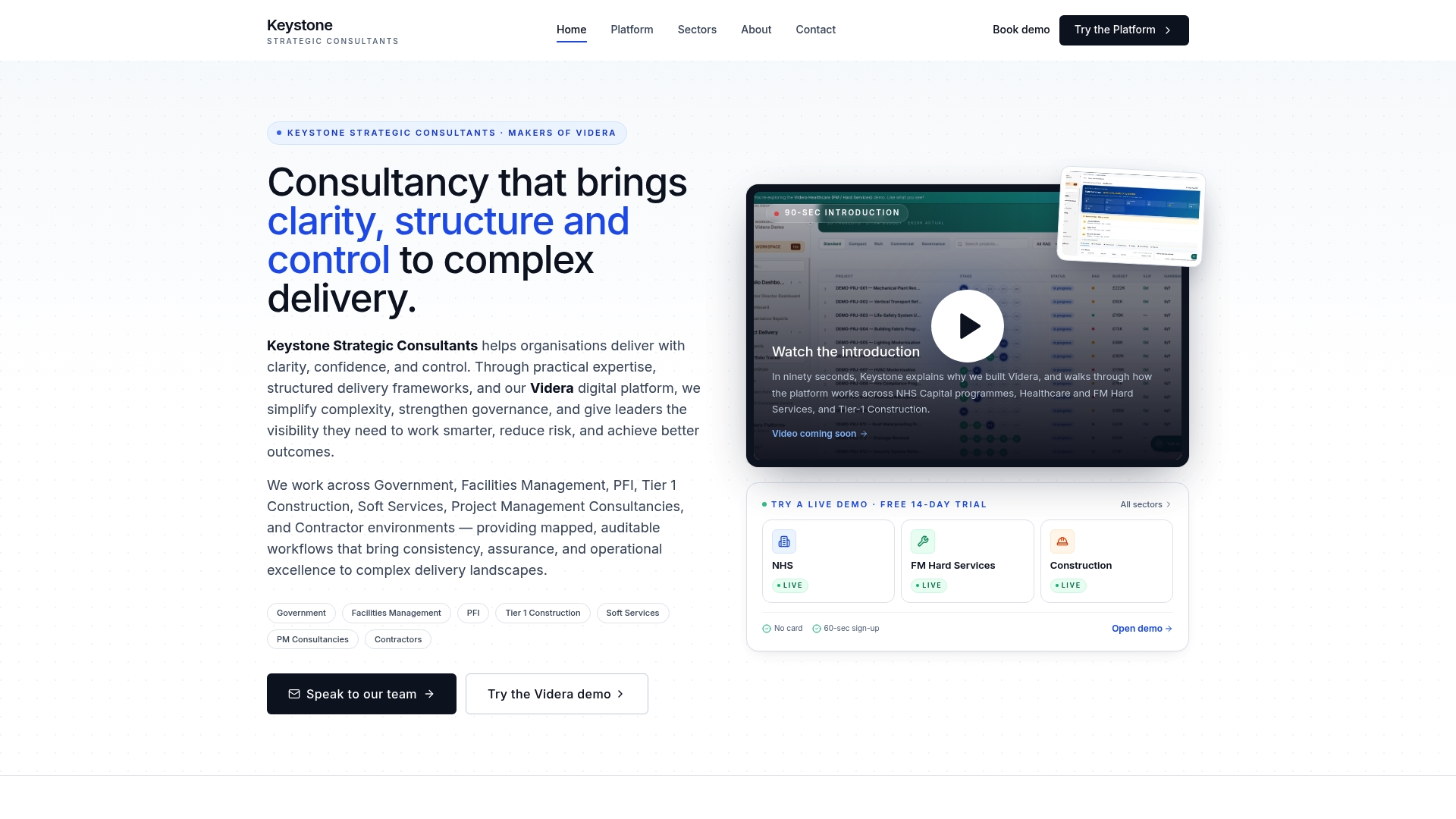
For UK organisations in healthcare, construction, and facilities management, the persistent problems are not a lack of project management tools. They are audit gaps, inconsistent reporting, and stage gates that exist in process documents but not in practice. Videra addresses these directly through mapped, auditable workflows, AI-powered board and exception report automation, and stage-gated controls that enforce decisions rather than record them after the fact. With 20 years of sector experience behind its design, Keystoneconsulting integrates directly with delivery teams rather than handing over a platform and stepping back.
The difference from a generic PPM subscription is concrete: sector-specific workspaces configured for NHS, CDM, and facilities management governance requirements, AI reporting that generates audit-ready outputs from live workflow data, and consultancy support that builds governance capability within your team rather than creating dependency on external resource. For enterprises where compliance is a board-level concern and reporting bottlenecks are costing PMO capacity, Videra is the most direct solution available in the UK market.
Explore the Videra platform and Keystoneconsulting's consultancy services to see how governance design and delivery support work together in practice.
Key takeaways
The best enterprise project governance platforms for 2026 combine automated stage-gate enforcement, audit-ready compliance tools, and AI-powered reporting to close the loop between strategy, delivery, and benefit realisation.
| Point | Details |
|---|---|
| Governance failure root cause | Static checkpoints rather than dynamic, automated controls cause most enterprise governance failures. |
| Top platform for regulated UK sectors | Videra by Keystoneconsulting delivers sector-specific, audit-ready governance for healthcare, construction, and facilities management. |
| AI governance is now a separate discipline | Holistic AI, Credo AI, and Massu AI govern AI systems at runtime, complementing traditional PPM tools rather than replacing them. |
| Implementation complexity is a real cost | Primavera P6, Planisware Enterprise, and Planview AdaptiveWork require experienced staff and significant configuration for governed deployments. |
| Standards alignment is a baseline requirement | EU AI Act and ISO/IEC 42001 compliance are now baseline selection criteria for any platform governing AI systems in UK enterprises with EU operations. |