
An effective RFI management process is a single, auditable workflow with one submission standard, a named owner for every request, and a fixed response SLA, nothing looser. Without those three controls, requests scatter across inboxes, answers arrive late or informally, and disputes over who said what become unanswerable months later. Get the workflow, the ownership, and the SLA right, and the rest of the process falls into place.
TL;DR:
- An effective RFI process requires a single, auditable workflow with clear submission standards, responsible owners, and fixed response SLAs to prevent delays and disputes.
- RFIs should be limited to clarifications of existing documents, with each request focusing on one specific question and proper labeling to avoid scope creep or scope changes.
- A formal workflow with seven stages, from identification to close-out, ensures accountability and traceability, reducing the risk of missed responses or scope misunderstandings.
- Implementing a structured tracking system that captures all metadata, responses, and changes, along with automated alerts for overdue RFIs, improves process transparency and efficiency.
- Contracts should explicitly define RFI standards, rights to reject incomplete requests, and fixed review periods to discourage misuse and prevent abuse of the process.
Table of Contents
- What counts as an RFI and why the definition matters
- The step-by-step RFI workflow from identification to close
- The RFI checklist: fields every submission needs
- Types of RFIs and why correct labelling matters
- Why RFIs get abused and how contracts should control it
- Manual spreadsheets versus a proper RFI tracking system
- Measuring RFI performance with the right KPIs
- Setting up or fixing your RFI workflow on a live project
- Where governance-first practice changes RFI outcomes
- Three priorities for leaders resetting their RFI process
- How Keystone and Videra support an auditable RFI process
- Sources
- FAQ
What counts as an RFI and why the definition matters
A Request for Information is a formal query raised when contract documents, drawings or specifications are unclear, conflicting or incomplete, and the answer is needed to keep work moving. Each RFI should address a single subject: bundling several questions into one submission slows the response and muddies the record. Contractors, subcontractors and design consultants typically raise RFIs, while the architect, engineer or owner's representative is expected to respond.
When the definition is loose, teams misuse RFIs to flag general concerns, request approvals or even propose changes, none of which belong in the process. That drift is exactly what the Construction Management Association of America warns against, recommending that contracts define what qualifies as an RFI before work starts.
- An RFI clarifies existing documents; it does not authorise new scope.
- Every RFI needs one clear question and one accountable respondent.
- Unmanaged RFIs commonly lead to delay claims when responses arrive too late to act on.
The step-by-step RFI workflow from identification to close
A clean workflow has seven stages, each with a defined owner and output. Skipping steps, especially tracking and close-out, is where most processes quietly fail.
- Identify: the field or design team confirms the document gap is genuine and cannot be resolved by a quick call or existing drawing note.
- Draft: the originator writes a single-subject question, references the relevant drawing or spec section, and proposes an interpretation or solution where possible.
- Submit: the RFI enters the project's single tracking system with a unique ID, date, priority and required-by date, never as a standalone email.
- Track: the system assigns a status (open, in review, answered, void) and an owner responsible for the current state.
- Respond: the design team or owner answers within the agreed SLA; if the answer changes scope or cost, the contractor should issue a notice of potential change before proceeding.
- Implement: the field team applies the answer and updates any affected drawings or method statements.
- Close: the RFI is marked closed with the response attached to the permanent project record for audit and future reference.
Pro Tip: Require every RFI to include a proposed answer from the originator. It forces sharper questions and often cuts the response time in half because the reviewer only has to confirm or correct, not start from a blank page.
The submission step deserves particular discipline. Metadata such as drawing references, location and required-by date should be mandatory fields, not optional extras, because incomplete submissions are the most common reason for delayed responses. Tracking should live in one place that every party can see, not split between a contractor's spreadsheet and an architect's inbox.
The response stage carries the greatest contractual risk. A design answer that changes the scope of work is a potential trigger for a claim, and a contractor who proceeds without issuing formal notice can forfeit the right to recover time or cost later, a point made directly in the detailed CMAA paper on RFI impact. Close-out is not administrative housekeeping either: a brief post-RFI review, noting whether the question could have been avoided with better coordination, feeds directly into the lessons-learned register for the next project stage.
The RFI checklist: fields every submission needs
A well-formed RFI should be answerable on first read, without the reviewer having to chase missing context. That means a fixed set of fields, applied every time.
- Unique ID and date raised, so the request can be tracked from submission to close.
- Subject line and single question, limited to one issue per RFI.
- Drawing and specification references, pointing to the exact sheet or section in question.
- Location, tying the query to a specific area, level or grid reference.
- Proposer and required-by date, so the reviewer knows who is asking and how urgent the answer is.
- Proposed interpretation or solution, where the originator has a reasonable suggestion.
Recommended attachments include annotated drawings, site photographs and measurements that support the question. Administrative screening, checking that these fields are complete before the RFI enters the tracking system, is one of the practical control measures the CMAA recommends to reduce processing delay caused by incomplete submissions.
RFIs that arrive incomplete are also more likely to be returned unanswered, which is why the same guidance recommends giving owners the explicit contractual right to reject a submission that fails to meet the required form, rather than processing it anyway.
Types of RFIs and why correct labelling matters
Not every RFI is the same kind of question, and labelling it correctly determines who should answer and whether it can trigger a change.
- Clarification RFIs ask what a drawing or spec means; the design consultant answers, and no scope change should follow.
- Site condition RFIs flag a discrepancy between documents and field conditions; these often require an owner or engineer decision and can lead to a change order.
- Directive RFIs effectively ask the owner to make a decision between options; they need owner sign-off, not just design commentary.
- Substitution RFIs propose an alternative product or method; they typically need both design and owner approval before proceeding.
Mislabelling causes real problems. A site condition RFI answered as a simple clarification, without owner involvement, can leave a contractor proceeding on an informal instruction that later needs a formal change order it never received.
Why RFIs get abused and how contracts should control it
The CMAA's guidance on RFI impact is blunt about a widespread problem: the RFI process is often used as a tool to shift risk or build a paper trail for claims, rather than to genuinely resolve document gaps. Contractors sometimes submit RFIs on issues they already understand, and owners sometimes sit on responses to avoid committing to a position.
The fix sits in the contract, not just in good intentions. CMAA recommends owners write RFI control specifications directly into the general conditions.
- Require a standard RFI form and reject submissions that do not use it.
- Set a fixed review period, commonly matched to the criticality of the item.
- Give the owner the explicit right to return an RFI that fails the single-subject rule.
- Define what an RFI is, in writing, so it cannot be stretched to cover approvals or scope proposals.
A contract that defines RFI submission requirements and response expectations gives owners the standing to reject frivolous or improperly formed requests without reviewing them on their merits.
That single clause, giving the owner return rights, does more to curb abuse than any amount of after-the-fact policing.
Manual spreadsheets versus a proper RFI tracking system
Email threads and shared spreadsheets are where RFI processes go to die. Attachments get lost in reply chains, status updates depend on someone remembering to update a cell, and by the time a dispute arises nobody can reconstruct who saw what and when. A document control system that treats RFIs as an afterthought inherits the same weaknesses.
A workable RFI tracking system, even a modest one, needs to cover the basics properly.
- A single source of truth that every party, including subcontractors, can access and update.
- Attachments held with the record, not linked from a separate drive that can move or disappear.
- SLA alerts that flag an RFI approaching or past its due date automatically.
- An audit trail recording every status change, response and edit with a timestamp.
Pro Tip: Before buying anything, map your current RFI workflow on paper. Most teams discover the bottleneck is not technology at all, it is an undefined handoff between two people who each assumed the other owned the next step.
Where automation earns its keep is in templating the submission form, linking RFIs directly to the drawing set they reference, and auto-routing each request to the correct discipline lead based on its type, cutting the manual sorting that eats the first day of most RFI delays with AI-enabled contractor communications and rapid response technologies.
Measuring RFI performance with the right KPIs
Tracking individual RFIs is not the same as understanding whether the process is healthy. Leaders need a small set of KPIs, reviewed regularly, that surface risk before it becomes a delay claim.
| KPI | What it shows | Why it matters |
|---|---|---|
| Average response time | How quickly the design team turns answers around | Slow averages predict schedule pressure before it hits the critical path |
| Overdue RFIs | Requests past their agreed SLA | A rising count signals a bottleneck at a specific reviewer or discipline |
| Age distribution | How RFIs are spread across open time bands | Long tails reveal chronically neglected categories, not just one-off delays |
| Percent implemented without dispute | Share of responses actioned without a later change order | A falling percentage suggests answers are changing scope without proper notice |
Response-time expectations should reflect delivery method. Research analysing over 2,000 RFIs across 17 highway projects found that Design-Build projects generate more RFIs and more late responses than Design-Bid-Build or CM-GC delivery, meaning DB programmes need tighter SLAs and dedicated review resource rather than a one-size target. Reports to sponsors should lead with overdue count and age distribution, the two metrics that flag a problem before it reaches the critical path.
Setting up or fixing your RFI workflow on a live project
Improving an existing process rarely needs a full platform migration on day one. It needs clear ownership and a short pilot.
- Assign RFI ownership within your Project RACI matrix, naming who submits, who reviews, who approves and who closes each request.
- Build a pilot on one work package: a standard template, a single tracking tool, a defined SLA and a short training session for the team using it.
- Run the pilot for four to eight weeks, then compare RFI volume, average response time and overdue count against the previous method.
- Fold lessons learned back into the procedure, updating the template or routing rules based on what the pilot exposed.
Pro Tip: Track your pilot's overdue rate weekly, not monthly. A process that looks fine at month's end can hide a reviewer who has been two weeks behind since week one.
Once the pilot proves out, extend the same template, tool and SLA structure across the rest of the project rather than letting each work package invent its own version.

Where governance-first practice changes RFI outcomes
Twenty years of delivery work across healthcare, construction and facilities management points to the same root cause behind most RFI failures: nobody owns the handoff between question and answer. Mapped workflows fix that by making the next step, and its owner, visible before a delay happens rather than after.
Reporting bottlenecks rarely come from a lack of data. They come from nobody being accountable for turning that data into a decision on time.
AI-powered reporting tools built on that same mapped structure turn RFI status into a live, audit-ready record rather than a document someone reconstructs after the fact.
Three priorities for leaders resetting their RFI process
Fix three things: one submission standard, one tracking system, one enforceable SLA. Reward teams for clear questions and fast answers, not for who avoided blame when an RFI went unanswered. Everything else in the process follows from getting those habits right.
— Peter
How Keystone and Videra support an auditable RFI process
Generic spreadsheets and inbox threads were never built to hold an owner accountable to an SLA, and most consultancies stop at recommending a policy rather than building the workflow that enforces it. Consultancies can integrate directly with project teams to map the RFI process into a structured, sector-specific workflow, so submission standards, routing and response deadlines are built into the system rather than left to memory.
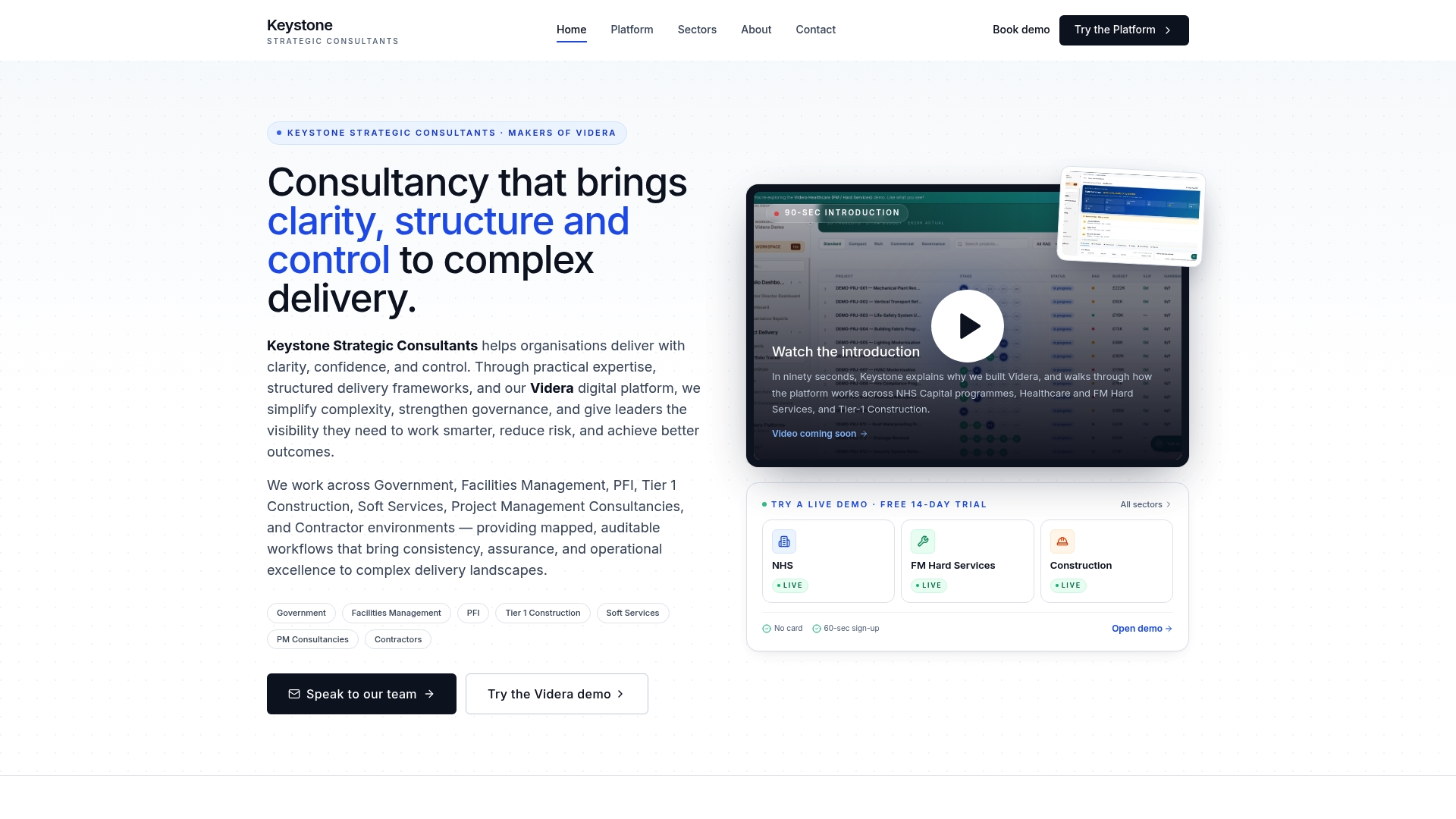
- Standard RFI forms and single-subject rules are enforced at submission, not checked afterwards.
- Every status change and response is captured automatically for audit-ready evidence.
- AI-powered reporting flags overdue RFIs and ageing trends before they reach a sponsor's desk.
Videra Construction is built for exactly this kind of stage-gated project governance, and Videra PM extends the same mapped-workflow approach across the wider programme. If your current process still runs on email and spreadsheets, book a conversation with our consultancy team to see how a mapped RFI workflow would look on your next project.
Sources
- Impact & Control of RFIs on Construction Projects | Construction Management Association of America
- Impact of Alternative Delivery on the Response Time of Requests for Information for Highway Projects
FAQ
What is an RFI process?
An RFI process is the structured way a project team raises, tracks and resolves questions about unclear or conflicting contract documents. It runs from identifying the gap, through drafting and submitting a single-subject question, to a tracked response and formal close-out.
Can an RFI be rejected?
Yes. Contracts that follow CMAA's recommended control specifications give owners the explicit right to return an RFI that fails to use the required form or breaches the single-subject rule, without reviewing its content.
How long should an RFI take?
There is no universal fixed period; the reasonable timeframe depends on the project's delivery method and contract terms. Research on Design-Build highway projects found these programmes generate more RFIs and more late responses than traditional delivery, so DB teams typically need tighter SLAs than DBB or CM-GC projects.
What is the RFI checklist?
A complete RFI checklist covers a unique ID, subject line, drawing and specification references, location, proposer, required-by date, and a proposed interpretation or solution where one is available. Supporting attachments such as annotated drawings, photographs and measurements strengthen the submission and reduce the chance it is returned incomplete.