
A project RACI matrix is a simple grid that assigns four roles, Responsible, Accountable, Consulted, and Informed, to every task or deliverable so nobody has to guess who does what. Build one whenever a project crosses more than one team, involves external stakeholders, or hits a handover point where work passes from one group to another. If your project has any of those features, don't wait for a problem to force the issue; the role of cloud consultants in driving migration success is crucial in avoiding common pitfalls during technical migrations.
Use it now if:
- Your project spans two or more departments or organisations.
- Sign-off delays or duplicated work have already happened once.
- A handover, phase gate, or go-live is coming up and ownership isn't written down anywhere.
Draft the grid this week, even roughly, and enforce one rule immediately: every task gets exactly one Accountable owner. Everything else in this guide builds from that single constraint.
Key Takeaways
A project RACI matrix works only when every task has exactly one Accountable owner and the chart lives somewhere the whole team actually checks.
| Point | Details |
|---|---|
| One Accountable owner, always | Split any task where two people claim ownership rather than naming both Accountable. |
| Use roles, not names | Function-based columns like "QA Lead" survive personnel changes; person-based ones don't. |
| Validate before publishing | Walk the draft through a stakeholder session and document any disagreements and their resolution. |
| Set a review trigger | Revisit the matrix at every phase gate or whenever scope or personnel changes. |
| Keep it live, not static | Keystoneconsulting's Videra platform ties RACI role assignments to auditable, mapped workflows so governance evidence is ready at all times. |
Table of Contents
- What is a project RACI matrix and what do the four roles mean?
- Why bother with a RACI matrix: benefits and limitations
- How to create a project RACI matrix step by step
- RACI matrix examples and templates you can adapt
- Common RACI mistakes and the rules that prevent them
- Keeping the RACI matrix current: tools, integration, and review cadence
- How Keystoneconsulting applies RACI in governance engagements
- Why RACI succeeds or fails depending on leadership, not paperwork
- A managed alternative for teams that need governance built in
- Sources
What is a project RACI matrix and what do the four roles mean?
A RACI chart maps four types of involvement onto a list of tasks, with roles or people across the top and deliverables down the side. Each cell gets one letter. Get the letters right and the rest of the exercise looks after itself.
- Responsible. The person or function doing the work. A task can have several Responsible parties, though the more you add, the harder it gets to track who's actually moving the ball forward.
- Accountable. The person who owns the outcome and answers for it if something goes wrong. This is the role most teams get sloppy with, and it's the one that matters most.
- Consulted. People whose input is needed before a decision or deliverable is finalised, typically through two-way conversation rather than a broadcast email.
- Informed. People who need to know the outcome after the fact but have no say in how it's reached.
The standard layout puts tasks or deliverables down the left column and roles across the top row, so you read each row left to right to see who touches a given piece of work. That axis convention isn't arbitrary. It makes the matrix scannable during a stakeholder meeting, where someone can run a finger down a column and immediately see everything a given role is on the hook for.
Two variants are worth knowing. RASCI adds a "Support" role for people helping the Responsible party without owning the delivery themselves, useful when a task genuinely needs two tiers of doing. DACI, by contrast, isn't a RACI variant at all. It's built for decisions rather than tasks, naming a Driver, Approver, Contributors, and Informed parties, and it pairs well with RACI on projects where task execution and decision rights need separate tracking. If your project has a handful of high-stakes decisions buried inside a long list of routine deliverables, running DACI or RAPID alongside RACI for just those decisions often works better than trying to force everything into one framework.
Why bother with a RACI matrix: benefits and limitations
The payoff is straightforward: fewer people doing the same job twice, and decisions that don't stall waiting for someone to admit they own the call. Naming one Accountable owner per task speeds up approvals because there's no ambiguity about who signs off, and that clarity compounds across a project with dozens of dependent deliverables. Wrike's research on RACI adoption points to the same pattern: duplication drops and approvals move faster once ownership is explicit rather than assumed.
The benefits show up most clearly here:
- Fewer duplicated efforts, because two people no longer quietly do the same piece of work assuming the other isn't.
- Faster sign-off, since there's no back-and-forth over who has the authority to approve.
- Better forward planning, because gaps in ownership surface while you're building the grid, not three weeks into delivery.
- A cleaner escalation path, since everyone knows who to go to when something's stuck.
But a matrix isn't free. Someone has to build it, validate it with the people named in it, and keep it updated as the project moves through phases or people change roles. For a five-person team running a two-week sprint, that overhead can genuinely outweigh the benefit. RACI earns its keep on projects with real complexity: multiple departments, external vendors, regulatory sign-off, or a project timeline long enough that people will forget who agreed to what. If you're coordinating four colleagues on a short internal task, a shared task list with named owners does the same job with less ceremony. Our guide to common project management bottlenecks covers several situations where the absence of clear ownership, not the absence of process, is the actual problem.
How to create a project RACI matrix step by step
Building a usable matrix takes an afternoon, not a week, provided you follow a sequence rather than trying to fill in the grid from memory. Meister's six-step approach is a solid backbone for this, and the steps below adapt it for a governance-conscious project team.
-
Define scope and list deliverables. Break the project down using a work-breakdown structure rather than a vague task list. "Design the homepage" is too broad; "approve homepage wireframe" and "sign off homepage copy" are tasks you can actually assign. Aim for the level of detail where a single person could plausibly be Accountable for the whole item.
-
Choose role names, not people, wherever possible. List "Finance Lead" or "Compliance Officer" rather than "Sarah" or "Tom". People leave, get promoted, or go on leave; roles don't. This single habit is the difference between a matrix that's still accurate in eighteen months and one that's obsolete the day someone changes teams.
-
Build the grid and assign R, A, C, and I to every task. Put deliverables down the side, roles across the top, and go through each row methodically. Resist the urge to mark several roles as Accountable "to be safe". It defeats the entire point of the exercise.
-
Enforce one Accountable owner per task, without exception. This is the rule experienced practitioners call the golden rule of RACI, and for good reason: two Accountable parties on one task means nobody's actually accountable when it slips. If a task genuinely needs two owners, split it into two tasks with a clean boundary between them.
-
Validate the draft in a stakeholder session. Don't publish a RACI matrix you built alone and hope it holds up. Walk it through with the people named in it, ask each Accountable owner if they agree they own that outcome, and document any pushback along with how it was resolved. This step catches the disagreements that would otherwise surface mid-project, when they're expensive to fix.
-
Publish it centrally and set a review trigger. A RACI matrix sitting in someone's personal folder might as well not exist. Put it somewhere the whole project team can see, and set a date or milestone at which it gets revisited.
Pro Tip: Run the validation session as a working meeting, not a presentation. Ask each Accountable owner out loud, "Do you agree you own this outcome?" People who'd nod along to a written document often hesitate when asked directly, and that hesitation is exactly the ambiguity you're trying to remove.
Keep the grid itself simple. A spreadsheet works fine for a first draft, but if your project already lives in a tool like Jira or Confluence, building the RACI structure directly into that shared space means role assignments stay visible next to the actual work items, rather than living in a separate document nobody opens after week one.
RACI matrix examples and templates you can adapt
A short worked example beats an abstract explanation every time. Take a website launch with three deliverables: content, design, and technical build.

For the "approve final copy" task, the Content Lead is Responsible for writing it, the Marketing Director is Accountable for the final sign-off, Legal is Consulted on any regulatory claims, and the wider marketing team is Informed once it's approved. For "build the checkout flow", the Developer is Responsible, the Technical Lead is Accountable, the Payments Provider is Consulted on integration requirements, and the Project Manager is Informed of completion. Two tasks, two completely different sets of people, and no ambiguity in either row about who answers for the outcome.
Templates generally split into two families. Role-based templates list functions like "Project Manager" or "QA Lead" across the columns, which suits organisations with stable structures and recurring project types. Person-based templates name individuals directly, which works for smaller, one-off projects where the team composition is unlikely to change before delivery finishes. For anything running longer than a few months, role-based wins on durability, as noted earlier.
There's also a depth choice to make:
- Minimal templates track only the deliverable and the four role columns, best for straightforward projects with under twenty tasks.
- Detailed templates add columns for deadlines, dependencies, and current status, useful when the RACI matrix doubles as a live tracking document rather than a one-off reference.
- Sector-specific templates exist for construction, healthcare, and IT delivery, often pre-populated with common roles like site managers or clinical leads, which saves time building from scratch.
A few readability habits make a real difference once the grid grows past a dozen rows. Group related deliverables under a shared heading, such as "Design Phase" or "Testing Phase", so the matrix reads in sections rather than as one long undifferentiated list. Cap the number of Responsible and Consulted entries per row at two or three; beyond that, the row becomes unreadable and defeats the purpose of a quick visual scan. If you use colour coding, apply it sparingly, one colour per role letter at most, since a matrix covered in colour blocks is harder to read than plain text in a well-structured table.
Common RACI mistakes and the rules that prevent them
Most RACI matrices fail for the same handful of reasons, and nearly all of them trace back to people avoiding the discomfort of naming a single owner. Watch for these:
- Too many Responsible or Consulted entries on one task. If five people are marked Responsible, nobody actually feels responsible. Keep the list tight and specific.
- An unclear or missing Accountable owner. This is the single most common failure mode, and it's usually a symptom of a manager not wanting to put their name against a risky deliverable.
- Everyone marked Informed by default. If half the organisation is Informed on every task, the Informed column stops meaning anything and becomes noise nobody reads.
- Tasks written too broadly to assign cleanly. If a task is too big for one person to own, split it rather than forcing shared accountability onto it.
Pro Tip: If two people both insist they should be Accountable for the same task, that's a sign the task itself is drawn too broadly. Split it along the natural handover point, and give each half its own owner.
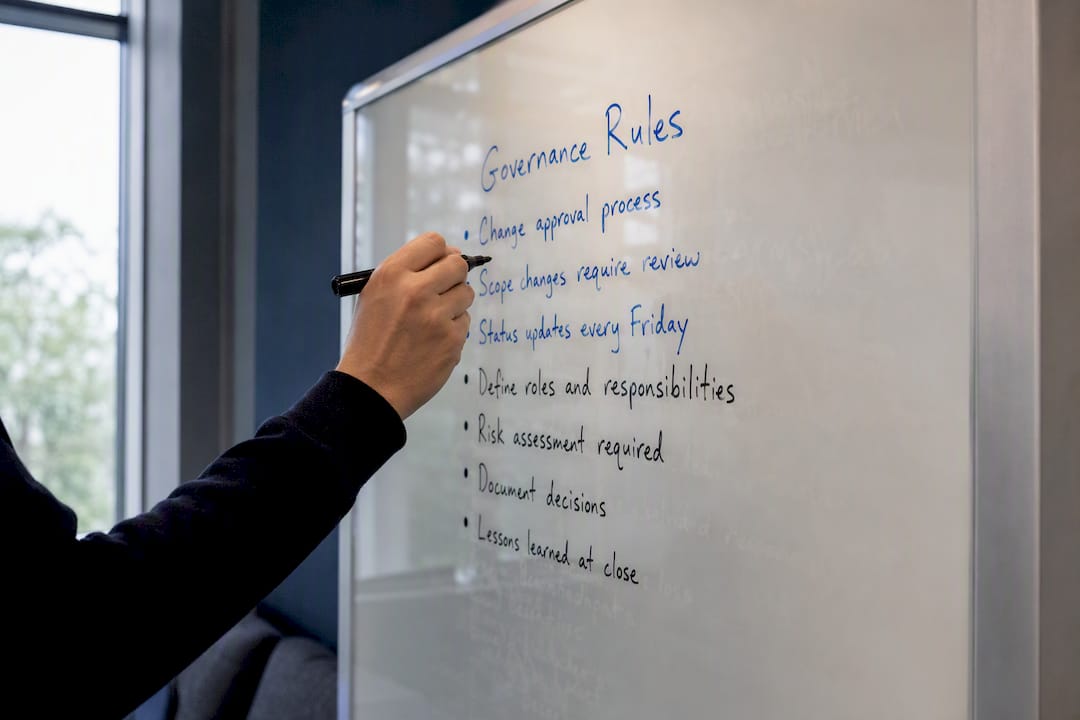
Governance rules keep the matrix trustworthy once it's live. Version every update with a date and the name of who made the change, require sign-off from the Accountable owner before any change to their row goes live, and write down a clear escalation path for when a Consulted party disagrees with a decision. Without those three habits, a RACI matrix quietly drifts out of date within a few months and starts costing you the clarity it was built to provide.
Keeping the RACI matrix current: tools, integration, and review cadence
A RACI matrix that lives in a forgotten spreadsheet is worse than no matrix at all, because people trust a document that's actually wrong. Store it somewhere the whole project team already works, whether that's a shared page in Confluence, a Jira project space, or a dedicated tab inside your delivery platform. Asana's guidance on RACI adoption makes the same point: keeping the chart linked to live work items, rather than isolated in its own document, is what actually drives adoption.
Link individual RACI entries to the tasks or tickets they describe wherever your tooling allows it. That traceability matters most when an auditor or a new team member asks "who approved this?" six months after the fact, and you need an answer that doesn't rely on someone's memory.
Set a review cadence rather than leaving updates to chance:
- Review at every phase gate, since scope and roles both tend to shift as a project moves between stages.
- Review whenever a named individual leaves the project or changes role, particularly if the matrix is still person-based rather than role-based.
- Review after any scope change significant enough to alter deliverables, since new deliverables need their own RACI assignments.
Assign one owner, usually the project manager, for keeping the matrix updated, and log every change with a date and reason. That single habit turns the RACI matrix from a one-time artefact into a living governance record.
How Keystoneconsulting applies RACI in governance engagements
Keystoneconsulting builds RACI directly into the workflow maps it creates for clients in healthcare, construction, and facilities management, rather than treating it as a document that sits beside the real work. Each role assignment gets tied to a specific stage in the workflow, so an auditor can trace exactly who approved what and when, without chasing down emails or meeting notes.
Pairing a RACI structure with mapped, auditable workflows and AI-powered reporting turns role clarity into something you can actually demonstrate at audit, not just something written down and hoped for.
...
Why RACI succeeds or fails depending on leadership, not paperwork
RACI matrices don't fail because the grid was drawn wrong. They fail because nobody with authority backed the accountable owners named in it. I've seen well-built matrices ignored within weeks because a senior sponsor never told the organisation the roles were real, and I've seen rough, half-finished ones work fine because leadership treated every Accountable assignment as binding.
If you're the sponsor, the highest-leverage thing you can do isn't reviewing the document. It's telling your team, out loud, that the people named Accountable actually have your backing to make the calls the matrix gives them.
— Peter
A managed alternative for teams that need governance built in
Building and maintaining a RACI matrix by hand works for plenty of teams, but it puts the ongoing discipline, the version control, the review cadence, the audit trail, entirely on whoever owns the spreadsheet. Keystoneconsulting takes a different route: the Videra platform builds role assignments directly into mapped, auditable workflows, so RACI structure and the actual work sit in the same place instead of two documents that inevitably drift apart.
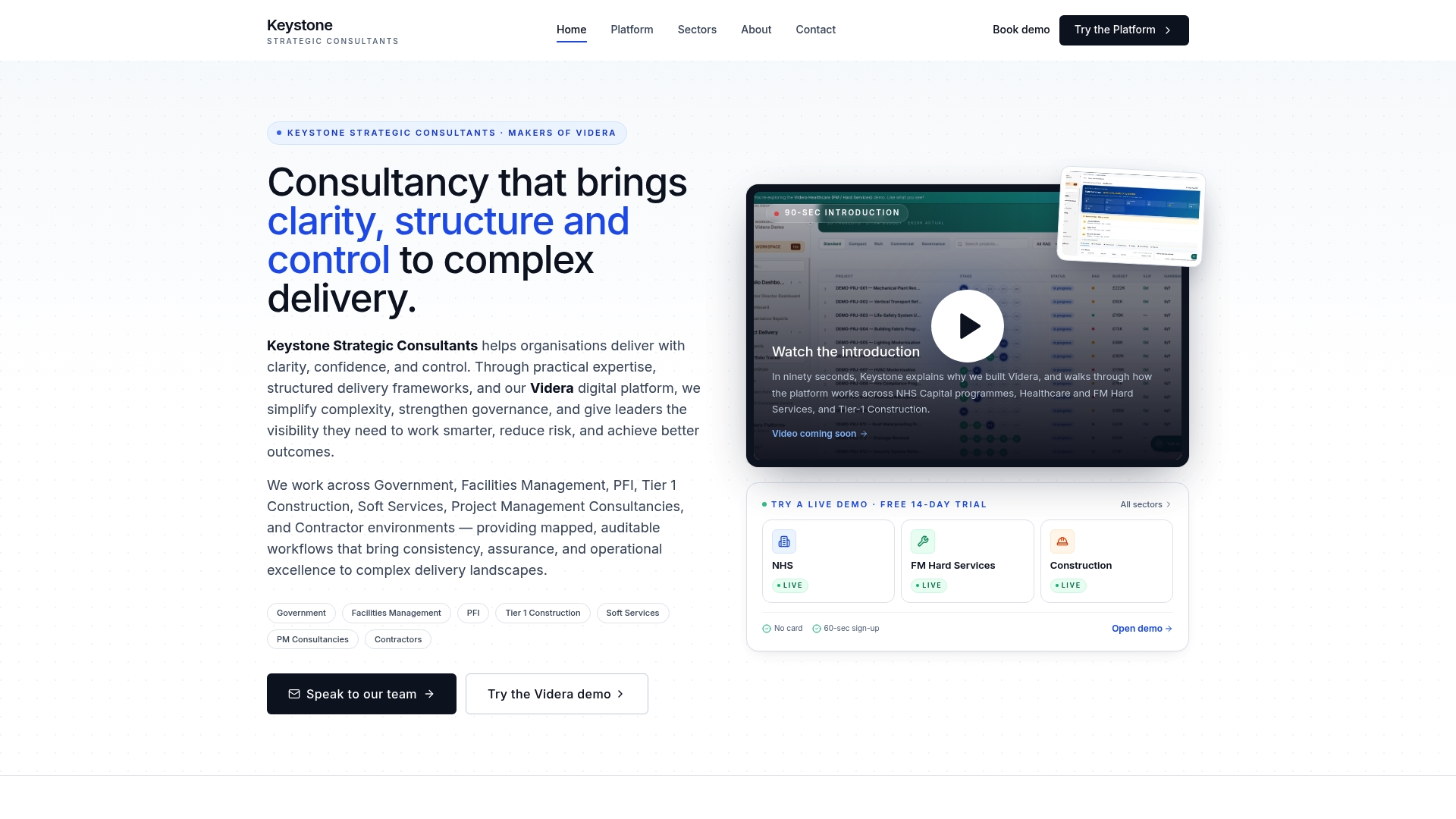
That matters most on projects where compliance is non-negotiable, healthcare capital schemes, construction handback, facilities lifecycle work, because Videra's AI-powered reporting turns every role assignment into something you can produce at audit without reconstructing it from memory. If your project involves multiple stakeholders, a regulatory sign-off requirement, or a governance gap you've already been asked to fix, that's the signal to look at a platform-based approach rather than another spreadsheet. Visit Keystoneconsulting to see how Videra maps onto your sector, or explore the Videra PM platform directly to check whether it fits your project's scale and compliance needs.