
For UK facilities leaders, the fastest route to measurable operational gains is a consultancy-led implementation paired with a modular platform that acts as your single system of record. Not software alone, not consultancy alone. The combination is what works.
Before you shortlist anything, insist on these four components:
- Mapped workflows designed before any configuration begins, so you digitise a working process rather than a broken one
- Pilot-first delivery on a single site for 30–60 days to surface gaps and build internal advocates
- Audit-ready reporting with timestamped, immutable records from day one
- A defined KPI baseline covering first-time fix rate, mean time to repair (MTTR), and SLA compliance so you can prove value to the board
JLL's operational efficiency guidance confirms that the vast majority of FM leaders name cost reduction as their primary priority. The platform and the governance framework are how you get there. Keystoneconsulting's Videra platform is built around exactly this model.
Table of Contents
- Why does a consultancy-led platform outperform software-only projects?
- What KPIs prove operational efficiency, and what gains can you expect?
- What should you look for when choosing a delivery partner and platform?
- What does a realistic implementation timeline and cost model look like?
- How do you design governance and integrations that scale without breaking?
- How do Keystoneconsulting and Videra deliver this in practice?
- Key takeaways
- The one move most FM leaders get wrong
- Keystoneconsulting and Videra: what a pilot engagement looks like
- Useful sources and further reading
Why does a consultancy-led platform outperform software-only projects?
The most common failure in FM digital transformation is not choosing the wrong software. It is configuring the right software around a broken process. Consultancy-led delivery fixes this by designing governance and simplifying workflows before a single screen is built.

A modular platform acting as the system of record then carries that governance across every site and service line. Organisations that adopt this approach can absorb new sites while reusing governance templates and data models rather than rebuilding from scratch each time.
The pilot-first model matters for a different reason: it exposes configuration gaps when the cost of fixing them is low, and it creates internal champions who accelerate adoption at scale. Ad hoc software installs skip this stage and pay for it later in low utilisation and poor data quality.
- Governance design prevents the "digitised chaos" trap
- A system of record reduces rework when scaling across sites
- Role-based training tied to staged governance cuts time-to-value
- Pilot retrospectives give you evidence to greenlight the rollout with confidence
Pro Tip: Before any vendor demo, map your highest-volume workflow on a whiteboard with the people who actually do it. You will find at least two steps that exist only because of a legacy workaround. Remove those first, then configure the software.
What KPIs prove operational efficiency, and what gains can you expect?
"Operational efficiency" means nothing to a finance director without a number attached to it. IFS benchmarking data for top-performing FM organisations shows a 35% increase in technician productivity, a 49% reduction in subcontractor spend, and a 19% SLA improvement when AI-enabled planning is combined with clear governance. Digitised workflows commonly deliver 20–30% less unplanned downtime and 15–25% improvement in MTTR. Audit preparation time, which can consume weeks of staff effort in manual environments, can fall to under a day.
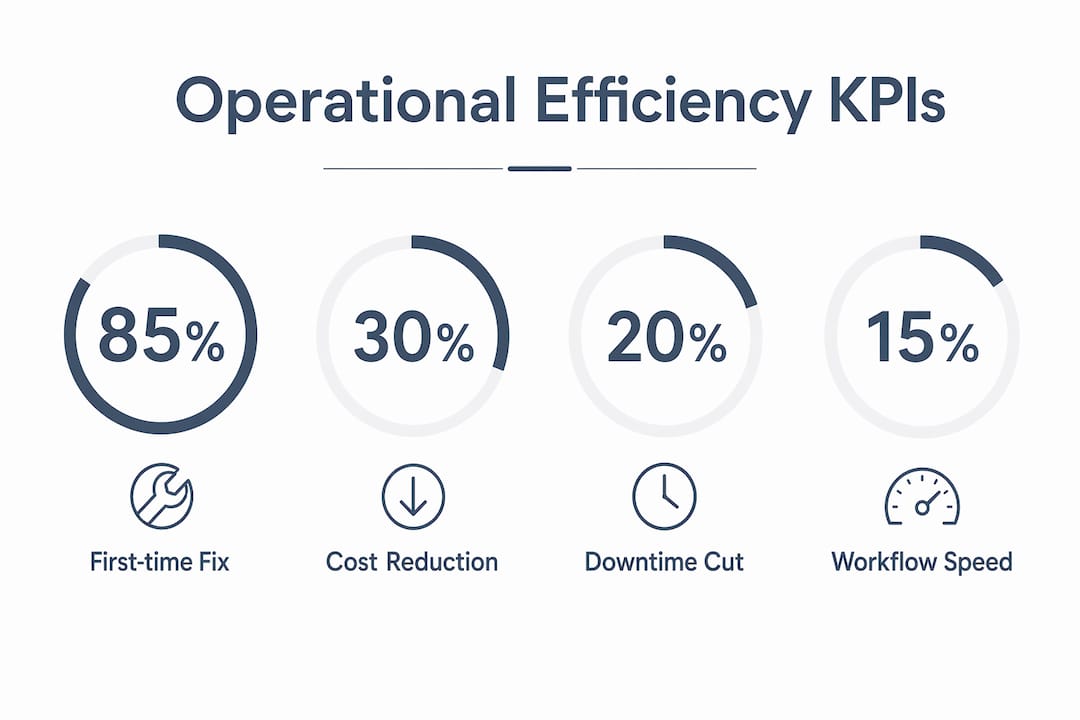
Set your baseline in the first 30–60 days of a pilot, report weekly during that period, then move to monthly reporting to evidence trend lines.
| KPI | Baseline target | Pilot target (30–60 days) | — |
|---|---|---|---|
| First-time fix rate | Measure current state | Identify top failure modes | Improve by 35% |
| MTTR | Measure current state | Reduce by 15–25% | Reduce by 15–25% |
| SLA compliance | Measure current state | Stabilise at agreed threshold | Improve by 19% |
| PM compliance | Measure current state | Reach scheduled completion target | Sustain above target levels |
| Subcontractor spend | Measure current state | Identify top spend drivers | Reduce by 49% |
| Audit preparation time | Measure current state | Reduce to under one week | Reduce to under one day |
What should you look for when choosing a delivery partner and platform?
Procurement teams often score vendors on features alone. The questions that actually separate good implementations from expensive failures are about governance, integration, and what happens after go-live.
Feature and capability checklist:
- System-of-record capability with a single canonical data model
- Configurable workflows without bespoke development for every change
- Mobile-first technician experience with minimal mandatory closure fields
- AI triage and dispatch to reduce coordination overhead
- Audit-ready reporting with exportable evidence packages
- APIs for ERP, CMMS, and IoT integration
- Role-based security and UK GDPR-compliant data handling
Scalability and governance criteria:
- Modular architecture that supports multi-site template reuse
- Stage-gate governance with defined approval and rollback procedures
- Tenant and zone configuration for complex portfolios
Commercial and total cost of ownership (TCO) considerations:
- Licence model: per user, per device, or enterprise flat fee
- Implementation fees separate from licence costs
- Configuration versus customisation: configuration is cheaper to maintain
- Annual support and maintenance line items
- Subcontractor management features that reduce manual coordination
Questions to ask every vendor and consultancy:
- What is your typical deployment timeline for a single-site pilot?
- What are your pilot success metrics, and who defines them?
- How do you handle training and change management for technicians and supervisors?
- What are your post-live support SLAs, and how are escalations handled?
- Can you show integration examples with ERP or finance systems in UK-regulated sectors?
- What evidence do you have of sector experience in healthcare, food, or public sector environments?
Pro Tip: Weight your scoring rubric as follows: product capability 30%, delivery governance 30%, sector experience 25%, price 15%. Teams that invert this and lead on price almost always face a costly remediation project within 18 months.
What does a realistic implementation timeline and cost model look like?
Single-site pilots take several weeks; complex multi-site rollouts generally span several months. Audit-ready dashboards are often visible within a couple of months of deployment. Plan your procurement window accordingly.
| Phase | Typical duration | Key deliverables |
|---|---|---|
| Discovery and workflow mapping | 2–4 weeks | Mapped workflows, gap analysis, governance design |
| Single-site pilot | 4 weeks | Configured platform, live KPI dashboards, user training |
| Iterative fixes and training | 30–60 days | Retrospective findings, updated configuration, adoption data |
| Scaled rollout | 3 months | Multi-site deployment, template reuse, governance handover |
Cost model components to budget for:
- Consultancy delivery fees covering discovery, workflow mapping, and pilot governance
- Platform licence or subscription fees (annual, per user, or enterprise)
- Integration work for API connectors to ERP, finance, and IoT systems
- Data migration from legacy CMMS or spreadsheets
- Training and change management across technician, supervisor, and management tiers
- Annual support and maintenance typically represents a portion of licence value
For a three-year TCO scenario, request conservative, expected, and optimistic projections from any shortlisted partner. The conservative scenario should assume integration complexity and a longer adoption curve. The optimistic scenario should reflect the IFS benchmark gains above. The gap between them is your risk range.
How do you design governance and integrations that scale without breaking?
Governance is what stops a successful pilot from becoming a chaotic rollout. The building blocks are straightforward but rarely implemented completely.
- Stage-gates with defined entry and exit criteria for each phase, signed off by a named sponsor
- RACI ownership matrix so every workflow step has one accountable owner, not a committee
- Naming conventions and a canonical data model to keep metrics comparable across sites
- Timestamped, immutable audit trails with role-based approvals and exportable evidence packages
Integration with ERP and finance systems is where most projects stall. Use standard APIs and, where building systems are involved, established protocols such as BACnet, Modbus, or MQTT. Transaction-level logging reconciled with your finance system gives you cost and parts tracking that survives an audit. For parts and inventory visibility across distributed sites, real-time supply monitoring tools can flag shortages before they cause unplanned downtime, which is the kind of inventory visibility that prevents reactive spend.
Pro Tip: Define the minimum closure data a technician must capture on mobile before a work order closes. Three to five fields maximum. Every additional mandatory field reduces compliance rates. Feed those fields directly into governance and reporting so the data earns its keep.
How do Keystoneconsulting and Videra deliver this in practice?
Keystoneconsulting's Videra platform is built as a governance-enabled system of record for FM and project operations. Mapped workflows, AI-powered reporting, stage-gated project governance, and audit-ready compliance tools are all configured within a single platform rather than bolted together from separate products.
The delivery model follows the consultancy-led approach described throughout this article. Keystoneconsulting provides discovery, workflow mapping, pilot delivery, staged rollout, and ongoing operational governance support. With 20 years of sector experience across healthcare, construction, and public sector portfolios, the team has seen the failure modes that generic software installs produce.
In a typical Keystoneconsulting pilot, you receive:
- A discovery output document mapping your current workflows and identifying simplification opportunities
- Configurable Videra templates aligned to your sector and service lines
- Live KPI dashboards within the pilot window
- Defined success criteria agreed before the pilot starts, used to greenlight the scaled rollout
"Governance failures and reporting bottlenecks are the two problems that consistently prevent FM teams from scaling. Videra addresses both by making governance the operating layer, not an afterthought. Our workflow management approach is designed to give operational leaders audit-ready evidence from the first week of a pilot."
Peter, Keystoneconsulting
Key takeaways
Consultancy-led implementation paired with a modular system-of-record platform is the lowest-risk route to measurable operational efficiency gains in UK facilities management.
| Point | Details |
|---|---|
| Governance before configuration | Map and simplify workflows before any software is configured to avoid digitising broken processes. |
| KPI baseline in 30–60 days | Measure first-time fix rate, MTTR, and SLA compliance from day one of the pilot to build your evidence base. |
| Pilot-first, then scale | A single-site pilot surfaces integration gaps and builds internal advocates before multi-site rollout. |
| TCO over three years | Budget for licence fees, integration, training, and annual support; request conservative and optimistic scenarios from any partner. |
| Keystoneconsulting and Videra | Keystoneconsulting delivers discovery, pilot, and rollout governance with the Videra platform as the system of record. |
The one move most FM leaders get wrong
Most FM digital transformation projects fail not because the software is wrong but because the process it runs on was never fixed. Teams spend months configuring a platform around a workflow that three people in the room know is broken, and nobody says anything because the project has momentum and a go-live date.
The right first move is not selecting a platform. It is spending two to three days mapping one high-volume workflow with the people who actually execute it, removing the steps that exist only as workarounds, and only then asking a vendor to show you how their product handles the simplified version. That sequence changes everything about what you buy and how quickly it delivers.
The pilot trap is the second failure mode. Running a pilot without defined success criteria is not a pilot; it is a proof of concept with no exit condition. Define the KPI thresholds that greenlight the rollout before the pilot starts, and hold the line when the pressure to scale early arrives.
Keystoneconsulting's operations consulting methods are built around exactly these two disciplines: simplify first, then configure, then pilot with clear criteria.
Keystoneconsulting and Videra: what a pilot engagement looks like
Twenty years of sector experience across NHS, construction, and public sector portfolios means Keystoneconsulting has seen what a governance-led implementation looks like when it works, and what it costs when it does not.
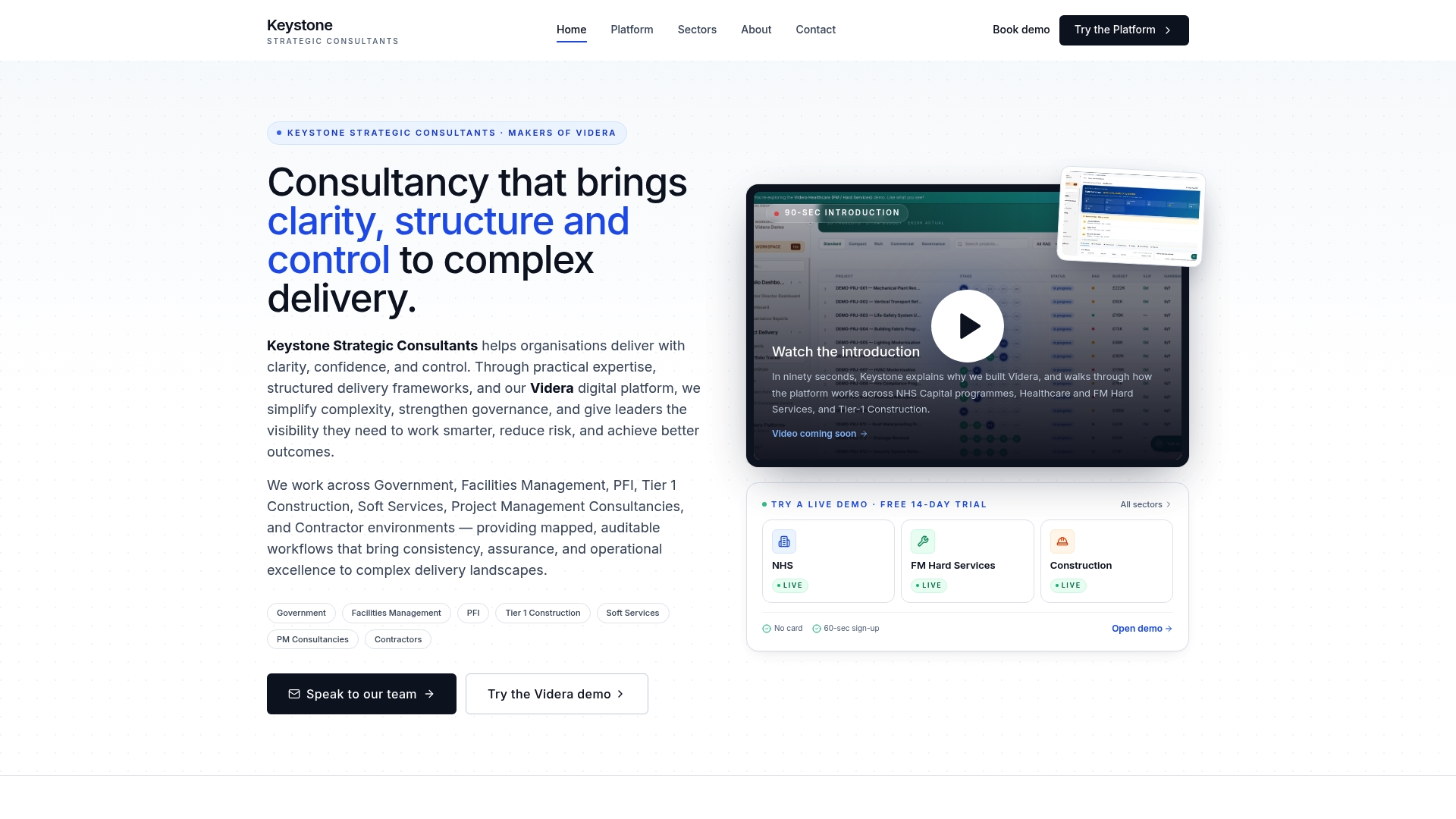
A pilot engagement with Keystoneconsulting covers discovery and workflow mapping, Videra platform configuration aligned to your service lines, live KPI dashboards, and agreed success criteria before a single site goes live. Commercially, the model separates consultancy delivery fees for the discovery and pilot phase from the ongoing Videra platform subscription, so you are not committing to a long-term licence before you have seen results. Ask for a three-year TCO scenario when you make contact: it is the clearest way to compare the cost of inaction against the cost of a structured implementation.
To request a pilot proposal or book an initial discovery session, visit Keystoneconsulting and contact the team directly. Come prepared with your current KPI baseline (or an honest admission that you do not have one), a shortlist of the workflows causing the most operational pain, and a named internal sponsor. That is enough to scope a proposal.
Useful sources and further reading
- IFS: Field workforce optimisation for facilities management — benchmarking data on technician productivity, subcontractor spend, and SLA improvement for FM organisations
- JLL: Defining operational efficiency in facilities management — leadership priorities and metric-setting guidance for FM operational efficiency
- Cryotos: Digital workflows in facility management — evidence on downtime reduction and MTTR improvement from digitised workflows
- OxMaint: Facility work order automation and CMMS guide — practical guidance on automated dispatch, closure rates, and audit data
- IBM: How Mitie scaled facilities operations with IBM Maximo — system-of-record approach and template reuse for multi-site FM scaling
- Keystoneconsulting: Workflow management systems examples — implementation guidance and scalable workflow examples for FM
- Keystoneconsulting: Operations consulting methods — governance design and delivery frameworks used in Keystone engagements
- Keystoneconsulting: Workflow automation use cases — practical automation use cases for work orders, PMs, and inspections