
A gate review checklist is a set of criteria a project must satisfy before a sponsor or gatekeeper authorises the next phase and the next tranche of spend. The strongest checklists split evidence into "must-meet" knockout items and "should-meet" scored questions, organised across project overview, deliverables, business case, risk, financials and stakeholder alignment. Get those buckets right and every review ends in a clear Go, conditional Go, or No Go.
TL;DR:
- Effective gate reviews should be scheduled based on project progress and risk thresholds, not fixed calendar dates, with triggers like major expenditure or regulatory milestones.
- Must-meet knockout criteria should be kept concise, ideally under eight items, to clearly determine pass or fail without unnecessary bureaucratic complexity.
- An evidence pack must contain final, approved documents, distributed two to four weeks before the review, and focus on exceptions and critical uncertainties.
- Outcomes of gate reviews include pass, conditional pass, fail, or stop, with strong emphasis on closing conditional actions before proceeding to the next gate.
- Using continuous evidence capture and independent review reduces last-minute assembly issues and improves overall gate process effectiveness.
Table of Contents
- What is a gate review process and why does terminology vary?
- Why gate reviews matter more than most teams assume
- When should you actually schedule a gate review?
- The gate review checklist: buckets, knockout criteria and scored questions
- Who should attend a gate review and what each role does
- How to prepare an evidence pack that makes the gate go smoothly
- What happens after the gate: outcomes, records and follow-up
- Common pitfalls (and how to keep reviews genuinely useful)
- The practitioner's view on why most gate reviews fail before they start
- Get gate-ready with Videra and Keystoneconsulting's consultancy support
- Sources
- FAQ
What is a gate review process and why does terminology vary?
A gate review is a scheduled decision point where a project pauses so someone with authority over the budget can judge whether it deserves to continue. Different industries use different labels for the same idea: pharmaceutical and manufacturing teams often say "stage gate," construction and infrastructure programmes favour "tollgate," and government or IT delivery frameworks tend to use "phase gate." All three describe the same mechanism.
Gates exist because continuing a project past a certain point commits more money, more people, or more reputational exposure than stopping it would. PMI's gate guidance frames gates as checkpoints placed exactly where the next phase would increase investment or risk, which is why the review has to happen before that spend, not after.
A gate review is not the same thing as a peer review or an internal audit. A peer review checks technical quality within a discipline, usually by colleagues at the same level. An audit checks compliance against a fixed standard, often after the fact. A gate review does neither on its own. It asks a single question with real consequences attached: does this project still deserve the organisation's money, and is it ready for what comes next?
Why gate reviews matter more than most teams assume
Gate reviews catch problems while they're still cheap to fix. A design flaw spotted before construction starts costs a fraction of what it costs once concrete has been poured, and the same logic applies to a flawed business case, an unrealistic schedule, or a risk nobody flagged early enough.
They also force alignment. A sponsor who hasn't looked closely at a project in three months gets a structured moment to re-engage, ask hard questions, and either commit fresh backing or withdraw it. Without that moment, projects drift on inertia rather than genuine support.
The catch is that gates only deliver this value when they're run properly. APM's practitioner guidance is blunt about the alternative: reviews that exist purely to produce a signed document, rather than to change a decision, become bureaucratic theatre. A gate review that never says "no" isn't managing risk. It's rubber-stamping it.
When should you actually schedule a gate review?
Gates should be paced by progress and risk, not a fixed date on the calendar. PMI recommends timing reviews to when the project is about to consume significantly more budget or expose the organisation to significantly more risk, which means the trigger is the work itself rather than the quarter.

Common triggers include a major expenditure commitment (signing a contract, releasing a construction tranche), a technical readiness milestone (a prototype passing initial testing), or a regulatory checkpoint (planning consent, a safety case submission). A rough lifecycle mapping looks like this: idea screen, planning gate, development gate, validation gate, and launch or post-launch review. Not every project needs all five. A small internal process improvement might only need two; a major capital build will need every one of them, plus sub-gates within phases.
The gate review checklist: buckets, knockout criteria and scored questions
A usable checklist separates two kinds of question. Must-meet items are knockout criteria: fail one, and the project doesn't pass regardless of how well it scores elsewhere. Should-meet items are scored on a scale, usually red/amber/green or a numeric weighting, and inform the panel's judgement without automatically blocking the decision. This split, common across commercial stage-gate templates, is what keeps a gate review defensible rather than a matter of opinion in the room.
Project overview
- Must-meet: Project charter or mandate is current and signed off by the sponsor.
- Should-meet: Scope statement reflects any changes agreed since the last gate.
- Should-meet: Success criteria are specific enough that two reviewers would agree on whether they'd been met.
Deliverables and milestones
- Must-meet: All deliverables due by this gate exist in final, approved form.
- Should-meet: Remaining milestones have realistic dates backed by resource availability, not aspiration.
- Should-meet: Dependencies on other projects or external parties are documented with owners.
Business case and strategic alignment
- Must-meet: The business case has been re-validated against current costs and benefits, not the original estimate.
- Should-meet: The project still maps to a named strategic objective or portfolio priority.
- Should-meet: Options analysis reflects the Five Case Model structure: strategic, economic, commercial, financial and management cases, each addressed rather than assumed.
Risk and opportunity
- Must-meet: No open risk sits above the organisation's defined risk appetite without an approved mitigation plan.
- Should-meet: The risk register has been reviewed and updated within the last reporting cycle.
- Should-meet: Opportunities (not just threats) have been captured and assessed.
Technical and execution readiness
- Must-meet: Any regulatory or safety approval required at this stage has been obtained.
- Should-meet: Quality assurance findings from the current phase have been closed or have agreed remediation dates.
Financial and resourcing
- Must-meet: Spend to date is within approved tolerance, or any overspend has an approved variance request.
- Should-meet: Resourcing for the next phase is confirmed, not provisional.
Stakeholder alignment
- Should-meet: Key stakeholders have been consulted on any material change since the last gate.
- Should-meet: Communication plan for the next phase is in place.
Lessons and actions
- Must-meet: All actions from the previous gate are closed, or their non-closure has been explicitly accepted by the gatekeeper.
- Should-meet: Lessons from the current phase have been logged for future projects.
A launch gate will weight financial and stakeholder items more heavily than an idea-screen gate, which leans on strategic fit and early risk. A validation gate for a construction project might add a must-meet item on planning consent status; a software validation gate might add one on penetration testing sign-off. The buckets stay constant. The specific questions inside them flex to the gate.
Pro Tip: Build your must-meet list first and keep it short, ideally under eight items. A knockout list that runs to twenty criteria stops functioning as a knockout list and starts functioning as a form nobody reads properly.

Who should attend a gate review and what each role does
Getting the invite list right matters as much as the checklist itself. A gate review with the wrong people in the room either rubber-stamps a weak project or turns into a technical deep-dive that never reaches a decision.
- Gatekeeper or chair: holds the authority to approve, defer, or stop the project, and runs the session.
- Sponsor: accountable for the business case and benefits realisation, usually the most senior stakeholder present.
- Reviewers or panel: independent subject-matter experts who assess evidence against the checklist, ideally without a stake in the project's success.
- Project manager: presents the evidence pack and answers questions but does not chair or vote.
- Subject-matter experts: attend for specific agenda items (a safety case, a cost model) and leave once their section closes.
- Secretariat: captures decisions, actions and rationale, and circulates the record afterwards.
A recurring point in gate governance is that the delivery team shouldn't sit on the decision-making core of the panel. It's a natural conflict: the people who built the plan are rarely best placed to judge it impartially, which is precisely why independent project assurance exists as a distinct function from delivery. Mandatory attendees are the gatekeeper, sponsor and project manager; reviewers and SMEs can often be represented by written input if attendance genuinely isn't possible, though a live Q&A window still beats a written-only submission for anything contentious.
How to prepare an evidence pack that makes the gate go smoothly
An evidence pack should contain only approved, final documents. Drafts, working versions, and "nearly there" spreadsheets have no place in a gate pack. If a deliverable isn't finished, the honest answer is that it isn't ready for that must-meet item, not that it gets submitted anyway with a caveat.
- Compile the pack against the checklist buckets, not against whatever documents happen to exist. Missing evidence for a bucket is itself a finding.
- Distribute two to four weeks ahead of the review. Reviewers need real time to read, not a document dump the night before.
- Collect clarification questions in advance and circulate a consolidated response, so the live session isn't spent on questions that could have been answered by email.
- Structure the agenda around exceptions, not walkthroughs. Spend time on the must-meet items in doubt and the should-meet scores that split opinion, not a slide-by-slide narration of a document reviewers have already read.
- Decide the format deliberately. Virtual sessions work well for straightforward, low-risk gates; in-person suits high-stakes or contentious decisions where body language and side conversations genuinely change outcomes. Build in a breakout slot for confidential financial or personnel discussion if the agenda needs it.
Pro Tip: Send a one-page "exceptions only" summary alongside the full pack. Reviewers who only have twenty minutes will read the summary properly instead of skimming the full pack badly.
What happens after the gate: outcomes, records and follow-up
Most gate frameworks recognise four outcomes. Fusion point guidance from APM sets these out clearly: pass (green), conditional pass (amber), fail (red), and stop.
A pass means the project proceeds without qualification. A conditional pass means it proceeds, but specific actions must close by agreed deadlines, each with a named owner and the evidence that will prove closure. A fail means the project pauses and returns to this same gate once the gaps are fixed, rather than moving forward with an asterisk attached. A stop means the project ends, and that outcome needs to be recorded as clearly and unemotionally as a pass.
The discipline that separates effective gates from theatrical ones is what happens to conditional actions afterwards. Every condition needs a deadline, an owner, and defined evidence of closure, entered into the project schedule as a real task rather than a note in the minutes. The strongest gate frameworks make closure of previous conditions an explicit entry requirement for the next gate. Turn up to gate four with gate three's actions still open, and the review simply doesn't proceed until they're resolved.
Common pitfalls (and how to keep reviews genuinely useful)
The single biggest failure mode is treating the checklist as a form to complete rather than a set of questions to actually answer. A pack full of ticked boxes and no evidence attached tells a panel nothing, and an experienced gatekeeper will notice.
Typical pitfalls:
- Evidence arriving the night before, leaving reviewers no time to read it properly.
- Wrong attendees: too many observers, too few people with actual authority to say no.
- Must-meet criteria so vague that almost anything can be argued to satisfy them.
- A review that never once returns a fail, which usually signals the bar has quietly dropped rather than that every project is genuinely excellent.
APM's guidance points to a small set of practical fixes: independent reviewers, proportionate gates sized to the project's actual risk, and clear behavioural ground rules for the session itself, things as simple as no interrupting, no defending a document instead of answering the question asked. One more habit is worth adopting deliberately: plan for "no." A gate calendar built on the assumption every project sails through has no slack for the rework a conditional pass or fail creates, and that's usually where schedules quietly slip.
Pro Tip: Before the meeting, agree explicitly what a "no" looks like for this specific gate. Panels that only discuss what success looks like tend to talk themselves into a pass by default.
The practitioner's view on why most gate reviews fail before they start
Most gate reviews don't fail because the checklist is wrong. They fail because the evidence pack was assembled the week before, from whatever documents happened to be lying around, rather than captured as the project actually progressed. By the time anyone opens a spreadsheet to check whether the risk register was updated last month, the honest answer is often "we're not sure," and that uncertainty is the real governance failure, not the missing tick box.
An effective Operational Readiness Review Evidence Checklist and maturity scoring approach addresses the problem of capturing evidence continuously, against defined gate criteria, so the pack is already assembled when the gate date arrives rather than reconstructed under pressure. We also recommend a standard post-implementation review at 60 to 90 days after any conditional pass, specifically to check whether the actions that unblocked the amber decision actually closed, rather than quietly disappearing from the minutes.
A platform that captures auditable evidence as work happens, rather than as a pre-meeting scramble, changes the tone of the room entirely. Boards stop asking "can we trust this pack?" and start asking the questions the gate actually exists for. That shift in confidence, more than any template, is what makes a gate review process worth the time it takes.
— Peter
Get gate-ready with Videra and Keystoneconsulting's consultancy support
Some consultancies and platforms exist to help bridge the gap between having a good checklist and running gates that hold up under scrutiny. Certain project management platforms map directly onto checklist buckets, capturing evidence against must-meet and should-meet criteria as projects progress, so gate packs can be built continuously rather than assembled in a rush before reviews.
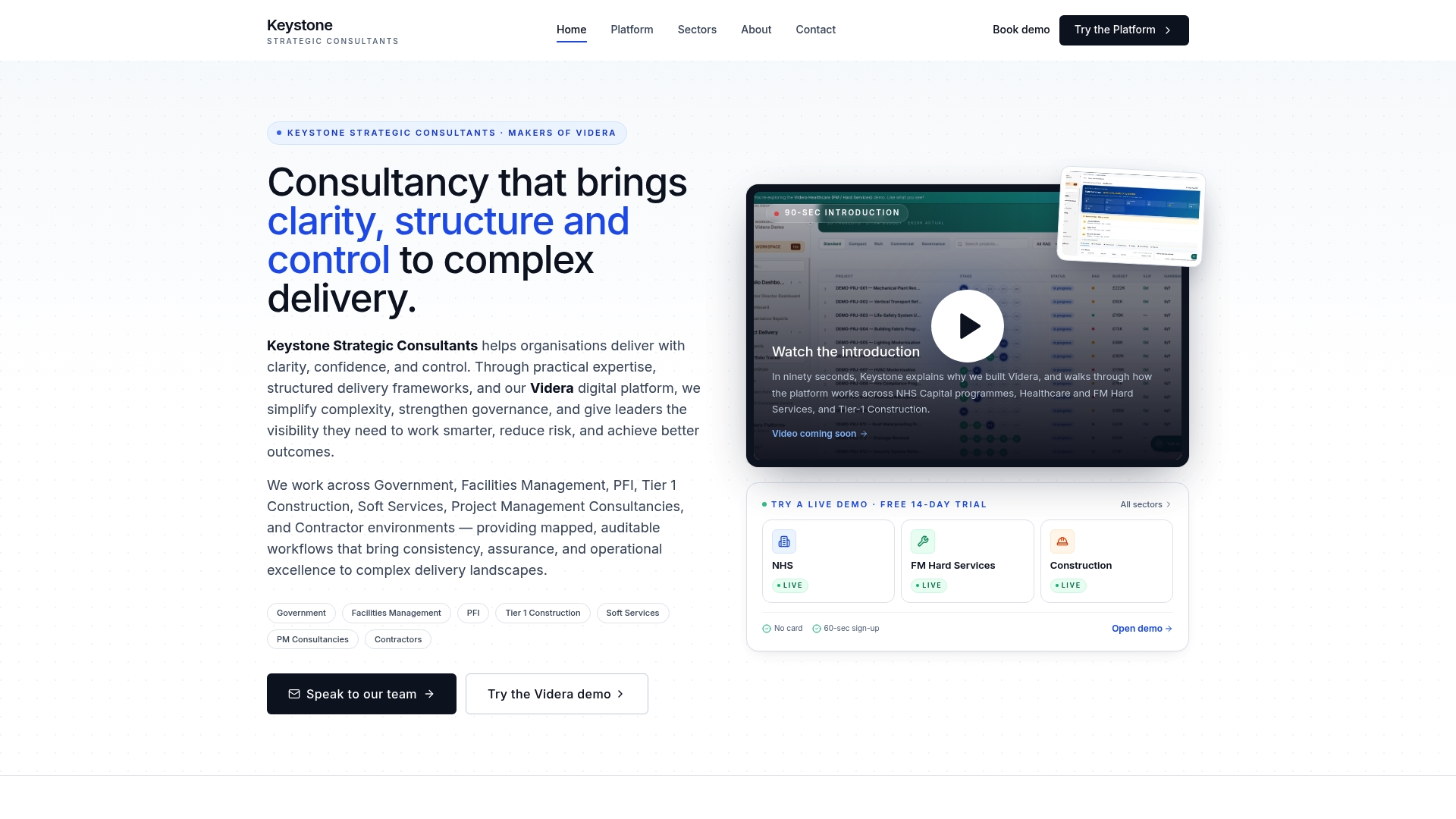
If you're setting up your first structured gate process, or fixing one that's drifted into tick-box territory, our consultancy team works directly alongside your project office to design the gates, criteria and evidence flow that fit your sector, whether that's healthcare, construction, or facilities management. For teams running project-heavy portfolios, Videra PM is worth a closer look as the platform behind the evidence capture. Get in touch to request a demo, or start by mapping your own gates against the checklist buckets above.
Sources
For readers who want the underlying standards rather than a summarised checklist, PMI's contemporary gate philosophy sets out the reasoning behind progress-paced gates, and the PMBOK Guide situates gate reviews within wider project management knowledge areas. APM's practical tips for stage gate reviews and its more detailed Fusion point guidance cover behavioural discipline and outcome recording in more depth than fits here. For further governance frameworks, Keystoneconsulting's insights library covers related topics including portfolio-level project governance.
FAQ
What is a gate review process?
A gate review process is a structured sequence of decision points, or gates, placed at key stages of a project where a sponsor or gatekeeper decides whether to continue, adjust, or stop the work. Each gate assesses evidence against defined criteria before authorising further investment, as set out in PMI's gate guidance.
What is an example of a gate review checklist item?
A typical must-meet item reads something like: "The business case has been re-validated against current costs and benefits, not the original estimate." A should-meet item might be scored, such as rating stakeholder alignment on a red/amber/green scale based on recent consultation.
What are the stages of the stage gate process?
Common lifecycle gates run from idea screen through planning, development, validation, and launch or post-launch review, though the exact number varies by industry and project size. A small project might use two or three gates; a major capital programme typically needs all five, plus sub-gates within longer phases.
What are stage gate reviews?
Stage gate reviews are the formal meetings held at each gate, where a panel examines evidence against checklist criteria and issues one of four outcomes: pass, conditional pass, fail, or stop, per Fusion point guidance. Unlike a routine progress update, a stage gate review carries real authority to halt or redirect the project.
Does Keystoneconsulting offer gate review support?
Keystoneconsulting provides both hands-on consultancy for designing gate criteria and governance structures, and the Videra PM platform for capturing gate evidence and automating reporting. Pricing for both is available on request through the consultancy and Videra PM pages.