
Benefits realization tracking is the discipline of measuring, monitoring and reporting whether a project's projected value actually materialises after delivery. The single most important action is to create a benefit profile for every expected gain, with a named accountable owner, a baseline figure, a target and a data source, before the project reaches its first review gate. Skip this step and attribution becomes guesswork, and governance has nothing to hold anyone to.
TL;DR:
- Proper benefits tracking requires a benefit profile with clear ownership, baseline, target, and data source before project review gates to ensure accountability.
- Tracking benefits involves multiple stages, from identifying and measuring to planning, realizing, and reviewing to prove actual value creation over time.
- Using a single, movement-based formula for progress helps monitor both benefits that should increase and those that should decrease, avoiding spreadsheet errors.
- Automated dashboards and integrated systems are essential for maintaining real-time, audit-ready benefits data at portfolio and project levels.
- Owners must be assigned early, with a formal handover process and continuous governance to ensure benefits survive project closure and are actively managed long-term.
Table of Contents
- Why tracking benefits matters more than tracking tasks
- The benefits realisation lifecycle: what tracking looks like at each stage
- Minimum fields for a benefits register and benefit profile
- Choosing metrics: KPIs, leading indicators and a formula that works both ways
- Tools and data integration: spreadsheets, dashboards, and system feeds
- Governance and roles: who owns a benefit once the project ends
- Measurement cadence: when to check, and what to do when results disappoint
- Common pitfalls and quick fixes
- Keystone's approach to sustained benefits tracking
- Keeping stakeholders informed without drowning them in numbers
- Connecting benefits tracking to your project and portfolio systems
- Why change management decides whether a benefit survives
- What the evidence actually says about tracking benefits properly
- See how Videra keeps benefits tracking honest
- Sources
- FAQ
Why tracking benefits matters more than tracking tasks
Most project reporting stops at delivery: on time, on budget, output shipped. Benefits realization management asks a harder question, whether that output actually changed anything the organisation cares about. PMI's benefits realization management framework frames this as the connective tissue between strategy, projects and outcomes, and tracking is how you prove that connection exists rather than assume it.
Executives fund portfolios, not tasks. When a board asks why a multimillion-pound system replacement was approved, "it went live on schedule" is not an answer, "claims processing time dropped from 11 days to 4" is. Tracking benefits properly means measuring both kinds of value:
- Tangible benefits: cost savings, revenue growth, headcount reduction, cycle time.
- Intangible benefits: staff confidence, compliance posture, customer trust, reputational risk reduction.
Intangible benefits are harder to quantify but rarely optional. A hospital rolling out a new scheduling system might struggle to price "reduced clinician stress," but a proxy metric, staff turnover in the affected ward, still gives leadership something to act on.
The benefits realisation lifecycle: what tracking looks like at each stage
Benefits tracking is not one activity, it changes shape as a project moves through its lifecycle. UK government guidance on assurance of benefits realisation in major projects sets out that maturity should evolve across five broad stages, and reviewers at each gate expect different evidence.
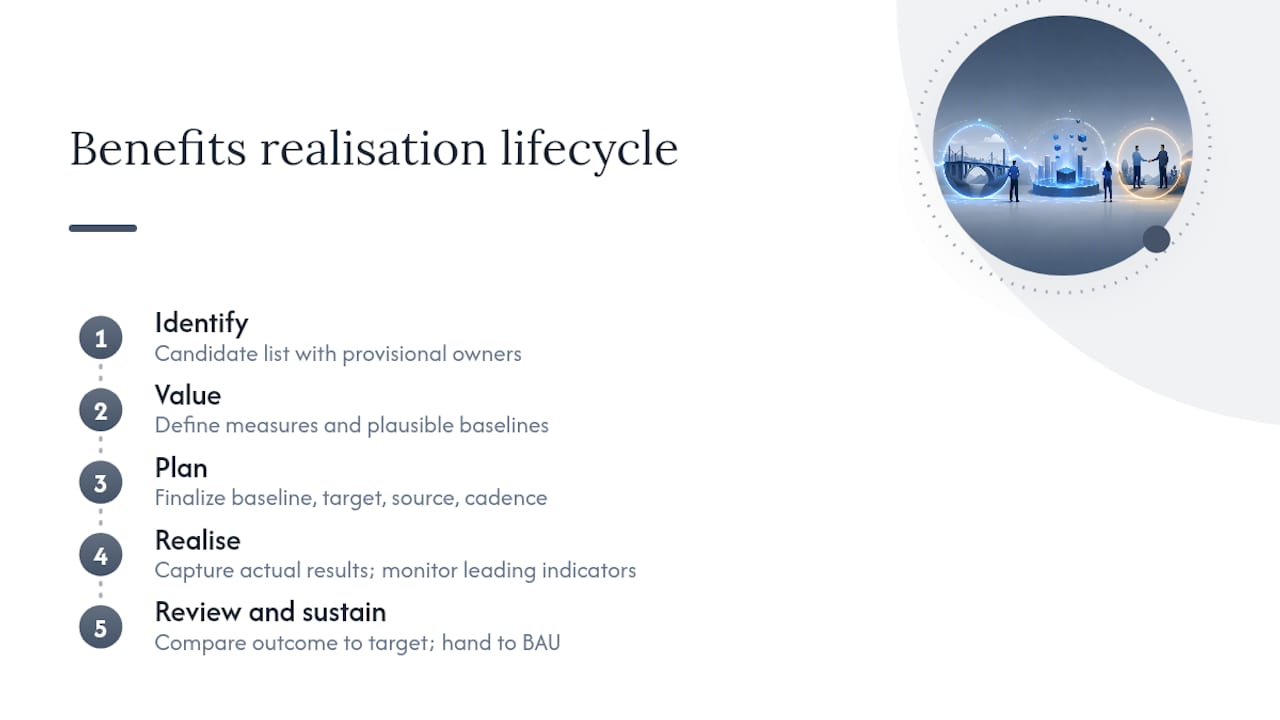
Identify. Benefits are named, roughly sized and linked to strategic drivers. Tracking here means little more than a candidate list with owners provisionally assigned.
Value. Each benefit gets a measure and a plausible baseline. This is where vague ambitions ("improve efficiency") must become specific figures ("reduce average processing time by 20%").
Plan. The benefit profile is finalised: baseline date, target date, data source, review cadence. The benefits register becomes the single source of truth, held centrally rather than scattered across spreadsheets on individual laptops.
Realise. Post go-live, actual results are captured against the baseline. This is where leading indicators start showing whether the benefit is on trajectory.
Review and sustain. Formal reviews compare outcome to target, and ownership shifts from the project team to a business-as-usual function that keeps measuring long after the project has closed.
The register should map directly onto your organisation's existing stage-gate structure, so a project stage gate review and a benefits review happen together, not as separate bureaucratic exercises.
Minimum fields for a benefits register and benefit profile
A benefit that cannot be measured cannot be tracked, and vague entries in a register are the single biggest reason realisation reviews collapse into argument rather than evidence. Every benefit profile needs a fixed set of fields, and missing even one turns the whole entry from a commitment into a wish.
- Unique ID and plain description: a short, jargon-free sentence any board member could understand without context.
- Benefit type: financial, operational, compliance-related or strategic, since each demands different evidence.
- Named accountable business owner: a person, not a department, who answers for the result.
- Specific measure and data source: the exact metric and where it comes from, whether that's a finance system, an HR platform or a service desk log.
- Baseline value with the date it was taken: what "before" actually looked like, dated precisely.
- Target value with the date it must be hit: what "success" means, numerically, by when.
- Earliest measurement date: the point at which it is fair to start checking, which is rarely the go-live date itself.
Drop the owner field and you get a benefit everyone assumes someone else is watching. Drop the baseline and any later number is meaningless, because you have nothing to compare it against.
Choosing metrics: KPIs, leading indicators and a formula that works both ways
Lagging indicators tell you what already happened, revenue booked, costs cut, incidents closed. Leading indicators predict whether that outcome is likely, and they matter more day to day because they let you intervene before a benefit quietly fails. If a new procurement system's leading indicator is "percentage of purchase orders raised through the new workflow," a stall at 40% after three months is your early warning, long before the lagging cost saving figure would ever confirm a problem. Leading indicators built into operational systems and executive dashboards tend to sharpen accountability, because they surface trouble while there is still time to fix it.
Intangible benefits need proxy metrics rather than direct measurement. "Improved governance confidence" might be tracked through audit finding volumes or exception report frequency instead of a survey nobody trusts.
For consistent progress reporting, use a single movement-based formula rather than separate logic for benefits that should rise (revenue) and those that should fall (costs, churn, complaints). Calculate progress as the movement from baseline towards target, expressed as a percentage of the total distance required, regardless of direction.
Pro Tip: Build your progress formula once, as a percentage of the baseline-to-target distance covered, and apply it to every benefit in the register. A separate formula for "good is up" versus "good is down" metrics is how spreadsheets quietly break.
Tools and data integration: spreadsheets, dashboards, and system feeds
A spreadsheet is fine for a handful of benefits on a single project. It stops being fine the moment you're running a portfolio, because nobody reconciles five different owners' versions reliably, and audit trails vanish into email threads. The decision point is usually volume plus governance exposure: if a regulator, board, or major funder will ask to see the evidence, you need an auditable system, not a shared file.
Automated dashboards earn their cost by pulling live data straight from the systems that actually generate it, finance platforms for cost benefits, HR systems for headcount or turnover, service desks for incident volumes, operational systems for throughput. Manual re-entry is where numbers quietly drift from reality.
An executive benefits dashboard should show four things at a glance: baseline, current value, variance against target, and a forecast of likely outcome at the target date. Anything less forces the reader to do the maths themselves, and boards do not read that closely.
Governance and roles: who owns a benefit once the project ends
Projects close. Benefits don't, they carry on materialising, or failing to, for months or years afterwards. That mismatch is where most benefits tracking quietly dies: the project team disbands, and nobody was ever told the tracking job was now theirs.
- Nominate the business owner early, ideally at the "value" stage, not at handover, so they've had input into what they're being asked to own.
- Run a formal handover checklist at closure: register transferred, data source access confirmed, review dates calendared, reporting line agreed.
- Establish the succession of governance bodies, from project board to a standing operational committee or portfolio office that inherits reporting responsibility.
- Confirm who escalates a shortfall, and to whom, before the first review happens rather than after a number disappoints.
A RACI matrix built at project start, rather than bolted on at closure, makes this handover far less painful.
Measurement cadence: when to check, and what to do when results disappoint
Baseline at the start, a checkpoint at go-live, then formal reviews at 6, 12 and 24 months tends to work for most benefit types. Measuring too early is one of the most common practical traps: benefits often take months after go-live to materialise, and checking at week two routinely produces a false negative that gets a perfectly sound project killed prematurely.
When a review shows a benefit off-track, resist the instinct to change the target. Check three things first: has the data source changed, is the business owner still engaged, and has an external factor (a market shift, a policy change) shifted the baseline itself. Only after ruling those out should you revisit the plan or the intervention.
Common pitfalls and quick fixes
- Vague benefit definitions. "Improve customer satisfaction" isn't trackable. Fix it by forcing a specific measure and data source before the benefit enters the register.
- Missing baselines. No "before" figure means no defensible "after." Fix it by refusing to approve any benefit profile without a dated baseline value.
- Ownership lapses at closure. The project team disbands and the benefit orphans. Fix it with a mandatory handover checklist tied to project sign-off, not a courtesy email.
- Tracking stops too early. Momentum fades once the project team's attention moves on. Fix it by embedding review dates into a standing governance calendar that outlives the project itself, as Assured Velocity's benefits realisation framework argues, treating this as a structural gap rather than a discipline failure changes how you fix it.
Keystone's approach to sustained benefits tracking
Keystoneconsulting works from the same principle: a benefit that isn't owned, dated and measurable will not survive contact with a busy organisation. Mapped workflows and audit-ready evidence capture through the Videra platform keep baseline, target and current values visible in one place, with AI-powered reporting flagging drift before a formal review forces the conversation. Ownership gets embedded into governance stage-gates rather than left to a closing memo, so benefit tracking becomes a standing operational habit, not a one-off project artefact.
Keeping stakeholders informed without drowning them in numbers
Different stakeholders need different views of the same benefit. A finance director wants the variance figure and the forecast. A frontline team lead wants to know whether the change they're living with day to day is actually working. A board member wants three lines, not thirty.
The fix is tiering your reporting rather than sending everyone the same dashboard export. Executive summaries should carry baseline, current value, variance and forecast, nothing more, because HBR's guidance on organising change around purpose and benefits makes the case that keeping the outcome visible, rather than burying it in activity metrics, is what sustains attention and adoption. Operational teams need more granularity, the leading indicators that tell them whether this month's numbers are trending the right way.
Cadence matters as much as content. A monthly one-page update to the steering group, paired with a quarterly deep-dive review, tends to outperform either a constant stream of minor updates or a single annual report nobody remembers reading. Constant noise trains people to ignore it, silence trains them to assume everything is fine.
Bad news travels worse than no news. If a benefit is off-track, say so early and pair it with the intervention plan in the same communication, not two months later once the trend has hardened. Stakeholders forgive a shortfall far more readily than they forgive being the last to know about one.
Connecting benefits tracking to your project and portfolio systems
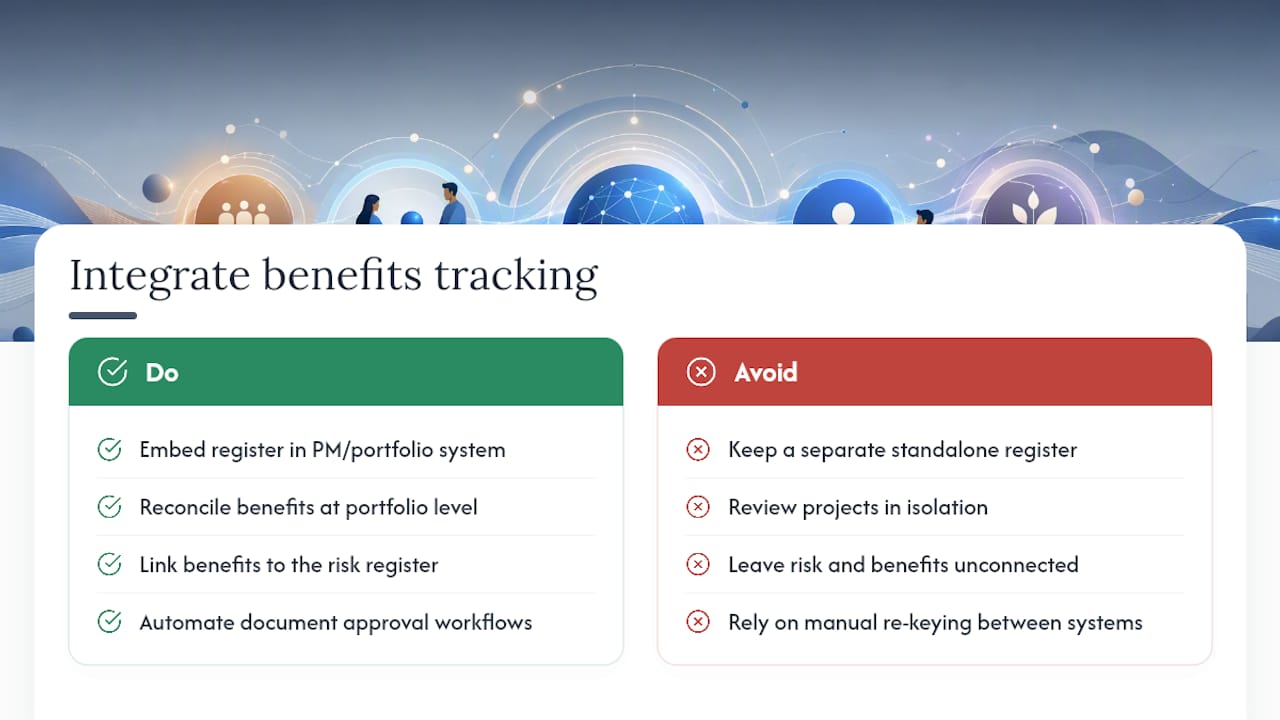
Benefits tracking that lives apart from your project and portfolio management tooling becomes a second job nobody has time for. The register should sit next to, or ideally inside, the same system that already tracks milestones, risks and resourcing, so a benefit review and a stage-gate review draw from the same live data rather than two conflicting spreadsheets.
Portfolio-level integration matters even more than project-level integration. A single project's benefit might look healthy in isolation while quietly cannibalising a benefit claimed by a different initiative, shared cost savings claimed twice, or a headcount reduction counted against two separate business cases. Portfolio governance structures that force a single reconciled view catch this kind of double-counting before it reaches the board.
Practically, this means your benefits data source should feed from, or into, whatever system holds your risk register too, since a realised risk is very often the reason a benefit slips. Risk management practice and benefits tracking are rarely treated as connected disciplines, yet a delayed supplier or a compliance finding shows up in both places at once.
Where organisations manage document-heavy approval chains, whether invoices, compliance sign-offs or change requests, automating that flow gives benefits tracking a cleaner data trail to draw from, since document workflow automation removes the manual re-keying that is usually where benefit numbers quietly go stale between systems.
Why change management decides whether a benefit survives
A benefit realised on paper and a benefit realised in practice are different things, and the gap between them is almost always a change management gap. Systems go live, processes get redesigned, and the projected saving assumes people actually use the new way of working. When adoption lags, so does the benefit, regardless of how good the underlying design was.
This is why benefits tracking and change management should never sit in separate silos, run by separate teams reporting to separate committees. The leading indicator for a productivity benefit is frequently an adoption metric first, log-ins to the new system, completion rates for the new process, exception volumes from people still working around it. A change manager watching adoption dashboards often spots benefit risk weeks before a finance report would ever surface it.
Communication and training are not soft add-ons to a benefits plan, they are the mechanism by which a projected number becomes a real one. HBR's framing of organising change around purpose and benefits reflects this directly: when people understand which outcome a change is meant to produce, adoption tends to hold up better than when the same change is framed purely as new process to follow. Tie your change management milestones, training completion, super-user rollout, feedback loops closed, directly into the benefit profile's leading indicators, rather than tracking them as a parallel, disconnected project stream.
What the evidence actually says about tracking benefits properly
Most guidance on benefits realisation reads like a compliance checklist: fill in the register, hold the review, file the report. That framing misses the real failure point. Benefits fail not because organisations lack templates, but because ownership dissolves the moment a project closes, and nobody was ever accountable for a number after the celebration email went out.
The conventional advice oversells the plan and undersells the handover. A beautifully specified benefit profile with a named owner who quietly leaves the organisation eight months later is worth nothing unless succession is built into governance from day one, not treated as an afterthought. That is the part most guides skip, and it is the part that actually determines whether a benefit survives.
If you take one thing from this, prioritise the handover mechanism before you polish the metrics. A rough baseline with a genuinely accountable, still-employed owner beats a perfect KPI framework with nobody watching it in eighteen months.
— Peter
See how Videra keeps benefits tracking honest
Some platforms offer alternatives to running benefits realisation through disconnected spreadsheets and closing reports that go unexamined. These solutions map workflows, capture evidence as it happens, and turn benefit profiles into live, auditable records that survive project closure rather than dying with it.
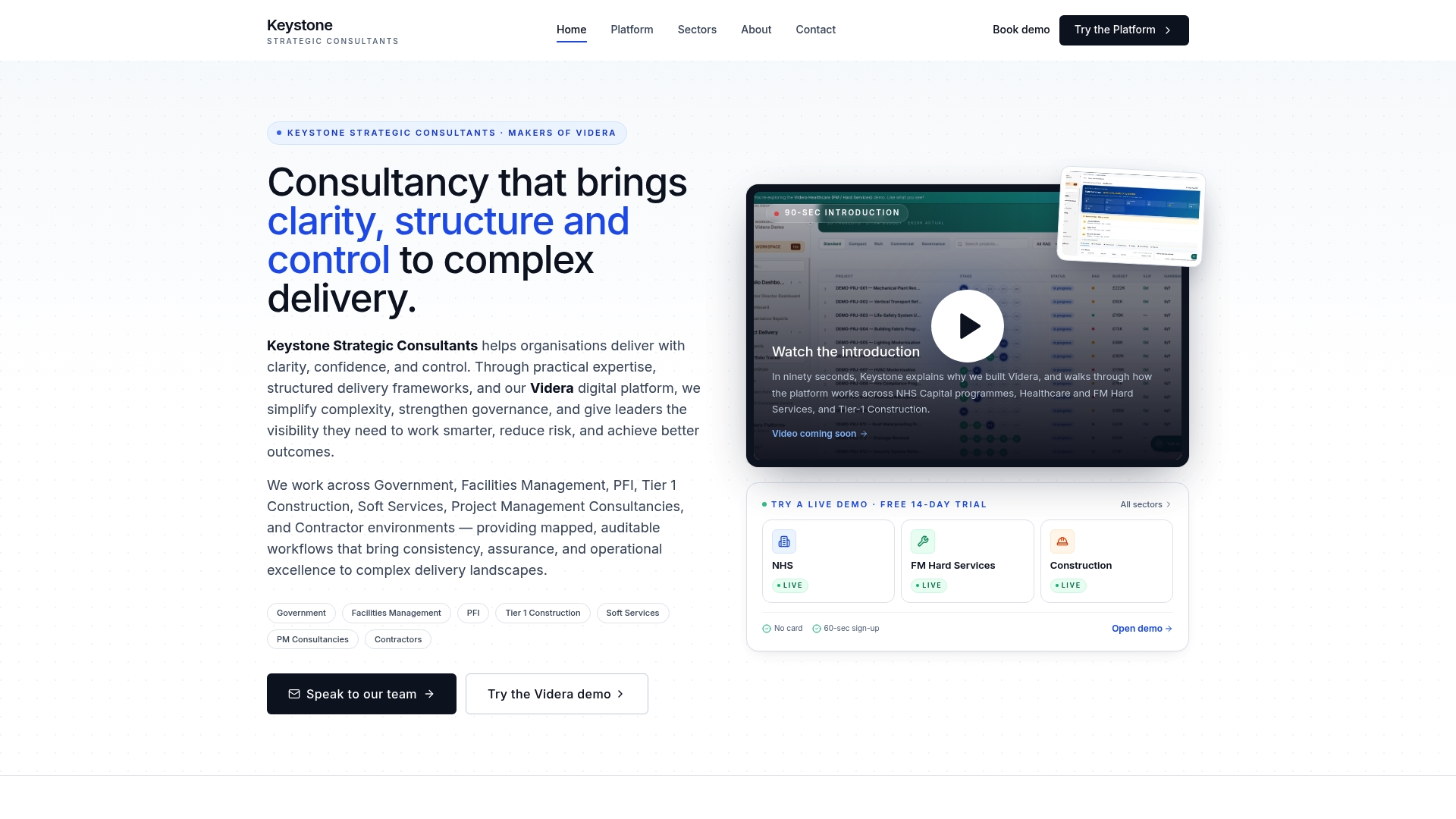
For project-heavy environments, Videra PM gives you a governed register with owners, baselines and variance visible in one dashboard, no more chasing five versions of a spreadsheet before a board meeting. In regulated settings, Videra Healthcare applies the same tracking discipline to NHS and clinical delivery programmes, where audit-readiness isn't optional. If your benefits tracking currently depends on one person remembering to update a file, that's the gap worth closing first.
Book a diagnostic conversation or request a demo through the consultancy services page to see what a governed benefits register looks like against your own portfolio.
Sources
For deeper standards and guidance, see the PMI benefits realization management practice guide, UK government assurance guidance for major projects, and HBR on structuring change around benefits.
- Benefits realization management framework | PMI
- Assurance of benefits realisation in major projects — UK government guidance
- Organize your change initiative around purpose and benefits | HBR
- Benefits realisation framework: how to stop transformation value leaking away | Assured Velocity
FAQ
What does "tracking benefits realisation" mean?
It means measuring, over time, whether a project's projected value, cost savings, efficiency gains, compliance improvements, actually materialised against a dated baseline and target. The PMI benefits realization management framework treats this as an ongoing discipline rather than a one-off closure task.
What does "benefit realisation" mean?
Benefit realisation is the point, or process, at which a planned improvement actually shows up in operational reality, rather than remaining a projection in a business case. It's confirmed through measurement against a baseline, not assumed from delivery alone.
What is a benefit tracker?
A benefit tracker, often called a benefits register, is a structured record of every expected benefit, its owner, its measure, its baseline and target values, and its review dates. Platforms like Videra PM turn this from a static spreadsheet into a live, auditable dashboard.
What is the benefit realisation framework and how does it work?
A benefits realisation framework, such as PMI's, sets out a lifecycle from identifying benefits through valuing, planning, realising and reviewing them, with governance and ownership running throughout. It works by forcing every claimed benefit through the same structured fields, so nothing gets tracked on assumption alone.
How much does Keystoneconsulting's platform cost?
Pricing for Videra and related consultancy services is available on request through the Keystoneconsulting site rather than published as a fixed rate.