
Environment of care compliance means maintaining a safe, functional physical environment across all PE domains and having audit-ready evidence that maps to Joint Commission and CMS requirements. The Joint Commission, CMS and NFPA jointly define what counts as compliant. Right now, the priority is to crosswalk your 2025 EC codes to the 2026 PE and NPG structure, start CEOC rounds in your highest-risk units, and confirm your maintenance and testing records are complete.
TL;DR:
- The January 2026 shift moved former EC requirements into PE and some into NPG, so update policies and checklists using a live crosswalk.
- A CEOC committee with executive sponsorship and domain owners should run multidisciplinary rounds, assigning each finding an owner, interim control, due date, and closure evidence.
- Map each life safety control separately to its Joint Commission PE citation, CMS requirement, and applicable NFPA section; occupancy classifications can change which code applies.
- When construction or a deficiency prevents code compliance, document risks before work, assign fire watches or safeguards, and retain inspection and restoration records.
Table of Contents
- Scope of the environment of care: domains and practical ownership
- 2026 PE reorganisation: what changed and what to do now
- Core elements of an audit-ready EC programme
- Practical checklist for recurring compliance tasks
- Life safety and codes: mapping NFPA, CMS and Joint Commission expectations
- Interim life safety measures and managing construction or temporary conditions
- Documenting evidence and survey preparation
- Practitioner perspective: quick wins and typical phasing
- How Keystone and Videra support audit-ready environment-of-care programmes
- FAQ
- Sources
Scope of the environment of care: domains and practical ownership
The environment of care touches nearly every corner of a healthcare facility, which is why it rarely has a single owner. The Joint Commission's Environment of Care resource groups requirements around the physical environment, hazardous materials and waste, medical equipment, utility systems, fire and life safety, security, and emergency management.
In day-to-day terms, this covers items like imaging equipment, medical gas lines, water systems and fire doors, each typically owned by a different team: biomedical engineering handles equipment logs, facilities manages utilities and the built environment, safety officers oversee hazardous materials, and clinical leads flag operational risks in patient-care areas.
- Built environment: interior spaces, egress routes, fire doors and ceiling integrity
- Medical equipment: imaging systems, anaesthesia machines and biomedical waste streams
- Utility systems: water, medical gas, electrical and HVAC
- Hazardous materials: chemical storage, disposal and staff training
- Security and emergency management: access control, drills and communication plans
Any unsafe condition found in a patient-care area, regardless of which department owns it, gets scored under the safe-environment requirement, so gaps in ownership tend to surface during survey rather than before it.
2026 PE reorganisation: what changed and what to do now
The Joint Commission consolidated many former EC requirements into a new Physical Environment (PE) chapter, effective January 2026, with some elements moved into the National Patient Safety Goals (NPG) chapter instead. This means familiar EC numbering and element-of-performance locations have shifted, and policies, checklists and reports written against the old structure may no longer point to the right place.
The 2026 Physical Environment essentials and matrices lay out the new PE chapter content and how it maps across provider types. Treat this as a migration project rather than a one-time read-through:
- Build a live crosswalk from 2025 EC codes to their 2026 PE or NPG equivalents.
- Update every policy, work order template and audit checklist that cites the old numbering.
- Review the Survey Process Guide and K-tag tools, since these are what surveyors will actually use.
The Joint Commission's own webinar materials confirm the 2026 PE chapter folds together requirements previously scattered across EC, which is the single biggest source of survey confusion facilities should plan for this year.
Core elements of an audit-ready EC programme
A compliant environment needs a governance structure that someone is actually accountable to, not just a binder of policies. An executive-sponsored Comprehensive Environment of Care (CEOC) committee, with multidisciplinary membership spanning facilities, biomedical, infection control, nursing and safety, gives that accountability a quarterly rhythm.
- Form a CEOC committee with executive sponsorship and representation from every domain owner.
- Design rounds with a fixed frequency, standardised questions and a rotating multidisciplinary team.
- Document every finding with an assigned owner, an interim control if needed, a due date, a work order reference and closure evidence.
- Report trends to leadership on a recurring schedule so recurring issues get systemic fixes, not repeat work orders.
The VHA's CEOC directive formalises this exact model, with mandated rounding frequencies by area and a dedicated Assessment and Compliance Rounding Tool for logging deficiencies. Non-VA facilities can borrow the same structure even without the directive's mandate.
Pro Tip: Assign one person to own the evidence trail for each finding from identification through closure, rather than splitting that responsibility across shifts.

Practical checklist for recurring compliance tasks
Recurring, documented tasks are what turn a policy into evidence. A risk-based touring programme, aligned with Joint Commission guidance on the built environment, should check more than appearances: it should verify that inspection and maintenance records actually exist for what the tour observes.
- Site tours: check egress routes, clutter, fire door function, ceiling tiles and signage, and log closure evidence for anything flagged.
- Medical equipment: maintain a current inventory, scheduled preventive maintenance, acceptance testing records, and biomedical ownership of every log, and ensure secure disposal through compliant IT equipment disposal services for devices storing sensitive data.
- Utility systems: test generators and emergency lighting on schedule, keep fuel logs current, and assign water management programme roles with documented records.
- Hazardous materials: manage Safety Data Sheets, secure storage areas, retain disposal manifests and document staff training.
- Security and emergency management: run drills, maintain evacuation plans, log access control activity and keep communication channels with local authorities current.
A rounding programme built this way does double duty: it catches problems early and produces the paper trail that shows a finding was controlled, assigned, corrected and sustained, which is the real test surveyors apply.
Life safety and codes: mapping NFPA, CMS and Joint Commission expectations
CMS adopts the NFPA Life Safety Code and Health Care Facilities Code as the federal framework certain provider types must meet, tying these codes directly to survey outcomes and waiver conditions. CMS guidance describes how NFPA 101 and NFPA 99 adoption connects to survey processes and forms such as CMS-2786, used during fire safety surveys.
Joint Commission K-tags map specific life safety code details to PE requirements, and the Survey Process Guide tells surveyors where to look for evidence during an on-site visit. The practical risk is assuming one control satisfies every authority at once.
- Map each control, such as a fire door inspection, separately to its Joint Commission PE citation, its CMS Condition of Participation, and its applicable NFPA code section.
- Confirm the occupancy type for each area, since Life Safety Code requirements vary by occupancy classification.
- Keep documentation for each authority distinct enough that a surveyor from any one programme can find what they need without cross-referencing another team's files.
Interim life safety measures and managing construction or temporary conditions
When the Life Safety Code cannot be immediately met, whether due to construction, equipment failure or a deficiency awaiting repair, Interim Life Safety Measures (ILSMs) are required to protect occupants until the condition is corrected. Joint Commission and CMS materials describe these measures as a bridge, not a substitute for correction, and CMS allows limited waivers where patient safety is not compromised.
- Identify and document the affected area and the specific fire or egress risk involved.
- Complete a risk assessment before work begins, not after.
- Put compensatory measures in place, such as additional fire watches or temporary signage, and name who is responsible for each.
- Set an inspection schedule for the duration of the interim period.
- Notify the authority having jurisdiction where required, and escalate internally if the condition extends beyond the planned timeline.
- Retain closeout evidence showing when normal conditions were restored.
Documenting evidence and survey preparation
Surveyors expect to see a complete, connected record, not isolated documents. Core records include the CEOC rounds log with closure evidence, equipment PM logs, sprinkler and alarm test records, water management programme documentation, and hazardous waste manifests.
- Keep a standards register that maps each record to its PE code, relevant K-tag and CMS Condition of Participation.
- Use that register during mock surveys to confirm every citation has a matching piece of evidence.
- Report trends, remediation status and exceptions to leadership on a fixed schedule so the board sees risk before a surveyor does.
| Record type | What it demonstrates | Typical owner |
|---|---|---|
| CEOC rounds log | Finding identification and closure | Safety officer |
| Equipment PM logs | Scheduled maintenance compliance | Biomedical engineering |
| Fire/alarm test records | Life safety system function | Facilities |
| Water management documentation | Utility system risk control | Facilities/infection control |
Our playbook for CMS-focused compliance reporting walks through assembling these records into a report leadership can actually use, and our guide to passing an unannounced tracer covers how to keep this evidence survey-ready between rounds.
Practitioner perspective: quick wins and typical phasing
The fastest wins are a standards crosswalk, CEOC rounds in your riskiest units, and chasing down missing test records before a surveyor does. After that, stabilise evidence capture first, then phase systemic remediation as separate projects rather than trying to fix everything at once.
— Peter
How Keystone and Videra support audit-ready environment-of-care programmes
Getting from scattered spreadsheets to a defensible audit trail is usually a governance problem before it is a technology problem, which is why we start with the crosswalk, the CEOC rounds design and the evidence workflow before anything else. Our consultancy work builds standards registers that map every requirement to its PE code, K-tag and CMS Condition of Participation, then hands facilities an operating model their own teams can run.
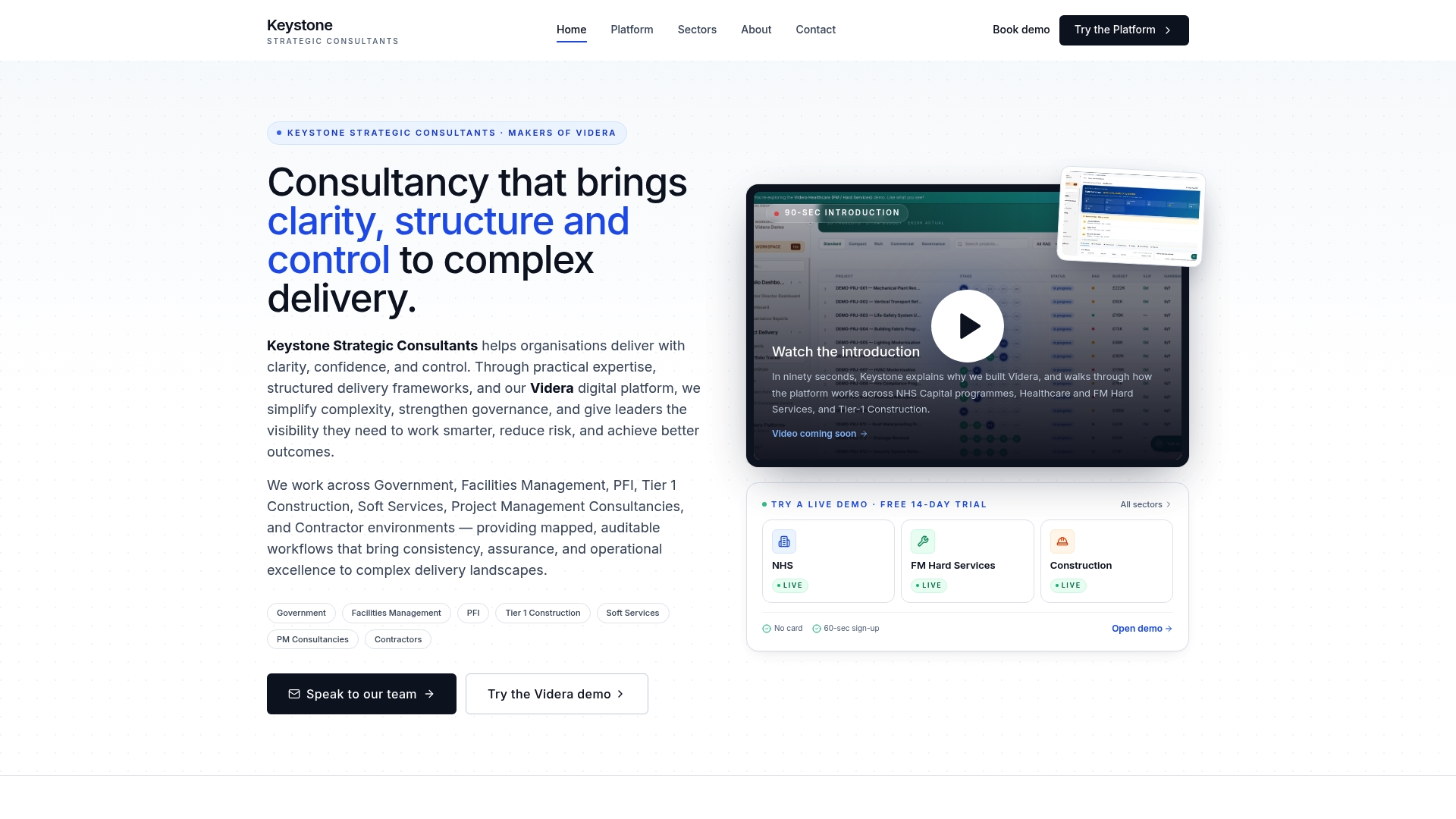
Typical deliverables from an engagement include:
- A completed 2025-to-2026 standards crosswalk tailored to your facility type
- A CEOC rounds programme with standardised questions and assigned ownership
- An evidence workflow with owner, interim control, due date and closure tracking built in
- Executive and board-ready exception reports
For healthcare teams that want this built into a platform rather than run manually, Videra Healthcare maps these workflows directly and captures audit-ready evidence as it happens, so your rounds data, maintenance logs and remediation tracking live in one connected system. For facilities managing hard services such as utilities and equipment maintenance schedules alongside compliance, Videra Hard Services does the same for that side of the operation. Visit our consultancy page to scope a crosswalk or governance review for your facility.
FAQ
What does environment of care compliance actually require?
It requires maintaining a safe, functional physical environment across domains like equipment, utilities, hazardous materials, fire safety and security, backed by evidence that maps to Joint Commission and CMS standards. Facilities demonstrate this through rounds logs, maintenance records and documented corrective actions.
What changed in the Joint Commission's 2026 Physical Environment chapter?
The Joint Commission consolidated many former EC requirements into a new Physical Environment (PE) chapter effective January 2026, with some elements moved into the NPG chapter instead. This shifted numbering and element-of-performance locations, which is why a crosswalk from old EC codes to new PE and NPG references matters now.
What are Interim Life Safety Measures and when are they required?
Interim Life Safety Measures are compensatory steps, such as additional fire watches, used when the Life Safety Code cannot be immediately met, often during construction or while a deficiency awaits repair. CMS guidance describes these as a temporary bridge alongside documented risk assessment and an inspection schedule until normal conditions are restored.
How often should environment of care rounds happen?
Rounding frequency should reflect risk, with higher-risk clinical areas reviewed more often than administrative spaces, following a model like the VHA's CEOC directive, which sets minimum frequencies by area type. Each round should use standardised questions and assign clear ownership for any finding.
How does CMS's Life Safety Code adoption affect survey outcomes?
CMS adopts the NFPA Life Safety Code and Health Care Facilities Code as the federal framework for certain provider types, linking these codes directly to survey processes, waiver conditions and forms such as CMS-2786. Facilities should map each life safety control separately to its CMS, NFPA and Joint Commission citation rather than assuming one record satisfies all three.
Sources
- Environment of Care Resource Center | Joint Commission
- Life Safety Code & Health Care Facilities Code Requirements | CMS
- 2026 Physical Environment Essentials for Health Care