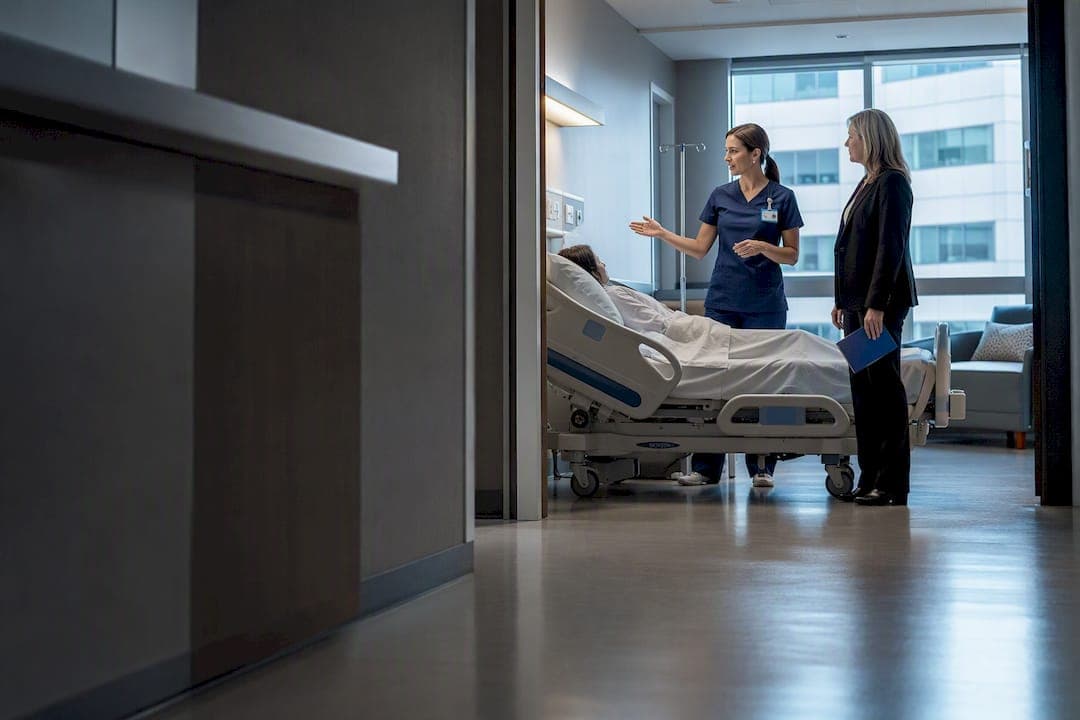
Joint Commission readiness means your organisation can pass an unannounced tracer, on any given day, without a scramble. It is not a binder you update the week before a survey window opens. The immediate action for leaders is simple: start running tracer-focused mock surveys now and fix how fast staff can produce evidence. The Joint Commission's own tracer methodology, its Survey Activity Guide, and the CMS Conditions of Participation are the three anchors everything else in this article hangs on.
TL;DR:
- Regular, unannounced mock tracers are essential for identifying operational gaps before surveyors arrive, especially across multiple shifts and departments.
- Effective documentation retrieval speed depends on designated super-users who can produce evidence within minutes, not hours, under survey conditions.
- Continuous readiness requires dedicated ownership, automated workflows, and periodic review, rather than relying on last-minute preparations or static binder updates.
- Mock tracers that follow actual patient or process paths reveal gaps in staff knowledge, documentation, and environment, enabling targeted fixes.
- Embedding routine checks into daily operations and maintaining ongoing evidence tracking improves confidence and reduces high-risk RFIs during surveys.
Table of Contents
- What does a Joint Commission survey actually evaluate?
- How does tracer methodology drive what surveyors actually do?
- Getting documentation ready for a surveyor's exact request
- Turning staff competence into confident interview answers
- Environment of care: the findings surveyors spot within minutes
- Running a mock tracer that actually exposes your gaps
- Making continuous readiness an actual governance function
- The 90-day countdown: what to do and when
- How Keystone helps you operationalise continuous readiness
- Three priorities that separate confident organisations from anxious ones
- Sources
What does a Joint Commission survey actually evaluate?
A survey checks whether your organisation meets standards built on the CMS Conditions of Participation (CoPs) and the National Patient Safety Goals. Each standard breaks down into Elements of Performance (EPs), the specific, measurable actions surveyors are actually looking for. Pass or fail comes down to those EPs, not the general spirit of a policy.
Surveyors spend most of their time doing three things: watching how care actually happens on the unit, interviewing staff about what they do and why, and pulling documents to see whether practice matches policy. This is why a beautifully written policy manual counts for very little if the nurse on shift describes a different process.
When a surveyor finds a gap, it becomes a Requirement for Improvement (RFI), and every RFI gets triaged in the SAFER 2 matrix, which prioritizes findings by risk and scope by likelihood of harm and scope, from limited to widespread. That matrix matters operationally: a single "high likelihood, widespread" finding demands a faster, more resourced corrective response than a handful of low-risk isolated ones. Leaders who understand SAFER 2 stop treating every RFI as equally urgent, and start allocating remediation effort where the real risk sits.
How does tracer methodology drive what surveyors actually do?
Tracer methodology is the mechanism behind almost everything a surveyor does on site, and understanding it changes how you prepare. Instead of auditing departments in isolation, surveyors follow the path a patient, a process, or a piece of data takes through your organisation.
Individual tracers follow one patient's actual journey. A surveyor might pick a patient from the census, then walk their care from admission through discharge, checking whether documentation, medication administration, consent, and handoffs all line up with what staff describe in the room.
System tracers work differently. Rather than following a person, they follow a function across the whole organisation. The Joint Commission's own guidance names four recurring system tracer topics: data management, medical staff credentialing, human resources, and infection prevention and control.
Why does this matter for readiness planning? Because tracers are built specifically to expose the gap between what your policy says and what actually happens at 2am on a Tuesday. A few practical implications:
- Individual tracers punish inconsistent handoffs between shifts far more than they punish a single documentation error.
- System tracers on infection prevention will cross-check your surveillance data against actual hand hygiene practice, not just your written protocol.
- Human resources system tracers will pull a random staff file and expect the training record to match what that person is actually doing on the floor today.
- Data management tracers often reveal that two departments are recording the same metric two different ways.
Readiness, seen through this lens, is really a test of consistency across departments and shifts, not a test of paperwork quality alone.
Getting documentation ready for a surveyor's exact request
Surveyors expect the right document to appear fast, in whatever format you keep it, making effective transcription for healthcare essential for timely access during surveys. The Standards Interpretation Group is explicit on this point: electronic or paper is fine, but you need a staff member who can navigate that system efficiently under time pressure, and missing documentation found during survey is not eligible for the post-survey clarification process. In practice, that means a document you cannot produce on the day is a document that does not exist as far as your accreditation is concerned.
Prioritise five categories: current policies and procedures, medical records for active and recently discharged patients, credential and competency files, environment-of-care and life-safety logs, and performance improvement data tied to your patient safety goals.
- Build a single index that maps each standard's likely evidence to a named owner and a retrieval location.
- Name a "super-user" per unit who can pull any requested record from your electronic health record or filing system within minutes, not hours.
- Run timed sample pulls monthly, aiming for retrieval well inside the reasonable window the Survey Activity Guide allows during an actual survey day.
- Keep evidence-of-action files for any prior RFI, showing the corrective step taken and the date it closed.
- Prepare accessible or translated copies of patient-facing materials where your population needs them.
Pro Tip: Time your super-user's actual retrieval speed, not their theoretical knowledge of where things live. A staff member who "knows the system" but takes eleven minutes to find a credential file under pressure will feel exactly like a gap to a surveyor watching the clock.
Turning staff competence into confident interview answers
Plenty of clinically excellent staff freeze under a tracer interview, not because they lack competence but because nobody rehearsed the specific way a surveyor phrases a question. A surveyor asking "walk me through what you'd do if this patient's oxygen alarm sounded" is testing whether the answer is instinctive, not whether the policy exists somewhere in a manual.
Preparation that actually moves the needle looks less like memo distribution and more like drilling:
- Run short, five-minute role-play drills at shift handover, rotating the "surveyor" role among charge nurses.
- Cover night and weekend shifts specifically, since surveys arrive unannounced and staffing patterns differ.
- Ask staff to explain a process out loud, not just perform it, since interview answers are verbal.
- Audit competency files quarterly against the actual role each person performs at the bedside today, not their original job description.
Surveyors checking personnel files look for licence verification (ideally with primary-source checks), documented competency assessments tied to current duties, and training records that match the equipment or procedure a staff member actually uses. One outdated competency assessment on a file surveyors happen to pull can trigger a broader human resources system tracer. A practical breakdown of interview preparation makes a fair point here: organisations tend to over-invest in paperwork polish and under-invest in staff confidence, and interview performance is often the higher-return fix.
Environment of care: the findings surveyors spot within minutes
Environment of care and life safety findings are often the fastest RFIs a surveyor logs, because they are visible the moment someone walks the corridor. Expired fire extinguisher inspection tags, blocked egress routes stacked with equipment, and missing documentation of fire drills across all required shifts are the recurring culprits.
The fix is a rounding cadence with a named accountable owner, not a one-off inspection before survey week:
- Weekly unit-level EOC rounds led by a designated safety officer, logged with date and finding.
- Monthly facility-wide life-safety walks covering egress, signage, and equipment tags.
- A closed-loop tracker linking every finding to a corrective action and a completion date, so the same RFI never reappears next cycle.
Running a mock tracer that actually exposes your gaps
A mock tracer is the single most reliable readiness tool because it mirrors exactly what a real surveyor does, including the parts that make staff uncomfortable. Choose scope deliberately: rotate between individual patient tracers and system tracers on data management, human resources, or infection prevention so no function goes untested for long.
- Schedule at least one mock tracer unannounced, across a night or weekend shift, mirroring how real surveys actually land.
- Assign someone outside the department being tested to play the surveyor role, so the exercise isn't self-graded.
- Follow one patient or one process from start to finish, interviewing whoever is actually on shift, not the manager who happens to be available.
- Pull the documentation that patient's chart or that process would generate, timing the retrieval.
- Walk the physical environment around that tracer, checking egress and equipment as you go.
- Log every gap found, whether that's a hesitant answer, a slow document pull, or a blocked corridor.
- Set a closure deadline for each logged gap, typically within 30 days, with a named owner.
Mock tracers scheduled shortly after one survey and again before the next catch the gaps that creep back in once attention drifts elsewhere. Run one now, even without a survey date on the calendar, and you will find something worth fixing.
Making continuous readiness an actual governance function
Continuous readiness only works if it has an owner, a cadence, and a line to the board, not just goodwill from the quality department. That means naming a readiness lead who reports gaps monthly, escalation triggers for anything that would land as a high-severity SAFER 2 finding, and a standing agenda item at leadership meetings, not an annual pre-survey fire drill.
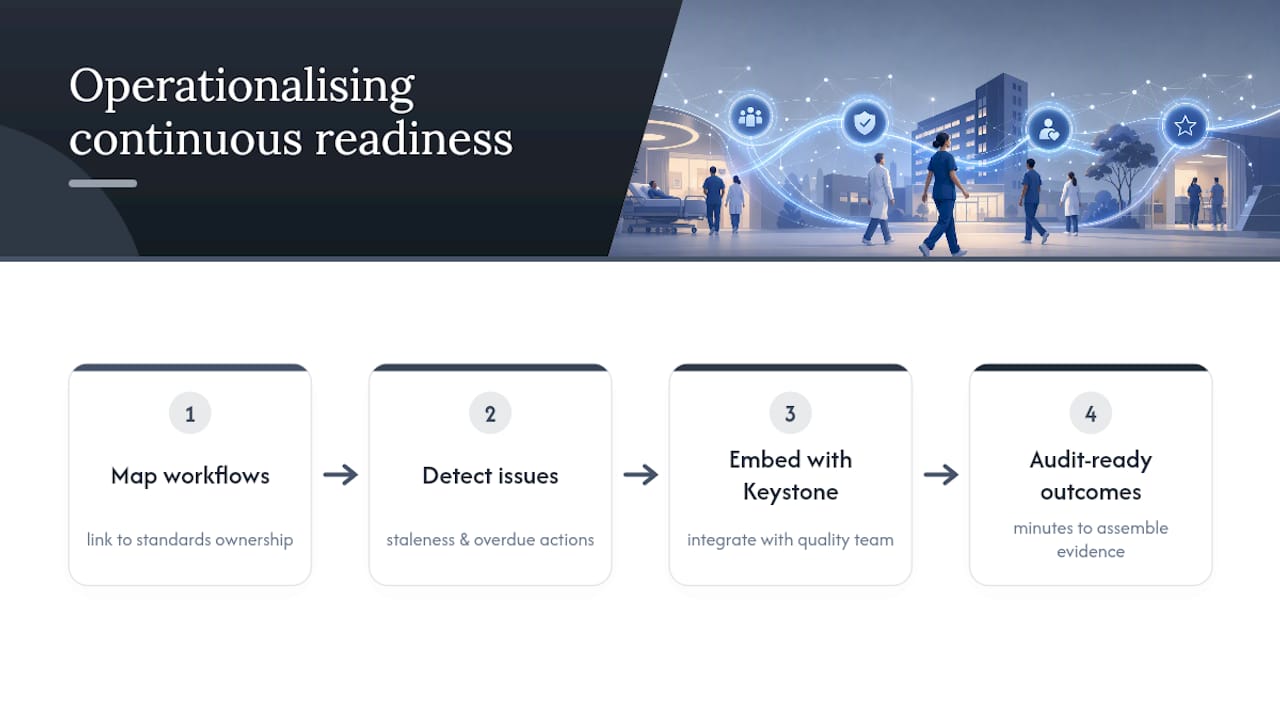
Mapped workflows and automated reporting make this realistic rather than aspirational. When a workflow tool tracks who owns each standard, when it was last checked, and where the evidence lives, an AI-assisted reporting layer can flag stale evidence or overdue actions before a surveyor ever does. A structured compliance programme built around defined ownership and recurring checks turns readiness from a project into an operating rhythm.
External advisory support, including the Joint Commission's own Continuous Service Readiness programme, adds real value here: an outside reviewer translates tracer methodology into a concrete exercise rather than a theoretical checklist.
Pro Tip: Ask any consultant or platform vendor exactly how they will show you evidence staleness. If the answer is "we'll help you build a spreadsheet," you're buying labour, not a governance system.
What responsible external support should give you:
- A clear map of which standards your current workflows already cover, and which are undocumented.
- Evidence of action tracking that survives staff turnover.
- Reporting your board can actually read without a translation layer.
The 90-day countdown: what to do and when
A survey window rarely gives more than a few days' notice, so the real preparation clock starts 90 days out, not 90 hours.
- Days 0-30: Confirm every EOC and life-safety log is current, close any open low-risk RFIs from prior cycles, and run a full documentation index audit.
- Days 30-60: Run at least one full mock tracer per major service line, prioritise closing any RFIs the SAFER 2 matrix, which prioritizes findings by risk and scope, would flag as high severity, and run interview drills across all shifts, including nights and weekends.
- Days 60-90: Rehearse full evidence assembly under time pressure, brief the board on outstanding gaps and closure status, and confirm named super-users are on-call and reachable for the entire survey window.
How Keystone helps you operationalise continuous readiness
The organisations that pass surveys comfortably aren't the ones with the thickest binder. They're the ones where governance, workflow mapping, and evidence tracking run as one connected system, all year, not just before a survey window. That's the specific gap a specialist consultancy was built to close for healthcare providers.
The Videra platform maps your accreditation-relevant workflows against standards ownership, so evidence staleness and overdue actions surface automatically instead of getting discovered by a surveyor first. For healthcare organisations specifically, Videra Healthcare configures that same governance logic around clinical lifecycle needs, from credentialing tracking to EOC action closure, with audit-ready reporting your board can read without a translation layer. Instead of a generic consulting engagement, Keystoneconsulting integrates directly with your quality team to build and embed these workflows, so continuous readiness survives staff turnover rather than depending on one person's memory.
If your evidence assembly still takes hours instead of minutes, that's the fix worth booking first. Start with Videra Healthcare and see what a mapped, audit-ready workflow actually looks like for your organisation.
Three priorities that separate confident organisations from anxious ones
If you take one thing from this, take this: embed the checks into daily operations rather than running a once-a-year campaign, empower named super-users with real authority over their evidence domain, and make mock tracers a standing calendar item, not a reaction to a rumoured survey date.
Track success through fewer RFIs per cycle, faster documented retrieval times, and staff who answer tracer questions without hesitating. Those three numbers tell you more than any pre-survey audit ever will.
— Peter