
Healthcare compliance reporting means producing auditable evidence that your organisation meets CMS, HIPAA and payer obligations, delivered as regulator-ready submissions and board-ready dashboards. Executives must ensure three things happen: mandatory filings (Section 111, GCPCA, Medicare Advantage reporting) go in on time, KPI dashboards reach the board with verifiable evidence attached, and every claim survives an outside audit.
TL;DR:
- Meeting mandatory filings requires timely submissions for Section 111, GCPCA attestation, and Medicare Advantage reporting, with each process having strict deadlines and specific formats.
- Board reports should include trend analysis, sector benchmarking, and top risks, backed by evidence such as audit logs, timestamps, and owner accountability for every metric.
- Fragmented compliance tools create visibility gaps, making continuous monitoring essential to track ownership, control IDs, and resolution speed in one integrated system.
- Building audit-ready processes involves mapping each obligation, establishing workflows, validation rules, and central evidence storage, with automation reducing manual reconciliation.
- Using platforms like Videra Healthcare automated mapping and reporting workflows shortens reconciliation cycles and improves audit readiness without manual data scrubbing.
Table of Contents
- What are the mandatory healthcare compliance reporting obligations?
- Which compliance metrics do boards actually want to see?
- Why do disconnected compliance tools create blind spots?
- How do you build an audit-ready compliance reporting process?
- What does 20 years of governance work teach about compliance reporting?
- Compliance reporting is a governance asset, not paperwork
- Get audit-ready reporting without building it from scratch
- Sources
- FAQ
What are the mandatory healthcare compliance reporting obligations?
Three filings sit at the centre of most healthcare organisations' compliance calendars, and missing any one of them creates immediate regulatory exposure.
Section 111 (MMSEA) requires group health plans to report certain coverage data to CMS through the Coordination of Benefits Secure Website, known as COBSW. Registration, query submissions and file monitoring all run through that portal, and the file specifications rely on X12 270/271 transaction formats for eligibility queries. Get the file structure wrong and CMS rejects the whole batch, not just the bad record.
The Gag Clause Prohibition Compliance Attestation (GCPCA) requires group health plans and issuers to submit an annual attestation confirming their contracts don't restrict access to cost and quality data. The CMS instructions set the annual deadline at 31 December, and while a third-party administrator can file on your behalf, your organisation remains the accountable Responsible Entity if the attestation is late or wrong.
Medicare Advantage organisations face a third layer under 42 CFR § 422.516: specified statistics must be compiled, validated and submitted to CMS on a fixed schedule, with data retained for up to ten years in HPMS records.
- Section 111: register and file via COBSW; watch for CMS alerts that supersede prior guidance.
- GCPCA: annual webform attestation, delegable but never removing your organisation's accountability.
- MAO reporting: validated submissions under 42 CFR § 422.516, with a decade of retention behind them.
Which compliance metrics do boards actually want to see?
Boards don't want raw data. They want a one-page verdict on where the organisation stands, backed by appendices an auditor can trust.
A useful executive summary answers three questions in under a page: is the trend improving or worsening, how does the organisation compare against its own historical baseline or sector peers, and what are the top three risks demanding board attention this quarter. Vendor examples of this format package year-on-year trajectory alongside peer benchmarking and a prioritised remediation roadmap, which is roughly the shape most boards expect now.
Five metrics tend to dominate the appendix:
- Incident trends — volume, severity and time-to-closure over the reporting period.
- Training completion — percentage of staff current on mandatory modules, broken out by department.
- Policy acknowledgements — signed attestations against the live policy set, not last year's version.
- Open corrective actions — count, age and owner for every unresolved finding.
- Resolution velocity — average days from finding to verified closure.
Every metric needs an evidence trail behind it: an audit log, a timestamp, a named owner and, where relevant, a remediation plan with a date. A KPI without evidence is an assertion, not a report.
Why do disconnected compliance tools create blind spots?
A compliance management system is the operational structure, policies, monitoring and reporting lines that turn a compliance strategy into daily practice. ISO 37301 codifies what a mature version of that structure looks like, covering governance, risk assessment, training, monitoring and continual improvement in a framework suited to organisations of any size.

The problem most healthcare organisations run into isn't a lack of policy. It's fragmentation. Spreadsheets tracked by one department, a training system owned by HR, incident logs sitting in a separate ticketing tool, none of them talking to each other. Analyses of compliance management system technology consistently point to the same failure mode: disconnected point solutions create visibility gaps, delay discovery of emerging risks, and force manual reconciliation before every audit or board meeting.
Continuous monitoring closes that gap by keeping a live audit trail, tagging every control with an ID, and tracking ownership and resolution speed in one place rather than reconstructing it from five systems the week before a review.
- Live audit trails replace after-the-fact reconstruction.
- Control IDs make each requirement traceable to evidence.
- Ownership and resolution velocity are visible in real time, not just at quarter-end.
Pro Tip: Before your next board cycle, ask whether any single metric in your dashboard would survive an unannounced OIG document request without three days of manual pulling. If the answer is no, that's your first fix.
How do you build an audit-ready compliance reporting process?
Audit readiness isn't a single project. It's a sequence of decisions about ownership, data and technology that either happen deliberately or get discovered painfully during an audit.
- Map every reporting obligation to a named owner and its evidence source, then keep that register current as staff change.
- Build a workflow register covering each report type, its cadence, and the portal or format it needs (COBSW files, X12 formats, the GCPCA webform).
- Set validation rules and retention periods for every data feed, matching the ten-year MAO retention standard where applicable.
- Integrate EHR, HR and payer feeds into a central evidence store rather than relying on exports assembled ahead of each deadline.
- Set a board cadence for review and bring in independent validation before submissions go out, not after.
- Documentation should answer "who approved this, when, and what changed" for every control.
- Automated reporting pipelines cut the manual reconciliation that causes late or inconsistent filings.
- A working 30 Day CMS Compliance Reporting Playbook gives most teams a realistic first sprint rather than an open-ended project.
What does 20 years of governance work teach about compliance reporting?
Keystoneconsulting has spent two decades inside healthcare, construction and facilities organisations fixing the same pattern: reporting gaps rarely come from a lack of policy, they come from workflows that were never mapped in the first place. The Videra platform builds mapped, auditable workflows with AI-assisted reporting, so evidence gets captured as work happens rather than reconstructed under deadline pressure.
Three resources worth working through directly:
- The 30 Day CMS Compliance Reporting Playbook for a practical first sprint on CMS obligations.
- HIPAA audit readiness guidance for assembling evidence fast.
- A step-by-step compliance programme guide for teams building governance from the ground up.
Organisations running a focused pilot typically see fewer manual reconciliation cycles and materials boards can actually use without a rewrite the night before.
Compliance reporting is a governance asset, not paperwork
Treat reporting as evidence for the board, not a compliance chore, and the whole function shifts from defensive to strategic. Continuous, auditable reporting removes the surprise exposure that damages payer relationships and patient trust. Sponsor one pilot, set two measurable deliverables, and let the results argue for the rest.
— Peter
Get audit-ready reporting without building it from scratch
Keystoneconsulting is the alternative to building a reporting function from spreadsheets and manual reconciliation: Videra Healthcare maps your reporting workflows and captures evidence automatically as work happens, so the board pack and the audit file come from the same source instead of two separate scrambles.
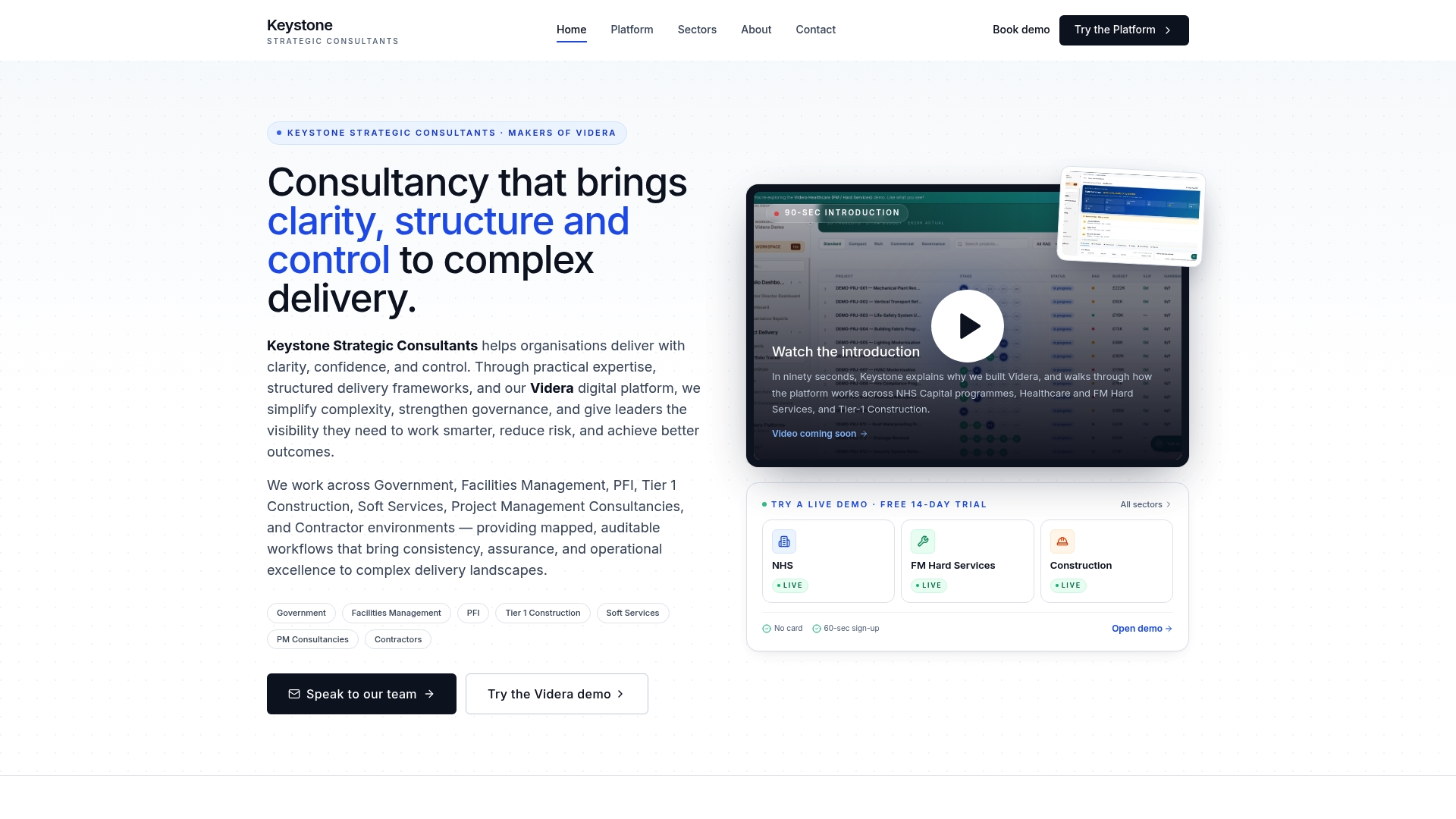
A pilot typically starts by mapping your existing Section 111, GCPCA and MAO workflows, then layering in AI-assisted reporting so KPIs and their evidence trails update continuously rather than at quarter-end. Teams managing broader project governance alongside compliance often run Videra PM alongside the healthcare workspace for a single evidence store across both. If you'd rather have a hands-on team design the governance structure first, Keystoneconsulting's consultancy engagements build that foundation before the platform goes live. Start with a scoped pilot: request a Videra Healthcare demo or pull the 30 Day CMS Compliance Reporting Playbook and set your first sprint this month.
Sources
- GHP User Guide | CMS
- Compliance | Office of Inspector General | U.S. Department of Health & Human Services
FAQ
What Are the Seven Elements of Healthcare Compliance?
The seven elements, drawn from federal sentencing guidelines and referenced throughout OIG compliance guidance, cover written policies, a compliance officer and committee, effective training, open communication lines, internal monitoring and auditing, consistent enforcement, and prompt corrective action. Most audit-ready reporting programmes map their metrics directly against these seven areas.
What Are the Three Main Areas of Healthcare Compliance?
Most frameworks group compliance into regulatory reporting (CMS, Section 111, MAO submissions), patient data protection (HIPAA and patient data compliance), and operational governance (policies, training and internal audit). Each area needs its own evidence trail, though a mature compliance management system reports on all three from one platform.
Can You Give Me an Example of a Compliance Report?
A board-ready compliance report typically opens with a one-page executive summary covering trend direction, benchmark position and top risks, followed by appendices detailing incident trends, training completion, policy acknowledgements and open corrective actions with evidence attached. Platforms like Videra Healthcare generate this structure directly from mapped workflow data rather than manual compilation.
What Is the Best Way to Report Compliance?
The most reliable approach pairs mandatory regulatory filings, Section 111, GCPCA and MAO reporting, with continuous internal monitoring that keeps audit trails live rather than reconstructed under deadline pressure. Automating data collection from EHR, HR and payer systems into one evidence store, an approach automation partners like BeAutomated also support, cuts the manual reconciliation that causes most late or inconsistent submissions.
How Much Does Keystoneconsulting's Videra Platform Cost?
Pricing for Videra Healthcare and Videra PM isn't published; current rates are available directly through Keystoneconsulting on request based on scope and pilot size.