
CMS compliance reporting is the mandatory submission of specified data sets to CMS under programmes including Part C, Part D, Section 111 and the GCPCA. Miss a deadline or submit incomplete records and you risk civil money penalties, not just a strongly worded letter. The immediate action is simple: confirm your last submission was actually accepted, not just sent, and identify one authoritative source of truth for the records feeding it.
TL;DR:
- Confirm that all CMS submissions are accepted and not just sent, with a trusted source of truth for data to prevent technical errors or incomplete records.
- Reporting requirements vary by program, with Part C and Part D requiring annual data uploads aligned to specific specifications, and Section 111 and GCPCA needing quarterly or yearly attestations through official CMS portals.
- Maintain comprehensive records, acceptance receipts, and source files for at least ten years to facilitate audits and quickly respond to CMS inquiries or informal notices.
- Address common failures such as reliance on unverified spreadsheets, skipping validation tests, and unclear vendor oversight by establishing a governance framework with clear data ownership and accountability.
- Use centralized, mapped workflows and automated validation tools to reduce submission errors and shorten cycle times, improving compliance efficiency and readiness for CMS reviews.
Table of Contents
- What counts as CMS reporting: scope and who is covered
- Where to find the official technical specifications
- Key data elements, deadlines and retention rules
- Enforcement, audits and penalties: what CMS actually does
- Cutting reporting cycle time: what actually works
- Preparing for a CMS review: your 30-day checklist
- Practitioner perspective: governance-first reporting that holds up
- Prioritising the fix: what earns executive buy-in
- Get audit-ready reporting with Videra
- Sources
- FAQ
What counts as CMS reporting: scope and who is covered
CMS compliance reporting is narrower than general healthcare compliance management, which encompasses broader HIPAA IT Requirements including technical controls for healthcare practices. A compliance management system covers your whole governance structure. CMS reporting is the specific, scheduled act of submitting defined data sets through defined channels, on defined timelines, to CMS or its contractors.
Several distinct programmes fall under this umbrella, each with its own rules and its own enforcement teeth:
- Part C reporting, required of Medicare Advantage organisations covering enrolment, appeals, grievances and quality measures.
- Part D reporting, required of prescription drug plan sponsors covering medication therapy management, opioid safety edits and grievance data.
- Section 111 (Mandatory Insurer Reporting), required of Group Health Plan Responsible Reporting Entities (RREs), including insurers, third-party administrators and certain self-funded plan sponsors.
- GCPCA, required annually of group health plans and health insurance issuers, including self-funded plans.
Which programmes apply to your organisation depends on what you are: a plan sponsor, an issuer, an RRE, or some combination. A hospital system that also self-insures its employee health plan can find itself an RRE under Section 111 while simultaneously managing GCPCA attestation as a plan sponsor. Scope determines everything downstream: what data fields you populate, how often you submit, and who inside your organisation owns the file.
Where to find the official technical specifications
Each programme publishes its own rulebook, and none of them are optional reading. Treat these as the primary reference, not the summary version a vendor hands you.
- Part C and Part D reporting technical specifications for CY2026 are published directly by CMS, detailing reporting sections and deadlines, including the CY2026 Part C requirements document and its Part D counterpart, which covers enrolment, grievance and opioid safety edit reporting. Most organisations report annually against these specs, with some measures collected quarterly.
- Section 111 obligations run through the COB Secure Website (COBSW), where RREs register, designate an authorised representative, complete testing cycles, and submit quarterly electronic files.
- GCPCA requires an annual attestation, due every 31 December, submitted through a CMS webform confirming your health plan contracts contain no prohibited gag clauses on cost or quality data.
Bookmark the primary CMS pages rather than relying on secondhand summaries. Specifications change year to year, and the CY2026 versions differ from prior cycles in reporting sections and data validation rules.
Key data elements, deadlines and retention rules
Reporting happens at two distinct levels, and confusing them is one of the most common causes of rejected files. Plan-level reporting aggregates data across an entire contract's membership. Contract-level reporting breaks figures down by individual plan benefit package. Part C measures like grievance counts, for instance, are typically reported at the contract level, while some quality metrics roll up to the parent organisation.
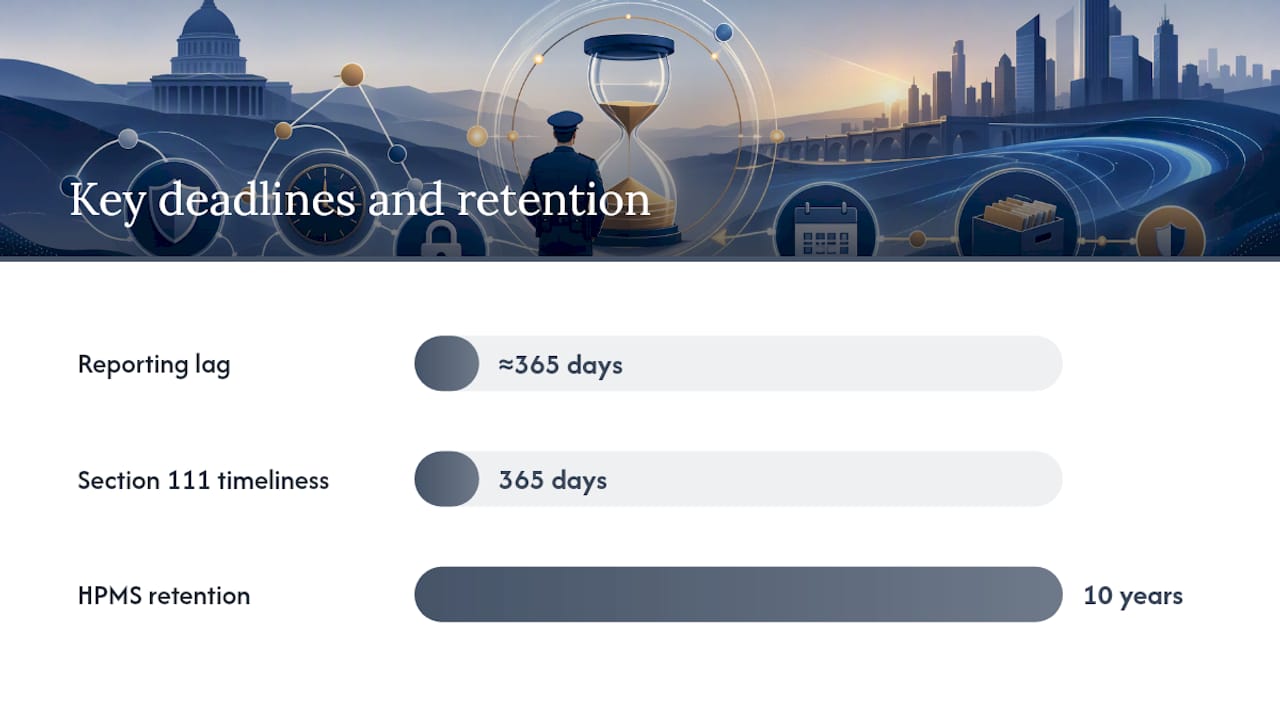
Timing has its own quirks that catch teams off guard. CMS frequently requires reporting of a given calendar year's activity during the following calendar year, with submission portals closing on a Pacific Time cutoff regardless of your own time zone. For Section 111, the 365-day timeliness rule governs how CMS reviews late or missing records for civil money penalty purposes: a Total Payment Obligation to the Claimant record reported more than a year after it should have been is a penalty trigger, not a technicality.
A few governance basics prevent most avoidable failures:
- Keep acceptance receipts and HPMS confirmation messages, not just proof of transmission.
- Retain source files for the ten-year HPMS archive window CMS expects for Part C data.
- Map every internal field to its exact CMS specification field before go-live, not after the first rejection.
- Track CMS error codes as a recurring pattern, not a one-off ticket, since repeat codes usually point to a source-data problem rather than a submission glitch.
Enforcement, audits and penalties: what CMS actually does
CMS runs a structured Compliance Review Program to identify recurring transaction violations, and it uses sampling rather than reviewing every submitted record. If your organisation gets selected, expect a request for a defined sample of files, not a blanket audit of everything you have ever filed.
For Group Health Plan RREs, the civil money penalty framework follows a sequence worth knowing before you are ever in it:
- CMS identifies a pattern of noncompliant or untimely records, often through the 365-day rule.
- An informal notice goes out, opening a window for the RRE to respond with mitigating evidence.
- CMS reviews that evidence and issues a proposed determination, which may include a reduced or waived penalty.
- The RRE can appeal a final determination through the process CMS specifies in that determination letter.
What triggers correspondence in the first place is usually mundane: a pattern of late quarterly files, repeated data validation errors, or a spike in rejected records. CMS enforcement is, per its own guidance, oriented towards education and remediation as much as punishment, which is exactly why the response window matters.
Pro Tip: Start assembling your submission logs, HPMS acceptance messages and internal validation records the day you receive an informal notice. Reconstructing them under deadline pressure costs far more time than keeping them current from the outset.
Cutting reporting cycle time: what actually works
Most reporting failures trace back to one root cause: no single, trusted source of truth. Data lives in claims systems, spreadsheets, and a vendor portal nobody fully controls, and each handoff between them is a chance to corrupt a field. Fixing this before optimising anything else is the single highest-leverage move a compliance team can make.

A centralised compliance reporting database, mapped field-by-field to CMS specifications, removes the guesswork of "which version is correct" that plagues spreadsheet-based teams. Once that source exists, automated pre-submission validation catches formatting and logic errors before they reach CMS, not after a rejection notice arrives.
Several operational habits reinforce that foundation:
- Run scheduled EDI test cycles against Section 111 specs well ahead of quarterly deadlines, not the week before.
- Confirm HPMS or COBSW acceptance explicitly for every file, rather than assuming silence means success.
- Assign clear accountability: the RRE remains legally responsible for Section 111 accuracy even when a third-party agent files on its behalf.
- Name a single EDI representative empowered to sign off on submissions and liaise with CMS.
- Run mock audits twice a year, pulling a sample of records exactly as CMS would.
- Retain raw source files alongside submitted files, so a discrepancy can be traced back to its origin.
Governance questions matter as much as the technology. Who signs the GCPCA attestation? Who owns vendor oversight when a third-party reporting agent misses a deadline? If those answers require a meeting to establish, that gap is itself a compliance risk. A practical compliance culture treats reporting accountability as a named role, not a shared assumption, and that clarity is what shows up favourably during a review.
Preparing for a CMS review: your 30-day checklist
An informal notice starts a clock, and how you spend the first days determines whether mitigation evidence is credible or thrown together.
- Pull submission logs immediately, including timestamps, file versions and every HPMS or COBSW acceptance message tied to the records in question.
- Reconcile source records against what was submitted: check MBI/SSN crosswalks and dates of coverage for the specific population CMS flagged.
- Notify internally within 48 hours: legal, the compliance officer, IT and any third-party reporting agent involved, since RRE accountability does not transfer to that vendor.
- Request the vendor's own logs if a third-party agent filed on your behalf, since gaps in their process are still your liability.
- Document root cause and corrective action in writing, not just a fix, since CMS mitigation review weighs a credible corrective action plan heavily.
Pro Tip: Build a standing "audit box" folder structure now, before any notice arrives. A team that assembles evidence in two days rather than two weeks starts every review from a position of credibility. Our HIPAA audit readiness guide walks through the same evidence-assembly discipline CMS reviews reward.
Practitioner perspective: governance-first reporting that holds up
The same three failure patterns show up across most healthcare organisations Keystoneconsulting works with: spreadsheet reliance that nobody fully trusts, submission testing skipped under deadline pressure, and vendor oversight that only activates after something has already gone wrong.
An effective approach starts with governance design before touching a reporting template: mapping who owns which data element, then building the workflow, then layering in AI-assisted validation to catch anomalies before submission rather than after rejection. Stage-gated delivery means each phase produces auditable evidence, not just a promise that things improved.
What that looks like in practice:
- A documented workflow map showing every handoff from source system to CMS submission.
- Validation logs demonstrating error rates falling over successive reporting cycles.
- A named governance structure with clear sign-off accountability, mirroring the seven core elements of an effective compliance programme.
Ask any vendor for evidence of reduced days-to-acceptance and fewer repeat error codes, not just a description of their methodology.
Prioritising the fix: what earns executive buy-in
Compliance leaders rarely struggle to identify what is broken. They struggle to get budget to fix it. The move that works is ranking fixes by risk against effort: a mis-mapped field causing repeat rejections is high risk and often low effort to correct, so fix that before chasing a bigger platform overhaul.
Executives respond to numbers they recognise from other parts of the business: reduction in submission errors, days-to-acceptance, and frequency of CMS correspondence requesting clarification. Small, visible wins, like eliminating one recurring error code, build the credibility that funds the larger infrastructure investment.
— Peter
Get audit-ready reporting with Videra
Spreadsheets and disconnected vendor portals get most compliance teams through one reporting cycle. They rarely survive three. The Videra platform is designed specifically for organisations that need mapped, auditable workflows rather than another dashboard bolted onto the same fragile process.
This platform gives compliance teams a centralised record of every workflow step, from source data through submission, with AI-assisted validation flagging anomalies before they become rejected files. Engagements typically start with a workflow mapping exercise against current reporting obligations, followed by stage-gated implementation so auditable evidence is seen at each phase, not just a finished product months later. The result compliance officers care about most: fewer repeat error codes and a shorter path from submission to acceptance. If your last CMS review turned up more surprises than it should have, request a readiness assessment for Videra and see where your current process is actually leaking time.
Sources
- Part C and Part D Reporting Requirements | CMS
- GHP civil money penalties | CMS
- Section 111 resources | CMS
- Gag clause prohibition compliance attestation (GCPCA) | CMS
FAQ
What are the CMS reporting requirements for 2026?
For CY2026, Medicare Advantage and Part D sponsors must submit data against the updated technical specifications CMS published for that cycle, covering enrolment, grievances and quality measures. Section 111 RREs continue quarterly electronic reporting through COBSW, and GCPCA attestation remains due every 31 December.
What is CMS compliance?
CMS compliance means meeting the reporting, data accuracy and submission timeliness obligations CMS sets for Medicare Advantage organisations, Part D sponsors, group health plans and insurers. It sits within the wider concept of healthcare compliance reporting but focuses specifically on scheduled submissions to CMS itself.
What is the minimum requirement for reporting data to CMS?
The minimum requirement depends entirely on which programme applies to your organisation. A Section 111 RRE must register, test and submit quarterly files, while a health plan under GCPCA need only complete one annual attestation by 31 December.
What is CMS in the United States?
CMS is the Centers for Medicare & Medicaid Services, the federal agency that administers Medicare, Medicaid and Marketplace plans and enforces the reporting rules covered under its administrative simplification programme.
How do I report CMS compliance issues or corrections?
Corrections generally go back through the same channel used for original submission, whether that is HPMS for Part C and Part D data or COBSW for Section 111 files, accompanied by documented root cause and corrective action if CMS has already flagged the issue.