
Audit-ready means you can hand over dated, complete tier-1 artefacts (your risk analysis, policies, training records, business associate agreements and breach log) within the timeframe an auditor sets, not weeks later. If you cannot say right now who owns each of those documents and how fast you could pull them, you are not ready. Run a timed retrieval check this week to find out.
TL;DR:
- Most organizations struggle to produce and verify tier-1 artifacts within the required audit timeframe unless they conduct regular timed retrieval drills.
- Maintaining current documentation, version history, and metadata for at least six years is essential to prove policy and evidence datedness at audit time.
- Technical safeguards such as vulnerability scans, patch management, and restore tests are increasingly scrutinized and must be well-documented in practice.
- Assigning clear ownership and running quarterly checks, annual simulations, and material change assessments helps sustain year-round HIPAA readiness.
- Using platforms like Videra can automate and streamline evidence collection, version tracking, and timed retrieval to prevent last-minute scrambles.
Table of Contents
- What does HIPAA audit readiness actually require?
- What auditors request: tier-1 artefacts explained
- How do you build a year-round HIPAA audit readiness programme?
- Why is the Security Rule the sharpest focus for 2026 audits?
- How do you run a mock audit and timed retrieval drill?
- How do you prove your documentation was current on the right date?
- What red flags cause the most audit findings?
- What does adopting a continuous readiness approach actually change?
- How does Videra help you get audit-ready and stay there?
- Where can you find the official guidance and practical tools?
- Sources
What does HIPAA audit readiness actually require?
Auditors from the HHS Office for Civil Rights work from a published list, not a mystery grab-bag. The OCR audit protocol sets out the tier-1 artefacts every covered entity and business associate should expect to produce: the security risk analysis, written policies and procedures, workforce training records, business associate agreements, the breach notification log, and contingency planning evidence. Knowing the list is the easy part. Producing dated, current copies fast is where most organisations stumble.
Build your checklist around evidence location and ownership, not just a tick-box of requirements. A generic list tells you a risk analysis is needed; it does not tell you where the 2026 version sits, who signed it off, or whether last year's remediation actions were closed. That gap is exactly what leaves organisations scrambling when a request lands.
- Security risk analysis (SRA): dated recently, with findings and remediation status attached.
- Policies and procedures: version-controlled, with effective dates and named approvers.
- Workforce training records: per-person completion logs tied to the policy version they were trained on.
- Business associate agreements (BAAs): a live inventory mapped to every vendor touching ePHI.
- Breach notification log: every incident, however minor, with disposition and dates.
- Contingency plan evidence: backup schedules and, critically, restore test results.
Investigations and audits typically request the same document set, and the window to assemble it is usually measured in weeks rather than months. Your internal drill should aim considerably tighter than that external deadline, because real requests rarely arrive with a comfortable lead time.
Retention matters as much as speed. Keep every version of a policy, not just the current one, for six years from creation or last effective date, and preserve the metadata that shows when each version governed operations.
What auditors request: tier-1 artefacts explained
Each artefact on that list exists to answer a specific question, and auditors know exactly what a weak answer looks like.
Your security risk analysis needs a visible methodology, a findings list, and evidence that remediation actually happened, not just got logged. A risk analysis from three years ago with no update trail is one of the fastest routes to a citation.
Policies and procedures should carry version history: an effective date, a named approver, and a record of what changed between revisions. Auditors have seen enough undated Word documents to treat them as a red flag on sight.
Workforce training records need to tie to a person and a policy version, not a blanket "all staff trained" statement. If your privacy policy changed in March, your training record should show who was retrained on it and when.
- BAAs need a living inventory, mapped to the specific systems that hold ePHI, with notes on which responsibilities sit with the vendor versus your organisation. A current BAA inventory is one of the clearest differentiators between programmes that sail through review and ones that don't.
- Incident logs should show disposition, not just occurrence, for every event, however small.
- Backup and restore evidence needs to show the restore actually worked, not that a backup job ran.
- Access reviews should show who reviewed access, when, and what changed as a result.
The common thread: auditors are not grading whether you have a policy. They are grading whether it was in force, understood, and acted on at a specific point in time.
How do you build a year-round HIPAA audit readiness programme?
Treat readiness as an operating rhythm, not a scramble before a known audit date, because most enforcement action starts with a breach report or complaint, not a calendar notice.
Assign clear ownership across five roles: a privacy lead, a security lead, an operations lead, legal counsel, and a vendor management lead. A simple RACI split works well: the privacy lead is accountable for the SRA and breach log, the security lead owns technical safeguards evidence, operations owns training completion, legal reviews BAAs, and vendor management maintains the system-mapping inventory.
- Run quarterly evidence checks — confirm each tier-1 artefact is current and correctly filed.
- Conduct a full annual audit simulation — treat it as a real OCR-style document request with a deadline.
- Trigger a re-assessment on material change — a new EHR system, a merger, or a significant vendor swap should prompt a fresh SRA covering the affected scope, not a wait for the next scheduled cycle.
- Prioritise remediation by risk, starting with access control gaps, missing multi-factor authentication, untested backups, and incident response weaknesses.
- Track every finding to closure, with a named owner, a target date, and proof that the fix actually happened.
Pro Tip: Treat every remediation item like a support ticket, not a note in a spreadsheet. If it does not have an owner and a due date, it will still be open next year.
A modular checklist tied to owners and review dates beats a static master document every time, because it helps surface gaps promptly rather than months later when someone finally reopens the file.
Why is the Security Rule the sharpest focus for 2026 audits?
OCR resumed audits with a clear tilt toward Security Rule compliance, and ransomware sits at the centre of that shift. Recent enforcement action tied to ransomware investigations signals that technical safeguards, not just paperwork, are under closer scrutiny.
Expect auditors to ask for evidence that goes beyond a written policy:
- Vulnerability scan results, dated and showing remediation follow-through.
- Multi-factor authentication logs across systems holding ePHI.
- Patch management records showing timely deployment, not just a patching policy.
- Backup restore test results, proving contingency plans work in practice rather than on paper.
- Incident response tabletop exercise records, with post-incident remediation timelines attached.
A proposed update to the Security Rule points toward regulators expecting more auditable technical artefacts, such as asset inventories and network maps, even ahead of any final rule, indicating a move toward higher evidentiary standards. That direction alone is reason to tighten technical evidence now rather than wait for the rule to land. NIST SP 800-66 remains the most practical map between technical controls and what the Security Rule expects, and it is worth working through if your team has not benchmarked against it recently.
How do you run a mock audit and timed retrieval drill?
A mock audit only works if it copies the pressure of a real one. Design it around a document request set that mirrors what OCR actually asks for, set a strict clock, and put someone outside the compliance team in charge of timing.
- Draft a realistic request letter listing the tier-1 artefacts, exactly as OCR's protocol would phrase it.
- Set a hard deadline shorter than any real-world request window, and start the clock without warning the retrieval team in advance.
- Time each artefact separately — SRA, BAAs, training exports, restore test evidence, and access review samples all get their own stopwatch.
- Test controls, not just paperwork — ask IT to actually perform a restore rather than produce the backup schedule alone.
- Log every gap as a remediation item with an owner and a close-out date, then verify closure at the next quarterly check.
Pro Tip: A realistic benchmark for a mid-sized organisation is assembling the full package within two business days. If your drill takes two weeks, that is your actual readiness number, not the one you'd tell an auditor.
Run this annually at minimum, with privacy, IT, and operations all represented, plus one observer with no stake in the outcome.
How do you prove your documentation was current on the right date?
Datedness is the difference between a policy that protects you and one that raises questions. Retain every compliance document, and every prior version of it, for at least six years from its creation date or last effective date.
Capture four pieces of metadata on everything: the effective date, the named approver, a short change summary, and a timestamped export showing when the file was pulled from your system.
- Store evidence in a repository that logs access and supports clean exports, not a shared drive with no audit trail.
- Keep superseded policy versions rather than overwriting them, so you can show what governed operations on any given date.
- Export training records with timestamps attached, not just a current snapshot of who is "up to date" today.
A platform that maps workflows to dated, exportable evidence removes most of this burden automatically, which is precisely the gap tools like Videra are built to close for healthcare organisations juggling multiple document owners.
What red flags cause the most audit findings?
The failures that generate findings are rarely exotic. They are the same handful of gaps, repeated across most organisations that get cited.
- A risk analysis that is technically present but years out of date.
- Policies with no visible effective date or approver.
- Missing BAAs for vendors that clearly touch ePHI.
- Training records that show a course was assigned, not that it was completed.
- Backups that have never been restore-tested.
- Access reviews that happened once and were never repeated.
Pro Tip: Run a five-minute check each month: pull one random policy, one random BAA, and one random training record. If any of the three feels stale, treat it as a signal the whole category needs review.
What does adopting a continuous readiness approach actually change?
Most organisations treat audit prep as a fire drill, dusting off the risk analysis a week before a deadline and hoping the training spreadsheet is current. That approach fails not because people are careless, but because evidence lives in five different systems with no single owner accountable for keeping it dated.
Keystoneconsulting's work maps each compliance requirement to a specific, ownable piece of evidence inside Videra, so a dated report exists automatically instead of being reconstructed under pressure. The organisations that hold up best under real audit scrutiny are the ones running mock drills routinely, not the ones with the thickest policy binder. An auditable evidence library, maintained continuously, beats a heroic scramble every time.
— Peter
How does Videra help you get audit-ready and stay there?
Keystoneconsulting built Videra specifically for the gap between having policies and being able to prove they worked, on a given date, without a fire drill. Videra maps your governance requirements to mapped workflows and an auditable evidence library, so tier-1 artefacts sit in one place with the version history and timestamps auditors ask for.
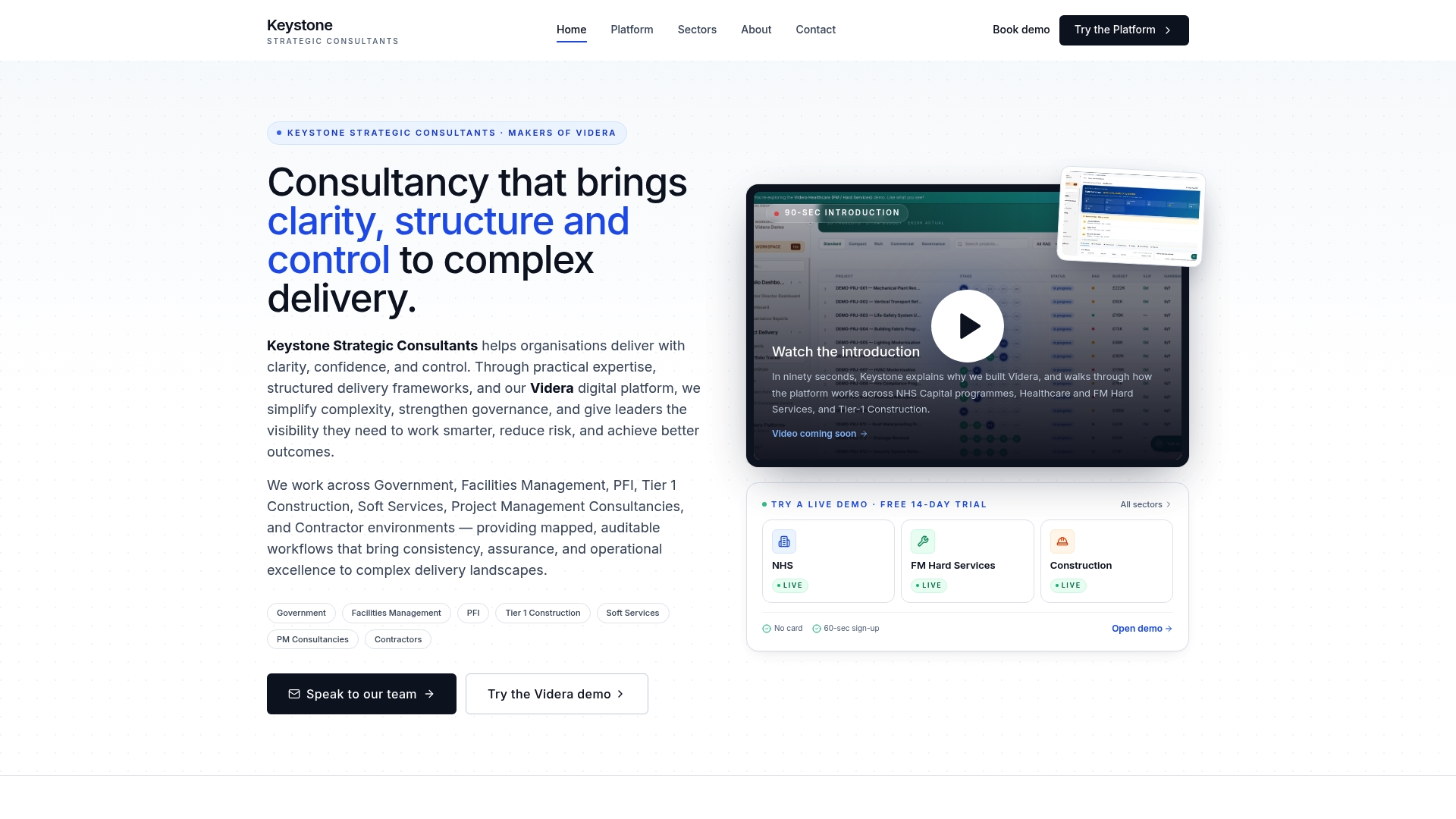
Instead of assembling a request package by chasing five different systems, you get AI-powered reporting that produces the dated evidence auditors want, with timed retrieval support built into the platform rather than bolted on before an audit. Engagement typically starts with a short demo, moves into scoping against your current gaps, and runs a pilot before full rollout, so you see where your real retrieval times stand before committing to anything larger.
If a monthly stress-test of your BAAs or training records already makes you uneasy, that is worth acting on now rather than after a request letter arrives. Start with a demo of Videra's project delivery platform or explore how Keystoneconsulting's governance work fits your organisation's current setup.
Where can you find the official guidance and practical tools?
Go straight to the source rather than a paraphrased summary. The OCR audit protocol and the official HIPAA audit programme page set out exactly what gets requested. For technical safeguards, NIST SP 800-66 remains the clearest bridge to Security Rule expectations, and BAA specifics are well covered in this breakdown of contract requirements.
This article is general information, not a substitute for advice from a qualified lawyer. Consult a qualified legal professional about your own circumstances before acting on anything here.