
Contractors holding applicable service contracts must file FAR service contract reports annually through SAM.gov by 31 October, covering the preceding Government fiscal year of 1 October to 30 September. This duty applies to cost-reimbursement, time-and-materials, labour-hour and certain fixed-price service contracts above the thresholds set out in FAR 4.1703. Primes also carry responsibility for first-tier subcontractor data. Your first move: confirm which contracts meet the thresholds, then calendar the owner and the deadline.
TL;DR:
- Contractors must verify their current FAR thresholds and contract types because they are periodically adjusted and can change with new rules.
- Subcontractor data is required at the first-tier level, and prime contractors should include it as a deliverable to avoid late or incomplete reports.
- Accurate reconciliation of invoiced dollars, labor hours, and subcontractor data against source records and FPDS is essential before submission.
- Building a documented, repeatable internal process with clearly assigned owners can prevent most common errors and ensure audit readiness.
- Missing the deadline or submitting inaccurate data risks performance penalties, contractual remedies, and longer-term exclusion from future federal contracts.
Table of Contents
- Scope and legal basis: FAR clauses and how reporting fits into the FAR system
- Who must report: thresholds, contract types and practical decision rules
- What to report and how to submit: required fields and data collection
- Timelines and agency review windows: calendar tasks and remediation steps
- Subcontractor reporting obligations and public disclosure considerations
- Enforcement, common mistakes and how to remediate errors
- Practical compliance checklist and internal controls for audit-ready reporting
- Practical barriers and fast wins from a Keystone implementation lens
- How Videra and Keystone's consultancy support audit-ready FAR reporting
- FAQ
- Sources
- Authoritative primary sources for FAR reporting
Scope and legal basis: FAR clauses and how reporting fits into the FAR system
Service contract reporting sits inside Part 4 of the Federal Acquisition Regulation, the section governing administrative matters rather than solicitation or evaluation procedures. Two clauses do the operational work. 52.204-14 covers standalone service contracts, while 52.204-15 applies the same logic to indefinite-delivery contracts, where reporting attaches to individual orders rather than the base vehicle. Both clauses require submission through SAM.gov and both set the same annual rhythm.
FAR 4.1703 is the threshold and applicability rule that decides whether a given contract falls inside the regime at all. It names the contract types captured (cost-reimbursement, time-and-materials, labour-hour above the simplified acquisition threshold, and fixed-price service contracts above stated monetary levels) and leaves agencies to apply it consistently across their awards.
None of this operates in isolation from the rest of the acquisition system. SAM.gov is the reporting interface, but the underlying award data also feeds the Federal Procurement Data System, so a contractor's submitted figures should reconcile against what the agency has already recorded in FPDS. Agencies with their own supplements, most notably the Defense Federal Acquisition Regulation Supplement, layer additional procedures on top through their own Procurement Guidance Instructions. A Defense Department contractor should check the relevant PGI alongside the base FAR text rather than assuming the civilian process transfers unchanged.
One point worth building into any internal procedure: FAR clauses are subject to class deviations and periodic rulemaking. A clause number or threshold that applies this fiscal year can shift with an interim rule or a final rule published in the Federal Register. Compliance officers should treat acquisition.gov and their agency's own contracting office notices as the living source of truth, checking both before each reporting cycle rather than relying on last year's internal memo. Building that check into a recurring calendar task costs little and avoids filing against a superseded threshold.

Who must report: thresholds, contract types and practical decision rules
Not every service contract triggers a report, and the decision point is a mix of contract type and dollar value. FAR 4.1703 sets out which contracts are in scope: cost-reimbursement contracts, time-and-materials contracts, and labour-hour contracts above the simplified acquisition threshold, plus fixed-price service contracts above the monetary levels the clause specifies. Because these thresholds are periodically adjusted, the exact current figures should always be confirmed against the live FAR text rather than copied from a prior year's checklist.
Indefinite-delivery vehicles add a wrinkle. Under an IDIQ, a GWAC or a Federal Supply Schedule contract, the reporting obligation generally attaches at the order level under 52.204-15, not to the overarching contract vehicle itself. That means a single IDIQ holder might report on some task orders and not others, depending on each order's dollar value and contract type. Treating the vehicle as a single reporting unit is one of the most common ways contractors miss an obligation, because the order that crosses the threshold can be easy to overlook among several that do not.
A workable decision process for a compliance officer reviewing a contract portfolio:
- Identify the contract or order type first: cost-reimbursement, time-and-materials, labour-hour or fixed-price service.
- Check the applicable dollar threshold for that type against the current FAR 4.1703 text.
- For IDIQ, GWAC or FSS awards, assess each order individually rather than the vehicle as a whole.
- Flag any contract close to a threshold for a second review before the fiscal year closes, since invoiced totals can shift late.
- Record the inclusion or exclusion decision and the reasoning, so the file shows how the determination was made.
That last step matters more than it looks. An agency reviewer or an internal auditor asking why a contract was excluded will want to see the reasoning documented at the time, not reconstructed months later.
What to report and how to submit: required fields and data collection
The report itself is narrower than the research effort behind it. Under 52.204-14 and 52.204-15, the core data fields are the contract or order number, the total dollars invoiced during the fiscal year, and contractor direct labour hours, along with corresponding subcontractor data where applicable. Getting those four figures right depends entirely on the quality of the underlying records.
A practical sequence for assembling the submission:
- Pull the full list of in-scope contracts and orders from the threshold review described above.
- Reconcile invoiced dollars against the finance system's actual billed totals for the fiscal year, not the contract ceiling or estimated value.
- Reconcile direct labour hours against timesheets or project accounting records, excluding indirect or overhead hours that fall outside the FAR definition.
- Request first-tier subcontractor data early, using a standard request template that asks for the same fields: dollars invoiced and direct labour hours for the period.
- Cross-check the assembled figures against FPDS records for the same contracts before submission, to catch mismatches early.
- Submit via SAM.gov, following the current SAM User Guide for the exact screens and file formats the system expects.
SAM.gov's own interface changes periodically, and contractors who leave the submission to the last week sometimes find a changed upload format or a renamed field. Starting the data pull at least six weeks ahead gives enough room to resolve a formatting surprise without risking the deadline.
Pro Tip: Build a standing subcontractor data request into the subcontract itself as a deliverable, rather than chasing it informally every autumn.
Common submission errors worth checking for before you hit submit: using a contract's ceiling value instead of actual invoiced dollars, omitting indirect labour correctly but then forgetting to include legitimately billable direct hours from a teaming partner, and leaving a subcontractor data field blank because the request went out too late to get a response. None of these is complicated to fix, but all three show up repeatedly in contractor files that get flagged for revision. Work with delivery teams across regulated sectors suggests that most of these errors trace back to a missing single source of truth for hours and invoices, something a mapped workflow addresses directly.
Timelines and agency review windows: calendar tasks and remediation steps
The filing deadline is fixed: 31 October, covering the Government fiscal year that ran from 1 October of the prior year to 30 September of the current one. That date does not move for contractors on a different fiscal calendar internally; the FAR reporting cycle follows the federal fiscal year regardless of a contractor's own accounting period.
After submission, agencies review the figures for reasonableness. Under 52.204-14, an agency that believes a revision is warranted will notify the contractor by 15 November. The contractor then has until 30 November to either revise the submission or document, in writing, why the original figures stand. That second deadline is easy to miss because it depends on an agency action landing in the contractor's inbox during a busy period, so a compliance officer should treat the window between 31 October and 30 November as an open task, not a closed one.
Practical calendarisation helps more than any single piece of software:
- Assign a named owner for each contract's reporting cycle, not a shared team inbox.
- Set three calendar milestones: the data pull (mid-September), the submission deadline (31 October), and the review response window (15 to 30 November).
- Retain the evidence used to build each figure (timesheets, invoice extracts, subcontractor confirmations) in a locked folder tied to the contract, so a later agency query can be answered from the file rather than from memory.
- Where an agency's request for revision is disputed, escalate through the Contracting Officer in writing before the 30 November deadline, rather than letting an informal phone conversation stand as the record.
Subcontractor reporting obligations and public disclosure considerations
A prime contractor's reporting duty does not stop at its own labour and dollars. Where a contract meets the thresholds in FAR 4.1703, 52.204-14 and 52.204-15 require the prime to include first-tier subcontractor data covering the same fields: dollars invoiced and direct labor hours for the reporting period. A first-tier subcontractor is one contracting directly with the prime, not a lower-tier supplier several steps removed.
Collecting that data reliably means treating it as a contract deliverable rather than an annual favour. Practical steps that reduce the usual last-minute scramble:
- Write the subcontractor reporting obligation into the subcontract agreement itself, with a specific due date ahead of the prime's own 31 October deadline.
- Use a standard data request template so every subcontractor returns figures in the same format, which speeds up the prime's reconciliation.
- Follow up in writing at the 60-day and 30-day marks before the deadline, rather than relying on a single request sent in September.
- Keep a record of each subcontractor's confirmed figures separately from the prime's own data, so a later discrepancy can be traced to its source quickly.
Once submitted, service contract report data generally becomes part of the public federal procurement record, visible through SAM.gov and reflected in FPDS. That visibility is worth planning for. Subcontractors sometimes treat their own invoiced totals or headcount figures as commercially sensitive, and a prime should agree in advance how any genuinely proprietary detail is marked and whether it needs to be aggregated rather than broken out by subcontractor. There is no FAR mechanism to keep standard reporting fields confidential once submitted, so the better strategy is agreeing the format and framing before data changes hands, not after.
Enforcement, common mistakes and how to remediate errors
Missing the reporting deadline is not a paperwork inconvenience. A contractor that fails to submit, or submits materially inaccurate data, exposes itself to the government's standard contract remedies, and the failure can be reflected in the contractor's performance information under FAR subpart 42.15. That performance record follows a contractor into future source selections, where past performance is routinely weighed. In more serious cases involving concealment or false certification, a contractor can face suspension or debarment proceedings, which bar it from future federal awards entirely.
The errors that cause the most trouble are rarely exotic. The recurring patterns are:
- Applying last year's dollar thresholds instead of checking the current FAR text, which can wrongly include or exclude a contract.
- Letting SAM.gov registration lapse mid-contract, which can stall a submission even when the underlying data is ready.
- Using a generic Unique Entity Identifier or CAGE code on contractual documents rather than the entity-specific code, which can cause reporting mismatches and payment misdirection.
- Omitting subcontractor totals entirely because the data arrived after the prime had already submitted.
When an error surfaces, whether through internal review or an agency query, the sequence that limits the damage is straightforward: document exactly what was wrong and when it was discovered, notify the Contracting Officer in writing rather than waiting to be asked, submit a revised report through SAM.gov following the agency's instructions, and log the whole exchange in the contract's evidence file. A clean record of a mistake found and fixed promptly reads very differently in a later review than the same mistake discovered by the agency first.
Practical compliance checklist and internal controls for audit-ready reporting
Reliable annual reporting comes from a repeatable process, not from a scramble every October. A workable annual cycle looks like this:
- In July or August, pull the full contract and order list and apply the threshold test from FAR 4.1703 to each.
- Assign a named owner to every in-scope contract, with the data sources (finance system, timesheet system, subcontractor contacts) listed against their name.
- In September, reconcile invoiced dollars and direct labour hours against FPDS records for the same contracts to catch discrepancies early.
- Send subcontractor data requests by mid-September, with a firm internal deadline well ahead of 31 October.
- Run a pre-submission review at least two weeks before the deadline, checking every field against source documents.
- Submit via SAM.gov by 31 October, and keep a dated copy of the submitted report alongside its supporting evidence.
- Monitor for agency review notices through 15 November, and have the revision or rationale ready to file by 30 November.
Pro Tip: Keep a single evidence folder per contract containing timesheets, invoice extracts and subcontractor confirmations, built as you go through the year rather than assembled retrospectively in October.
Beyond the reporting cycle itself, 52.203-13 sets a separate but related obligation: contractors above certain thresholds must maintain a written code of business ethics and conduct, an internal control system, and an internal reporting mechanism such as a comprehensive OFAC screening program hotline. That same clause carries a mandatory disclosure duty: credible evidence of a federal criminal law violation or a False Claims Act violation connected to contract award, performance or closeout must be disclosed in writing to the agency's Office of Inspector General, with a copy to the Contracting Officer, and that disclosure obligation continues for at least three years after final payment. A compliance programme built around service contract reporting should sit inside this broader ethics framework, not beside it as a separate exercise.
Technical controls worth building into the same cycle include keeping SAM registration current under 52.204-13, which requires accurate and complete registration maintained through the life of the contract with annual updates, reconciling submitted figures against FPDS after each cycle, and retaining an audit trail of who approved each submitted figure and when. Teams building this out from scratch often find it faster to start from an existing framework; a step-by-step compliance programme guide or an audit readiness checklist covers much of the same ground that FAR reporting controls need. Document retention periods should match the longer of the agency's own record schedule or the three-year window tied to the mandatory disclosure obligation under 52.203-13.
Practical barriers and fast wins from a Keystone implementation lens
Most FAR reporting failures are not caused by unclear regulations. They come from fragmented data: timesheets in one system, invoices in another, subcontractor figures arriving by e-mail in a dozen different formats, and no single person accountable for pulling it all together before 31 October. The clauses themselves are specific about what is required. The gap is almost always operational.

The fastest fix is rarely a new piece of software. It is naming an owner for each contract's reporting cycle, mapping out where the four required data points actually live, and building one reconciliation point where invoiced dollars, direct labour hours and subcontractor figures get checked against each other before submission. Teams that treat subcontractor data as a standing deliverable, requested on a schedule rather than chased every autumn, consistently avoid the late scramble that causes most errors.
None of this requires reinventing a compliance function. It requires making the existing one visible, so a reviewer, an auditor or a new hire can see exactly where each figure in the report came from.
— Peter
How Videra and Keystone's consultancy support audit-ready FAR reporting
Teams without a mapped process for pulling contract hours, invoices and subcontractor figures together tend to rebuild that process from scratch every reporting cycle, which is where most of the errors covered above come from. Videra PM maps the underlying workflow, from contract intake through invoice reconciliation to subcontractor data collection, so the evidence a service contract report needs is captured as the work happens rather than reconstructed under deadline pressure.
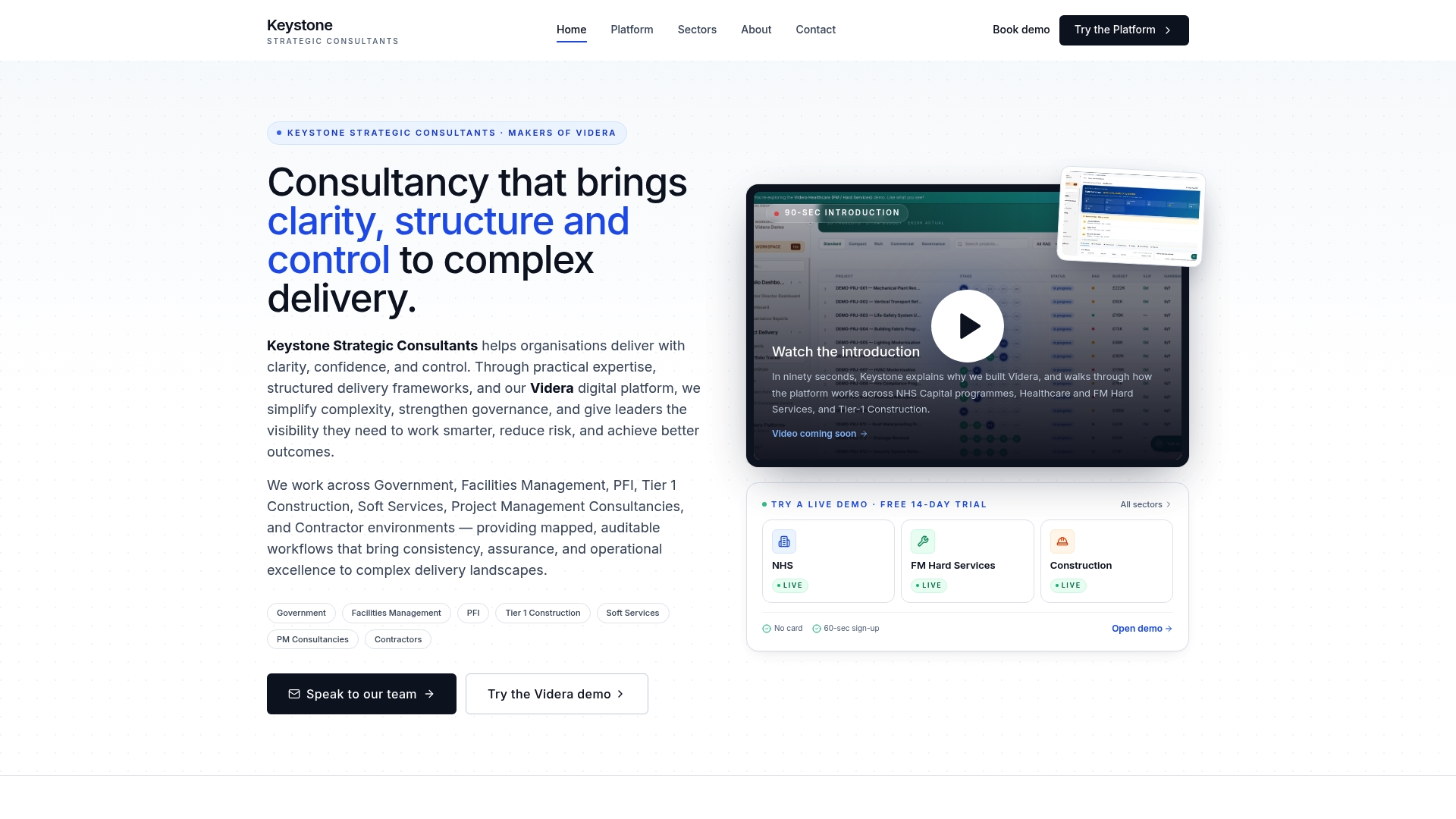
That matters most for contractors managing several IDIQ orders or fixed-price service contracts at once, where tracking which orders cross the FAR 4.1703 thresholds and which do not becomes a standing administrative job rather than a once-a-year task. They work directly with delivery teams to build that mapped, audit-ready workflow rather than handing over a generic template. For a healthcare, construction or facilities organisation weighing up whether its current reporting process would survive an agency query, a readiness review with Keystone's consultancy team is a practical next step, and the Videra PM product page has more detail on how the platform supports the workflow.
FAQ
What are the key updates to the FAR for 2026?
FAR text, including the thresholds in 4.1703 and the data fields in 52.204-14, is subject to periodic rulemaking and class deviations. Contractors should check acquisition.gov directly ahead of each reporting cycle rather than relying on a prior year's threshold figures, since the current regulation text is the only reliable source for what applies now.
Who must comply with the FAR?
Any business holding a contract with a federal agency is bound by the FAR terms incorporated into that contract, including service contract reporting clauses where the contract type and value meet the thresholds in FAR 4.1703. First-tier subcontractors on applicable contracts also have a data-provision role, even though the submission itself is the prime's responsibility.
What is the difference between FAR and DFARS?
The FAR is the baseline federal acquisition regulation applying across civilian and defence agencies, while DFARS is the Defense Department's supplement, adding defence-specific procedures on top of the FAR text. A Defense contractor needs to check both the base FAR clauses, such as those in 52.204-14, and the relevant DFARS or PGI guidance for its agency.
What happens if a contractor misses the FAR reporting deadline?
A missed or inaccurate service contract report can lead to contractual remedies and can be reflected in the contractor's performance record under FAR subpart 42.15, which future source selections may weigh. In more serious cases involving concealment, suspension or debarment proceedings are a possibility.
Authoritative primary sources for FAR reporting
Verify every clause and threshold directly before relying on it. The core texts are 52.204-14, 52.204-15 at Cornell LII, 52.204-13, 52.203-13 and FAR 4.1703, alongside PGI 204.6 for agency-level procedures and compliance check guidance at FAR 22.406-7. Submissions themselves go through SAM.gov.