
Change control governance is a decision framework that captures, evaluates and authorises changes so projects and services remain auditable and resilient. It typically involves sponsors, change managers and operational owners who weigh risk against benefit before anything moves into production. The outcome we are after is simple: every change is traceable, every decision is recorded, and plans stay intact even when circumstances shift.
TL;DR:
- Routine changes need lightweight approval and a brief closure record; major changes require impact assessment, testing evidence, a tested rollback plan, and formal signoff.
- Emergency changes can use an abridged review during active incidents, but teams need an immediate rollback option and must complete a postimplementation review every time.
- A routine request may need only change manager approval, while a major system change requires review by the change board and executive sponsor.
- Store impact analyses, approval records, test logs, and review findings under version control; track success rates, planned versus unplanned changes, and implementation time.
Table of Contents
- Change control versus change management: what each one actually covers
- Routine, major and emergency changes need different governance levels
- Who approves what: roles and the approval hierarchy
- The change control process, step by step
- Keeping an audit trail that actually holds up
- Scaling governance without slowing everything down
- Common pitfalls we see and the controls that fix them
- Why decision speed matters as much as decision quality
- A direct route to audit-ready governance with Videra
- FAQ
- Sources
Change control versus change management: what each one actually covers
Change control is the formal decision process that captures, assesses and authorises a specific change before it happens. Change management is broader: it covers how people adopt that change, including communications, training and behavioural adjustment across an organisation. Conflating the two causes real problems, because a request can clear every technical approval and still fail if nobody manages the human side of adoption.
Change control governance focuses on decision authority, auditability and risk containment. It answers questions such as who can approve a change, what evidence is required, and how the decision is documented for later review. The scope of that control usually includes:
- Configuration items such as systems, equipment and infrastructure components.
- Controlled documents, including specifications, plans and procedures.
- Business processes and workflows affected by the proposed change.
- Any system or platform whose behaviour will shift as a result.
A documented approval hierarchy, as recommended in FFIEC change management guidance, sits at the centre of this distinction. Policies should categorise changes by severity, name the staff or committees responsible for each category, and set out how decisions get made and recorded. Change management activity can then build on a decision that has already been through proper scrutiny.
Routine, major and emergency changes need different governance levels
Not every change deserves the same scrutiny, and treating a password reset like a core system migration wastes time without reducing risk. Routine or planned changes are low-impact, frequently repeated actions, such as a scheduled software patch or a standard equipment swap, and they typically follow a pre-approved, lightweight process. Major changes carry higher risk or cost, for example a core platform upgrade or a facility-wide process redesign, and they need full impact assessment, testing and multi-level sign-off. Emergency changes respond to an active incident, such as a security breach or a critical system failure, where waiting for the standard review cycle would cause more harm than acting quickly.
Governance can be abridged for emergencies, but only within clear limits. According to FFIEC guidance on emergency modifications, the ability to reverse a disruptive emergency change is often more critical than the speed of deploying it, which is why a post-implementation review is required for every one of them, without exception.
Across all three categories, expectations scale rather than disappear:
- Routine changes need a lightweight back-out note and a brief closure record.
- Major changes need full testing evidence, a tested rollback plan and formal sign-off.
- Emergency changes need an immediate back-out option and a mandatory post-implementation review.
Pro Tip: Build your back-out plan before you touch production, not after something goes wrong.
Who approves what: roles and the approval hierarchy
A documented approval hierarchy only works if everyone in it understands their part. The roles below appear, in some form, in most functioning governance models:
- Requester: raises the change, describes the business case and supplies initial impact information.
- Change manager: coordinates the process, checks completeness and routes requests to the right reviewers.
- Configuration item owner: confirms technical feasibility and flags dependencies within their area.
- Change control or change advisory board (CCRB or CCB): assesses, prioritises and authorises or rejects changes based on risk and impact.
- Executive sponsor: approves changes above a defined cost, risk or scope threshold and owns accountability for the outcome.
Authority should scale with the change itself. FFIEC guidance notes that entities should maintain a documented hierarchy for approvals, scaling the review mechanism, whether a change advisory board or a steering committee, to match the scope, risk and urgency of the request. A low-cost routine change might need only change manager sign-off, while a major system change requires full CCRB review and executive approval.
A CCRB charter needs three essentials to function well: clear membership that spans technical, operational and business perspectives, a defined remit covering what the board can approve versus what must escalate further, and a fixed meeting cadence so requests do not stall waiting for an ad hoc session. The CRR Supplemental Resource Guide on Configuration and Change Management describes comparable roles, including an owner or manager, a configuration manager and a CCRB, each with distinct responsibilities for maintaining asset integrity.
The change control process, step by step
A controlled change moves through a consistent sequence, regardless of how large or small it is. The steps below describe that lifecycle from first submission to final closure.
- Capture the request: use a standardised form that records the requester, business justification, affected assets, proposed timing and urgency level.
- Assess impact: evaluate the technical effect, business consequences, quality implications, compliance exposure and schedule knock-on before anyone reviews the request.
- Review and route: the change manager checks completeness and sends the request to the appropriate reviewer, whether that is a single approver or the full CCRB.
- Approve or reject: the reviewing body records its decision, the reasoning behind it and any conditions attached to approval.
- Implement: the approved change is carried out according to the agreed plan, with the back-out option ready if something goes wrong.
- Verify: testing evidence confirms the change behaves as intended and has not introduced unexpected side effects.
- Close: the record is finalised once verification is complete, and any outstanding actions are logged for follow-up.
Impact assessment deserves particular attention because it is where most weak governance fails. A thorough assessment covers technical feasibility, business disruption, quality and compliance exposure, and schedule impact on dependent work. The CRR supplemental guidance on change types recommends standardised request forms and impact analysis ahead of CCRB review, paired with clear communication once a decision, whether approval or denial, has been made.
Verification and closure are where many processes quietly lose discipline. A change should not close until testing evidence is on file, the back-out plan has been confirmed as unnecessary, and the result matches what was approved. Skipping this step is how undocumented drift creeps into a system that looked well governed on paper.
Keeping an audit trail that actually holds up
Every change request should leave behind a complete record: the original impact analysis, the approval decision and who made it, test logs confirming the outcome, and a post-implementation review summarising what happened. Without these, a governance process looks sound in theory but collapses the moment an auditor or regulator asks for evidence.

FFIEC guidance requires change control to be measurable, tracking metrics such as implementation success rates, the ratio of planned to unplanned changes, and total implementation time. These figures tell you whether governance is working rather than simply existing. A high rate of unplanned changes, for instance, usually signals that routine processes are being used to mask poorly controlled work.
The records worth maintaining for each request include:
- The initial impact analysis covering technical, business and compliance dimensions.
- A record of who approved the change and under what authority.
- Test logs demonstrating the change performed as expected.
- A post-implementation review, especially for major and emergency changes.
Automation and version control reduce the manual error that creeps into paper-based or email-driven approval chains. When requests, approvals and evidence sit in one version-controlled system, nobody has to reconstruct a decision from scattered inboxes months later, and the audit trail writes itself as the work happens.
Scaling governance without slowing everything down
Full governance is appropriate for high-risk, high-cost or wide-reaching changes, but applying it to every minor adjustment creates bottlenecks that push people towards workarounds. The Change Control Best Practices Tool recommends scalability as a design principle, so the full programme is reserved for changes that genuinely warrant it.
A few rules keep the balance right:
- Tier approval requirements by scope, cost and risk rather than applying one process to everything.
- Tie major changes to project stage gates so governance decisions align with existing milestones.
- Keep the risk register and configuration baseline updated whenever a change is approved, not after the fact.
- Communicate decisions promptly so downstream teams can adjust plans before the change lands.
Training matters more than most governance documents admit. A RACI model, clear document control, and a communication plan for every approved change keep baselines accurate and reduce the number of surprises that surface during delivery.
Common pitfalls we see and the controls that fix them
The most persistent failure we encounter is the "emergency" label applied to changes that are simply late, not genuinely urgent. That mislabelling strips out the review step that would have caught a problem before it reached production. The fix is procedural: require every change tagged as emergency to carry a mandatory post-implementation review, with no exceptions, so the label cannot be used to dodge scrutiny.
A second recurring gap is the missing back-out plan. Teams often assume a change will work and skip rollback planning to save time, which turns a minor issue into an extended outage. Treat rollback capability as a first governance principle, not an afterthought.
Pro Tip: If a proposed change has no tested back-out plan, it is not ready for approval, regardless of urgency.
Audit-ready workflows and board-level exception reporting close the loop, giving leadership visibility into what was approved, what failed, and what needs attention before the next review cycle.
Why decision speed matters as much as decision quality
The governance failures I see most often are not about weak policy, they are about delay. Teams write solid approval criteria, then wait weeks for a committee to actually convene, and the business routes around the process out of necessity rather than defiance. Mapped workflows paired with a fixed meeting cadence remove that friction, because people know exactly when a decision will be made and what evidence to bring.
Clear approval lines also kill what I call decision theatre, where a request gets discussed repeatedly without anyone actually owning the call. A short pilot using a handful of real change requests can help show whether a tighter governance model holds up under normal pressure.
— Peter
A direct route to audit-ready governance with Videra
Our sector delivery work across healthcare, construction and facilities management taught us that governance fails most often at the handoff points: the request that nobody logged properly, the approval nobody can locate later. We built Videra PM to close those gaps, with mapped workflows, stage-gated approvals and AI-powered reporting.
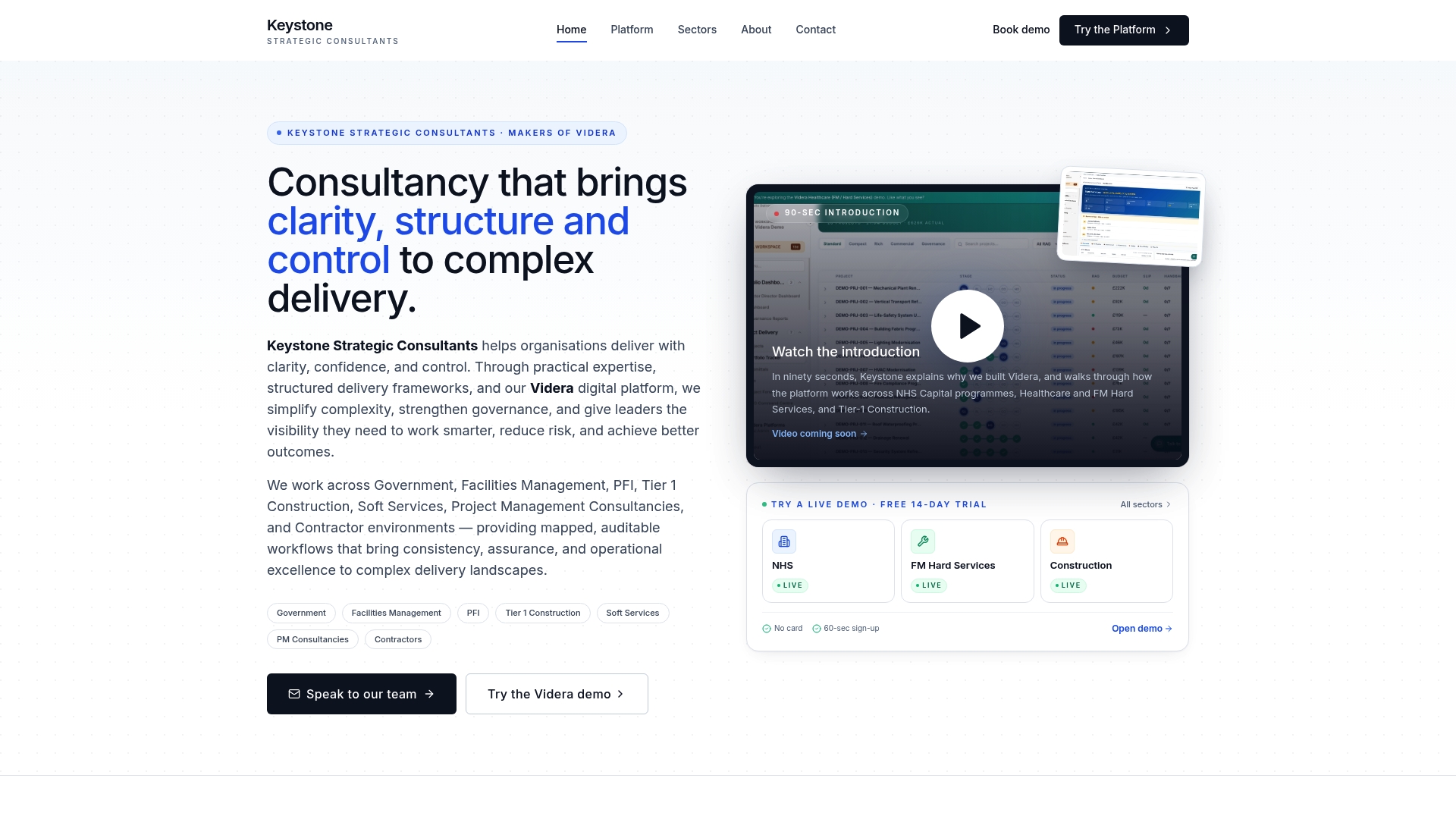
We also work with teams whose change requests involve physical configuration and compliance evidence, through sector-specific builds such as Videra Construction and Videra Healthcare. A pilot, run through our consultancy engagement, can help put a governance model into auditable practice. Teams building their own request-routing tools alongside this work sometimes pair it with a no-code platform like SoftEXIT's workflow and access-control tools for role-based request intake.
If you want to see how mapped workflows and stage-gated approvals would sit against your current process, get in touch through our consultancy page to arrange a walkthrough.
FAQ
What are the five C's of change management?
Definitions vary across frameworks, and there is no single authoritative version tied to change control governance specifically. Organisations are better served by focusing on the documented elements this article covers: clear roles, a scaled approval hierarchy, impact assessment, testing and audit trail requirements.
What are the six steps in the change control process?
A typical change control process runs through capture, impact assessment, review, approval, implementation and closure, with verification sitting between implementation and closure. Each step produces a record that becomes part of the audit trail, from the original request form through to the post-implementation review.
What are the seven principles of change management?
No single set of seven principles is tied specifically to change control governance in the guidance referenced here. The consistent practical principles across FFIEC and CRR material are documented approval hierarchies, risk-scaled review, mandatory testing, and audit-ready records.
What are the five pillars of change management?
As with the five C's, no fixed "five pillars" model appears in the authoritative guidance this article draws on. The practical pillars that do appear consistently are role clarity, a scaled approval process, impact assessment, documentation and metrics, and post-implementation review.
How does change control governance differ for emergency changes?
Emergency changes allow an abridged review to act quickly against an active incident, but they still require authorisation, monitoring and documentation. Every emergency change needs a mandatory post-implementation review, because the ability to reverse a disruptive change matters as much as the speed of making it, according to FFIEC guidance on emergency modifications.
Sources
For primary guidance, see the FFIEC IT Examination Handbook on change management and the CRR Resource Guide on Configuration and Change Management. For operational checklists, our posts on operational change control and document version control walk through practical implementation steps.
- FFIEC IT Examination Handbook InfoBase - III.D.1 Change Management
- CRR Supplemental Resource Guide, Volume 3: Configuration and Change Management