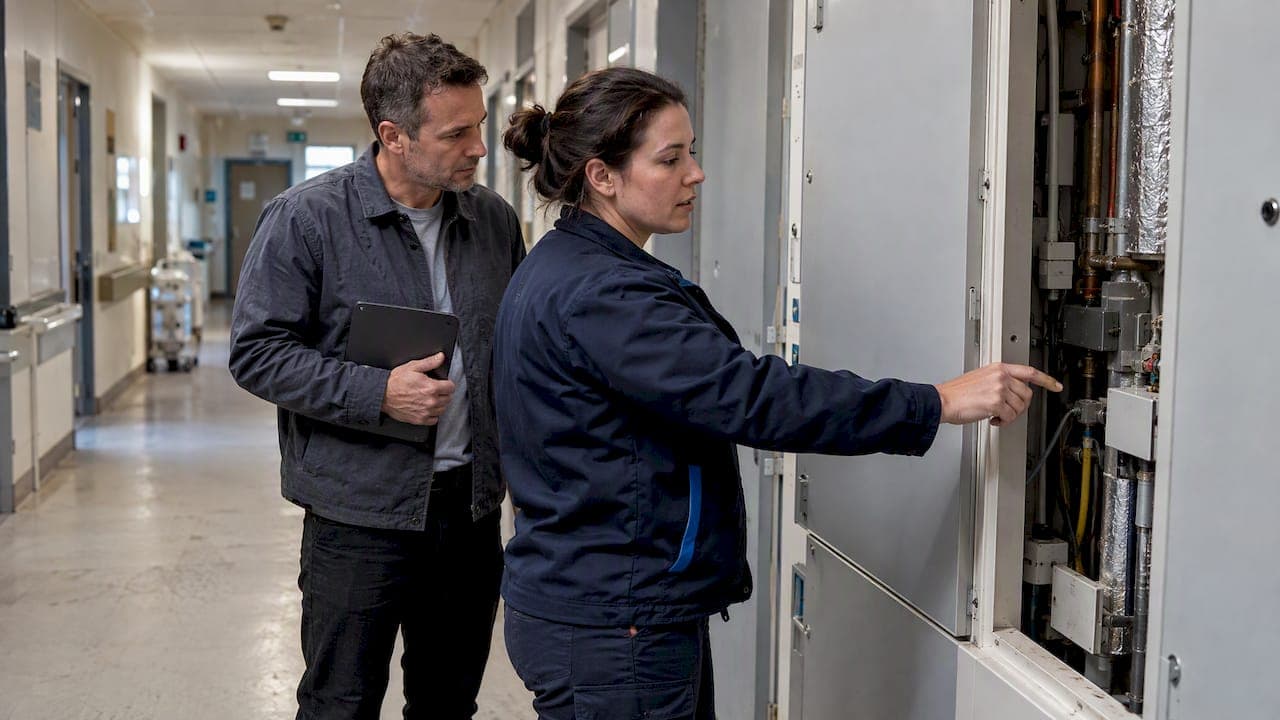
The approach that works is simple to state: a risk-tiered, evidence-first change control process, where every change is classified before it is touched, high-impact work carries a tested rollback plan, and every decision leaves an auditable change package behind. The workflow runs initiate, screen, assess, approve, implement, capture and close out. Skip the rollback plan or the paper trail on anything but the lowest-risk changes, and you are not managing risk, you are hoping.
TL;DR:
- Proper change classification and a tested rollback plan are essential for high-impact changes, while minor updates can often skip detailed paperwork.
- Risk-tiered workflows categorize changes into routine, normal, or emergency, with each level demanding proportionate review and approval processes.
- A complete change package must include technical notes, approval records, test evidence, rollback procedures, updated documentation, and training confirmation.
- Effective automation links change records, evidence, and approvals to ensure an audit-ready trail without replacing critical human review points.
- Start fixing weak change control processes by securing critical assets with tested rollback plans, then improve record-keeping and governance structures progressively.
Table of Contents
- Scope and typical change types: when operational change control must apply
- End-to-end change control workflow: initiate, screen, assess, approve, implement, capture
- Risk tiers and decision thresholds: scaling rigour to the change
- Technical review and governance: how CAB and CCB actually work
- What a change control package must contain
- Testing, rollback and post-implementation review
- Tools and automation patterns for traceable change control
- Keystone's approach: governance design, maturity scoring and Videra
- Practitioner priorities: what to fix first when change control is weak
- How Keystone and Videra deliver an audit-ready change control capability
- FAQ
- Sources
Scope and typical change types: when operational change control must apply
Not every change needs the same ceremony, but every change needs to be identified, even the small ones. DOE guidance is blunt about this: multiple minor changes can accumulate into real risk, and each one deserves at least a cursory look before it is waved through. The failure mode we see most often is not reckless change, it is invisible change: adjustments made outside any recognised process that quietly drift a system, a facility or a care pathway away from its approved baseline.
Operational change control typically needs to apply across five categories.
- Equipment changes: replacing, upgrading or reconfiguring physical assets, from HVAC units to clinical devices.
- Process changes: altering a sequence of work, a staffing model or a clinical or safety procedure.
- Personnel changes: shifting responsibilities, approval authority or on-call cover in ways that affect who signs off on what.
- Configuration changes: modifying system settings, access permissions or network architecture.
- Software changes: deploying new code, patches, integrations or third-party updates.
A change mechanism matters because it is the only thing standing between a controlled adjustment and untracked drift. Construction change management processes face the same logic as IT change control: a variation to a structural specification, a substitution of materials or a change to a method statement all need the same discipline as a server patch, because the underlying question is identical. Who approved this, what evidence supports it, and can we undo it if it goes wrong?
End-to-end change control workflow: initiate, screen, assess, approve, implement, capture
The IChemE Safety Centre's Management of Change guidance sets out a lifecycle that maps cleanly onto most operational settings: initiate, screen, review, approve, implement, capture and close out. Here is what each stage should actually involve.
- Initiate: log the change request with a minimum data set, requester name and role, affected asset or process, description of the change, business justification, proposed date, and dependencies. A request missing any of these fields should bounce back before it reaches triage.
- Screen: apply a short triage rubric. Does this touch a safety-critical system? Does it affect more than one team? Is it reversible? Screening sorts requests into routine, normal or emergency tracks and decides how much rigour the next stages need.
- Assess: a meaningful risk assessment covers technical impact, who else is affected, how the change interacts with other scheduled work, and what happens if it fails. For anything beyond routine work, this stage should also produce a documented rollback approach, not just a plan to implement.
- Approve: routine changes may be pre-approved under a standing policy; normal changes typically need a named approver or a small technical review; higher-risk changes should go to a Change Advisory Board or Change Control Board, convened specifically because the decision has cross-team or safety consequences. NIST SP 800-53 Revision 5 frames this scaling explicitly under Control CM-3: lightweight planning for low-risk changes, formal multidisciplinary review for high-impact ones.
- Implement: before work begins, confirm the implementation window, the people executing the change, and, where the change affects a facility or major system start-up, a pre-start-up safety review (PSSR) covering whether documentation, training and safety systems are ready. Implementation readiness is not a formality; it is the last checkpoint before the change becomes live, which can be supported by practical change management activities for teams to build engagement and readiness Change management activities for teams.
- Capture and close-out: record what was actually done, not just what was planned, update as-built documentation and configuration baselines, confirm test results, and formally close the change request. This is also the point at which lessons for the next similar change should be logged while they are still fresh.
A ticketing system that tracks only "open" and "closed" misses the point of this workflow. Each stage needs its own status and its own evidence, because an auditor or an incident investigator will want to see not just that a change happened, but how it was screened, who assessed the risk, and who signed off before it went live.
Risk tiers and decision thresholds: scaling rigour to the change
Classifying a change correctly at the screening stage determines whether the rest of the process is proportionate or either dangerously thin or needlessly heavy. Three tiers cover most operational settings.
- Routine: low impact, well understood, easily reversible, for example restarting a non-critical service or swapping a like-for-like component; these can run under a pre-approved standing policy with minimal individual sign-off.
- Normal: moderate impact, cross-team visibility needed, reversible but with some effort, for example a process change affecting a single department; these need a named technical reviewer and documented approval before work starts.
- Emergency: urgent action required to prevent or resolve an incident, approval compressed into the moment but still logged and reviewed retrospectively within a defined window.
The decision factors that separate these tiers are consistent: how many people or systems are affected, whether the change can be tested before it goes live, how hard rollback would be, and whether the work crosses team boundaries. The Virginia Tech operational change management guide makes a point worth repeating here: if rollback is hard to test, the change should automatically be reclassified as higher risk, regardless of how simple the change itself looks on paper.
A workable rubric scores each change on impact, reversibility and scope, and routes anything that scores high on more than one dimension up a tier. Operational rules should state explicitly who can execute routine changes without escalation, usually the team directly responsible for the asset, and under what conditions a routine change must be escalated to normal, typically when it touches a system outside its usual boundary or affects a customer-facing service.
Technical review and governance: how CAB and CCB actually work
A Change Advisory Board or Change Control Board exists to catch what a single approver would miss: conflicts between simultaneous changes, dependencies across teams, and risks that only become visible when several perspectives sit in the same room. Minimum membership typically includes a technical lead, an operations or service owner, a risk or compliance representative and, for construction or facilities contexts, a safety lead.
- Present the change concisely: what is changing, why, the risk assessment summary, dependencies, and the rollback plan, ideally on a single page.
- State the decision being asked for: approve, defer or reject, rather than leaving the board to work out what it is deciding.
- Flag conflicts in advance: any other scheduled change touching the same system or window should be surfaced before the meeting, not during it.
Meeting cadence should match the volume and risk profile of changes passing through, weekly for environments with frequent normal-tier changes, with a standing emergency path that does not wait for the next scheduled meeting. The most common bottleneck is boards reviewing routine changes that should never have reached them. Tight screening criteria fix this faster than adding meeting slots. Our guidance on operating model governance covers how to set these decision authorities so the right changes reach the right level the first time.
Pro Tip: Put a hard page limit on change submissions to the board; a request that cannot be justified in one page usually has not been thought through properly.
What a change control package must contain
The change control package is the authoritative record of what happened, not a formality attached to it afterwards. The Virginia Tech practical guide treats this package as a living system of record, with tickets, deployment logs and test artefacts linked together rather than scattered across separate tools. DOE-STD-1073 sets a similarly firm expectation for capital asset projects: technical analyses, acceptance criteria and documented justification, assembled before the change is signed off, not reconstructed afterwards for an audit.
A complete package should include:
- Technical review notes: the assessment findings and any conditions attached to approval.
- Approval records: who approved the change, at what tier, and on what date.
- Test evidence: results from pre-production testing against defined acceptance criteria.
- Rollback plan: the tested, documented steps to reverse the change if needed.
- As-built updates: the configuration or design documentation reflecting what actually changed.
- Training records: confirmation that anyone affected by the change has been briefed.
Retention periods should match the asset's lifecycle, not a generic document policy; a change to a long-life piece of infrastructure needs its package retained as long as that asset is in service. GSA's configuration management guidance recommends automated recordkeeping specifically because manually assembled packages tend to go missing exactly when an investigation needs them. Linking a ticketing system directly to deployment logs, so that the record builds itself as the change progresses, removes most of that risk.
Testing, rollback and post-implementation review
Rigour before go-live determines how much you regret the decision afterwards. The sequence below should run for every normal or higher-tier change.
- Test on non-production systems wherever possible, against acceptance criteria defined before testing begins, not invented afterwards to match whatever happened.
- Document the rollback procedure in full, including any special recovery steps, and verify it works rather than assuming it will.
- Test rollback separately from the forward change, since a rollback that has never been exercised is a plan, not a safeguard.
- Schedule the post-implementation review within a set window, typically days rather than weeks, with the requester, implementer and at least one reviewer who was not directly involved present.
- Capture outcomes against the original acceptance criteria, noting any deviation, any incident during implementation, and whether the rollback plan would have worked had it been needed.
Rollback complexity should be treated as a risk multiplier, not a footnote. A change that is difficult to reverse carries more risk than its technical impact alone suggests, and should be reclassified upward if testing reveals rollback is harder than first assessed.
Pro Tip: If you cannot describe how to undo a change in three sentences, it probably is not ready for implementation yet.

Tools and automation patterns for traceable change control
Automation earns its place where it removes manual effort without removing judgement. Record capture, approval notifications, and evidence linking between tickets, test results and deployment logs are strong automation candidates. They reduce the chance that a package goes missing and keep the audit trail current without extra administrative work.
- Automate the paperwork, not the decision: notifications, status updates and evidence attachment can run automatically; the approval decision itself should not.
- Link configuration management baselines directly to approved change records so the system of record updates itself as changes close.
- Pre-approve routine changes through standing policy, with a gated, reviewed workflow reserved for normal and emergency tiers.
- Keep a human checkpoint at every high-risk decision point, because over-automating approval gates tends to produce rubber-stamping rather than genuine review.
The construction change control process benefits from the same pattern: pre-approved flows for minor variations, gated review for anything touching structural specification or safety case, and automated linking between site instructions and the as-built record.
Keystone's approach: governance design, maturity scoring and Videra
Governance design work typically starts with a maturity assessment: where a process breaks down, which changes are slipping through without review, and where evidence is reconstructed after the fact rather than captured as it happens. From there, we map the existing workflow against a risk-tiered structure like the one above, before touching any tooling.
The Videra platform is how we operationalise that mapped workflow: configurable stage gates that match an organisation's own risk tiers, automated evidence capture that links approvals, test results and sign-offs into a single change package, and board-ready reporting that removes the manual effort of assembling audit evidence after the fact.
- Workflow mapping turns an organisation's existing (often informal) change process into a defined, stage-gated structure.
- Automated evidence capture attaches documentation to each change as it moves through the workflow, rather than afterwards.
- Audit-ready reporting produces the change package automatically from the linked records.
A risk-based approach to change control is a foundational element of frameworks such as NIST SP 800-53 Revision 5, scaling review intensity to the impact of the change rather than applying one process to everything.
Our operational readiness review checklist sets out the evidence and maturity scoring approach we use alongside this work.
Practitioner priorities: what to fix first when change control is weak
When a change control process is thin or missing entirely, do not try to fix everything at once. Start by identifying the handful of assets or processes where an uncontrolled change could cause real harm, a core clinical system, a structural element, a customer-facing service, and mandate a tested rollback plan for any change touching them. That single rule closes most of the real exposure within weeks.
The medium-term fixes follow once the immediate exposure is covered: agree the tier definitions in writing, charter a CAB with named members and a clear remit, and decide which parts of the record-keeping get automated first. Automation should follow the process, not replace the thinking behind it.
Three pitfalls show up repeatedly. Process fatigue, where every change gets routed through full board review regardless of risk, until people start working around the process entirely. Undocumented rollbacks, where a plan exists in someone's head but never on paper, and that someone is unavailable the night it matters. And opaque approvals, where a change is signed off verbally with no record of who decided or why, leaving nothing for the next investigation to go on. Fix the exposure first, then the structure, then the paperwork, in that order.
— Peter
How Keystone and Videra deliver an audit-ready change control capability
Building this capability from scratch, while running day-to-day operations, is where most organisations stall. Integration directly with client teams rather than handing over a generic template helps ensure the risk tiers, approval routes and evidence requirements match how the organisation works, not a theoretical process nobody follows.
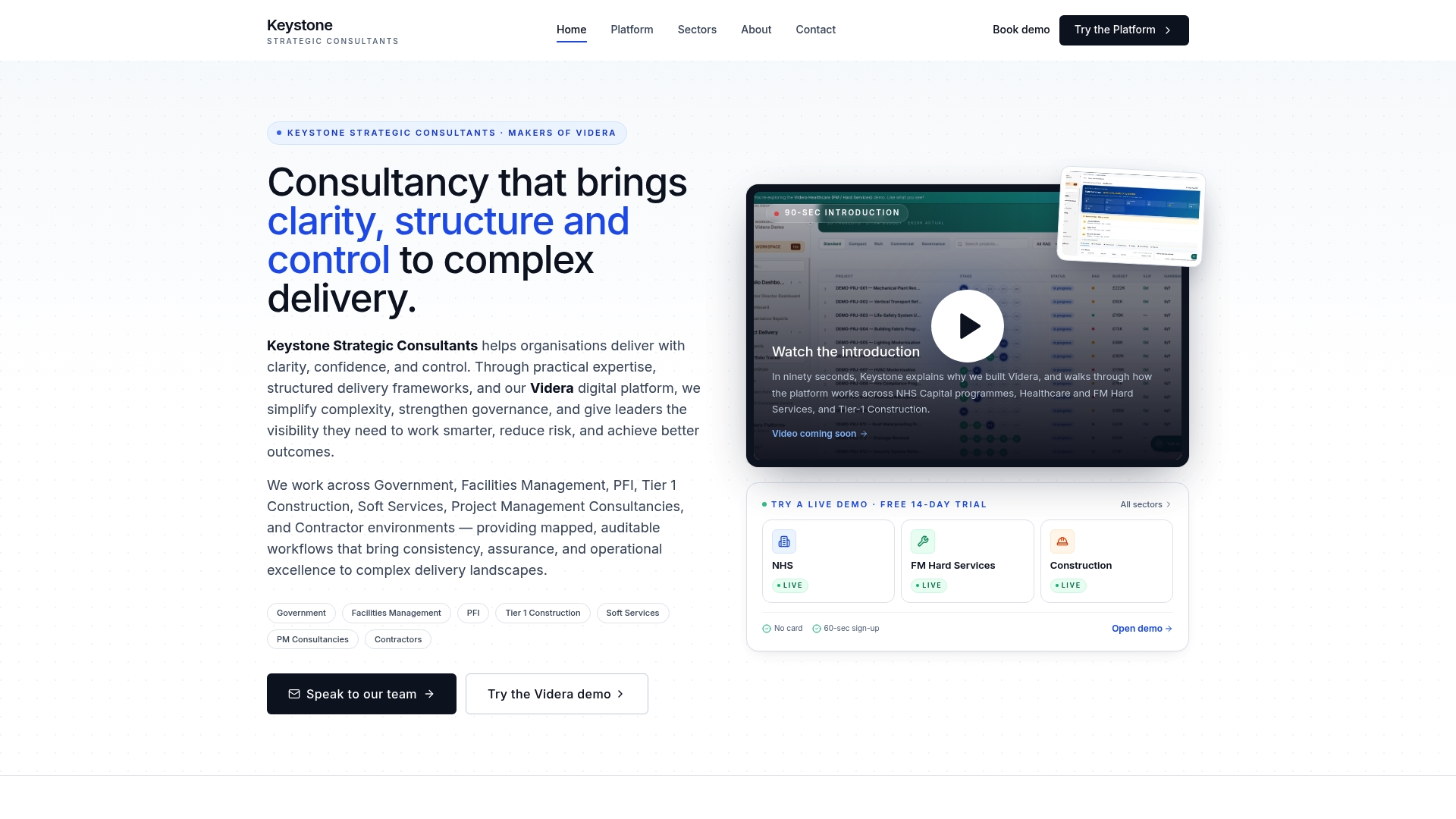
Videra PM fits organisations that need mapped workflows and automated evidence capture across general project and operational change. Videra Healthcare is built for the governance and audit demands specific to clinical and NHS settings, while Videra Construction handles the variation and change control demands of live construction programmes. Where the need is governance design rather than a platform on its own, our consultancy team works alongside yours to build the tiering, CAB structure and change package templates described above.
If change control in your organisation is currently undocumented, inconsistent or reconstructed after the fact, get in touch through our consultancy page to discuss where your current process stands and what a mapped, audit-ready version would look like.
FAQ
What are some examples of operational changes?
Operational changes include equipment replacements, process or procedure revisions, personnel or role changes, system configuration updates, and software deployments. In construction and facilities settings, they also cover material substitutions, method statement revisions and schedule changes that affect dependent work.
What are the 5 C's of change leadership?
Definitions of the "5 C's" vary across change management frameworks, so there is no single agreed version. Most common variants include elements such as clarity, communication, commitment, culture and capability, but readers should treat any specific list as one interpretation rather than a universal standard.
What are the six steps in the change control process?
A widely used structure, drawn from IChemE's Management of Change guidance, runs initiate, screen, review, approve, implement, then capture and close out. Each step scales in rigour depending on the change's assessed risk tier.
What are the four types of organizational change?
Organisational change is commonly grouped into strategic, structural, process and people-focused change, covering shifts in direction, reporting lines, how work gets done, and staffing or culture respectively. Operational change control typically governs the process and structural categories most directly, since these carry the clearest risk of untracked drift.
How do you build a change control package that survives an audit?
A defensible change control package includes technical review notes, documented approvals, test evidence against defined acceptance criteria, a verified rollback plan, updated as-built records and training confirmation. Platforms such as Videra can automate the linking of these records as a change moves through its workflow, reducing the risk of gaps surfacing later.
Sources
- NIST Special Publication 800‑53 Revision 5 (Control CM‑3)
- IChemE Safety Centre — Management of Change (MOC) guidance
- DOE‑STD‑1073 configuration management guidance
- GSA configuration management guidance (CM)
- Operational change management — practical guide (Virginia Tech)