
AI compliance reporting automates the assembly of audit‑ready evidence and drafts regulator‑facing narratives from that evidence. It does not replace judgment: every drafted report needs a named human reviewer who attests before it reaches an auditor or regulator. Some providers build this attestation step into their platforms, treating it as a governance control rather than a formality.
TL;DR:
- Most compliance leaders report AI increases efficiency, improves analytics, and offers cost savings, especially in faster decision-making and continuous evidence collection.
- Guardrails such as human review of drafts, approved processing gateways, and source data quality checks are essential to prevent hallucinations and misclassification in AI compliance reports.
- Pilots should start with simple document types like meeting notes, assign clear roles, and implement strict attestation and metric tracking before scaling to higher-stakes reporting.
- A single evidence pipeline supporting multiple regulatory frameworks and drift detection enhances efficiency and helps flag control changes proactively.
- Buying an existing platform with built-in workflows and control mapping reduces setup time compared to in-house development and streamlines audit-ready reporting.
Table of Contents
- What are the real benefits of AI compliance reporting?
- Where does AI compliance reporting go wrong?
- How do you pilot AI compliance reporting without risking an audit finding?
- How does AI reporting integrate with dashboards and control frameworks?
- What proof points back a provider like Keystoneconsulting?
- Where should you actually spend the first six months?
- Get audit-ready reporting without building the pipeline yourself
- Sources
- FAQ
What are the real benefits of AI compliance reporting?
The efficiency case for AI compliance reporting is no longer theoretical. A survey run by Compliance Week and konaAI found a majority of compliance leaders report AI has increased departmental efficiency, with more than half seeing better analytics and monitoring, and a substantial share citing direct cost savings.
Statistic callout: Most compliance leaders surveyed report faster, better‑informed decisions once AI handles first‑draft reporting, alongside measurable efficiency and cost gains.
Continuous evidence collection is the mechanical reason this works. Rather than pulling access logs, invoices, or inspection records once a quarter, a well‑built pipeline gathers evidence on an ongoing basis and timestamps it against the control it supports. That matters for audit defensibility: a point‑in‑time snapshot can be challenged as unrepresentative, whereas a continuous trail shows the control operating throughout the period, not just on the day someone remembered to check.
In practice, operational leaders should expect these outputs from a mature system:
- Formatted audit workpapers, ready for auditor review rather than raw exports.
- Structured evidence sheets (commonly labelled PBI_Controls, PBI_Deficiencies, and PBI_Evidence) built to feed dashboards directly.
- Exception dashboards that surface control failures the moment evidence contradicts a stated control.
- Board packs and executive summaries drafted from the same underlying evidence, so the story to the board matches the story to the auditor.
An open‑source example, the ITGC Audit Workpaper Automator, shows the pattern clearly: it analyses uploaded evidence and produces Excel workpapers with PBI‑ready sheets, while stating plainly that it is a drafting assistant requiring auditor verification before anything is finalised.
Where does AI compliance reporting go wrong?
Two failure modes dominate. The first is hallucination: an AI model can write a fluent, plausible control narrative that simply isn't supported by the evidence it was given, especially when evidence is thin or ambiguous. The second is misclassification, where evidence gets mapped to the wrong control or the wrong framework clause, producing a report that reads correctly but answers the wrong question.
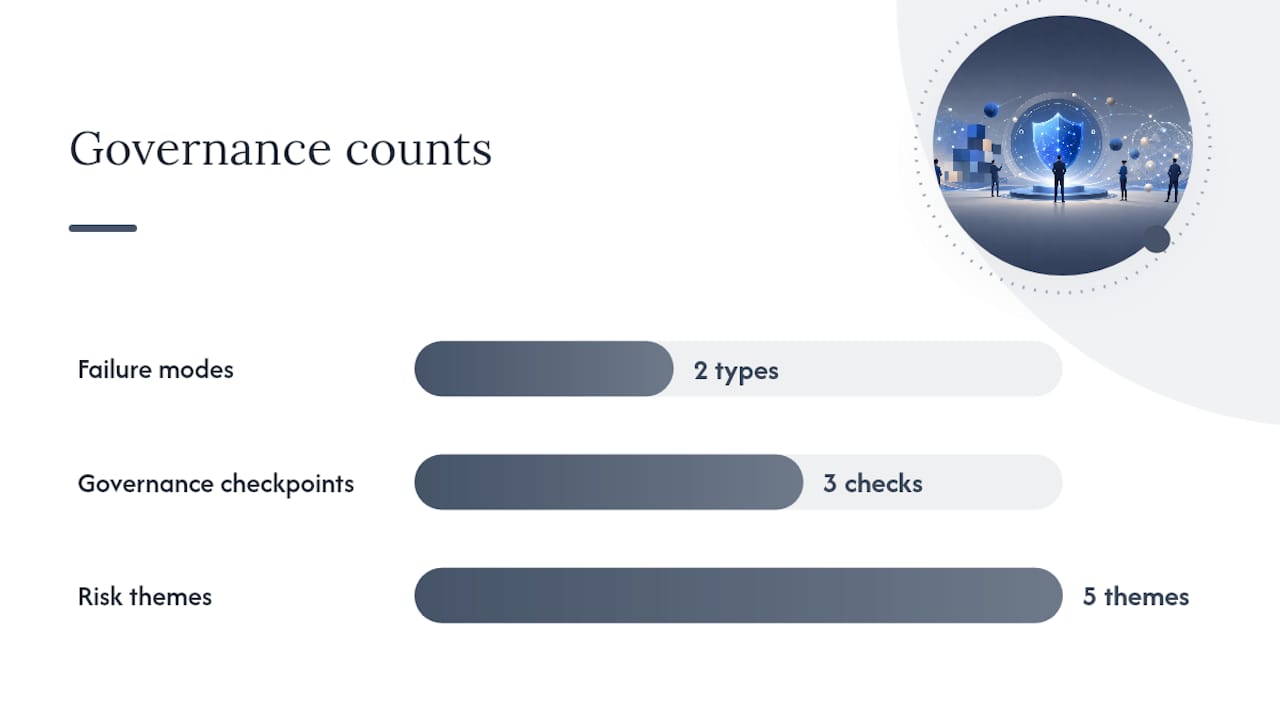
Neither failure is hypothetical. The AMCiS 2026 study on generative AI in regulated projects found that AI genuinely accelerates documentation in regulated environments, but only when governance preserves auditability and traceability. The researchers derived a minimal governance artefact of three checkpoints mapped across five risk themes, essentially a floor below which speed becomes a liability rather than a benefit.
Guardrails that hold up under audit scrutiny tend to share the same shape:
- A named reviewer verifies every material claim in a draft against the source evidence before it moves forward, mirroring standard audit responsibility.
- AI processing runs only through approved gateways, with personal or patient identifiers redacted before anything reaches a model.
- A written AI data policy defines what evidence categories may be processed, by which tool, and who owns the log of that processing.
- Source data quality gets checked first. Automation cannot fix inaccurate entitlement records or stale access lists; it will faithfully report what those records say, wrong as they may be.
Pro Tip: Run a "known bad" test before go‑live: feed the system a deliberately incomplete evidence set and check whether the draft flags the gap or quietly writes around it. That single test tells you more about hallucination risk than a week of vendor demos.
How do you pilot AI compliance reporting without risking an audit finding?
Start narrow. Trying to automate an entire compliance programme in one pass is how pilots collapse under their own scope.
- Pick one or two document types and a single control family. ITGC workpapers or routine status reports are sensible starting points, since practical guidance on AI in project documentation suggests meeting notes and status reports are reliably automatable, while decisions, contracts, and compliance documents demand heavier review.
- Assign four roles explicitly, drafter, named reviewer/attestor, data owner, and security or compliance approver, so no report moves without a person accountable at each stage.
- Confirm the tooling handles your real evidence formats: images, PDFs, DOCX, XLSX, and CSV files, with outputs structured for Power BI so dashboards update without manual re‑keying.
- Build a hard attestation gate. No report leaves the pipeline without a recorded sign‑off, and that attestation metadata, who approved it, when, against what evidence version, becomes part of the audit trail itself.
- Track four metrics through the pilot: time saved per report, evidence coverage percentage, reviewer error rate, and reviewer time per report.
Statistic callout: Nearly half of compliance leaders in the Compliance Week × konaAI survey reported faster decision‑making after adopting AI reporting tools, a metric worth tracking against your own reviewer time data from week one.
Scale up only once the reviewer error rate stabilises. A pilot that saves time but produces a rising error rate is not ready for a second document type, regardless of how the time‑saved number looks.
How does AI reporting integrate with dashboards and control frameworks?
The pattern that scales well is a single evidence pipeline feeding multiple regulatory narratives. Tag a piece of evidence once against the controls it satisfies, and the same underlying record can support SOX, HIPAA, PCI, or FISMA narratives without re‑collecting anything, which is the core efficiency argument behind continuous evidence mapping.
Drift detection complements this. Where reporting automation answers "what happened," continuous posture monitoring answers "has anything changed since the last report," flagging control drift before it becomes a finding rather than after.
Retain versioned drafts and attestation records as evidence in their own right; regulators increasingly want to see the review trail, not just the final report.
| Evidence layer | What it does | Where it lands |
|---|---|---|
| PBI_Controls | Tags each control with framework references | Power BI control dashboard |
| PBI_Deficiencies | Logs exceptions and their status | Exception and remediation view |
| PBI_Evidence | Stores source records against each tag | Auditor workpaper backup |
A tool like Videra can help track this evidence chain end to end, mapping control workflows once and rendering framework‑specific narratives from the same source data, though the reviewer attestation step still sits with your own named personnel.
Standardised evidence collection also removes a quieter bottleneck: manual approval routing. Procore's work with public health portfolios found standardised data collection and automated approval workflows create a single source of truth across large portfolios, which is exactly what a reporting pipeline needs to stay reliable at scale.
What proof points back a provider like Keystoneconsulting?
Twenty years of delivery experience across healthcare, construction, and facilities management underpin this approach, reflected in a platform built with mapped workflows first and AI-powered reporting layered on top, rather than bolted onto an ungoverned process.
The 30 Day CMS Compliance Reporting Playbook gives healthcare operators a concrete sequence for audit readiness, while a broader step‑by‑step compliance programme guide and an AI governance roadmap cover the wider build‑out. Configurable sector workspaces mean a healthcare programme and a construction programme aren't forced through the same generic template, and PBI‑ready outputs plug into the review gates and reporting cadence each sector already runs.
Where should you actually spend the first six months?
Spend it on the evidence pipeline and the attestation control, not on broad generative AI experiments. A flashy pilot that drafts twenty document types with no named reviewer is worse than no pilot at all, because it creates an audit trail nobody can vouch for.
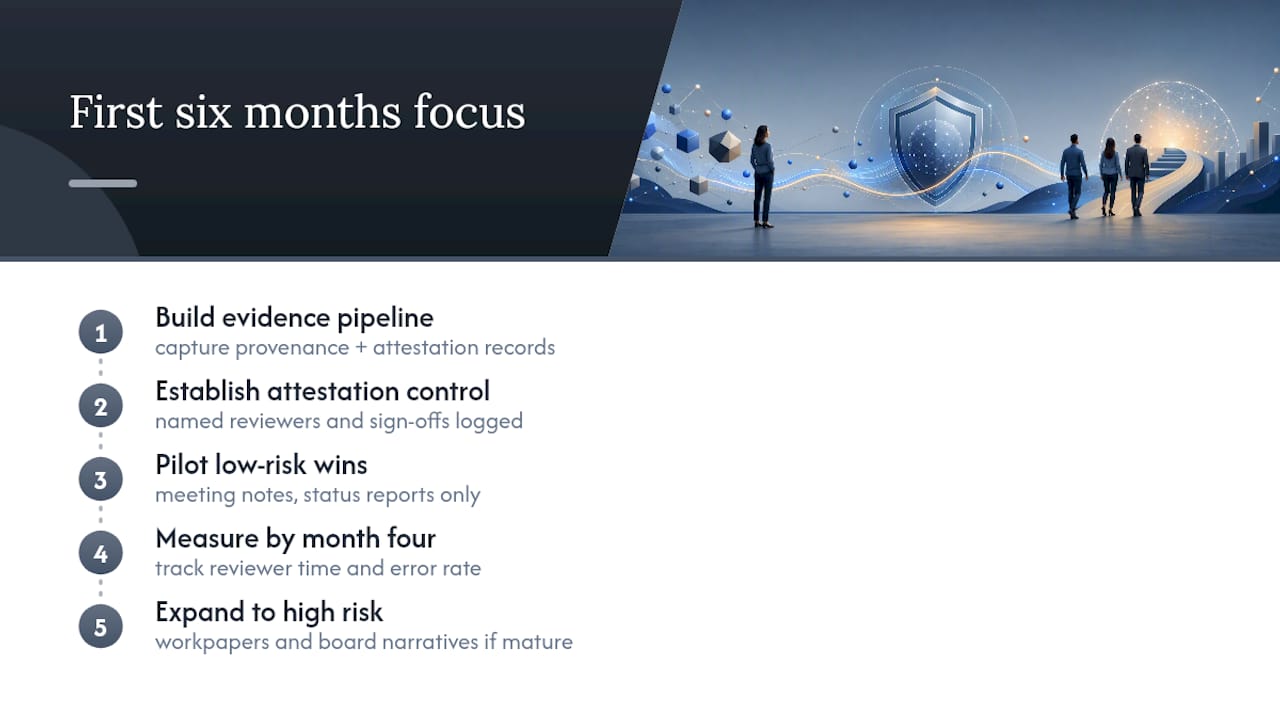
Start with low‑risk wins, meeting notes and status reports, to build reviewer trust in the tool's judgment. Only then move up to workpapers and board narratives, where the cost of an unverified claim is much higher.
Track reviewer workload and error rate from day one. If reviewer time per report isn't falling by month four, the pipeline isn't mature enough to expand, whatever the time‑saved headline number suggests. The attestation record, not the draft, is the asset that survives an audit.
— Peter
Get audit-ready reporting without building the pipeline yourself
Most operational leaders weighing AI compliance reporting are really choosing between building an evidence pipeline in‑house or buying one that already has the review gates and control mapping built in. Building it yourself means months of integration work before you see a single draft report. Certain platforms provide an evidence pipeline already mapped to sector workflows, with attestation gates and PBI-ready outputs built into the delivery rather than added afterwards.
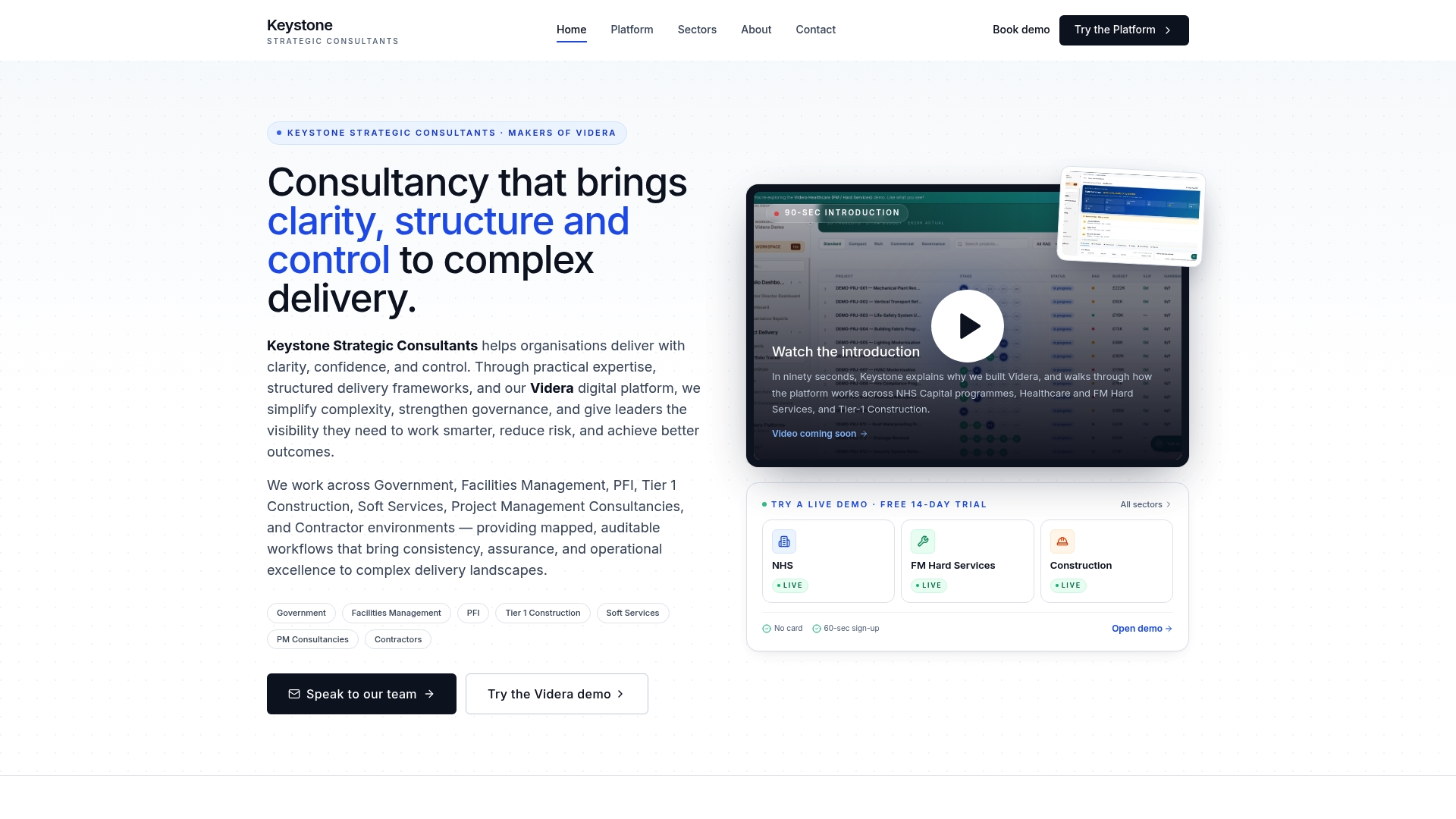
The engagement path is straightforward: a discovery conversation, a scoped pilot on one or two document types, a proof‑of‑value review against your own metrics, then either a platform subscription or a fuller delivery engagement. Healthcare teams can start with Videra Healthcare, construction programme leads with Videra Construction, and facilities teams with Videra Hard Services. If your priority is stage‑gated project governance more broadly, Videra PM is the starting point. Book a discovery workshop through Keystone's consultancy team and bring one real document type to the first conversation.
Sources
For the survey data behind the efficiency and analytics figures, see the Compliance Week × konaAI AI Compliance Survey. The governance checkpoint model comes from the AMCiS 2026 paper on generative AI in regulated projects. For a working example of workpaper drafting, see the ITGC Audit Workpaper Automator README, and for the "AI drafts, humans attest" framing, the Avatier 2026 guide to AI regulatory reporting. Healthcare programme leads should also read Keystoneconsulting's 30 Day CMS Compliance Reporting Playbook.
- AI Compliance Survey — Compliance Week × konaAI (2026)
- Generative AI and governance resilience in regulated projects (AMCiS 2026 paper)
- AI regulatory reporting automation — 2026 guide (Avatier)
FAQ
What is AI compliance reporting?
AI compliance reporting is the automated assembly and drafting of audit‑ready evidence and reports using AI, covering everything from control narratives to board packs. A named human reviewer must still attest to the draft before it goes to an auditor or regulator, a principle set out clearly in the Avatier regulatory reporting guide.
Can AI replace a human reviewer in compliance reporting?
No. Every credible implementation, including the ITGC Audit Workpaper Automator, treats AI as a drafting assistant that requires human verification against source evidence before anything is finalised. Removing that step turns a helpful draft into an unverifiable claim.
What documents should you automate first?
Start with meeting notes and status reports, which AI drafts reliably, before moving to workpapers or board narratives once your review process is proven, following guidance from a practical AI documentation guide. This staged approach builds reviewer confidence before higher‑stakes documents enter the pipeline.
How much does Keystoneconsulting's Videra platform cost?
Pricing for Videra PM, Videra Healthcare, Videra Construction, and Videra Hard Services is available on request through Keystoneconsulting's consultancy page. A discovery conversation is the fastest way to get a figure scoped to your sector and document volume.
What metrics prove an AI compliance reporting pilot is working?
Track time saved per report, evidence coverage percentage, reviewer error rate, and reviewer time per report throughout the pilot. A falling error rate alongside falling reviewer time is the real signal; a fast pilot with a rising error rate is not ready to scale.